Tag Archives: China

image_pdfimage_print

LCQ5: Promoting use of electric public light buses

     Following is a question by the Hon Wilson Or and a reply by the Secretary for the Environment, Mr Wong Kam-sing, in the Legislative Council today (May 26):
 
Question:
 
     Over the years, the Government has been encouraging the transport sector to try out and use green innovative transport technologies, including electric and hybrid public light buses (PLBs). In this connection, will the Government inform this Council:
 
(1) of the latest progress of the Government’s efforts in promoting the switch to electric PLBs (e-PLBs) by PLB service operators; whether it has drawn up a timetable for that;
 
(2) as the Government is taking forward a pilot scheme on setting up fast charging facilities for e-PLBs and providing a relevant paid charging service at the public transport interchange in Kwun Tong Town Centre, of the latest progress of the scheme; and
 
(3) as some PLB service operators have indicated that the Government’s failure to resolve the problem of insufficient charging facilities for e-PLBs all along is the main reason for the trade’s hesitation in putting in more resources for switching to e-PLBs, of the Government’s new solutions to this problem?
 
Reply:
 
President,
 
     The Environment Bureau announced in March this year the first Hong Kong Roadmap on Popularisation of Electric Vehicles (EV Roadmap), setting out the long-term policy objectives and plans on the adoption of electric vehicles and their associated supporting facilities. One of the initiatives is to actively promote trials for electric public transport and commercial vehicles including e-PLBs so as to map out a more concrete way forward and timetable in around 2025.
 
     Regarding the questions raised by the Hon Wilson Or on e-PLBs and their charging facilities, my responses are as follows:
 
(1) PLBs are a means of transportation unique to Hong Kong with specific dimensions, specifications and number of seats. As technologies related to e-PLBs are still under development, coupled with the fact that both the hilly terrain in Hong Kong and the supply of air-conditioning during summer require e-PLBs to have batteries with a higher driving range, models of e-PLB that can meet their whole-day operational needs are currently not yet available in the local market. To speed up the adoption of e-PLBs in Hong Kong, the Government engaged a consultant in March 2019 to develop the basic specifications and requirements for e-PLBs and their associated charging facilities that are suitable for the local operating environment, in order to provide guidance for manufacturers and charging service providers in the manufacturing of e-PLBs and charging facilities capable of fast charging. The consultant was also tasked to identify suitable PLB routes for trial under the pilot scheme, and to consult PLB trade members about their intention of joining the pilot scheme and using e-PLBs. The guidelines on such specifications and requirements were published in October 2020. We have preliminary identified various public transport interchanges (PTIs) in Hong Kong Island, Kowloon and the New Territories with the operation of e-PLBs which are suitable for the trial, and will determine the routes within this year after our detailed review. Besides, we have liaised with several e-PLB suppliers and encouraged them to develop and supply suitable e-PLBs for the local use as early as possible.

     The Government has earmarked $80 million to subsidise about 40 (e-)PLBs and their associated charging facilities for the implementation of a pilot scheme on e-PLBs. We will first focus on green PLBs as they are running on fixed routes that are relatively short and hence their requirements on driving range and charging power are easier to cope with. Quick charging facilities will be installed at PLB termini, PTIs or other places where PLBs operate. We anticipate that the trial scheme will officially commence in 2023, when e-PLBs running on various routes will conduct a trial for about 12 months. Upon completion of the trial, we will evaluate the performance of e-PLBs and their charging facilities, and devise a concrete and feasible roadmap for the electrification of PLBs.
 
(2) The operators and relevant trade associations of PLBs operating in Kwun Tong once informed the Urban Renewal Authority (URA) that a supplier of e-PLB charging facilities had expressed willingness to set up charging facilities at its own cost for providing e-PLBs with paid charging services at the PTI in Kwun Tong Town Centre. Subsequently, the URA has reserved power supply and three locations at the PTI for future installation of charging facilities, and has also requested the relevant government departments to assist in arranging for a contractor to install e-PLB charging facilities at the PTI. In this connection, the Environmental Protection Department (EPD) issued a notice on October 15, 2020, inviting contractors interested in setting up, at their own cost, e-PLB charging facilities at the new PTI in Kwun Tong Town Centre to submit proposals. The open invitation set out the conditions to be observed by the contractors to ensure that they could provide e-PLB charging facilities catering for the local operating environment of PLBs at a fee level acceptable to the trade. A total of five proposals were received in the open invitation. However, after careful examination, none of these proposals was accepted because they could not meet the specified requirements in full. The EPD made another open invitation on March 22, 2021. A total of four proposals have been received and they are being examined.
 
(3) It is stated clearly in the EV Roadmap that the Government will pave the way for the trade to switch to electric commercial vehicles progressively in the coming few years, and continue to conduct trials together with different trades to test the technical and commercial viability of different types of electric commercial vehicles for use in the local environment, with a view to identifying the best options for Hong Kong so as to map out a more concrete way forward and timetable in around 2025. As for e-PLBs, we will formulate the electrification options based on the experience gained and the data collected through the trial for e-PLBs. Moreover, the Government will designate charging bays for e-PLBs in all newly planned PTIs, with the amount of charging facilities provided subject to the number and daily mileage of e-PLBs.
 
     Thank you, President. read more
LCQ5: Promoting use of electric public light buses

     Following is a question by the Hon Wilson Or and a reply by the Secretary for the Environment, Mr Wong Kam-sing, in the Legislative Council today (May 26):
 
Question:
 
     Over the years, the Government has been encouraging the transport sector to try out and use green innovative transport technologies, including electric and hybrid public light buses (PLBs). In this connection, will the Government inform this Council:
 
(1) of the latest progress of the Government’s efforts in promoting the switch to electric PLBs (e-PLBs) by PLB service operators; whether it has drawn up a timetable for that;
 
(2) as the Government is taking forward a pilot scheme on setting up fast charging facilities for e-PLBs and providing a relevant paid charging service at the public transport interchange in Kwun Tong Town Centre, of the latest progress of the scheme; and
 
(3) as some PLB service operators have indicated that the Government’s failure to resolve the problem of insufficient charging facilities for e-PLBs all along is the main reason for the trade’s hesitation in putting in more resources for switching to e-PLBs, of the Government’s new solutions to this problem?
 
Reply:
 
President,
 
     The Environment Bureau announced in March this year the first Hong Kong Roadmap on Popularisation of Electric Vehicles (EV Roadmap), setting out the long-term policy objectives and plans on the adoption of electric vehicles and their associated supporting facilities. One of the initiatives is to actively promote trials for electric public transport and commercial vehicles including e-PLBs so as to map out a more concrete way forward and timetable in around 2025.
 
     Regarding the questions raised by the Hon Wilson Or on e-PLBs and their charging facilities, my responses are as follows:
 
(1) PLBs are a means of transportation unique to Hong Kong with specific dimensions, specifications and number of seats. As technologies related to e-PLBs are still under development, coupled with the fact that both the hilly terrain in Hong Kong and the supply of air-conditioning during summer require e-PLBs to have batteries with a higher driving range, models of e-PLB that can meet their whole-day operational needs are currently not yet available in the local market. To speed up the adoption of e-PLBs in Hong Kong, the Government engaged a consultant in March 2019 to develop the basic specifications and requirements for e-PLBs and their associated charging facilities that are suitable for the local operating environment, in order to provide guidance for manufacturers and charging service providers in the manufacturing of e-PLBs and charging facilities capable of fast charging. The consultant was also tasked to identify suitable PLB routes for trial under the pilot scheme, and to consult PLB trade members about their intention of joining the pilot scheme and using e-PLBs. The guidelines on such specifications and requirements were published in October 2020. We have preliminary identified various public transport interchanges (PTIs) in Hong Kong Island, Kowloon and the New Territories with the operation of e-PLBs which are suitable for the trial, and will determine the routes within this year after our detailed review. Besides, we have liaised with several e-PLB suppliers and encouraged them to develop and supply suitable e-PLBs for the local use as early as possible.

     The Government has earmarked $80 million to subsidise about 40 (e-)PLBs and their associated charging facilities for the implementation of a pilot scheme on e-PLBs. We will first focus on green PLBs as they are running on fixed routes that are relatively short and hence their requirements on driving range and charging power are easier to cope with. Quick charging facilities will be installed at PLB termini, PTIs or other places where PLBs operate. We anticipate that the trial scheme will officially commence in 2023, when e-PLBs running on various routes will conduct a trial for about 12 months. Upon completion of the trial, we will evaluate the performance of e-PLBs and their charging facilities, and devise a concrete and feasible roadmap for the electrification of PLBs.
 
(2) The operators and relevant trade associations of PLBs operating in Kwun Tong once informed the Urban Renewal Authority (URA) that a supplier of e-PLB charging facilities had expressed willingness to set up charging facilities at its own cost for providing e-PLBs with paid charging services at the PTI in Kwun Tong Town Centre. Subsequently, the URA has reserved power supply and three locations at the PTI for future installation of charging facilities, and has also requested the relevant government departments to assist in arranging for a contractor to install e-PLB charging facilities at the PTI. In this connection, the Environmental Protection Department (EPD) issued a notice on October 15, 2020, inviting contractors interested in setting up, at their own cost, e-PLB charging facilities at the new PTI in Kwun Tong Town Centre to submit proposals. The open invitation set out the conditions to be observed by the contractors to ensure that they could provide e-PLB charging facilities catering for the local operating environment of PLBs at a fee level acceptable to the trade. A total of five proposals were received in the open invitation. However, after careful examination, none of these proposals was accepted because they could not meet the specified requirements in full. The EPD made another open invitation on March 22, 2021. A total of four proposals have been received and they are being examined.
 
(3) It is stated clearly in the EV Roadmap that the Government will pave the way for the trade to switch to electric commercial vehicles progressively in the coming few years, and continue to conduct trials together with different trades to test the technical and commercial viability of different types of electric commercial vehicles for use in the local environment, with a view to identifying the best options for Hong Kong so as to map out a more concrete way forward and timetable in around 2025. As for e-PLBs, we will formulate the electrification options based on the experience gained and the data collected through the trial for e-PLBs. Moreover, the Government will designate charging bays for e-PLBs in all newly planned PTIs, with the amount of charging facilities provided subject to the number and daily mileage of e-PLBs.
 
     Thank you, President. read more
Hong Kong Customs seizes suspected counterfeit mobile phones and accessories (with photo)

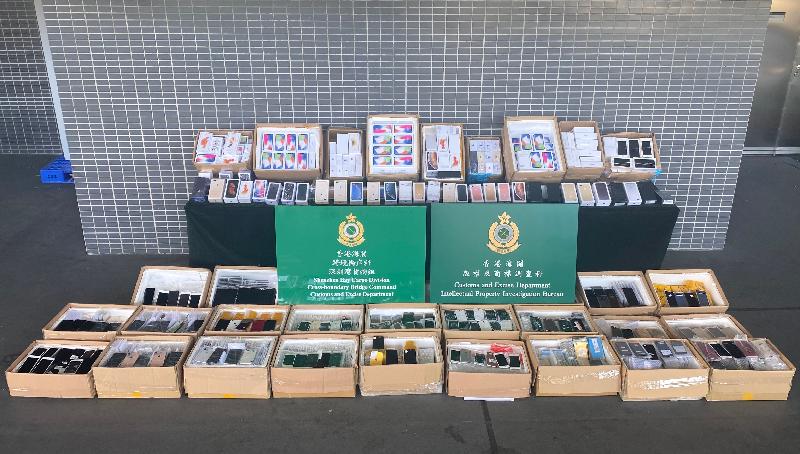
     â€‹Hong Kong Customs seized a total of about 6 000 items of suspected counterfeit mobile phones and accessories with an estimated market value of about $6 million at Shenzhen Bay Control Point on May 22. 

     Through risk assessment, Customs officers intercepted an incoming truck at Shenzhen Bay Control Point on that day. The batch of suspected counterfeit mobile phones and accessories was found inside the cargo compartment. A 62-year-old male driver was arrested.  

     Initial investigation revealed that the counterfeit goods were to be transhipped to the Middle East region by air. 

     Investigation is ongoing and the arrested man has been released on bail pending further investigation.

     Hong Kong Customs will continue to strengthen co-operation with the Mainland and overseas law enforcement agencies and take stringent enforcement action against cross-boundary counterfeit goods activities.

     Under the Trade Descriptions Ordinance, any person who imports or exports any goods to which a forged trademark is applied commits an offence. The maximum penalty upon conviction is a fine of $500,000 and imprisonment for five years.

     Members of the public may report any suspected counterfeiting activities to Customs’ 24-hour hotline 2545 6182 or its dedicated crime-reporting email account (crimereport@customs.gov.hk).

Photo  
read more

Hong Kong Customs seizes suspected counterfeit mobile phones and accessories (with photo)

     â€‹Hong Kong Customs seized a total of about 6 000 items of suspected counterfeit mobile phones and accessories with an estimated market value of about $6 million at Shenzhen Bay Control Point on May 22. 

     Through risk assessment, Customs officers intercepted an incoming truck at Shenzhen Bay Control Point on that day. The batch of suspected counterfeit mobile phones and accessories was found inside the cargo compartment. A 62-year-old male driver was arrested.  

     Initial investigation revealed that the counterfeit goods were to be transhipped to the Middle East region by air. 

     Investigation is ongoing and the arrested man has been released on bail pending further investigation.

     Hong Kong Customs will continue to strengthen co-operation with the Mainland and overseas law enforcement agencies and take stringent enforcement action against cross-boundary counterfeit goods activities.

     Under the Trade Descriptions Ordinance, any person who imports or exports any goods to which a forged trademark is applied commits an offence. The maximum penalty upon conviction is a fine of $500,000 and imprisonment for five years.

     Members of the public may report any suspected counterfeiting activities to Customs’ 24-hour hotline 2545 6182 or its dedicated crime-reporting email account (crimereport@customs.gov.hk).

Photo  
read more

Pay Trend Survey Committee Meeting on May 26, 2021

The following is issued on behalf of the Pay Trend Survey Committee:
 
     The Pay Trend Survey Committee (PTSC) met earlier today (May 26) to consider the findings of the 2021 Pay Trend Survey (PTS).
               
     The survey findings indicate that the following average pay adjustments have been awarded by the surveyed companies over the 12-month period from April 2, 2020, to April 1, 2021:
 

    Basic Pay Indicator + Additional Pay Indicator = Gross Pay Trend Indicator
Lower Salary Band
(below $24,070 per month)
:  1.67% + -1.19% = 0.48%
Middle Salary Band
($24,070 – $73,775 per month)
:  2.03% + -1.54% = 0.49%
Upper Salary Band
($73,776 – $147,235 per month)
:  1.60% + -2.60% = -1.00%
 
     The 2021 PTS was conducted by the Pay Survey and Research Unit of the Joint Secretariat for the Advisory Bodies on Civil Service and Judicial Salaries and Conditions of Service based on an improved methodology as approved by the Chief Executive-in-Council in March 2007.
 
     The survey findings reflect the pay trend in 113 companies covering 145 544 employees over the 12-month period from April 2, 2020, to April 1, 2021. The survey takes into account adjustments to basic salary and additional payments awarded to employees of the surveyed companies attributable to factors in relation to the cost of living, general prosperity and company performance, general changes in market rates, merit and inscale increment, in accordance with the improved survey methodology.
 
     A breakdown of the 113 companies by size is as follows:
 
  No. of Companies
Larger companies
(employing 100 or more staff)
83 (73.5%)
Smaller companies
(employing 50–99 staff) 
30 (26.5%)
Total:  113 (100%)
                             
     The distribution of the 145 544 employees by the three salary bands is as follows:
 
  No. of Employees
Lower Salary Band
(below $24,070 per month)
70 749 (48.6%)
Middle Salary Band
($24,070 – $73,775 per month)
64 231 (44.1%)
Upper Salary Band
($73,776 – $147,235 per month)
10 564 (7.3%)
Total: 145 544 (100%)

     The PTSC met on May 26, 2021, to verify and consider the 2021 PTS Report. The two representatives of the Standing Commission on Civil Service Salaries and Conditions of Service, the representative of the Standing Committee on Disciplined Services Salaries and Conditions of Service, the Secretary General of the Joint Secretariat for the Advisory Bodies on Civil Service and Judicial Salaries and Conditions of Service, the two representatives of the Civil Service Bureau, the two Staff Side Representatives of the Model Scale 1 Staff Consultative Council and the two Staff Side Representatives of the Police Force Council validated the survey findings.
 
     The meeting was chaired by Mr Lee Luen-fai, Chairman of the PTSC. Mr Lee is a member of the Standing Commission on Civil Service Salaries and Conditions of Service.
               
     Mr Lee said, “The 2021 PTS was conducted in accordance with the agreed methodology and in a professional and objective manner. The PTSC will submit the report on the 2021 PTS to the Government for consideration.
 
     “The relevant pay trend indicators are the survey findings of the pay trend in private sector companies. Civil service pay adjustment is, however, a separate matter. I understand that in accordance with the established practice, the Chief Executive-in-Council will take into account the pay trend indicators derived from the PTS and other pertinent considerations before making a decision on the 2021-22 civil service pay adjustment,” Mr Lee added.
 
     Mr Lee wishes to express the PTSC’s sincere appreciation for the co-operation and assistance rendered by the companies to the Pay Survey and Research Unit.  read more