Tag Archives: China

image_pdfimage_print

Amendments to guidelines for censors under Film Censorship Ordinance gazetted

     Amendments to the guidelines for censors under the Film Censorship Ordinance (Cap. 392) (the Ordinance) were gazetted today (June 11). The amendments seek to provide censors with clearer guidelines on film examination and classification following the implementation of the Law of the People’s Republic of China on Safeguarding National Security in the Hong Kong Special Administrative Region (the National Security Law).
 
     Under the current film censorship regulatory framework, films intended for public exhibition have to be examined and classified by censors according to the criteria under sections 10(2) and 10(3) of the Ordinance, as set out below:
 
(1) whether the film portrays, depicts or treats cruelty, torture, violence, crime, horror, disability, sexuality or indecent or offensive language or behaviour;
 
(2) whether the film denigrates or insults any particular class of the public by reference to the colour, race, religious beliefs or ethnic or national origins or the sex of the members of that class;
 
(3) the effect of the film as a whole and its likely effect on the persons likely to view the film;
 
(4) the artistic, educational, literary or scientific merit of the film and its importance or value for cultural or social reasons; and
 
(5) in relation to the intended exhibition of the film, the circumstances of such exhibition.

     “According to Article 3 of the National Security Law, it is the duty of the Hong Kong Special Administrative Region (HKSAR) under the Constitution to safeguard national security and the HKSAR shall perform the duty accordingly, and that the executive authorities, legislature and judiciary of the HKSAR shall effectively prevent, suppress and impose punishment for any act or activity endangering national security in accordance with the National Security Law and other relevant laws. The censor must abide by these provisions in discharging his duties under the Ordinance,” a spokesman for the Commerce and Economic Development Bureau said.
 
     Key amendments to the Film Censorship Guidelines for Censors include:
 
(1) the censor should be vigilant to the portrayal, depiction or treatment of any act or activity which may amount to an offence endangering national security, or which may otherwise jeopardise the safeguarding of national security by the HKSAR, and any content of a film which is objectively and reasonably capable of being perceived as endorsing, supporting, promoting, glorifying, encouraging or inciting such act or activity;

(2) when considering a film as a whole and its effect on the viewers, the censor should have regard to his duties to prevent and suppress acts or activities endangering national security, and the common responsibility of the people of Hong Kong to safeguard the sovereignty, unification and territorial integrity of the People’s Republic of China;

(3) having regard to the fundamental importance of safeguarding national security and to effectively prevent or suppress any act or activity endangering national security, the censor may come to the opinion that a film is not suitable for exhibition on the basis of matters referred to in section 10(2) and section 10(3) of the Ordinance; and

(4) generally speaking, if the exhibition of a film would likely constitute an offence endangering national security, or if the film contains a matter referred to in section 10(2) of the Ordinance and the film as a whole and its effect on the viewers may endanger national security or the safeguarding of national security, the censor should form the opinion that the film is not suitable for exhibition.

     “The film censorship regulatory framework is built on the premise of a balance between protection of individual rights and freedoms on the one hand, and the protection of legitimate societal interests on the other. Although fundamental rights (including the right to freedom of expression in the exhibition of films) should be respected, the exercise of such rights are subject to restrictions provided by law that are necessary for pursuing legitimate aims, such as respecting the rights or reputation of others, and the protection of national security or public order, or public health or morals,” the spokesman said.
 
     The Ordinance stipulates that films intended for public exhibition have to be submitted to the Film Censorship Authority. Censors may determine the suitability of a film for exhibition and its classification, and the need for excisions and imposing conditions according to the Ordinance.
 
     The Secretary for Commerce and Economic Development may, in accordance with section 30 of the Ordinance, from time to time cause to be prepared, guidelines not inconsistent with the Ordinance, indicating the manner in which it is proposed that censors exercise their functions under the Ordinance.
 
     The amended guidelines take effect today. For details, please visit the website: www.ofnaa.gov.hk/filemanager/ofnaa/en/content_1398/filmcensorship.pdf. read more

HKSARG strongly refutes the remarks contained in latest UK Six-monthly Report on Hong Kong

     The Hong Kong Special Administrative Region (HKSAR) Government objects to the inaccurate remarks on Hong Kong in the United Kingdom Six-monthly Report on Hong Kong (the Report) released on June 10.

     The HKSAR is an inalienable part of the People’s Republic of China (PRC), is a local administrative region that enjoys a high degree of autonomy under “one country, two systems” and comes directly under the Central People’s Government (CPG). To uphold and implement the principle of “one country, two systems” meets the interests of the Hong Kong people, responds to the needs of maintaining Hong Kong’s prosperity and stability and serves the fundamental interests of the nation. The CPG has time and again made it clear that it will unswervingly implement the policy of “one country, two systems”, and repeatedly urged foreign parties to stop intervening in Hong Kong affairs. Foreign governments should not attempt to interfere in the HKSAR’s affairs under international laws and basic principles of non-intervention.

Hong Kong National Security Law

     “The comments in the Report smearing the Law of the PRC on Safeguarding National Security in the Hong Kong Special Administrative Region (Hong Kong National Security Law) could not be further from the truth, and are clearly adopting double standards. Any objective person will see that since the implementation of the Hong Kong National Security Law, stability, which is vital to business activities, has been restored to society and national security has been safeguarded in the HKSAR. Our people can continue to enjoy their basic rights and freedoms in accordance with the law,” the spokesman said.

     The Hong Kong National Security Law upholds the rights and freedoms of Hong Kong people as well as the high degree of autonomy of the HKSAR. The Hong Kong National Security Law clearly stipulates that the HKSAR shall protect the rights and freedoms enjoyed by residents under the Basic Law of the HKSAR of the PRC (the Basic Law) and the provisions of the International Covenant on Civil and Political Rights (ICCPR) and the International Covenant on Economic, Social and Cultural Rights as applied to Hong Kong in accordance with the law. However, certain rights and freedoms recognised in the ICCPR are not absolute: the ICCPR stipulates that certain rights and freedoms may be subject to restrictions as prescribed by law if it is necessary in the interests of national security, public safety, public order or the rights and freedoms of others, etc.

     “The four categories of offences endangering national security clearly stipulated under the Hong Kong National Security Law are narrowly defined. There is no question of law-abiding persons inadvertently violating the law.”

     “We would like to emphasise that any law enforcement actions taken by Hong Kong law enforcement agencies are based on evidence, strictly according to the law, for the acts of the person(s) or entity (entities) concerned, and have nothing to do with their political stance, background or occupation. It would be contrary to the rule of law to suggest that people or entities of certain sectors or professions could be above the law.”

Prosecutorial Decisions

     We must reiterate that prosecutorial decisions made by the Department of Justice are based on evidence, applicable laws and the Prosecution Code. The Prosecution Code explicitly stipulates that prosecutors must not be influenced by political, media or individual interest. Cases are handled with the same benchmark irrespective of the political beliefs or background of defendants. Prosecution would only commence and continue if there is sufficient admissible evidence to support a reasonable prospect of conviction and it is in the public interest to do so. Article 63 of the Basic Law expressly guarantees that all prosecutions are free from any interference.

Judicial Independence

     The Report also expressed concerns on judicial independence in the HKSAR. That the courts of the HKSAR can exercise independent judicial power, including that of final adjudication free from any interference, has been enshrined under the Basic Law as set out in Articles 2, 19 and 85. Article 92 of the Basic Law also clearly stipulates that judges and other members of the judiciary of the HKSAR shall be chosen on the basis of their judicial and professional qualities. The constitutional duty of judges, in the exercise of their judicial power, is to apply the law and nothing else. Such duty does not change when judges decide cases arising from or involving political controversies.

General Election of the Legislative Council

     The HKSAR Government respects and safeguards the lawful rights of Hong Kong people, including the right to vote and the right to stand for elections. It also has a duty to implement and uphold the Basic Law and ensure that all elections will be conducted in accordance with the Basic Law and relevant electoral laws.

     In the Discontinued 2020 Legislative Council (LegCo) General Election, Returning Officers invalidated 12 nominees. The Returning Officers clearly stated that, in determining the validity of nominations, the core question was whether the nominee had complied with the declaration requirement under section 40(1)(b)(i) of the Legislative Council Ordinance (Cap.542), i.e. to uphold the Basic Law and pledge allegiance to the HKSAR of the PRC. The decisions of Returning Officers aimed to ensure that the election would be held in strict accordance with the Basic Law and other applicable laws in an open, honest and fair manner. There was no question of any political censorship, restriction of the freedom of speech or deprivation of the right to stand for elections as alleged by some members of the community. The HKSAR Government fully supports Returning Officers in the discharge of statutory duties in accordance with the laws.

     On the postponement of the General Election of the LegCo, the health and the well-being of the people are the overriding concerns of any responsible government. The HKSAR Government has repeatedly stressed that the postponement of the 2020 LegCo General Election was entirely based on public health grounds.

     The Decision of the Standing Committee of the National People’s Congress (NPCSC) on November 11, 2020 regarding the qualification of LegCo members of the HKSAR clearly establishes that a member of the LegCo of the HKSAR does not fulfil the legal requirements and conditions on upholding the Basic Law and pledging allegiance to the HKSAR of the PRC if the member advocates or supports “Hong Kong independence”, refuses to recognise the PRC’s sovereignty over Hong Kong and the exercise of the sovereignty, solicits intervention by foreign or external forces in the HKSAR’s affairs, or carries out other activities endangering national security. When the member is so decided in accordance with law, he or she is immediately disqualified from being a LegCo member. The Decision is applicable to the members of the sixth-term LegCo whose nominations were decided to be invalid in accordance with law by the HKSAR during the nomination period of the election for the seventh-term LegCo of the HKSAR originally scheduled for September 6, 2020. Four members of the sixth-term LegCo have submitted nomination to run for the seventh-term LegCo General Election that was originally scheduled for September 6, 2020. Their nominations were invalidated by Returning Officers before the end of the nomination period, and they hence lost the qualification for running for the election and were immediately disqualified from being LegCo members. The NPCSC’s Decision is a constitutional, lawful and reasonable arrangement. It is necessary and complies with the relevant stipulations of the Basic Law.

Improving Electoral System

     We firmly oppose to the misleading claims by some foreign politicians concerning CPG’s improvement to the HKSAR’s electoral system as well as their ulterior motives. We stress that the improvement to the electoral system of the HKSAR is both timely and necessary, as anti-China forces had created chaos in the Legislative Council (LegCo), paralysed the operation of the HKSAR Government, and even colluded with external forces to undermine Hong Kong’s security and interests. No country or government could turn a blind eye to such dangers. The Government is committed to ensuring elections are conducted in a fair, just and open manner.

     The National People’s Congress (NPC) on March 11, 2021 passed the Decision on Improving the Electoral System of the HKSAR (the Decision). The Decision is entirely constitutional, legal, reasonable and rational. The Central Authorities take the initiative from the national level to improve the electoral system of the HKSAR, aiming to plug the loopholes in and eliminate the deficiencies of the existing electoral system. Through constructing a democratic system that is consistent with the actual situation of Hong Kong, fully conforms to the constitutional order under the “one country, two systems” principle and manifests Hong Kong characteristics, we can thereby put Hong Kong back on track and make rectification. The amendment embodies several key principles:
 
(i) safeguarding our Country’s sovereignty, national security and development interests, upholding HKSAR residents’ right to vote and the right to stand for election in strict accordance with the law; 

(ii) fully implementing the principle of “patriots administering Hong Kong” to lay down structural protection to the implementation of “one country, two systems”; 

(iii) strengthening the representativeness of the Election Committee and the LegCo, broadening the balanced and orderly political participation, as well as safeguarding the overall and fundamental interests of the Hong Kong society; and 

(iv) strengthening the effective collaboration between the administration and the legislature, enhancing the governance capability of the Government, mitigating internal attrition and political wrangling, enabling the HKSAR Government and the society to focus their energy on developing the economy, improving livelihoods and maintaining the long-term prosperity and stability of Hong Kong. read more

CE visits On Tai Estate (with photos/video)

     The Chief Executive, Mrs Carrie Lam, today (June 10), accompanied by the Secretary for Transport and Housing, Mr Frank Chan Fan, visited On Tai Estate at On Sau Road, Kwun Tong, which was located in a site which was formerly the Anderson Road Quarry, to learn more about the environmental protection considerations of the Housing Department in building public housing in recent years, and the progress of various development plans of the site.
      
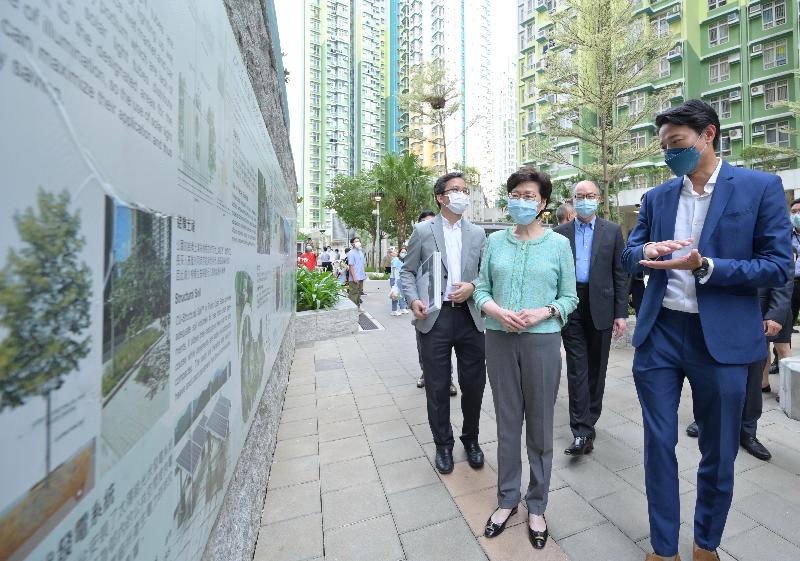
     Mrs Lam and officials visited On Tai Estate, which was planned and built with concepts of sustainable development and community engagement. With a greening ratio over 30 per cent, the estate has plenty of environmental friendly and green installations, and many of the facilities feature art, the quarry’s history, and education elements. It won the Grand Award of the Hong Kong Residential (Multiple Buildings) Category of the Quality Building Award 2020, and the “Sustainable Construction” Bronze Award of the Construction Industry Council in 2019.
      
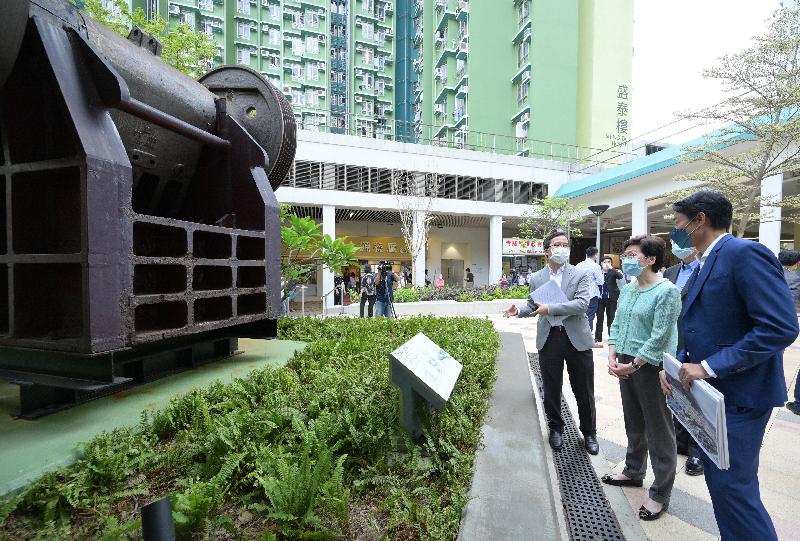
     The environmental friendly facilities viewed by Mrs Lam included solar pipes, which re-direct natural daylight to designated areas, a green acoustic barrier and walkways, a planting area equipped with the Zero Irrigation System and the oasis void in the car park. She also visited the outdoor exhibition gallery, which showcases the history of the Anderson Road Quarry and various precious natural resources therein, and its observation deck, an exhibit of an old machine part used at the quarry and other artworks. She was pleased to note that innovative technology of 5D BIM (Building Information Modeling) was applied and prefabrication was widely used in the design and construction of On Tai Estate to enhance efficiency, promote environment protection, reduce construction time and more, which is a good example of a works project.
      
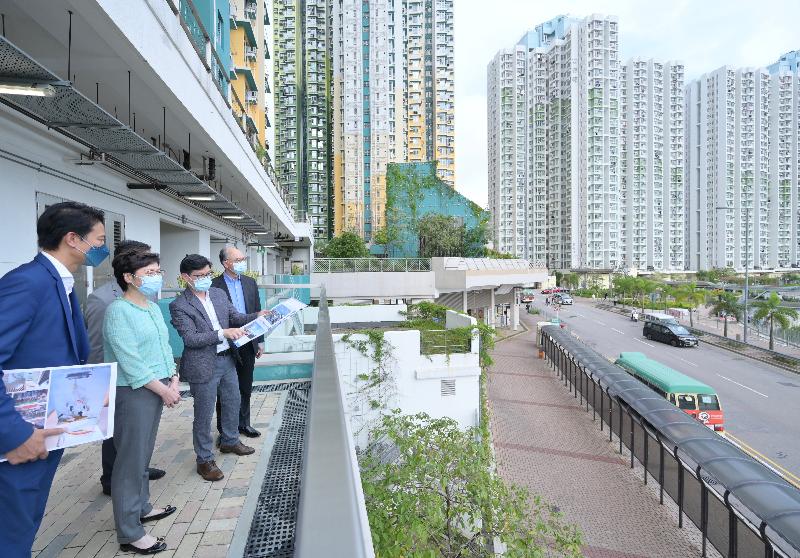
     Mrs Lam and officials had a bird’s eye view of the Anderson Road Quarry site from the rooftop of a building at On Tai Estate and received a briefing on the progress of the relevant development project. The development of the Anderson Road Quarry site project, which is currently in progress, covers 11 housing sites. Eight of them are for public housing development (including five sites by the Hong Kong Housing Authority and three sites by the Hong Kong Housing Society). Another two sites have been successfully sold for private housing development and the remaining one has been reserved for the pilot project of the second Starter Homes for Hong Kong Residents (Starter Homes) development, which is the first time the Government enlisted the participation of developers in building and selling Starter Homes units through land sale. Starter Homes is part of the efforts of the current-term Government to rebuild the housing ladder for the higher-income families, which are not eligible for the Home Ownership Scheme and yet cannot afford private housing, to become homeowners at a specific discount rate. The first Starter Homes pilot project was eResidence, rolled out by the Urban Renewal Authority, which received overwhelming support by qualified families at its sale.  
      
     “The architectural design of On Tai Estate is outstanding. I believe that residents are satisfied with the living environment. I applaud the efforts of colleagues of the Hong Kong Housing Authority and the Housing Department in building a quality living environment for members of the public.
      
     “I announced in my 2020 Policy Address that with the efforts over the years, we have identified all of the land required for providing public housing units to meet the demand in the coming 10 years, with the re-allocation of sites at the Anderson Road Quarry for public housing development being one of the sources of supply. The current-term Government will continue to spare no effort to provide land with a multi-pronged approach and roll out various short-, medium- and long-term initiatives to increase land supply to strive to provide suitable housing for families in different income brackets,” Mrs Lam said.

Photo  Photo  Photo  Photo  
read more