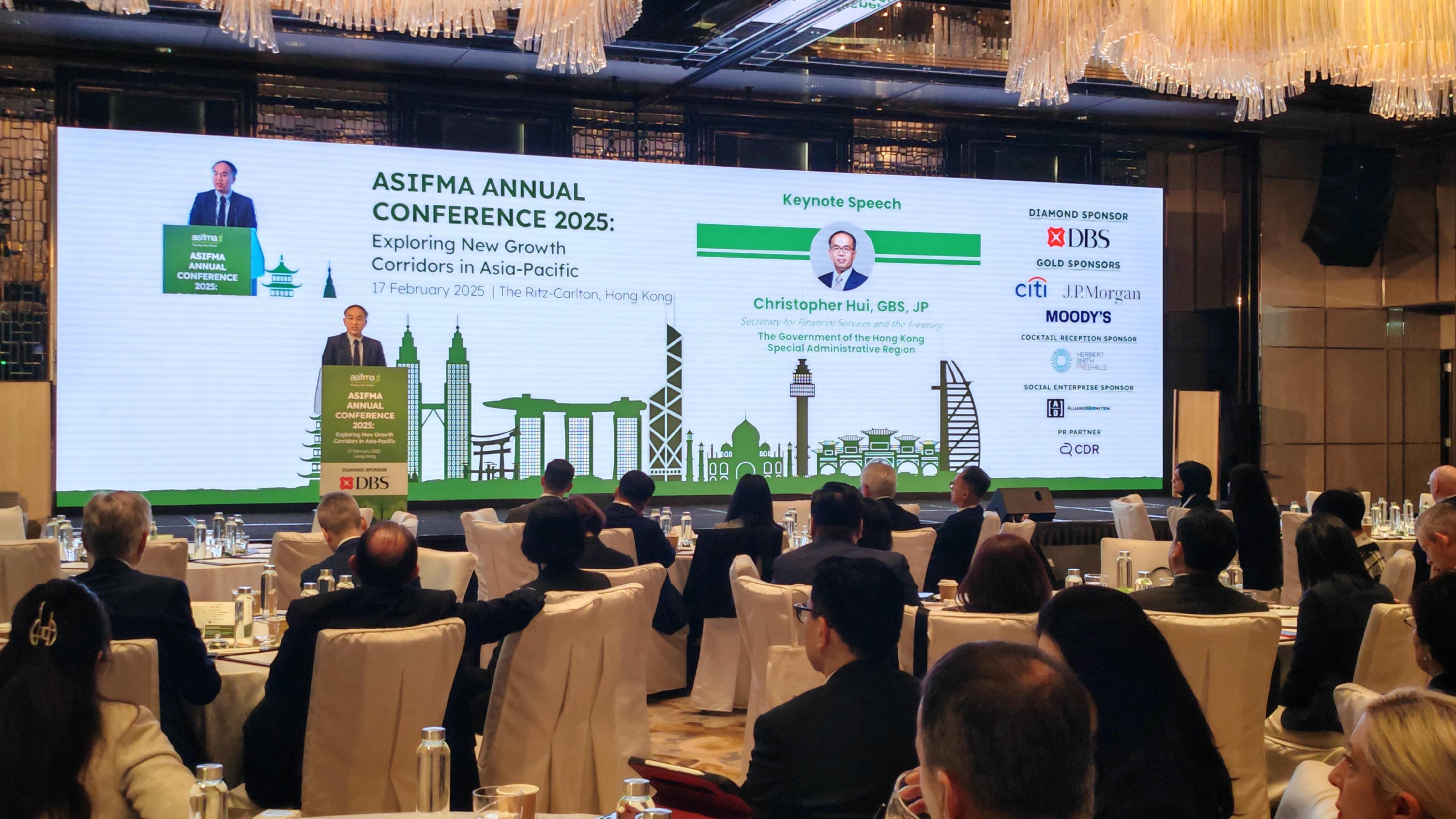
Following is the keynote speech by the Secretary for Financial Services and the Treasury, Mr Christopher Hui, at the Asia Securities Industry & Financial Markets Association (ASIFMA) Annual Conference 2025 today (February 17):
Peter (Chief Executive Officer of the ASIFMA, Mr Peter Stein), distinguished guests, ladies and gentlemen,
Good morning. It is my great pleasure to join the ASIFMA Annual Conference today, where global leaders, policymakers, and industry experts gather to explore new growth opportunities in the midst of an unprecedented transformation in the global environment.
Our financial market is characterised by deep liquidity, diverse financial products and services, strong emphasis on investor protection, a well-educated and highly efficient workforce, ease of entry for non-local professionals, and effective and transparent financial regulations aligned with international standards. These competitive advantages have been widely recognised by various international institutions. Hong Kong ranked first as Asia’s leading international financial hub in the latest Global Financial Centres Index. Recently, the International Monetary Fund also reaffirmed that our financial system remains resilient, supported by robust institutional frameworks, ample policy buffers, and the smooth functioning of the Linked Exchange Rate System.
And so far, we have made good progress in developing the stock market. Hong Kong’s stock market surged by some 18 per cent and the average daily turnover jumped by 26 per cent from a year earlier. We were also the world’s fourth-largest and Asia’s second-largest initial public offering (IPO) market, with IPO proceeds at about HK$80 billion last year, which is almost double that in the year before last. To strengthen the competitiveness of our market, we have implemented a range of measures including optimising the vetting procedures of listing applications, enhancing the listing regime for specialist technology companies, and enabling market trading under severe weather, to name just a few.
To further boost the efficiency and liquidity of our stock market, the Government, in collaboration with the regulators and HKEX (Hong Kong Exchanges and Clearing Limited), is continuously exploring different market development measures to further enhance our listing regime and trading mechanism, with a view to strengthening overall market competitiveness and expanding our overseas networks. A consultation ongoing is the one concerning optimisation of our IPO price discovery and open market requirements. The consultation will last till March 19 and I am sure Peter will make sure that you are being heard.
The Hong Kong bond market has continued to grow in tandem with the Government’s active promotion. Hong Kong has been the largest centre for arranging bonds issued in the region by Asia-based entities for 16 consecutive years, with nine years being the leader internationally, capturing about a quarter of the market in 2023.
The Government and the regulators will continue to promote the advantages of our bond market to issuers and investors on the Mainland and overseas to deepen our bond market development. We will expand the issuance of Renminbi bonds and support the issuance of more green and sustainable offshore Renminbi bonds in Hong Kong by Mainland and international issuers.
We are expanding our mutual access programmes with the Mainland’s financial market, too. They include expanding the scope of eligible ETFs (exchange-traded funds) under Stock Connect, optimising the arrangements under Swap Connect, as well as the latest enhancement and expansion of Southbound trading of Bond Connect, improving transaction and settlement efficiency while broadening the investment channels for Mainland and offshore investors.
The Government, in collaboration with the regulators and HKEX, will continue to work closely with the Mainland to implement the measures supported by regulators in the two places, including the introduction of Mainland government bond futures in Hong Kong and inclusion of a Renminbi counter under Southbound trading of Stock Connect, and actively exploring further enhancement initiatives.
Building an international gold trading centre is a new growth point for Hong Kong to cement our status as an international financial centre. The Government will promote the development of world-class gold storage facilities and, building on the increased gold holding, scale up associated support and financial services and expand related derivative transactions, hence creating a comprehensive ecosystem in a progressive manner. We already set up a working group last year and we are now working at full steam to formulate a comprehensive implementation plan. Furthermore, we are committed to increasing the storage and delivery of commodities in Hong Kong, not only precious metals but also base metals, and providing better services to Mainland enterprises engaging in international commodity trade. To achieve this, we will facilitate the relevant international commodity exchange which is the London Metal Exchange (LME) to set up accredited warehouses in Hong Kong, enhance associated financial services, and also support the creation of a thriving commodity trading ecosystem.
If you may recall, the 2024 Policy Address announced that the Government will facilitate the opening of new distribution channels for private equity (PE) funds through HKEX’s listings. Alternate asset funds, including PE funds, as eligible collective investment schemes (CISs), may apply for listing in Hong Kong under Chapter 20 of our Listing Rules. The SFC (Securities and Futures Commission) has been engaging with HKEX, industry associations and interested fund managers to explain the relevant regulatory and requirements. On that front, the SFC plans to issue a circular very soon this month to clarify the requirements for authorising closed-end alternative funds for listing on HKEX. The SFC also plans to issue a discussion paper in the first quarter of this year to seek the industry’s views on the viability of allowing retail investors to invest in unlisted alternative funds without committing on any rule changes.
We will also attract more global capital to be managed in Hong Kong. Last March, we launched the New Capital Investment Entrant Scheme. So far, around HK$6.5 billion has been invested. If you look at the amount of financial assets being invested through this HK$6.5 billion, most of them go to financial products, with 45 per cent going to CISs, 39 per cent going to equities and 15 per cent going to debt securities. From March this year, we will relax the net assessment and calculation requirements. We will also accept investments made through an applicant’s wholly owned eligible private company. In addition, we will enhance the profits tax exemption regimes for funds and single family offices. The Government will also put in place an inward company redomiciliation regime which provides a simple and straightforward route for non-Hong Kong incorporated companies to transfer their domicile to Hong Kong while ensuring business continuity. We are confident that these measures will help to bring in more of the world’s top companies and of course talent to our city.
We also strive to deepen our reforms and explore new growth areas using a new mindset amidst changing circumstances. A new growth opportunity is green and sustainable finance, a fast-developing area on the back of climate change. Hong Kong is a leading green and sustainable finance hub in Asia. The total green and sustainable debt, including both bonds and loans, issued in Hong Kong exceeded US$50 billion in 2023. Among which, the volume of green and sustainable bonds arranged in Hong Kong topped the Asian market, accounting for 37 per cent of the regional total.
To solidify the competitiveness of enterprises in Hong Kong to address the global demand for sustainability disclosure, we launched a roadmap on sustainability disclosure in Hong Kong. The roadmap provides a well-defined pathway for large publicly accountable entities (PAEs) to fully adopt the ISSB Standards (International Financial Reporting Standards – Sustainability Disclosure Standards) no later than 2028, leading Hong Kong to be among the first jurisdictions to align our local requirements with those of the ISSB Standards.
Fintech is a new growth area and also one of the new strategic areas. On this front, we issued a policy statement last year to set out the policy stance and approach for promoting the responsible application of artificial intelligence in the financial market. Regarding the sustainable development of virtual assets, we have enhanced the regulatory framework and introduced a bill last year on the regulation of fiat-referenced stablecoin issuers. In addition, the Government will put forward a proposed licensing regime for virtual asset custodian service providers.
And in fact, if you look at the calendar of key events this year, we will very soon have the conference Consensus Hong Kong 2025 which is a world-renowned Web3 global conference. This is the first time they will land in Asia and they have picked Hong Kong as their first stop.
Ladies and gentlemen, the opportunities in Hong Kong are immense despite the complex geopolitical and economic landscape. As we actively integrate into and embrace the opportunities presented by the national development strategies, Hong Kong will remain as an ideal gateway connecting the Mainland capital market with the rest of the world, and provide a prime location and platform for international businesses and investors to tap into the vast business potential and investment opportunities in the Guangdong-Hong Kong-Macao Greater Bay Area, Mainland China and beyond, and of course include the Middle East, ASEAN (Association of Southeast Asian Nations) and India as covered in this year’s conference in many more years to come.
As a leading global financial centre, we will continue to expand and enrich our dynamic capital markets and liquidity pool as well as diversify our product and services offerings to better serve both regional and international investors. We welcome you all to use Hong Kong as a platform to grab the opportunities and at the same time to give us more comments and also views in terms of how we can grow this market further. Thank you.