Tag Archives: China

Health Bureau responds to media enquiries on relocation of services of Queen Elizabeth Hospital and future use of King’s Park site

     In response to media enquiries on the relocation of the services of Queen Elizabeth Hospital (QEH) and the future use of the King’s Park site, a spokesman for the Health Bureau said today (March 19) that at this stage, the Government has no plan to use the King’s Park site for purposes other than for healthcare. The Government will consider the future healthcare use and development plan of the King’s Park site in the course of reviewing the Second Hospital Development Plan (HDP).
 
     The spokesman said, “To dovetail with the implementation of the First HDP of the Hospital Authority (HA), the services of QEH will be relocated to New Acute Hospital (NAH) at Kai Tak Development Area gradually starting from early 2026. By then, most of the clinical services of QEH, including the accident and emergency services, will be relocated to NAH; while the Ambulatory Care Centre (Extension) of QEH will remain at the King’s Park site.”
 
     Situated in Central Kowloon, NAH will form a service network with Our Lady of Maryknoll Hospital, Hong Kong Buddhist Hospital and Tung Wah Group of Hospitals Wong Tai Sin Hospital in Kowloon City District; Kwong Wah Hospital, Kowloon Hospital and other hospitals in the Kowloon Central Cluster; as well as the Ambulatory Care Centre (Extension) of QEH to provide comprehensive healthcare services to the residents of the community.
 
     The HA has been maintaining close liaison with the relevant departments, including the Transport Department (TD), on various support for NAH. Regarding public transport services, the TD will plan in advance the provision of appropriate public transport services having regard to the progress and anticipated completion date of the NAH project. The TD will also continue to closely monitor the development of the area, and adjust or strengthen the local public transport services based on actual circumstances, with a view to further enhancing the road traffic network in the vicinity of NAH having regard to the needs of the passengers, including patients seeking services at the hospital.
 
     The spokesman added that the Health Bureau and the HA are reviewing the Second HDP by taking into account the future planning of Hong Kong (including the latest development of the Northern Metropolis), anticipated population distribution and projected healthcare service demand. After the relocation of clinical services from QEH to NAH, there will be room for development of healthcare services at the King’s Park site. Given the convenient geographical location, it will be a feasible option to consider the expansion of the ambulatory care services at the King’s Park site based on the demand of the population in Kowloon.  read more
Firearms and Ammunition (Amendment) Bill 2025 to be gazetted on Friday

     A spokesman for the Security Bureau (SB) said today (March 19) that the Government will publish the Firearms and Ammunition (Amendment) Bill 2025 in the Gazette on Friday (March 21) and introduce it into the Legislative Council (LegCo) for First Reading and Second Reading on April 2 to implement the relevant requirements of the “Protocol against the Illicit Manufacturing of and Trafficking in Firearms, Their Parts and Components and Ammunition” (the Firearms Protocol).

     The spokesman said, “The Firearms Protocol entered into force in 2005 to strengthen control over licit firearms, prevent their diversion into the illegal circuit, and promote relevant law enforcement co-operation among the States Parties. The Firearms Protocol has entered into force for the People’s Republic of China (including the Hong Kong Special Administrative Region) since January 18, 2024. The Firearms Protocol stipulates the requirement to criminalise the illicit manufacturing of or cross-border trafficking in firearms, component parts and ammunition, as well as falsifying or illicitly obliterating, removing or altering the requisite markings on firearms.

     “Under the Firearms and Ammunition Ordinance (Cap. 238) (the FAO), the existing regulatory framework regulates the manufacturing and import or export of firearms (including their component parts and ammunition) by way of trade or business by the dealer’s licence regime, and does not contain specific provisions for criminalising the illicit manufacturing and import or export of firearms (including their component parts and ammunition) by way other than trade or business. There is also no mandatory legal requirement on marking of firearms, and no criminal offence of falsifying or illicitly obliterating, removing or altering such markings. We therefore have to amend the FAO in order to fully implement the Firearms Protocol.”

     The spokesman emphasised, “Apart from criminalising the aforementioned types of conducts and enhancing the penalties for the illicit manufacturing of and cross-border trafficking in firearms (including their component parts and ammunition) for greater deterrence, the Bill will also align with international practices in the regulation of firearms by requiring markings to be made on firearms at the time of manufacture and import for the purpose of identifying and tracing each firearm. The detailed technical marking requirements and specifications will be set out by way of subsidiary legislation after the amended FAO comes into force.”

     The spokesman added, “The SB has briefed the holders of dealers’ licence in firearms on the Bill, and consulted the LegCo Panel on Security in February 2025. The trade and the Panel supported the Bill in general. We will continue to consult the trade in the formulation of the relevant subsidiary legislation.” read more

Government welcomes passage of Air Pollution Control (Amendment) Bill 2024

     The Government welcomes the Legislative Council’s passage of the Air Pollution Control (Amendment) Bill 2024 today (March 19).
      
      To more effectively combat unlicensed specified processes operations that may cause serious air pollution, the Bill introduces a statutory closure notice mechanism. At the same time, the amendment exercise optimises the scope of “cement works” and the definition of “premises” under specified processes to avoid misinterpretation or control circumvention, such that the trade could enjoy a clearer and fairer business environment.
      
     The amendment exercise also tightens five existing Air Quality Objectives (AQOs) and adds three parameters newly introduced by the World Health Organization (WHO) to the WHO Global Air Quality Guidelines. Among the 15 updated AQOs, seven are set at the most stringent levels of the Guidelines, which are on par with those of other advanced economies. 
      
     The Bill will come into effect on April 11, 2025.
      
     A Government spokesman said, “Through implementing various local air pollution control measures and closely collaborating with the Guangdong Provincial Government, Hong Kong’s air quality has continued to improve. Over the past two years, Hong Kong’s air quality has attained the best level since its return to the motherland, and the concentrations of major air pollutants have dropped by about 40 to 80 per cent. We will continue to work with Guangdong Province to improve the air quality of the entire Guangdong-Hong Kong-Macao Greater Bay Area and build a beautiful bay area together.” read more

CE meets Governor of Guangdong Province (with photo)

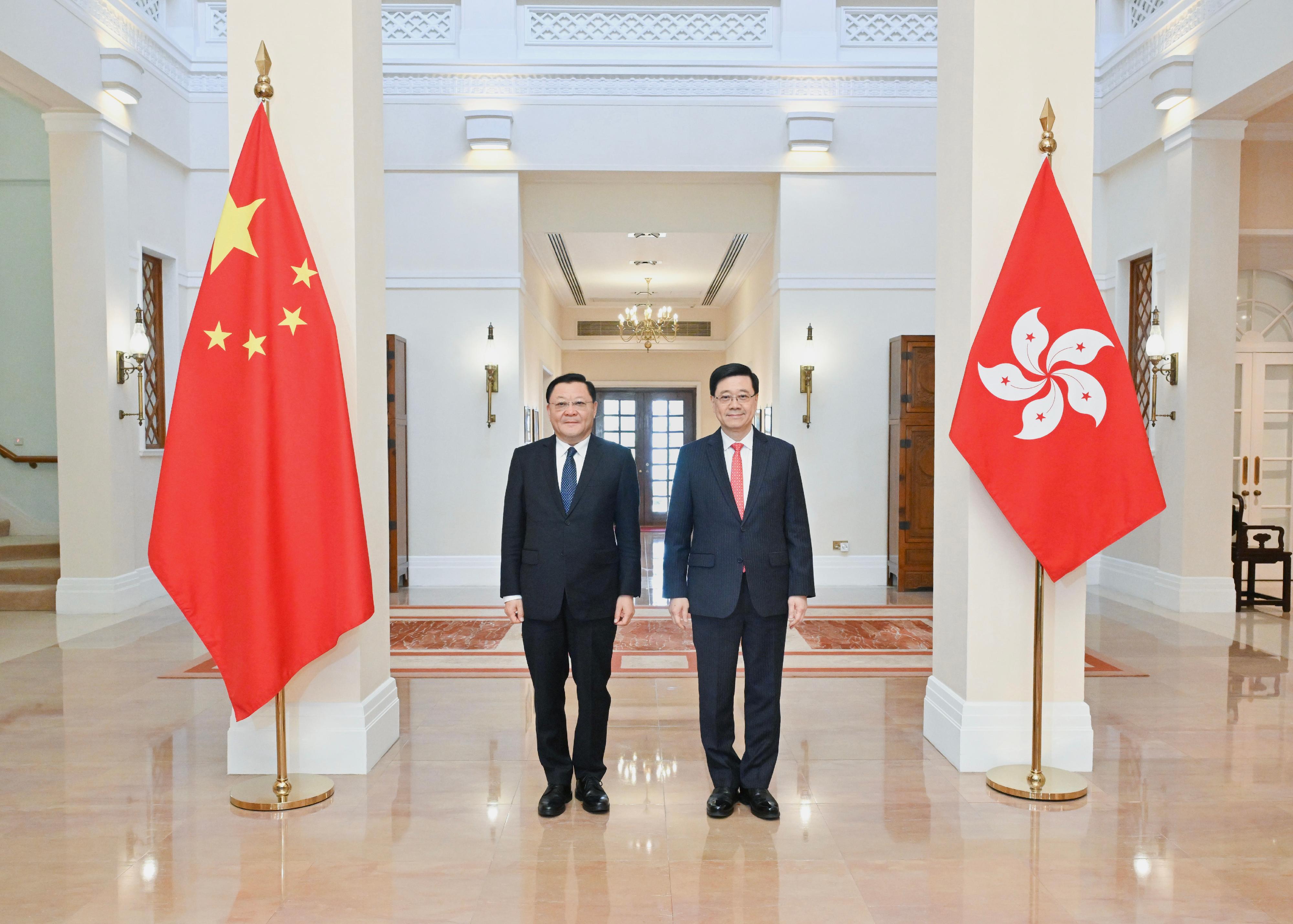
     The Chief Executive, Mr John Lee, met the Governor of Guangdong Province, Mr Wang Weizhong, at Government House today (March 19) to exchange views on further strengthening co-operation between Hong Kong and Guangdong, and promoting the high-quality development of the Guangdong-Hong Kong-Macao Greater Bay Area (GBA). Also attending the meeting were the Chief Secretary for Administration, Mr Chan Kwok-ki; the Secretary for Constitutional and Mainland Affairs, Mr Erick Tsang Kwok-wai; the Director of the Chief Executive’s Office, Ms Carol Yip; and the Commissioner for the Development of the Guangdong-Hong Kong-Macao Greater Bay Area, Ms Maisie Chan.
          
     Mr Lee welcomed Mr Wang and his delegation to Hong Kong. Mr Lee said that the Hong Kong Special Administrative Region (HKSAR) Government attaches importance to the work on Hong Kong’s integration into the overall national development. Shortly upon the establishment of the current-term Government, the Steering Group on Integration into National Development was set up to take forward and provide a steer from the top level on the work of serving the development of the GBA. He said that Guangdong and Hong Kong are adjacent to each other and interdependent, and have shared an all-round, deep and multidisciplinary co-operative relationship for many years. With the strong support from the Central Authorities, Guangdong and Hong Kong have worked with one mind to promote co-operation in finance, innovation and technology, logistics, healthcare and other fields, and have achieved fruitful results.
      
     Mr Lee highlighted that the People’s Government of Guangdong Province issued offshore Renminbi (RMB) local government bonds in Hong Kong for the first time in September last year. This initiative not only further strengthened Hong Kong’s position as a global offshore RMB business hub, but also promoted the GBA in better serving as the driving force for high-quality development. Welcoming more Mainland local governments to issue offshore RMB bonds and green bonds in Hong Kong, Mr Lee noted that Hong Kong will continue to leverage its advantages in connecting with the international financial system and providing professional services, contributing to the country’s promotion of high-level financial opening up.
      
     Mr Lee said that the HKSAR Government will continue to actively maintain close co-operation with the People’s Government of Guangdong Province, with a view to enhancing the innovation capabilities and influence of the GBA as a region with economic development advantages, as well as achieving complementarity and collaborative development among Guangdong, Hong Kong and Macao. It also aims to align with national development strategies and leverage Hong Kong’s unique advantages of being backed by the motherland and connected to the world under the “one country, two systems” principle to deepen international exchanges and co-operation, and better integrate into the overall national development.

Photo  
read more