Tag Archives: China

image_pdfimage_print

Exchange Fund Bills tender results

The following is issued on behalf of the Hong Kong Monetary Authority:

     Exchange Fund Bills tender results:
 

Tender date : 21 February 2025
Paper on offer : EF Bills
Issue number : M2501
Issue date : 24 February 2025
Maturity date : 19 March 2025
Amount applied : HK$2,960 MN
Amount allotted : HK$600 MN
Average yield accepted : 3.55 PCT
Highest yield accepted : 3.56 PCT
Pro rata ratio* : About 50 PCT
Average tender yield : 3.76 PCT

*”Pro rata ratio” refers to the average percentage of allotment with respect to each tender participant’s tendered amount at the “highest yield accepted” level. read more

32 landlords of subdivided units under regulated tenancies convicted of contravening relevant statutory requirements

     Thirty-two landlords of subdivided units (SDUs), who contravened Part IVA of the Landlord and Tenant (Consolidation) Ordinance (Cap. 7) (the Ordinance), pleaded guilty and were fined a total of $86,900 on February 14 and today (February 21) at the Eastern Magistrates’ Courts. Since the Ordinance came into force, the Rating and Valuation Department (RVD) has successfully prosecuted 590 cases involving a total of 505 SDU landlords, with fines ranging from $400 to $34,800, amounting to a total of $1,393,910.
 
     The offences of these 32 landlords include (1) failing to submit a Notice of Tenancy (Form AR2) to the Commissioner of Rating and Valuation within 60 days after the term of the regulated tenancy commenced; (2) failing to produce copies of the bills and provide an account in writing when requiring the tenant to pay for the reimbursement of the apportioned water and/or electricity charges; and (3) requesting the tenant to pay money other than the types permitted under the Ordinance (including requiring the tenant to pay an amount of rent for the second-term tenancy exceeding the maximum amount of rent permitted under the Ordinance). One of the landlords committed nine offences under (1) and (3) and was fined $9,200.

     The RVD earlier discovered that the landlords failed to comply with the relevant requirements under the Ordinance. Upon an in-depth investigation and evidence collection, the RVD prosecuted against the landlords.
 
     A spokesman for the RVD reiterated that SDU landlords must comply with the relevant requirements under the Ordinance, including prohibiting landlords from doing any act calculated to interfere with the peace or comfort of members of the tenant’s household, with the intention of causing the tenant to give up occupation of the SDU; or requiring the tenant to pay an amount of rent for the second-term tenancy exceeding the maximum amount of rent permitted under the Ordinance, and also reminded SDU tenants of their rights under the Ordinance, including a four-year (i.e. two years plus two years) security of tenure. He also stressed that the RVD will continue to take resolute enforcement action against any contraventions of the Ordinance. Apart from following up on reported cases, the RVD has been adopting a multipronged approach to proactively identify, investigate and follow up on cases concerning landlords who are suspected of contravening the Ordinance. In particular, the RVD has been requiring landlords of regulated tenancies to provide information and reference documents of their tenancies for checking whether the landlords concerned have complied with the requirements of the Ordinance. If a landlord, without reasonable excuse, refuses to provide the relevant information or neglects the RVD’s request, the landlord commits an offence and is liable to a maximum fine at level 3 ($10,000) and to imprisonment for three months. Depending on the actual circumstances, and having regard to the information and evidence collected, the RVD will take appropriate actions on individual cases, including instigating prosecution against suspected contraventions of the Ordinance.
 
     To help curb illegal acts as soon as possible, members of the public should report to the RVD promptly any suspected cases of contravening the relevant requirements. Reporting can be made through the telephone hotline (2150 8303), by email (enquiries@rvd.gov.hk), by fax (2116 4920), by post (15/F, Cheung Sha Wan Government Offices, 303 Cheung Sha Wan Road, Kowloon), or in person (visiting the Tenancy Services Section office of the RVD at Room 3816-22, 38/F, Immigration Tower, 7 Gloucester Road, Wan Chai, Hong Kong, and please call 2150 8303 to make an appointment). Furthermore, the RVD has provided a form (Form AR4) (www.rvd.gov.hk/doc/en/forms/ar4.pdf) on its website to facilitate SDU tenants’ reporting to the RVD.
 
     The RVD reminds that pursuant to the Ordinance, a regulated cycle of regulated tenancies is to comprise two consecutive regulated tenancies (i.e. the first-term tenancy and second-term tenancy) for an SDU, and the term of each regulated tenancy is two years. A tenant of a first-term tenancy for an SDU is entitled to be granted a second-term tenancy of the regulated cycle, thus enjoying a total of four years of security of tenure. Since the first batch of regulated tenancies has already approached their second-term tenancies, the RVD has started a new round of publicity and education work in order to assist SDU landlords and tenants to understand the important matters pertaining to the second-term tenancy, and procedures that need to be followed about two months prior to the commencement of the purported second-term tenancy. In addition, the RVD has started issuing letters enclosing relevant information to the landlords and tenants concerned of regulated tenancies in batches, according to the expiry time of their first-term tenancies, to remind them about their respective obligations and rights under the Ordinance. These landlords and tenants may also visit the dedicated page for the second-term tenancy on the RVD’s website (www.rvd.gov.hk/en/tenancy_matters/second_term_tenancy.html) for the relevant information, including a concise guide, brochures, tutorial videos and frequently asked questions. SDU landlords and tenants are also advised to familiarise themselves with the relevant statutory requirements and maintain close communication regarding the second-term tenancy for handling the matters properly and in a timely manner according to the Ordinance.
 
     For enquiries related to regulated tenancies, please call the telephone hotline (2150 8303) or visit the RVD’s webpage (www.rvd.gov.hk/en/our_services/part_iva.html) for the relevant information. read more

Inspection of aquatic products imported from Japan

     In response to the Japanese Government’s plan to discharge nuclear-contaminated water at the Fukushima Nuclear Power Station, the Director of Food and Environmental Hygiene issued a Food Safety Order which prohibits all aquatic products, sea salt and seaweeds originating from the 10 metropolis/prefectures, namely Tokyo, Fukushima, Ibaraki, Miyagi, Chiba, Gunma, Tochigi, Niigata, Nagano and Saitama, from being imported into and supplied in Hong Kong.
 
     For other Japanese aquatic products, sea salt and seaweeds that are not prohibited from being imported into Hong Kong, the Centre for Food Safety (CFS) of the Food and Environmental Hygiene Department will conduct comprehensive radiological tests to verify that the radiation levels of these products do not exceed the guideline levels before they are allowed to be supplied in the market.
 
     As the discharge of nuclear-contaminated water is unprecedented and will continue for 30 years or more, the Government will closely monitor and step up the testing arrangements. Should anomalies be detected, the Government does not preclude further tightening the scope of the import ban.
 
     From noon on February 20 to noon today (February 21), the CFS conducted tests on the radiological levels of 180 food samples imported from Japan, which were of the “aquatic and related products, seaweeds and sea salt” category. No sample was found to have exceeded the safety limit. Details can be found on the CFS’s thematic website titled “Control Measures on Foods Imported from Japan” (www.cfs.gov.hk/english/programme/programme_rafs/programme_rafs_fc_01_30_Nuclear_Event_and_Food_Safety.html).

     In parallel, the Agriculture, Fisheries and Conservation Department (AFCD) has also tested 52 samples of local catch for radiological levels. All the samples passed the tests. Details can be found on the AFCD’s website (www.afcd.gov.hk/english/fisheries/Radiological_testing/Radiological_Test.html).
 
     The Hong Kong Observatory (HKO) has also enhanced the environmental monitoring of the local waters. No anomaly has been detected so far. For details, please refer to the HKO’s website
(www.hko.gov.hk/en/radiation/monitoring/seawater.html).
 
     From August 24, 2023, to noon today, the CFS and the AFCD have conducted tests on the radiological levels of 117 175 samples of food imported from Japan (including 76 792 samples of aquatic and related products, seaweeds and sea salt) and 27 176 samples of local catch respectively. All the samples passed the tests. read more

HKSAR Government sets up Hong Kong Cross-boundary Public Services self-service kiosk and “iAM Smart” self-registration kiosk in Dongguan (with photos)

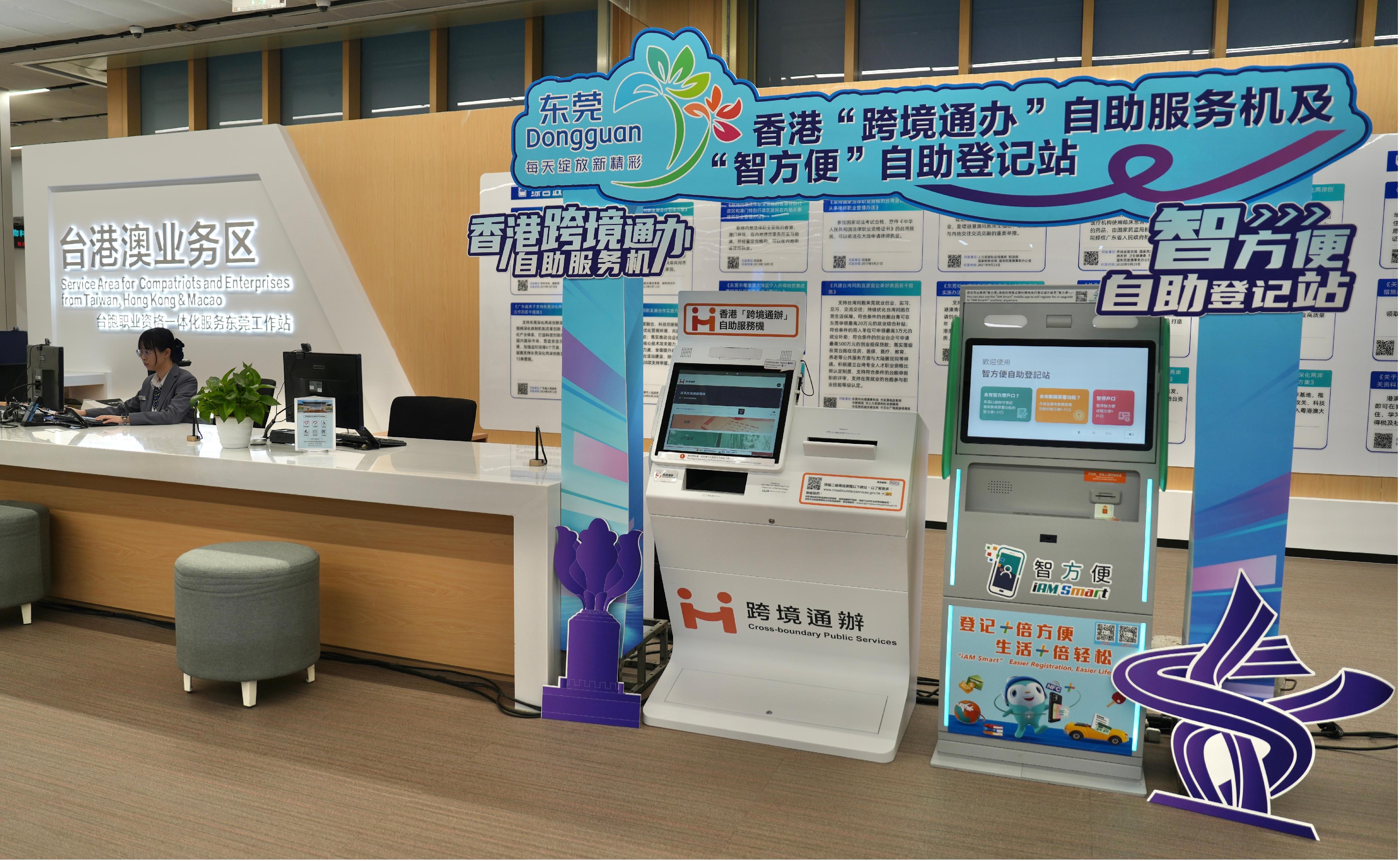
     â€‹To advance the development of a digital government, the Hong Kong Special Administrative Region (HKSAR) is collaborating with Guangdong Province to promote the Cross-boundary Public Services initiative. The Digital Policy Office (DPO) announced today (February 21) the setting up of a Hong Kong Cross-boundary Public Services self-service kiosk in Dongguan to enable residents and enterprises in Mainland cities of the Guangdong-Hong Kong-Macao Greater Bay Area (GBA) to access public services of Hong Kong without the need to travel to Hong Kong in person.
 
     Starting today, the public can use the Hong Kong Cross-boundary Public Services self-service kiosk located on 2/F, Dongguan Citizen Service Center to access various public services of Hong Kong. The opening hours of the kiosk in the Center are 9am to noon and 1pm to 5pm, Monday to Friday (except public holidays on the Mainland). For details, please visit the Hong Kong Cross-boundary Public Services thematic website at www.crossboundaryservices.gov.hk/en/home/index.html.
 
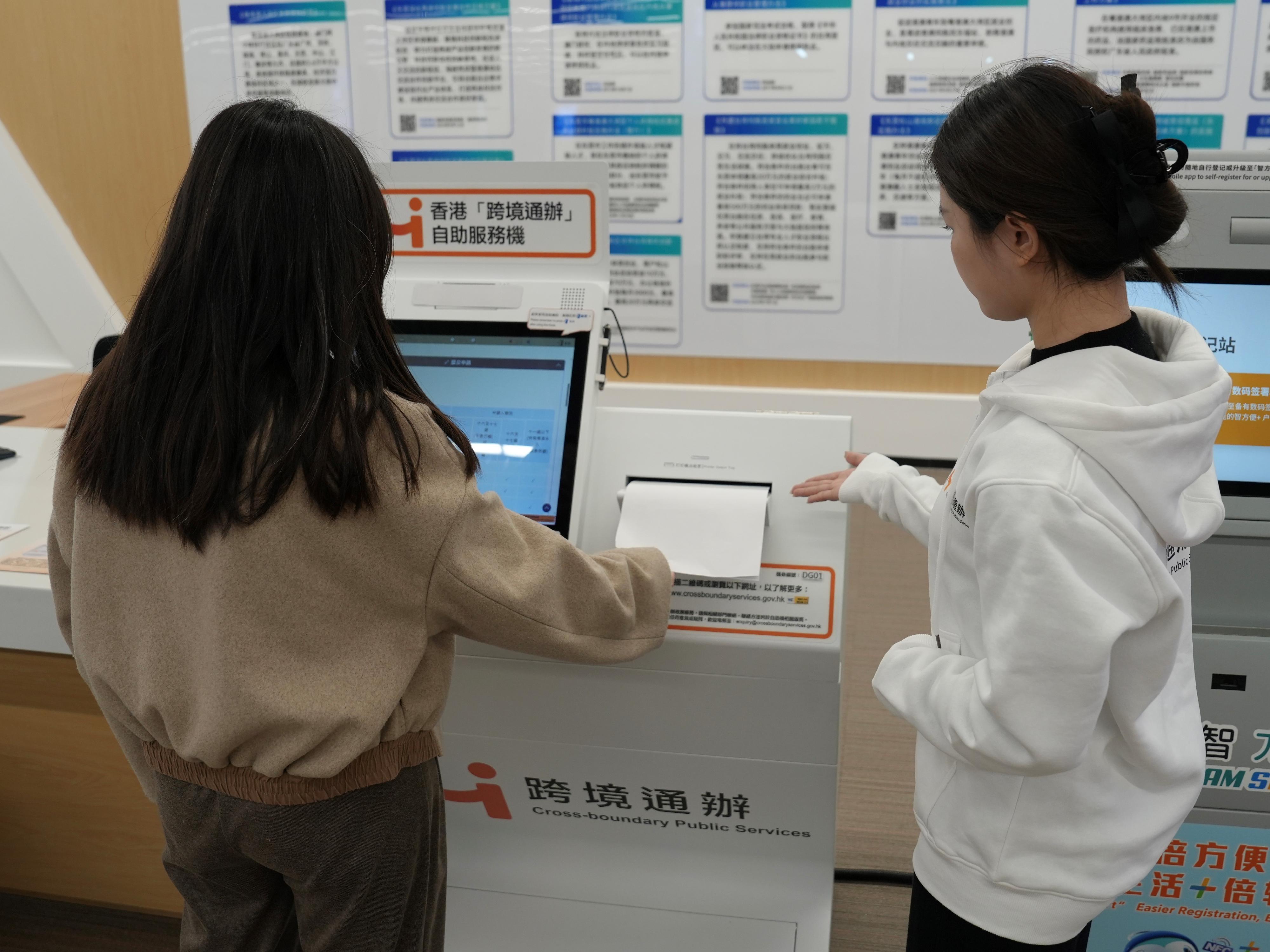
     Following the Hong Kong Cross-boundary Public Services self-service kiosks that commenced operation earlier in Guangzhou, Qianhai and Futian in Shenzhen, Zhuhai and Foshan as well as Huizhou, the Cross-boundary Public Services self-service kiosk in Dongguan also provides over 70 public services from 12 government bureaux and departments as well as related organisations, encompassing eight areas commonly used by enterprises and the public including taxation, company registration, property and vehicle enquiry and registration, application for personal identification documents and entry of talent, welfare and education, healthcare, immigration clearance, urgent assistance as well as culture and tourism. Members of the public can use the self-service kiosks to perform data entry, document scanning and result printing to enjoy one-stop access when applying for various public services. 
 
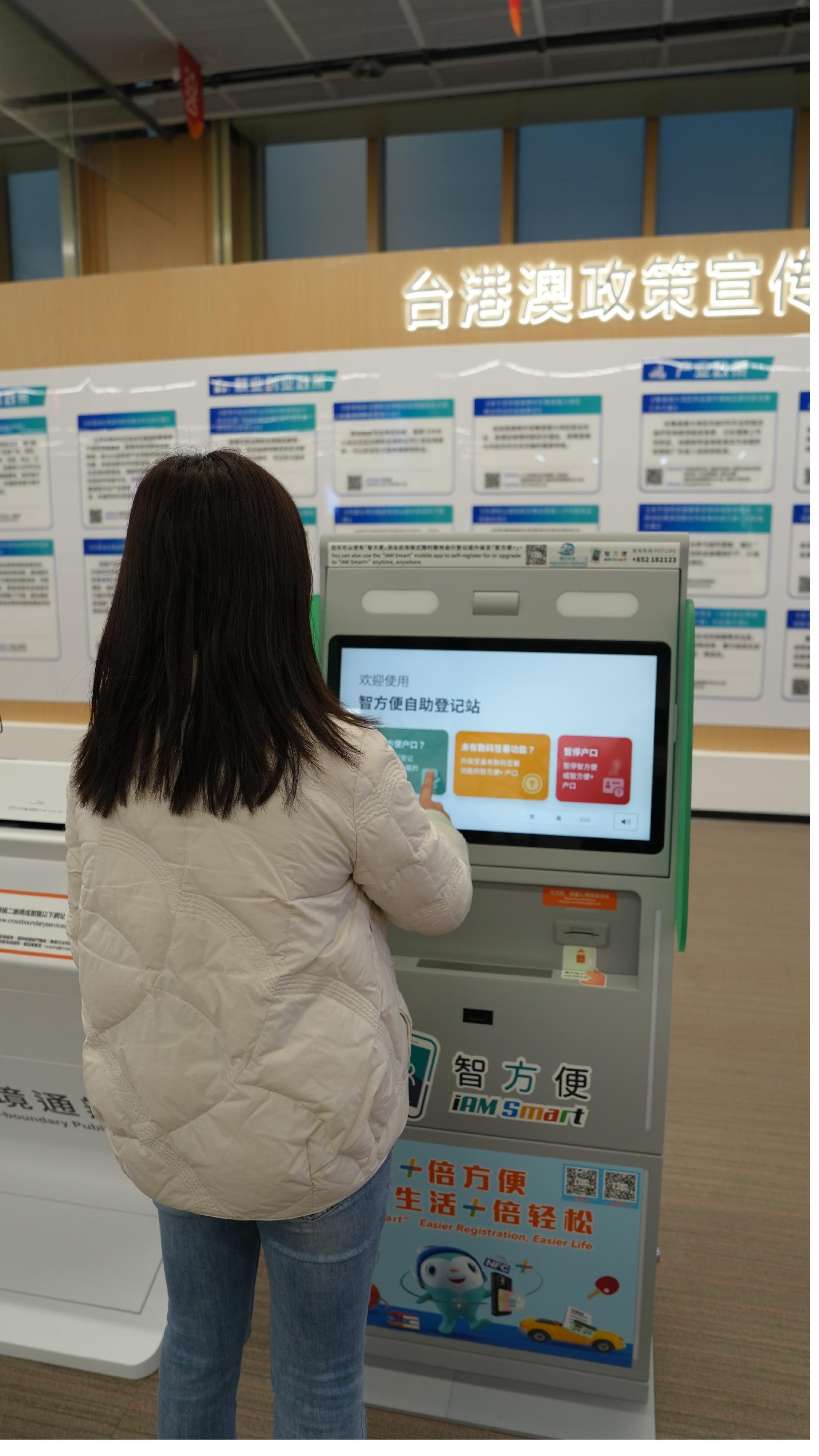
     An “iAM Smart” self-registration kiosk is also set up at the Dongguan location to enable Hong Kong residents working and living on the Mainland to register for “iAM Smart+” and directly use the “iAM Smart” mobile app for one-stop public services, covering more than 400 Hong Kong public services, such as renewal of a vehicle licence, enrolment for the Contactless e-Channel, and application for student grant. For details and registration requirements, please visit the “iAM Smart” thematic website at www.iamsmart.gov.hk/en/reg.html.
 
     A spokesman for the DPO expressed sincere gratitude to the Guangdong Provincial Administration of Government Service and Data for its strong support, and to the Center for its full co-operation. The DPO will continue to discuss with the Guangdong Provincial Administration of Government Service and Data to set up self-service and self-registration kiosks in more Mainland cities of the GBA to cope with the demands of residents and enterprises in the GBA for public services of Hong Kong.
      
     To implement the State Council’s Guiding Opinions to all provincial governments on Cross-provincial Public Services and their comprehensive deployment, the HKSAR Government and the Guangdong Provincial Administration of Government Service and Data jointly commenced work of the GBA Cross-boundary Public Services in 2021, and jointly introduced a dedicated service area/thematic website for Cross-boundary Public Services in November 2023. The initiative enables enterprises and the public in both regions to enjoy simple and convenient cross-boundary services, with a view to facilitating the provision of public services and investment in the GBA, and enhancing the satisfaction and sense of contentment of enterprises and the public in accessing services across the boundary.

Photo  Photo  Photo  Photo  
read more

Speech by DSJ at Sports Law Conference luncheon (English only) (with photo)

     Following is the speech by the Deputy Secretary for Justice, Dr Cheung Kwok-kwan, at the Sports Law Conference luncheon organised by the Law Society of Hong Kong today (February 21):
 
President Roden Tong (President of the Law Society of Hong Kong), distinguished guests, ladies and gentlemen,
 
     Good afternoon. It is a great pleasure for me to speak at this lunch conference.
 
     This morning, you heard from esteemed experts on the relationship between sports and law, highlighting how it supports the ever-expanding sports industry – locally, regionally and globally. As the sports market continues to grow, there is an increasing demand for dispute resolution services tailored to address a wide range of sports-related issues, including competition-related disputes, contractual disputes, and governance matters. In the next few minutes, I would like to share with you the Government’s latest initiatives aimed at fostering the growth of sports dispute resolution in Hong Kong.
 
     Over the past two years, the Government, specifically the Department of Justice (DoJ) and the Culture, Sports and Tourism Bureau, has been actively engaging with key stakeholders in order to better understand the needs of our sports sector.
 
     In the Chief Executive’s Policy Address last year, the Government announced the initiative to explore establishing a sports dispute resolution mechanism and promote sports arbitration, leveraging the institutional advantages of Hong Kong in dispute resolution. Specifically, the Government supports the industry in launching a pilot scheme on sports dispute resolution in Hong Kong within 2025.
 
     To this end, we have met with the two legal professional bodies in Hong Kong, the Law Society of Hong Kong and the Hong Kong Bar Association, as well as the Sports Federation & Olympic Committee of Hong Kong, China (SF&OC), to explore Hong Kong’s potential for establishing a sports dispute resolution mechanism. Through these dialogues, it has become clear that the industry seeks a neutral, fair, and efficient system for resolving sports disputes.
 
     Furthermore, during a meeting of the Legislative Council (LegCo) Panel on Administration of Justice and Legal Services last May, the DoJ briefed Members on Hong Kong’s potential for the development of sports dispute resolution, and sought their views on its future direction. Members of the Legislative Council and the two legal professional bodies expressed unanimous support for advancing sports dispute resolution in Hong Kong and exploring the establishment of a dedicated dispute resolution mechanism.
 
     To effectively implement the initiative, the DoJ has established the Advisory Committee on Sports Dispute Resolution, which I have the privilege to chair. The Advisory Committee comprises representatives from the Culture, Sports and Tourism Bureau, the Law Society of Hong Kong and the Hong Kong Bar Association. Their role is to advise the Government on the design, establishment and implementation of the pilot scheme. We held our first meeting last month to kick-start the preparatory work for the pilot scheme.
 
     We are actively gathering input from stakeholders on the design and implementation mechanism of the pilot scheme. Just this week, we met with the SF&OC, and we will meet with LegCo Members next week. Preparatory work is in full swing, and our goal is to launch the pilot scheme in the second half of this year.
 
     We will finalise the details of the pilot scheme and announce it after further deliberation with the Advisory Committee. Nonetheless, I would like to share a few preliminary thoughts with you today.
 
     In the coming months, we will invite interested dispute resolution institution or institutions to submit proposals for the operation of the pilot scheme. We plan to appoint a suitable administering body to oversee the pilot scheme and provide institutional support for the conduct of arbitration and mediation under the pilot scheme, including compiling specific rules, recruiting and appointing mediators and arbitrators, devising fee structures, and administering the dispute resolution proceedings. In addition, to promote a wider use of lawtech and online dispute resolution, a technology provider will be engaged to provide the necessary technological infrastructure and support.
 
     One of the primary objectives of the pilot scheme is to facilitate local athletes and sports associations in utilising alternative dispute resolution services. By doing so, we aim to promote a more accessible and efficient means of resolving disputes, ultimately supporting the development of the sports community.
 
     The pilot scheme is set to run for an initial period of about three years, allowing us to test the market, gather insights, and evaluate the need for refinement, extension or regularisation. We invite all of you here with us today – many of whom are dispute resolution experts – to support and actively participate in this initiative.
 
     Last but not least, I would like to extend my gratitude to the Law Society of Hong Kong for organising the Sports Law Conference 2025, which provides an excellent platform for these important discussions. I am also very pleased to see various organisations hosting events and training in sports dispute resolution. Industry participation, capacity building, promotion and public education are crucial as we strive to advance the sports industry and strengthen the sports dispute resolution framework.
 
     May we all embrace today’s theme: “Be Just! Be a Good Sport!” And let’s take a step further: let us cultivate a culture of effective sports dispute resolution, and build a good sports community that promotes growth and excellence. Thank you.

Photo  
read more