Tag Archives: China

image_pdfimage_print

LCQ5: Emotional support services for pregnant women and their family members

     Following is a question by the Hon Sunny Tan and a written reply by the Secretary for Labour and Welfare, Dr Law Chi-kwong, in the Legislative Council today (May 4):

Question:

     It has been reported that earlier on, a mother suspected of suffering from postnatal depression dropped her two-week-old daughter from a footbridge, and the baby girl passed away after being sent to hospital for emergency rescue. There are comments pointing out that the pressure of making preparations for the arrival of newborn babies and taking care of them may cause pregnant women and their family members to develop negative emotions. In this connection, will the Government inform this Council:

(1) given that the Comprehensive Child Development Service (CCDS) currently implemented by the authorities includes the identification of pregnant women with mental health problems and mothers suffering from postnatal depression, whether the authorities have assessed if the service is adequate for supporting pregnant women and their family members to face emotional problems before and after pregnant women give birth to their babies; if they have assessed and the outcome is in the affirmative, of the details; if the assessment outcome is in the negative, whether the authorities will, by drawing reference from the practices of other places, provide emotional education and psychological counselling services to pregnant women and their family members when pregnant women attend antenatal check-ups, as well as offer them and their family members relevant online teaching materials, support hotlines and online meeting services;

(2) of the following information on persons identified under the CCDS in each of the past five years as having antenatal mental health problems/postnatal depression: (i) their number and proportion in the total number of persons receiving the service, (ii) the number of such persons who received treatment, (iii) their proportions by age, (iv) the types of follow-up services received, and (v) the time taken for waiting for and receiving treatment (set out in a table); and

(3) as there are comments pointing out that people planning to have babies should prepare in advance for emotional awareness and management, whether the authorities will consider formulating a more comprehensive and in-depth baby care policy, as well as enhancing collaboration with community organisations to provide people in need with pre-pregnancy, antenatal and postnatal emotional awareness and management education, psychological counselling and support services; if so, of the details; if not, the reasons for that?

Reply:

President,

     The Comprehensive Child Development Service (CCDS) is a measure jointly implemented by the Labour and Welfare Bureau, the Education Bureau, the Department of Health (DH), the Hospital Authority (HA) and the Social Welfare Department (SWD), which aims to early identify various health and social needs of children (aged zero to five) and their families and provide intervention services for the protection, and to foster healthy development of children through multi-disciplinary collaboration (paediatrics, psychiatry, obstetrics and gynaecology, social work and clinical psychology). 

     The above service enables health care providers to identify various health and social needs of children and their families, through the collaborative platforms, such as the Maternal and Child Health Centres (MCHCs), hospitals, the Integrated Family Service Centres/Integrated Services Centres (IFSCs/ISCs) and pre-primary institutions, including at-risk pregnant women, mothers with postnatal depression, families with psychosocial needs and pre-primary children with health, developmental and behavioural problems, etc., so as to provide support to pregnant women/mothers and their families, and provide necessary health and social services for the healthy development of children. In addition, the IFSCs/ISCs operated by the SWD or the non-government organisations (NGOs) also provide developmental and preventive services to needy families, such as family life education, parent-child activities, educational/developmental groups/programmes, etc. 

(1) During the antenatal period, pregnant women with mood problem or past record of psychiatric illness are identified by the nurses at the MCHCs. They are then offered supportive counselling service or assessed by the visiting psychiatric team of the HA at the MCHCs, as well as referred to the CCDS midwives at the obstetric clinics of the HA for follow-up and monitoring to ensure that they receive proper psychiatric service.

     At the postnatal stage, nurses at the MCHCs identify mothers with probable postnatal depression using professional assessment tools and refer them to the visiting HA’s outreach psychiatric nurses at the MCHCs for further assessment and counselling. Depending on the severity of the condition and needs of the mothers and their children, the concerned cases are followed up by the visiting outreach psychiatric teams or paediatricians at the MCHCs, the regular psychiatric service of the HA and/or the IFSCs/ISCs operated by the SWD or the NGOs. Upon receiving referrals from the MCHCs, social workers at the IFSCs/ISCs will assess the needs and problems of the families and provide appropriate services.

     According to the above mode, relevant service units of the CCDS could identify mothers at-risk and with perinatal depression at an early stage and refer them to the appropriate health and social services, including psychiatric services, parenting programmes, family planning education, counselling service, supportive groups and programmes, and even drug detoxification service etc., to help them adjust the physical and psychological changes during pregnancy and cope with the stress of taking care of a newborn baby.

(2) The table below sets out the relevant figures of persons identified to have antenatal mood problems/postnatal depression under the CCDS in the past five years. 
 

  MCHCs under DH Psychiatric clinics
under HA
Year Mothers identified as having antenatal mood problems/postnatal depression
(headcount)
Referral for follow-up management in the appropriate health and/or social service units
(number of cases)
New cases of antenatal and postnatal women receiving psychiatric service of HA after referral
(headcount) (Note 2)
2021 (Note 1) 3 560 2 052 3 178
2020 (Note 1) 2 269 1 517 2 967
2019 6 538 3 766 4 889
2018 6 798 4 133 1 105
2017 7 463 4 385 1 047

Note 1: As affected by COVID-19 epidemic, the number of service users in the MCHCs has decreased as compared to past years.
Note 2: Including psychiatric service provided by visiting HA’s outreach psychiatric team at the MCHCs and psychiatric outpatient clinics. Source of referral cases include the MCHCs, obstetrics of the HA or other service units.

     â€‹Relevant Government departments have not kept a breakdown of other aspects of the CCDS. However, all high-risk pregnant women as identified by the HA under the CCDS will be arranged to receive psychiatric services as early as possible.

(3) The obstetric units of the HA have been offering antenatal classes to prepare mothers-to-be to walk through various anxiety stages of pregnancy. The HA obstetric mobile application “HApi Journey” (Hospital Authority Pregnancy Information Journey) was launched in February 2017 to provide updated information and useful tools for mothers-to-be, including nutritious diet during pregnancy, breastfeeding and caring of the newborn, in a timely manner to empower mothers-to-be and reduce their anxiety. In addition, the MCHCs provide expectant parents and parents with anticipatory guidance on antenatal and postnatal emotional changes, childcare, child development and parenting during the antenatal period and throughout the pre-school years of children via various means, e.g. counselling interviews, leaflets/videos, online resources, hotline and public talks, etc. These aim to support parents to understand and early identify postnatal mood problems, and equip them with more knowledge and handling skills on the growth and development of children. read more
LCQ6: Pilot scheme for charging land premiums at standard rates for redevelopment of industrial buildings

     Following is a question by the Hon Jimmy Ng and a written reply by the Secretary for Development, Mr Michael Wong, in the Legislative Council today (May 4):
 
Question:
 
     In March last year, the Development Bureau launched a pilot scheme for charging land premiums at standard rates for redevelopment of industrial buildings (IBs) (the pilot scheme) under which standard rates are set for the uses involved in lease modifications for IBs, and owners of IBs may compute the land premiums payable at the promulgated standard rates based on the uses and gross floor areas of their IBs before and after lease modifications. The pilot scheme runs for two years and is applicable to IBs constructed before 1987. In this connection, will the Government inform this Council:
 
(1) of the respective numbers of applications made under the pilot scheme which have been received, approved and rejected by the Government so far, and the number of applications under vetting; the average time taken for vetting and approving each application;
 
(2) among the approved applications mentioned in (1), of the respective numbers of those involving commercial/modern industrial use and residential use after lease modifications, as well as the following information of each application: (i) the district involved, (ii) whether there is an increase in the gross floor area after the lease modification (if so, of the details), and (iii) the amount of land premium involved; and
 
(3) whether it will consider extending the application deadline of the pilot scheme or regularising it, and at the same time expanding the scope of the pilot scheme to cover IBs constructed in or after 1987; if so, of the details; if not, the reasons for that?
 
Reply:
 
President,
 
     The Development Bureau and the Lands Department (LandsD) launched in mid-March 2021 the pilot scheme for charging land premiums at standard rates for redevelopment of industrial buildings (IBs) (the pilot scheme), for lease modifications involving the redevelopment of IBs constructed before 1987. The pilot scheme provides an option for charging land premiums at standard rates on these lease modifications, as an alternative to the conventional mechanism for premium assessment (i.e. individual premium assessment based on the circumstances of each case). Through promulgating in advance a set of standard rates on land premium, the pilot scheme aims to provide certainty on land premiums and expedite the completion of lease modification procedures involved in the redevelopment of aged IBs to facilitate the early transformation of the land into uses more compatible with the needs of society, and thus optimise the use of land.
 
     My reply to each part of the Hon Ng’s question is as follows:
 
(1) As at mid-April 2022 (over the past one year and so), applicants of nine eligible lease modifications opted for standard rates under the pilot scheme. Out of them, seven cases have had land premium agreed with the LandsD (five of which have been executed and two are expected to be executed in three months), and the remaining two cases are under processing. For reference, in the three years prior to the launch of the pilot scheme, on average only about three to four lease modification cases of IB redevelopment had premium agreed per year.
 
     Under the pilot scheme, eligible applicants should exercise their option on whether to have land premium calculated at standard rates upon acceptance of provisional basic term offer (PBTO) of the lease modification (which is the last step before commencement of the premium assessment process). Generally speaking, after the eligible applicant has opted and accepted the PBTO, the LandsD will complete the ensuing processes, including premium calculation and title checking etc., and issue the binding basic term offer with premium offer within about five weeks from the acceptance of the PBTO.
 
     Thereafter, the applicant should accept the premium offer within one month.  Upon the applicant’s acceptance (i.e. the two parties have agreed on the land premium amount), the lease modification document will be executed within three months. Under standard rates, as the applicant has made the option knowing the land premium amount in advance, there is no need for both parties to negotiate on the premium. Therefore, the time required from issuing the premium offer to reaching an agreement on the land premium (one month in general, as mentioned above) is much shortened from that required under conventional premium negotiation (around seven months on average in recent years).
 
(2) Under the pilot scheme, standard rates are set for the use before lease modification of IBs (i.e. “industrial/godown” use before redevelopment) and two common uses after lease modification (i.e. “commercial/modern industrial” and “residential” uses after redevelopment). The five executed lease modification cases above are all for commercial/modern industrial use after modification, with details at the Annex. The information of other cases can be searched at the Land Registry after the relevant lease modification documents are executed and the relevant documents are registered at the Land Registry. Key information will also be available on the LandsD’s website.
 
(3) The pilot scheme targets pre-1987 IBs for revitalisation, because they were constructed before the Fire Services Department enhanced the fire safety requirements in 1987. These buildings have relatively less adequate fire service installations and could pose safety risks to IB users and the society. Therefore, the Government focused on promoting the redevelopment of these IBs in order to address the safety problems in a more fundamental manner. Given this particular policy objective, the Government will continue to focus on IBs constructed before 1987 for the time being.
 
     In order to give owners a push factor in taking forward redevelopment expeditiously, the pilot scheme is time-limited and set to run for two years originally. The Government announced in end-March this year to extend the Pilot Scheme for one year until March 31, 2024, during which the previously announced standard rates will remain unchanged, to allow more time for IB owners to plan for redevelopment and for the Government to gather more experience for a review to consider the way forward.
 
     In fact, in view of the positive response from the industry towards the pilot scheme, the Chief Executive’s 2021 Policy Address announced the extension of the standard rates approach for premium assessment to lease modifications in the new development areas, with details announced in end-March this year. The Government will continue to keep in view the implementation of standard rates, so as to consider the feasibility of extending the scope of applying standard rates. read more

Hong Kong Customs seizes suspected ketamine worth about $4.3 million (with photo)

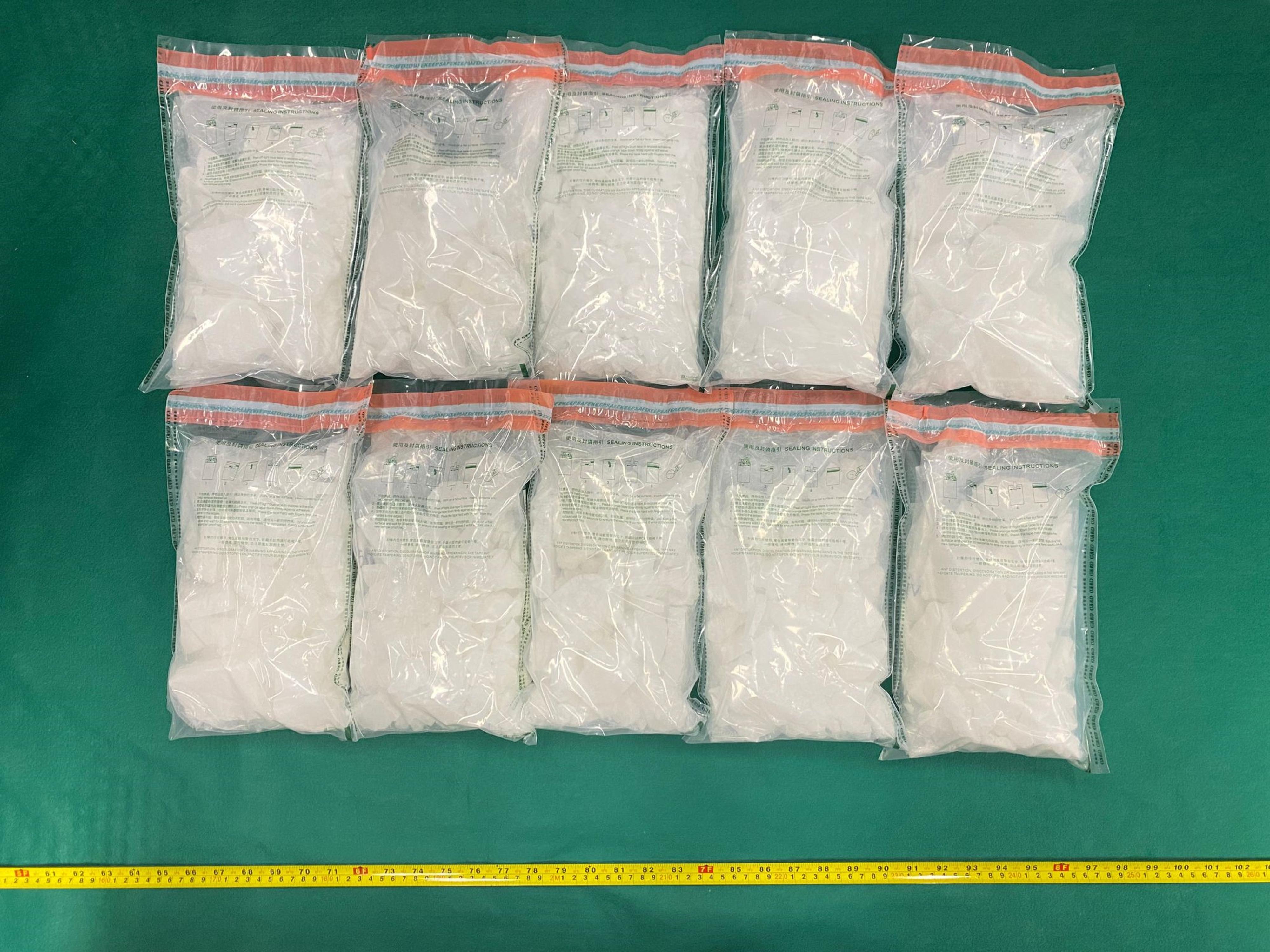
     Hong Kong Customs seized about 10 kilograms of suspected ketamine with an estimated market value of about $4.3 million at Hong Kong International Airport on May 2.

     Customs officers on that day inspected an express air consignment, declared to be carrying digital watches, arriving in Hong Kong from Spain. The batch of suspected ketamine was found concealed inside six bags of dog food packed in two boxes of goods. 

     Upon follow-up investigation, Customs officers yesterday (May 3) arrested a 17-year-old man suspected to be connected with the case in Lai Chi Kok. 

     An investigation is ongoing.

     Customs reminds members of the public to stay alert and not to participate in drug trafficking activities for monetary return. They must not accept hiring or delegation from another party to carry controlled items into and out of Hong Kong. They are also reminded not to carry unknown items for other people, nor to release their personal data or home address to others for receiving parcels or goods.

     Under the Dangerous Drugs Ordinance, trafficking in a dangerous drug is a serious offence. The maximum penalty upon conviction is a fine of $5 million and life imprisonment.

     Young people should especially pay attention to the fact that drug trafficking is a serious criminal offence. Criminal conviction will result in grave repercussions for their future and they should not take risks in the hope that they may not be caught.

     Members of the public may report any suspected drug trafficking activities to Customs’ 24-hour hotline 2545 6182 or its dedicated crime-reporting email account (crimereport@customs.gov.hk).

Photo  
read more

Government finishes exercise on “restriction-testing declaration” in respect of specified “restricted area” in Ming Toa House, Ming Tak Estate, Tseung Kwan O and enforcement operation for breaches of compulsory testing notice

     The Government yesterday (May 3) exercised the power under the Prevention and Control of Disease (Compulsory Testing for Certain Persons) Regulation (Cap. 599J) to make a “restriction-testing declaration” effective from 4pm yesterday, under which people (hereafter referred to as “persons subject to compulsory testing”) within the specified “restricted area” in Tseung Kwan O (i.e. Ming Toa House, Ming Tak Estate, Tseung Kwan O, excluding Ming Tak Estate Property Service Management Office and social service unit thereat) were required to stay in their premises and undergo compulsory testing. Persons subject to compulsory testing were required to stay in their premises until all such persons identified in the “restricted area” had undergone testing and the test results were mostly ascertained.
 
     In addition, the Government issued a compulsory testing notice yesterday, requiring persons who had been present at the above building for more than two hours from April 27 to May 3, 2022, even if they were not present in the “restricted area” at the time when the declaration took effect, to undergo compulsory testing on or before May 5, 2022.
 
     The Government finished the compulsory testing exercise at around 9am today (May 4) and carried out enforcement action in the “restricted area” afterwards to verify that all people in the “restricted area” had undergone compulsory testing in accordance with the requirements of the relevant declaration and compulsory testing notice. The Government announced that the enforcement operation ended at around 12noon today.
 
     The Government delivered food pack to persons subject to compulsory testing to facilitate their meal arrangements. Anti-epidemic proprietary Chinese medicines supplied by the Central Government and rapid test kits were also provided to persons subject to compulsory testing to help them fight against the virus. The Electrical and Mechanical Services Department set up a hotline for people restricted by the declaration to make enquiries and seek assistance.
 
     The Government thanks persons subject to compulsory testing for their support and understanding. With everyone’s co-operation and efforts, coupled with the tireless efforts of the testing contractors, residents have been informed about their testing results by SMS notification. After finishing the compulsory testing exercise at around 9am today, the Government took enforcement action in the “restricted area” immediately to verify that all people in the “restricted area” had undergone testing according to the requirements of the declaration and the compulsory testing notice. Persons who could present an SMS notification containing a negative testing result or wore a wristband as proof of having undergone the compulsory testing could leave the “restricted area” through the designated exit after providing personal information to a prescribed officer. The enforcement operation was completed at around 12noon. Test records of 617 persons subject to compulsory testing were checked. Two persons were found not having undergone compulsory testing and compulsory testing orders were issued to them. Taking into account the above situation, the Secretary for Food and Health revoked the “restriction-testing declaration” in accordance with Cap. 599J (see attachment).
 
     The Government reminds the 118 households who have not answered the door to contact the Government for arrangement of testing as soon as possible after reading the notices put up by the Government, in the hope of eliminating the possible risk of further spread of the virus in the community.

  The Government thanks all participating government staff and the testing agencies for their hard work. The Government is also grateful to those subject to compulsory testing for their support and understanding, and their full co-operation during this period in undergoing testing and waiting for the results at home.

  The Government will seriously follow up on the compliance situation of the compulsory testing notices and the “restriction-testing declaration” by persons subject to compulsory testing. Any person who fails to comply with the compulsory testing notices commits an offence and may be liable to a fixed penalty of $10,000. The person will also be issued with a compulsory testing order, requiring him or her to undergo testing within a specified time frame. Failure to comply with the order or the “restriction-testing declaration” is an offence and the offender may be liable to a fine of level 5 ($50,000) and imprisonment for six months.  read more