Tag Archives: China

image_pdfimage_print

“LeaveHomeSafe” new version 3.2.3 available for update

     A spokesman for the Office of the Government Chief Information Officer (OGCIO) said today (May 4) that the new version 3.2.3 of the “LeaveHomeSafe” mobile app is now available for update to fix the intermittent problem with the display of the Vaccine Pass QR code in the mobile phones of some users. Members of the public can now update the app in different app stores.

     The spokesman said that some users previouslyencountered intermittent problems in retrieving the stored Vaccine Pass QR code under some specific circumstances when scanning the venue QR code, resulting in an error in displaying a red QR code of “No Vaccination Record”. The OGCIO took urgent follow-up action and released the latest version 3.2.3 in all platforms today to fix the issue. The latest version also supports the storage of the “Provisional Vaccine Pass” QR code to facilitate travallers on short-term visit to Hong Kong to enter the specified premises under the Vaccine Pass arrangement.

     The spokesman reminded members of the public to update the “LeaveHomeSafe” mobile app through App Store, Google Play or Huawei AppGallery directly and refrain from deleting the old version. Updating the app will not affect previous visit records saved in users’ mobile phones.

     If members of the public encounter any difficulties in using the “LeaveHomeSafe” mobile app, they can seek assistance from the mobile support stations of the OGCIO at 25 MTR stations. For details, please visit the thematic webpage of LeaveHomeSafe at www.leavehomesafe.gov.hk/en/. read more
Government gazettes compulsory testing notice

     The Government exercises the power under the Prevention and Control of Disease (Compulsory Testing for Certain Persons) Regulation (Cap. 599J) and publishes in the Gazette a compulsory testing notice, which requires any person who had been present at 40 specified places during the specified period (persons subject to compulsory testing) to undergo a COVID-19 nucleic acid test.

     In view of a number of cases testing positive, 40 specified places are included in the compulsory testing notice. The Government strongly reminds members of the public to strictly follow the compulsory testing requirements and undergo testing on time as required. Mobile specimen collection stations have been set up by the Government in different districts to facilitate testing to be conducted in compliance with the compulsory testing notice. The above compulsory testing requirement applies to those who have completed a COVID-19 vaccination course as well.

     Persons who have tested positive in the past three months (including positive cases tested either by nucleic acid tests recorded by the Department of Health (DH) or by rapid antigen tests (RATs) that have been self-declared to the DH) do not need to undergo compulsory testing. For those who are subject to compulsory testing (save for those who have declared their positive RAT results as mentioned above), they must undergo nucleic acid tests in accordance with relevant compulsory testing notices and cannot use RATs to fulfil the requirement of such notices. In other words, a negative RAT result cannot be deemed as fulfilling the compulsory testing requirement. Furthermore, unless a person subject to compulsory testing has obtained a medical certificate proving that he or she is unfit to undergo testing using a sample taken through combined nasal and throat swabs because of health reasons, the person cannot provide a deep throat saliva sample to fulfil the compulsory testing requirement.

     Details of the compulsory testing notice are available on the Centre for Health Protection (CHP)’s website via the following link: www.chp.gov.hk/files/pdf/ctn_20220504.pdf.

     If any persons test positive under compulsory testing, such positive cases will be handled in the same manner as in those identified through other nucleic acid tests or self-declared through RATs. Their isolation arrangements (as well as the quarantine arrangements of their household members) are no different from other positive cases.

     Persons subject to compulsory testing in accordance with a compulsory testing notice must go to any of the mobile specimen collection stations, community testing centres (CTCs) or recognised local medical testing institutions to undergo professional swab sampling in fulfilling the requirements for compulsory testing. Young children may continue to undergo the test using a stool specimen. For details on obtaining stool specimen bottles, please refer to the COVID-19 thematic website: www.coronavirus.gov.hk/pdf/Stool_bottle_collection_points.pdf.

     The Comirnaty and CoronaVac vaccines are highly effective in preventing severe cases and deaths from COVID-19. They can provide protection to those vaccinated to prevent serious complications and even death after infection. The Government appeals to persons who are not yet vaccinated to get vaccinated without delay. The Government is working towards the goal of boosting the vaccination rates of children, teenagers and the elderly so that they can be protected by the vaccines as early as possible. Furthermore, the Scientific Committee on Vaccine Preventable Diseases and the Scientific Committee on Emerging and Zoonotic Diseases under the CHP of the DH has updated the consensus interim recommendations, and persons aged 60 or above who have taken three doses of vaccine are recommended to receive an additional dose (i.e. fourth dose) of either Comirnaty vaccine or CoronaVac vaccine at least three months after their last dose. Members of the public who are eligible should get the fourth dose as early as possible for better protection.

     CTCs provide testing services for the public. Booking and walk-in services are available. Members of the public only need to provide simple personal information on the 24-hour booking system (www.communitytest.gov.hk/en). The system shows the booking status of the centres for the coming two weeks to facilitate the public’s planning and selection of a suitable testing centre and a time slot for testing. The testing centres will accord priority to serve individuals with advance bookings. As of 6pm today (May 4), there was around 97 per cent availability for booking places for the coming two weeks. Members of the public may call the testing centres for enquiries on the availability of bookings or walk-in quotas before visiting the centres.
 
     Ticketing machines have been installed in a number of service points for on-site ticket arrangement. Members of the public who have obtained a ticket can visit the CTC website (www.communitytest.gov.hk/en) to check the real-time queueing ticket status. Booking service is also provided for some large-scale mobile specimen collection stations, and members of the public may use the 24-hour booking system (www.communitytest.gov.hk/en) to reserve a suitable time slot for testing.
 
     Other than persons subject to compulsory testing, all members of the public may conduct free testing at CTCs or mobile specimen collection stations (if the service scope is applicable). The opening dates and operating hours of the mobile specimen collection stations are stated in the Annex.

     Persons subject to compulsory testing may choose to undergo testing via the following routes:

(a) For tests which require using a sample taken through combined nasal and throat swabs
1. To visit any of the mobile specimen collection stations (see the list and target groups (if applicable) at www.coronavirus.gov.hk/eng/early-testing.html) for testing;
2. To attend any of the CTCs (see the list at www.communitytest.gov.hk/en);
3. To self-arrange testing provided by private laboratories which are recognised by the DH and can issue SMS notifications in respect of test results (see the list at www.coronavirus.gov.hk/pdf/List_of_recognised_laboratories_RTPCR.pdf), and the relevant sample must be taken through combined nasal and throat swabs; or
4. To use a specimen bottle distributed to the relevant specified premises by the CHP (if applicable), and return the specimen bottle with the stool sample collected as per relevant guidelines.

(b) For persons holding a medical certificate issued by a registered medical practitioner proving that they are unfit to undergo testing using a sample taken through combined nasal and throat swabs because of health reasons
1. To obtain a deep throat saliva specimen collection pack from post offices, vending machines set up at MTR stations or designated general out-patient clinics (GOPCs) of the Hospital Authority and return the specimen to one of the designated specimen collection points (see the distribution points and times, and the specimen collection points and times, at www.coronavirus.gov.hk/eng/early-testing.html);
2. To undergo testing at any of the GOPCs of the Hospital Authority as instructed by a medical professional of the Hospital Authority; or
3. To self-arrange testing provided by private laboratories which are recognised by the DH and can issue SMS notifications in respect of test results.

     A spokesman for the Food and Health Bureau cautioned that testing received at the Accident and Emergency Departments of the Hospital Authority, or testing provided by private laboratories which cannot issue SMS notifications in respect of test results, does not comply with the requirements of the aforementioned compulsory testing notice.

     “If persons subject to compulsory testing have symptoms, they should seek medical attention immediately and undergo testing as instructed by a medical professional. They should not attend the mobile specimen collection stations or the CTCs.”

     Persons subject to compulsory testing must keep the SMS notifications containing the result of the test and the relevant medical certificate (if applicable) for checking by a law enforcement officer when the officer requires the persons to provide information about their undergoing the specified test.

     Any enquiries on compulsory testing arrangements may be addressed to the hotline at 6275 6901, which operates daily from 9am to 6pm.

     The Government will continue to trace possibly infected persons who had been to relevant premises, and seriously verify whether they had complied with the testing notices. Any person who fails to comply with the testing notices commits an offence and the maximum penalty upon conviction is a fine at level 4 ($25,000) and imprisonment for six months. The fixed penalty for discharging the liability is $10,000. The person may also be issued with a compulsory testing order requiring him or her to undergo testing within a specified time frame. Any person in breach of the compulsory testing order would be liable to a fine at level 5 ($50,000) and imprisonment for six months.

     The spokesman said, “The Government urges all individuals who are in doubt about their own health conditions, or individuals with infection risks (such as individuals who visited places with epidemic outbreaks or had contact with cases tested positive), to undergo testing promptly for early identification of infected persons.” read more

EAC Chairman and SCMA inspect simulated activities for staff at main polling station and central counting station (with photos)

The following is issued on behalf of the Electoral Affairs Commission:
 
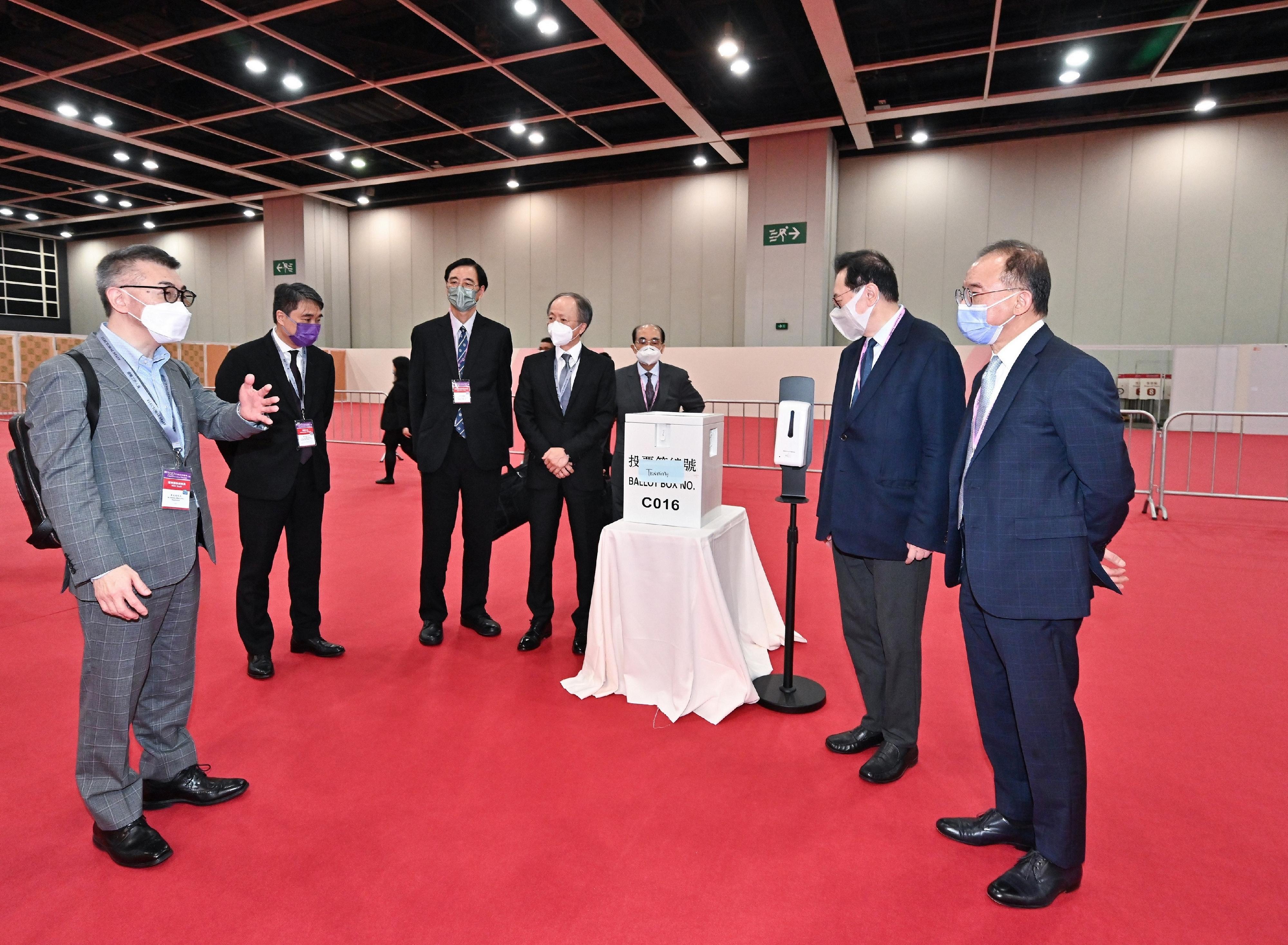
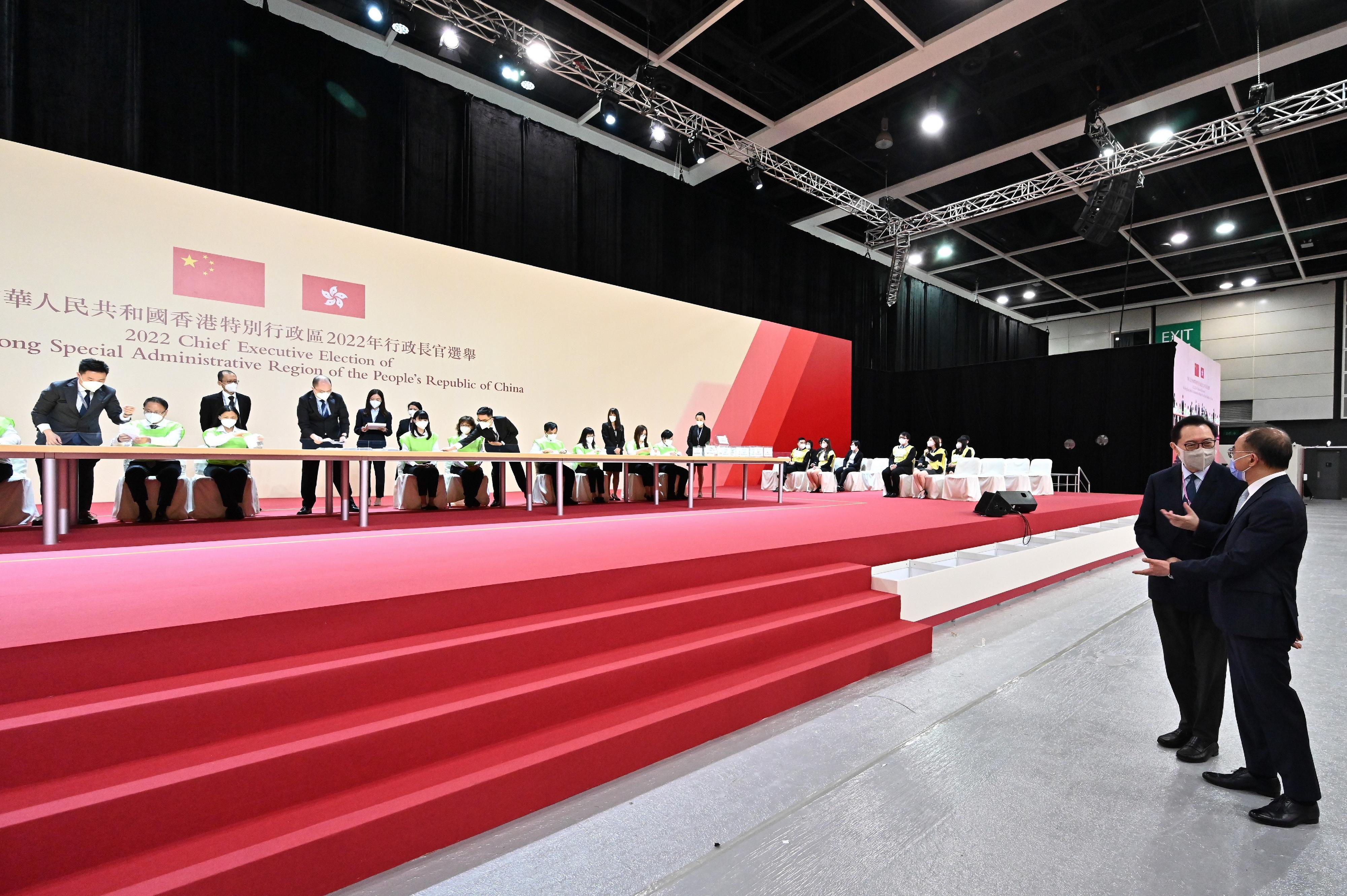
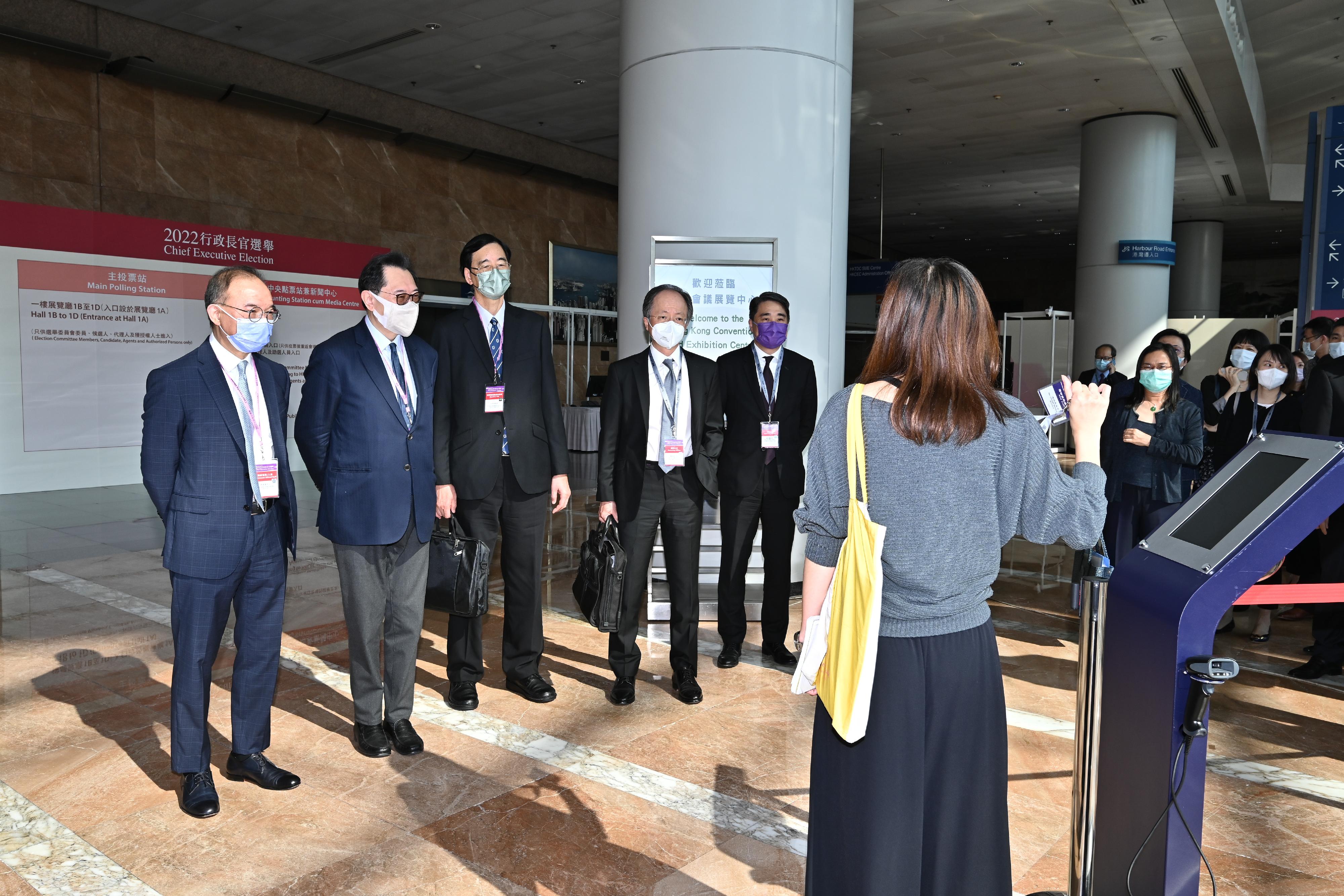
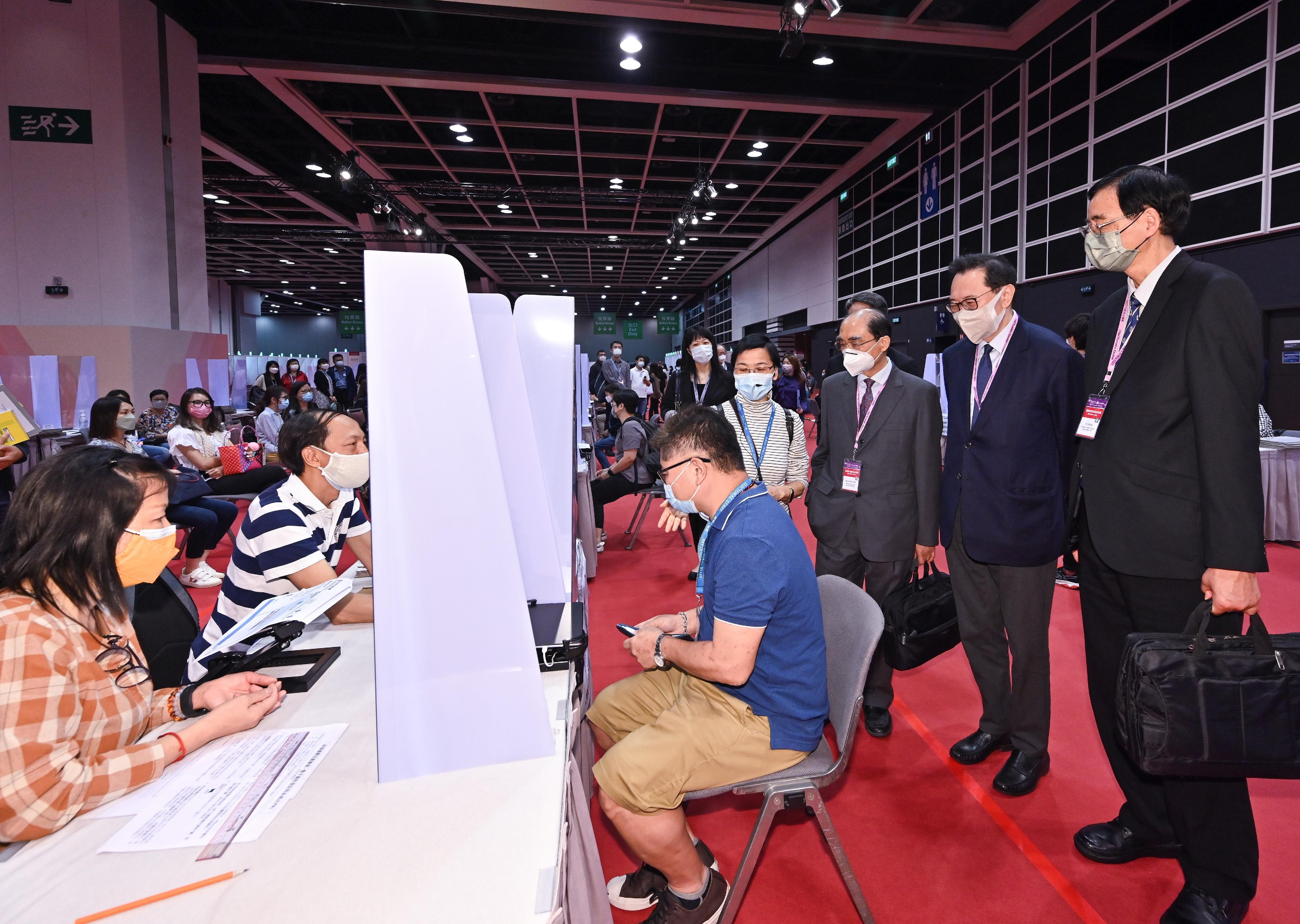
     The Chairman of the Electoral Affairs Commission (EAC), Mr Justice Barnabas Fung Wah, together with the Secretary for Constitutional and Mainland Affairs, Mr Erick Tsang Kwok-wai, EAC members Mr Arthur Luk, SC, and Professor Daniel Shek, and the Returning Officer, Mr Justice Keith Yeung Kar-hung, today (May 4) visited the Hong Kong Convention and Exhibition Centre (HKCEC) to inspect the training with practical sessions and simulated activities for the staff members at the main polling station and central counting station of the 2022 Chief Executive (CE) Election. They thanked colleagues for their efforts made, and encouraged them to make their best endeavours to ensure that the poll and vote counting this Sunday (May 8) will be carried out smoothly.
 
     Mr Justice Fung said that most of the preparatory work for the 2022 CE Election is nearing completion, and staff members would continue their work to ensure that the election will be conducted smoothly and efficiently. He also appealed to the Election Committee (EC) members to vote on the polling day.
 
     He said, “The 2022 CE Election, which will be held this Sunday, is the first CE Election after the Improving Electoral System (Consolidated Amendments) Ordinance 2021 came into effect. The next term of CE shall be elected by nearly 1 500 EC members by secret ballot on a one-person, one-vote basis. The Registration and Electoral Office (REO) will set up the main polling station and central counting station cum media centre at the HKCEC. In addition, there will be a polling station at the Penny’s Bay Community Isolation Facility and a dedicated polling station at Happy Valley Police Station.
 
     On the polling day, staff from various departments will discharge electoral duties at different posts. The EAC encouraged all electoral staff to step up training to familiarise themselves with details of the procedures and arrangements.
 
     The Electronic Poll Register (EPR) system will be used for issuing ballot papers at the main polling station in the election for more flexible, efficient and accurate issuance of ballot papers. An EC member needs to present the original of his/her Hong Kong permanent identity card and temporarily pull his/her mask aside as instructed at the ballot paper issuing desk. The staff will scan the EC member’s identity card with an EPR tablet to verify his/her identity, and then issue the ballot paper. After the close of the poll, all ballot boxes will be delivered to the central counting station for counting by staff manually.
 
     The REO held numerous training sessions to brief polling and counting staff on the polling and counting procedures. The staff could familiarise themselves with the workflow and response in the event of contingencies through practice sessions with simulated scenarios. The training sessions covered every procedure, including the set-up of polling and counting stations and their preparatory work, contingency measures for the EPR system, steps immediately after the close of the poll, delivery of ballot boxes, points to note about sorting and counting of votes so as to ensure accuracy while enhancing efficiency, co-ordination and responsiveness, and make thorough preparations for the CE Election.
 
     The EAC will closely monitor the conduct of the election on the polling day, ensuring that the election is conducted in an open, just and honest manner.

Photo  Photo  Photo  Photo  Photo  
read more

Grading of beach water quality released

     The Environmental Protection Department (EPD) today (May 4) released the latest grading of water quality for 38 gazetted beaches (see Note 1 and Note 2) and one non-gazetted beach (i.e. Discovery Bay, see Note 3).     
        
     Thirty-one beaches were rated as Good (Grade 1), six as Fair (Grade 2) and two as Poor (Grade 3).

Grade 1 beaches are:

Big Wave Bay Beach Lower Cheung Sha Beach
Butterfly Beach* Middle Bay Beach
Cafeteria New Beach Pui O Beach*
Cafeteria Old Beach Repulse Bay Beach*
Castle Peak Beach Shek O Beach*
Cheung Chau Tung Wan Beach Silver Mine Bay Beach*
Chung Hom Kok Beach Silverstrand Beach*
Clear Water Bay Second Beach* South Bay Beach
Deep Water Bay Beach* St. Stephen’s Beach
Golden Beach* Stanley Main Beach
Hap Mun Bay Beach* Tai Po Lung Mei Beach*
Hung Shing Yeh Beach* Tong Fuk Beach
Kadoorie Beach Trio Beach
Kiu Tsui Beach Turtle Cove Beach
Kwun Yam Beach Upper Cheung Sha Beach
Lo So Shing Beach  
      
Grade 2 beaches are:
Approach Beach Discovery Bay
Casam Beach* Hoi Mei Wan Beach
Clear Water Bay First Beach Ting Kau Beach

Grade 3 beaches are:
Lido Beach* Ma Wan Tung Wan Beach*

     Under the present grading system, beaches are classified into four grades, namely Good (Grade 1), Fair (Grade 2), Poor (Grade 3) and Very Poor (Grade 4), according to the level of E. coli in the water. Grades are calculated on the basis of the geometric mean of the E. coli counts on the five most recent sampling occasions.

     A summary of beach grades is published weekly before the weekend. The latest beach grades based on the most current data may be obtained from the EPD’s website on Beach Water Quality (www.epd.gov.hk/epd/beach) or the beach hotline, 2511 6666.

Note 1: In view of the relaxation of some social distancing measures, the Leisure and Cultural Services Department announced on May 3 that 15 gazetted beaches, marked with an asterisk above, will reopen on May 5 with lifeguard services to be provided.

Note 2: The Stonecutters Island Sewage Treatment Works, which was affected by the unstable supply of chemicals earlier on, has resumed normal dosage of sodium hypochlorite solution (referred to as bleach) in the disinfection system, and met the discharge standard for bacteriological water quality. The routine water quality monitoring conducted by the EPD at Tsuen Wan beaches confirmed that their water quality has returned to normal level, suitable for swimming.  

Note 3: Discovery Bay is a non-gazetted beach without lifeguard service. read more