Tag Archives: China

image_pdfimage_print

SITI attends Mobile World Congress 2025 in Barcelona, Spain (with photos)

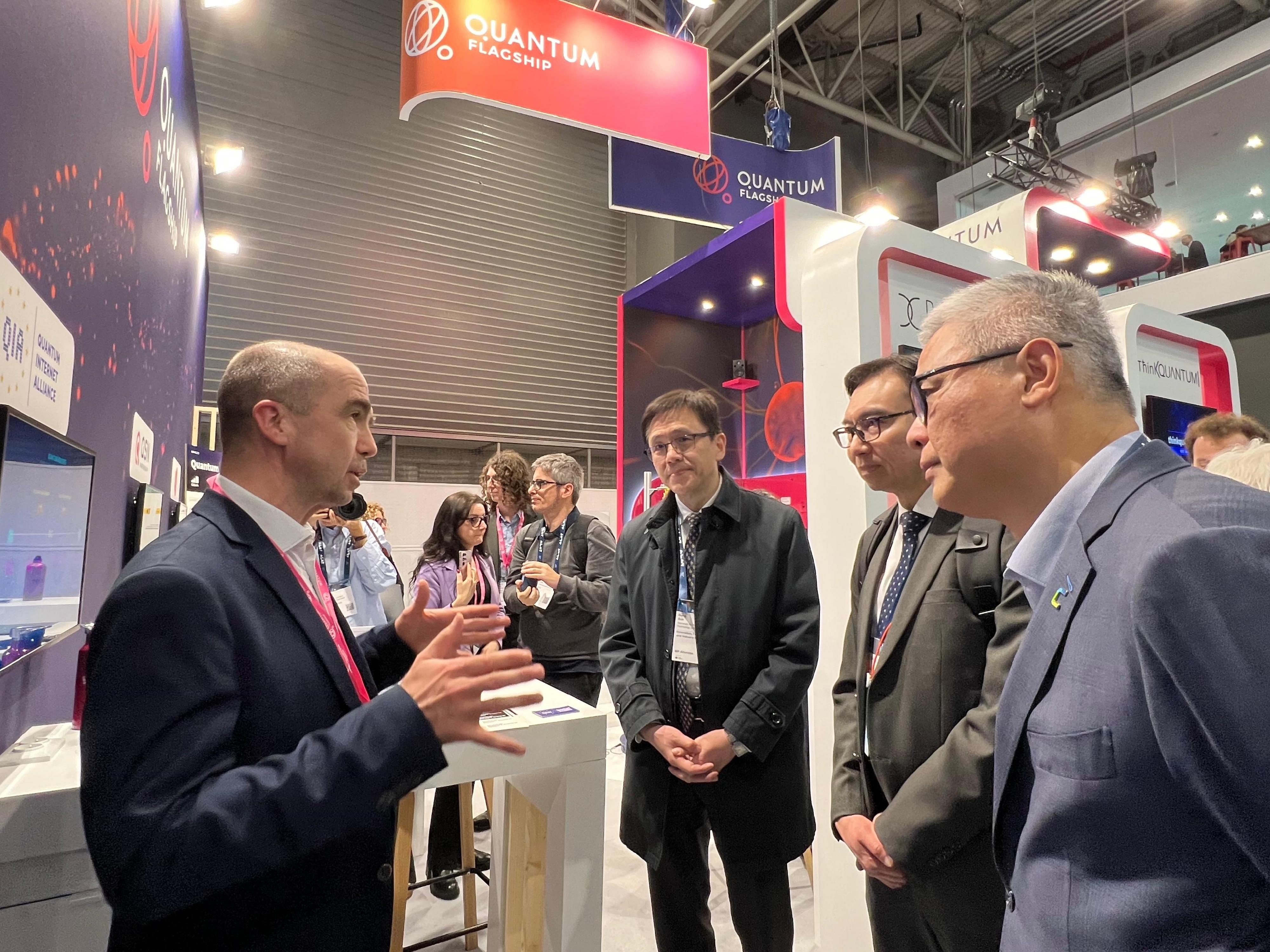
     The Secretary for Innovation, Technology and Industry, Professor Sun Dong, leading a delegation of representatives from the innovation and technology (I&T) sector, continued his visit in Barcelona, Spain on March 5 (Barcelona time) and attended the Mobile World Congress (MWC) 2025.

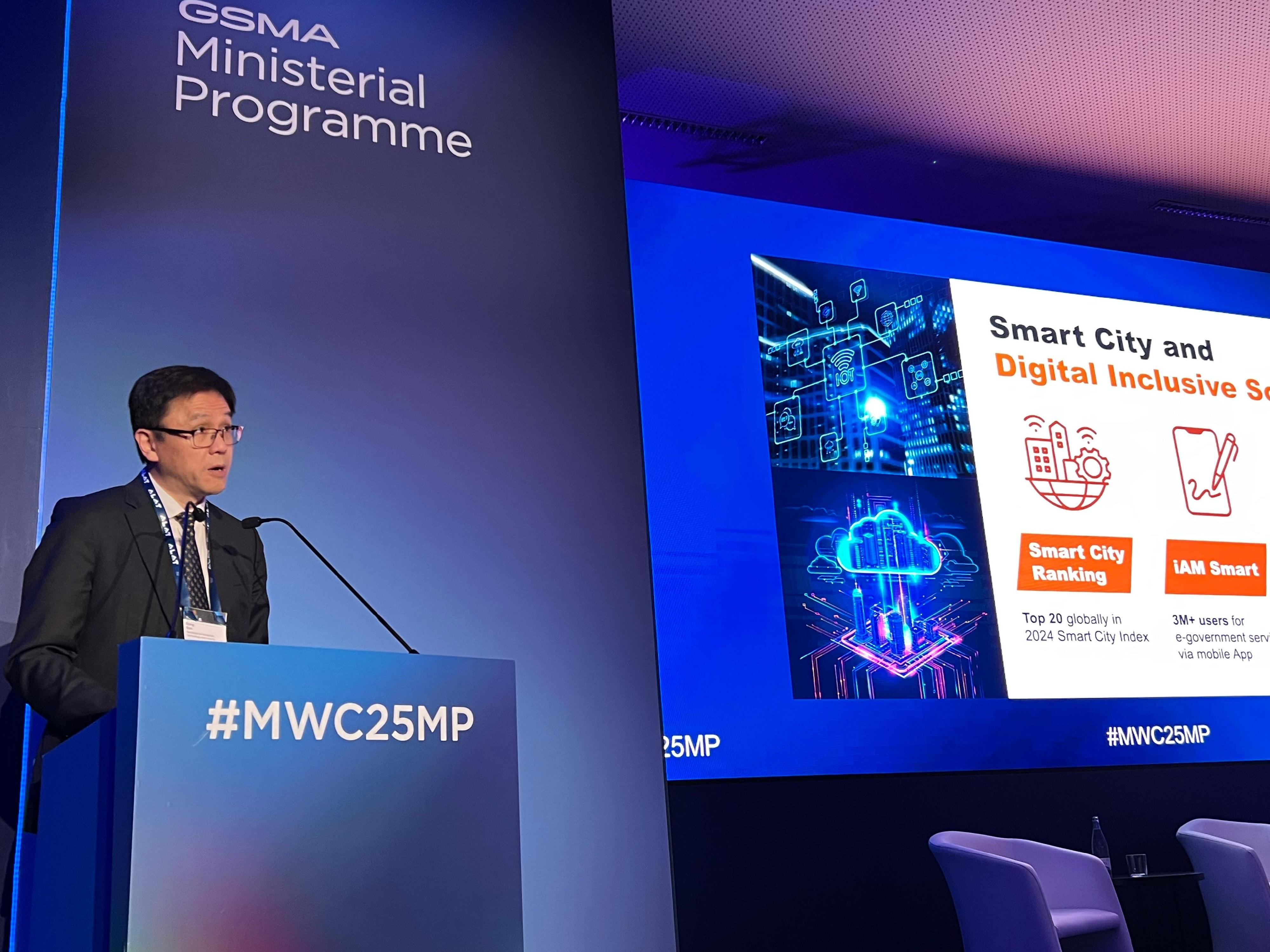
     Delivering a keynote speech at the Global System for Mobile Communications Association (GSMA) Ministerial Programme “2025+: A Tech Odyssey”, Professor Sun said Hong Kong is actively building a smart city and a digitally inclusive society to bridge digital divide. “One of the best testimonies to a city’s I&T achievement is the degree of digitalisation. In Hong Kong, all submissions and payments to the Government have electronic options. More than three millions of people are enjoying the convenience and efficiency of accessing government services and online identity verification through a mobile application called ‘iAM Smart’. A corporate version of ‘iAM Smart’, nick-named CorpID, is upcoming too.”

     He noted that on digital inclusiveness, Hong Kong’s household broadband penetration rate and smartphone penetration rate are both approximately 97 per cent. The internet usage rate among Hong Kong citizens aged 65 and above rocketed, from 56 per cent in 2018 to 84 per cent in 2023, slightly ahead of the European rate of around 78 per cent.

     He added, “As society becomes so digitally knitted and increasingly mobile, we recently launched the ‘Smart Silver’ Digital Inclusion Programme for Elders, to address the challenges of an increasingly aging society. This programme fortifies our digital inclusive efforts by providing elders with community-based training and on-the-spot helpdesks to enhance elders’ knowledge on new digital technologies and support their navigation by common mobile applications.”

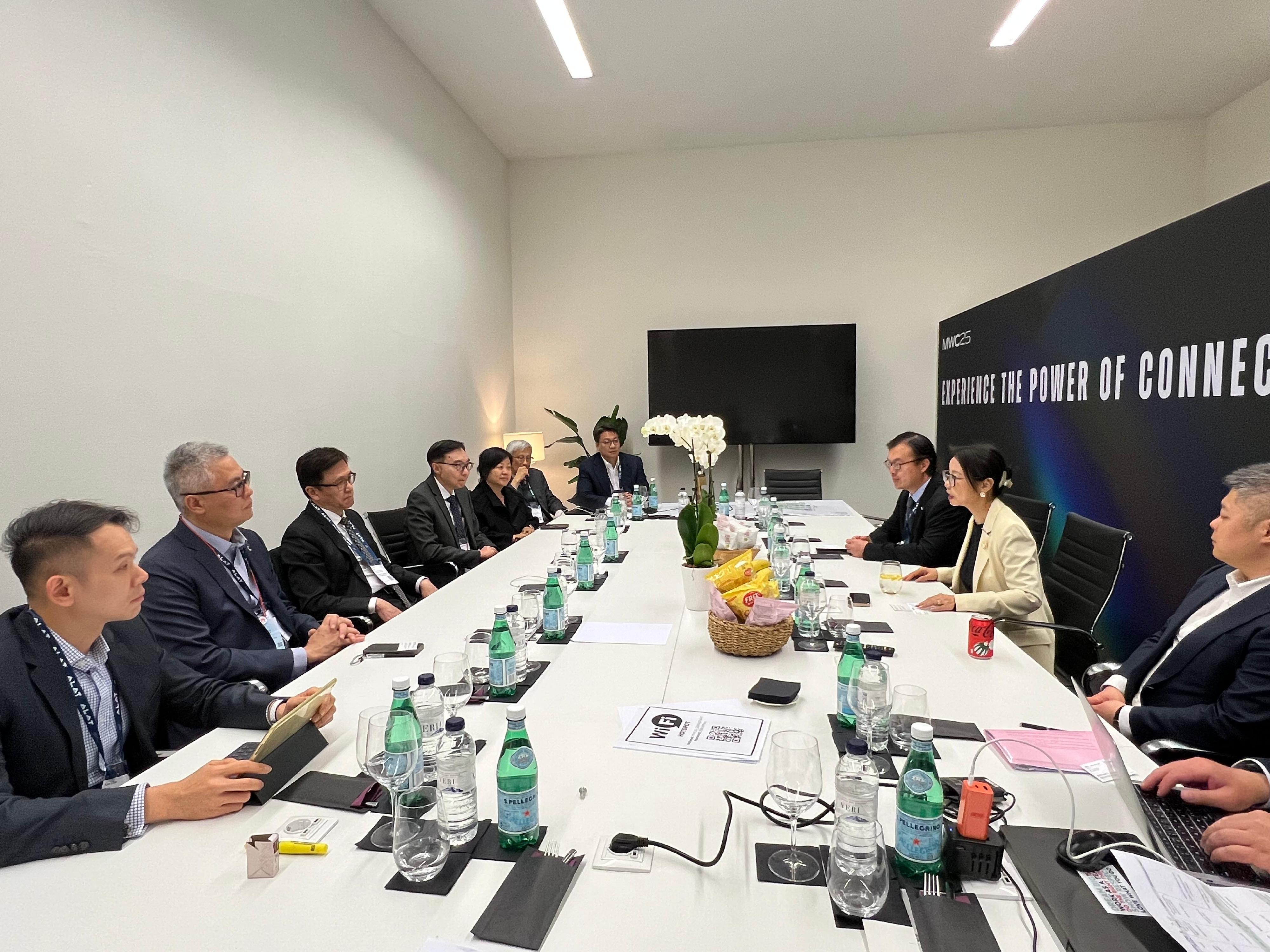
     During the Congress, Professor Sun met with the Head of Greater China of GSMA, Ms Sihan Bo Chen, to learn about the international mobile industry association’s work in developing the mobile communications industry and ecosystem as well as promoting industrial innovation in Asia.

     Professor Sun visited various exhibition pavilions on-site, including the EU Quantum Flagship, to learn about the latest quantum technologies and initiatives of companies under the flagship.

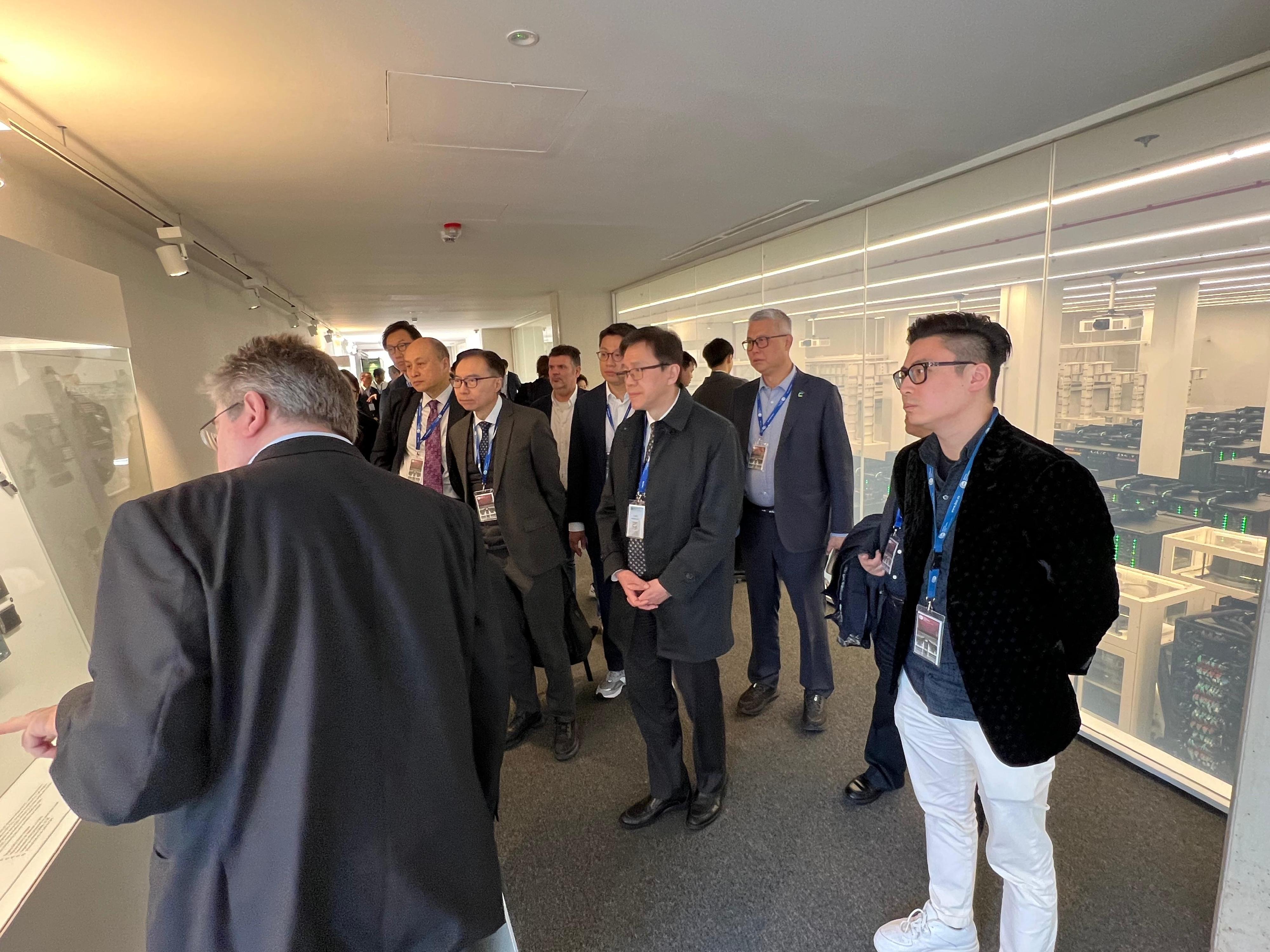
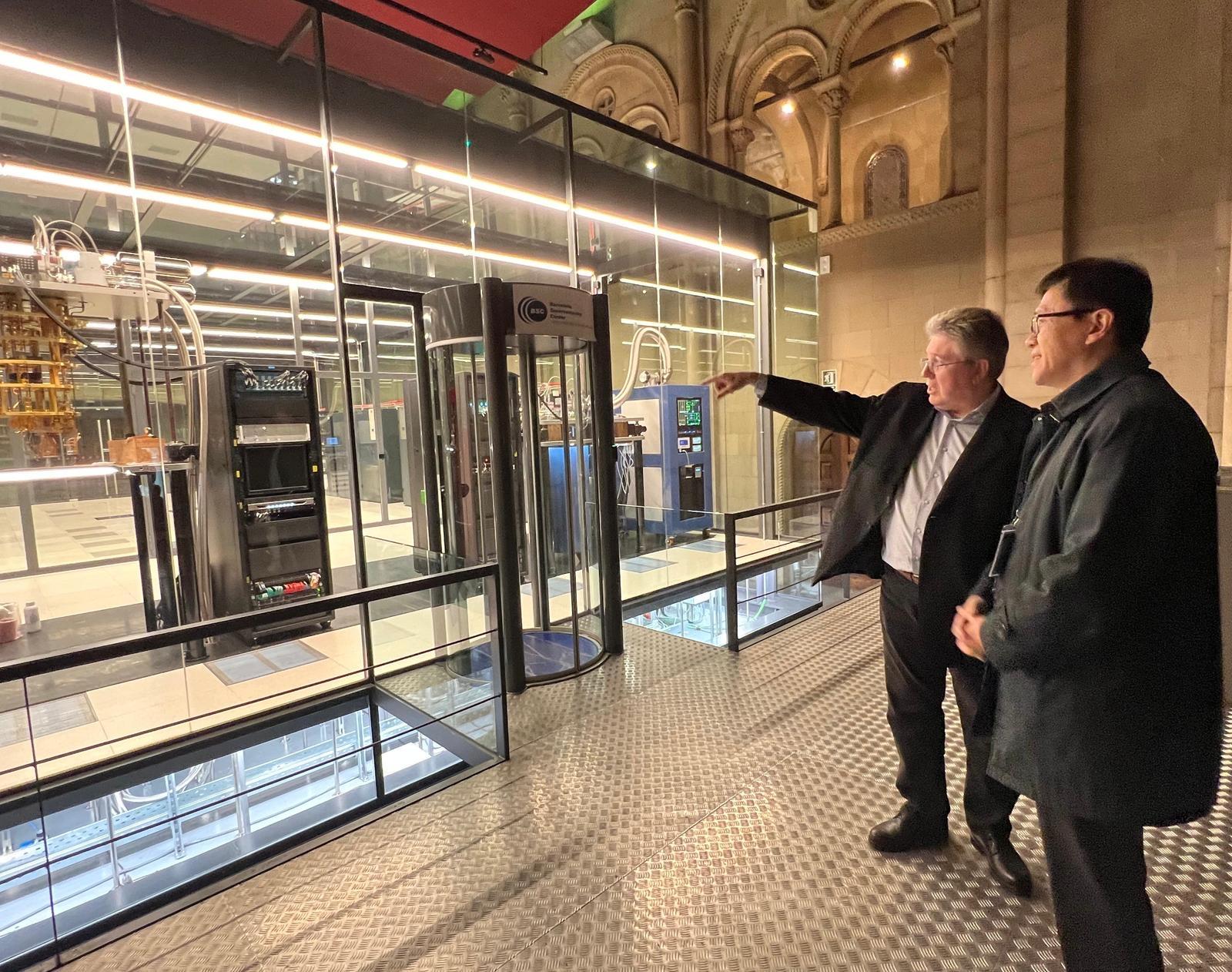
     Professor Sun and the delegation also visited the Barcelona Supercomputing Center. They were briefed on the technology of MareNostrum 5, one of the most powerful supercomputers in Spain, and quantum computers, the establishment of AI factories, and the innovative achievements in promoting the development of high-performance computing in Spain and the whole of Europe as well as applications.

     Members of the delegation include heads from the Hong Kong Science and Technology Parks Corporation (HKSTPC), Cyberport, the Hong Kong Applied Science and Technology Research Institute and the Hong Kong Microelectronics Research and Development Institute, as well as representatives of 24 local I&T enterprises or institutions. The HKSTPC and the Hong Kong Trade Development Council co-ordinated the participation of the I&T representatives of the enterprises and institutions at the MWC 2025.

     Professor Sun Dong will proceed to Lisbon, Portugal on March 6 (Lisbon time) to continue his visit.

Photo  Photo  Photo  Photo  Photo  
read more

Keynote speech by SITI at GSMA Ministerial Programme of Mobile World Congress 2025 in Barcelona (English only)

     Following is the keynote speech by the Secretary for Innovation, Technology and Industry, Professor Sun Dong, at the Global System for Mobile Communications Association (GSMA) Ministerial Programme of the Mobile World Congress (MWC) 2025 in Barcelona, Spain on March 5 (Barcelona time):
 
Distinguished speakers, guests, ladies and gentlemen,
 
     Buenas tardes! Good afternoon! It is a privilege to join you all at the MWC Barcelona 2025, Europe’s pre-eminent mobile tech summit hosted in the fascinating city of Barcelona.
      
     Renowned for its architectural brilliance and rich cultural tapestry, Barcelona is undoubtedly a beacon of creativity in Europe. More than ten thousand kilometers away, Hong Kong shares the same dynamic spirit and strong commitment to innovation. This brings me here today to share with you Hong Kong’s innovation and technology (I&T) landscape as well as opportunities that connect people around the world.
 
Hong Kong: Our odyssey to be an International I&T Centre
 
     Well known for the free, international and business-friendly environment, Hong Kong ranks first in Asia and third in the world in the Global Financial Centres Index. The success of this Asia’s World City is our spirit of embracing changes and evolving with times.
      
     The theme of this year’s MWC Barcelona, “Converge, Connect, Create”, aptly encapsulates the key directions of Hong Kong’s new mission. We are racing to become an international I&T centre, as enshrined in our I&T Development Blueprint promulgated in 2022. We strive to perfect Hong Kong’s I&T ecosystem with conducive policies to support the development of strategic tech industries, including AI and robotics, life and health technologies, new energy and advanced manufacturing industries.
      
     The Blueprint not only converges and connects our game plan on technological innovation and talent cultivation, but also creates new impetus to Hong Kong’s high quality development and enhances our citizens’ quality of life with day-to-day convenience brought about by technology innovation.
 
Bridging the digital divide by building a Smart City and a Digital Inclusive Society
 
     Hong Kong is among the world’s top 20 smart cities in the Smart City Index released by the IMD (International Institute for Management Development). One of the board development direction set out in our I&T Blueprint is to promote digital economy and develop Hong Kong into a smart city. Over the years, the Hong Kong Special Administrative Region Government has rolled out various measures to make Hong Kong a more advanced and livable smart city, such as developing new digital infrastructure, opening up public data, and enhancing government services by applying advanced technologies such as blockchain and IoT (Internet of Things).
      
     Indeed, one of the best testimonies to a city’s I&T achievement is the degree of digitalisation. In Hong Kong, all submissions and payments to the Government have electronic options. More than three millions of people are enjoying the convenience and efficiency of accessing government services and online identity verification through a mobile application called “iAM Smart”. A corporate version of “iAM Smart”, nick-named CorpID, is upcoming too.
 
     Known for the cultural diversity and international landscape, digital inclusiveness is an area that we take pride in. In Hong Kong, where the household broadband penetration rate and smartphone penetration rate are both approximately 97 per cent, the internet usage rate among Hong Kong citizens aged 65 and above rocketed, from 56 per cent in 2018 to 84 per cent in 2023, slightly ahead of the European rate of around 78 per cent.
      
     Hong Kong’s life expectancy has seen a steady increase over the past half century, reaching 83 years for men and 88 years for women in 2023. As society becomes so digitally knitted and increasingly mobile, we recently launched the “Smart Silver” Digital Inclusion Programme for Elders, to address the challenges of an increasingly aging society. This programme fortifies our digital inclusive efforts by providing elders with community-based training and on-the-spot helpdesks to enhance elders’ knowledge on new digital technologies and support their navigation by common mobile applications.
 
Hong Kong’s Research and Development (R&D) Excellence driving global I&T collaboration
 
     Global collaboration is a necessity to tackle unprecedented challenges. Hong Kong is the only city in the world housing five of the world’s top 100 universities, providing a readily available pool of R&D capabilities, know-how and talent. These favourable conditions make possible many scientific and technological breakthroughs by harnessing cutting-edge innovations from both the East and the West.
      
     You may wish to know that our flagship R&D initiative – InnoHK has built collaboration with more than 30 world-renowned universities and research institutes from 12 economies, set up a total of 30 research laboratories. Of these, 16 of them focus on AI and robotics-related technologies. Our goal is to converge top-notch researchers from all over the world to conduct world-class and impactful collaborative researches.
 
     The vigorous development of AI is reshaping global economic landscape. Our AI Supercomputing Centre has just commenced operation, and the computing power will be ramped up gradually to 3 000 petaFLOPS this year. Newly announced in our annual Government Budget last week, we will earmark $1 billion Hong Kong dollars, equivalent to 120 million euros, for the establishment of the Hong Kong AI Research and Development Institute. Hong Kong stands ready to play a full role in promoting global I&T collaboration.
 
Hong Kong: an Ideal Home to I&T enterprises and start-ups
 
     In fact, Hong Kong stands in a prime location for I&T and business collaborations. With the distinctive advantages of “one country, two systems”, over 1 400 companies from outside Hong Kong have set up regional headquarters in Hong Kong, including some global tech giants. Our strategic location and unique role as a “super-connector” and “super value-adder” empower them to tap into the vast markets of Mainland China including the Guangdong-Hong Kong-Macao Greater Bay Area, the Asia-Pacific region and also the Belt-and-Road countries.
      
     Hong Kong is also an ideal home for breeding I&T start-ups. According to the Global Start-up Ecosystem Report 2024, Hong Kong ranks first in Asia and third globally among the top 100 emerging ecosystems. As of 2024, the number of start-ups in Hong Kong has surged to about 4 700, reaching the record highs.
      
     Our two I&T flagships, the Hong Kong Science and Technology Parks Corporation and the digital tech-oriented Cyberport, provide robust support for start-ups through various incubation programmes. They also offer opportunities for start-ups to participate in I&T mega events, which include, of course, the MWC Barcelona. If you are interested in discovering Hong Kong’s vibrant I&T scene, be sure to visit the Hong Kong Tech Pavilion at Hall 6 and speak to our tech ventures there.
 
Concluding remarks
 
     Ladies and gentlemen, I hope my sharing just now could vividly show the colours of Hong Kong’s I&T scene, just like the beautiful city of Barcelona. Seeing is believing. I welcome you all to Hong Kong to explore more on our robust digital infrastructure, smart city initiatives and digital economy development.
      
     Before I close, I would like to extend my heartfelt thanks to GSMA for inviting me to the Ministerial Programme. I wish everyone here a fruitful exchange. Gracias! Thank you! read more

Director of Hong Kong and Macao Work Office of CPC Central Committee and Hong Kong and Macao Affairs Office of State Council meets CE in Beijing (with photo)

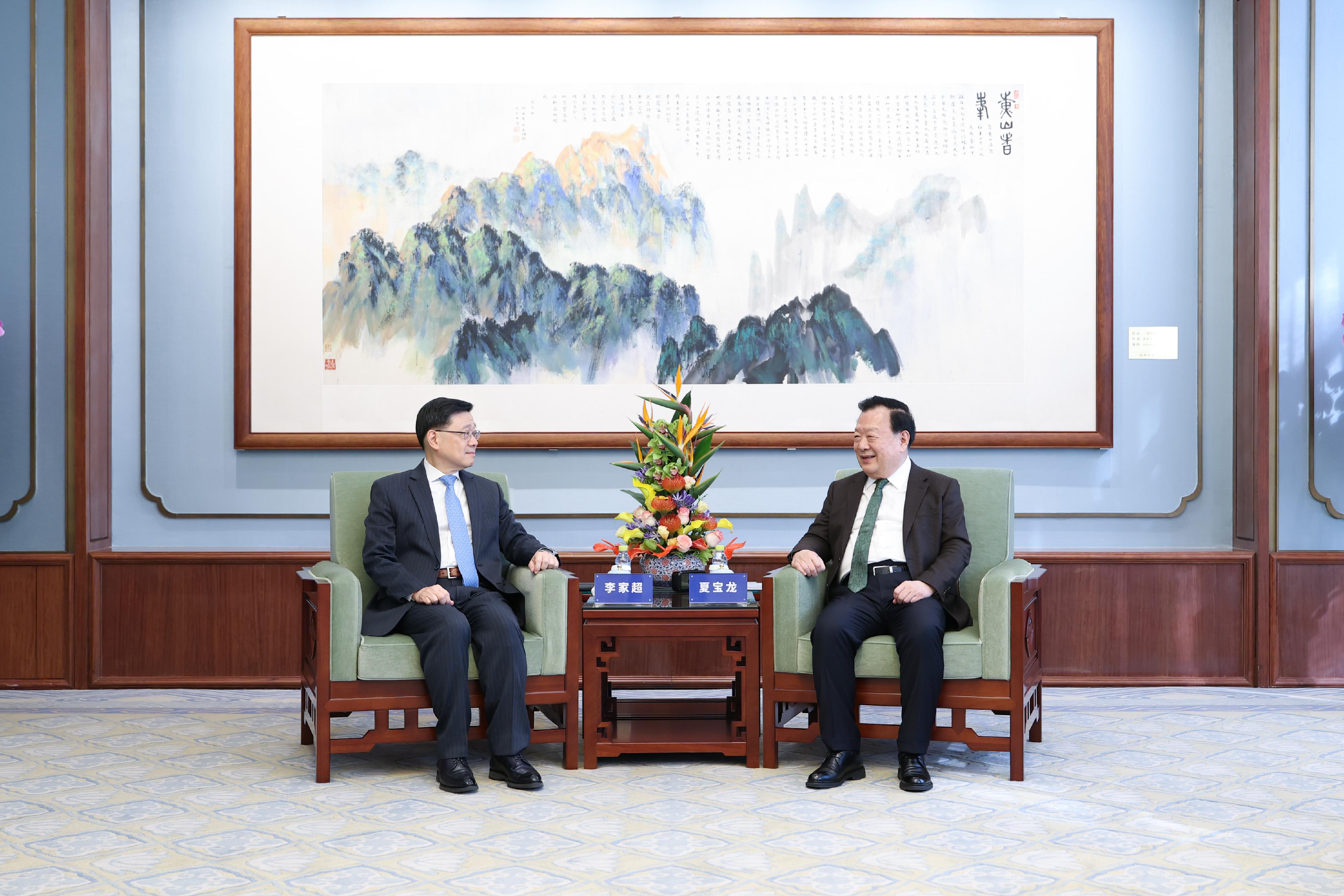
     â€‹The Director of the Hong Kong and Macao Work Office of the Communist Party of China Central Committee and the Hong Kong and Macao Affairs Office of the State Council, Mr Xia Baolong, met the Chief Executive, Mr John Lee, who was in attendance at the opening meeting of the third session of the 14th National People’s Congress (NPC), in Beijing today (March 5).

     Mr Xia said that the Central Government remains committed in fully and faithfully implementing the principle of “one country, two systems”, and will continue to fully support Hong Kong and Macao in integrating into national development. Mr Xia noted that under the leadership of Mr Lee, the governance team of the Hong Kong Special Administrative Region (HKSAR) has been resolutely implementing the guiding principles of important speeches by President Xi Jinping on Hong Kong and Macao affairs and the Central Government’s strategic decisions. Mr Xia said that by proactively identifying, adapting to, and driving change, the team has firmly safeguarded high-level security and strenuously promoted high-quality development, while uniting all sectors of society to focus on economic growth, pursue development and advance infrastructure, achieving good results in the areas. Mr Xia expressed his confidence that the HKSAR Government and the Hong Kong community will seize opportunities, pursue reforms and endeavour to fully leverage the institutional strengths of “one country, two systems”, consolidate and enhance Hong Kong’s status as an international financial, shipping and trade centre, establish an international hub for high-calibre talents, and in turn expedite the city’s transition from stability to prosperity, making greater contributions to the building of a great country in all respects and advancing toward national rejuvenation through Chinese modernisation.

     Mr Lee expressed his gratitude for the Central Authorities’ support and recognition of the efforts of the HKSAR Government. He also expressed his gratitude for Mr Xia’s guidance and care for the HKSAR. Mr Lee said that 2025 marks the conclusion of the 14th Five-Year Plan, and is an important year in further deepening reform comprehensively. He said that since assuming office, the current term of the HKSAR Government has striven to consolidate and realise the positioning of the “eight centres” under the 14th Five-Year Plan, proactively attracting businesses and talent while expanding economic and trade networks. The Government has introduced multiple reform measures, including over 600 policy initiatives spanning diverse sectors outlined in last year’s Policy Address, specially themed “Reform for Enhancing Development and Building Our Future”. These measures aim to deepen reforms and uncover new economic growth areas, while upholding the city’s principle and embracing innovation. Mr Lee said that the measures will consolidate Hong Kong’s status as an international financial, shipping and trade centre, establish an international hub for high-calibre talents, accelerate Hong Kong’s development into an international innovation and technology centre, and advance such developments as the Northern Metropolis and the Hetao Shenzhen-Hong Kong Science and Technology Innovation Co-operation Zone.

     Mr Lee remarked that the HKSAR Government will continue to unite all sectors of society in driving innovation and reform, and better understand, respond to and embrace changes. Giving full play to its institutional strengths under the “one country, two systems” principle and unique strengths in internationalisation, Hong Kong will further strengthen its bridging role between the Mainland and the world, actively integrate into national development, and contribute to the Guangdong-Hong Kong-Macao Greater Bay Area development and the Belt and Road Initiative, telling the good stories of the country and Hong Kong. Mr Lee highlighted that in collaboration with the community, the HKSAR Government will earnestly study and implement the spirit of the third session of the 14th NPC and the third session of the 14th Chinese People’s Political Consultative Conference National Committee, foster unity, and achieve greater development for Hong Kong, thereby making greater contributions to the building of a great country in all respects and advancing toward national rejuvenation.

     Deputy Director of the Hong Kong and Macao Work Office of the Communist Party of China Central Committee and the Hong Kong and Macao Affairs Office of the State Council Mr Wang Linggui, and the Director of the Chief Executive’s Office, Ms Carol Yip, also joined the meeting.

Photo  
read more

DH investigates Legionnaires’ Disease cluster

     The Centre for Health Protection (CHP) of the Department of Health today (March 5) announced that it is investigating a cluster of Legionnaires’ disease (LD) cases involving four members of a tour group to Qingyuan and Foshan. The CHP appealed to those who participated in the package tours organised by the Sino Step Travel Services to Qingyuan and Foshan from February 20 to 28 to contact the CHP for health assessment and medical surveillance.
 
      An epidemiological investigation was launched immediately after the CHP received a notification that a 77-year-old female was infected with LD. It was subsequently found that two males and one female who had joined the same tour group were also infected with LD. The four patients involved two males and two females, who aged between 61 and 77.
 
      The four persons concerned joined the above tour groups to Qingyuan and Foshan during the incubation period (travel dates: February 20 to 22; tour code: LB3280). Initial investigation revealed that they did not have common local exposure history. Therefore, they are believed to have become infected during the outbound tour and were classified as imported cases.
 
     The Sino Step Travel Services organised two other tours (both with tour code LB3280) with the same itineraries and hotel accommodation recently, held from February 21 to 23 and February 26 to 28 respectively. For the sake of prudence, the CHP is actively contacting the participants of the three tour groups to follow up on their health conditions. The CHP also appealed to them to call the CHP’s hotline (telephone number: 2125 2670) for follow up and medical surveillance. The hotline will be operating from tomorrow (March 6) to March 14, from 9am to 5pm from Monday to Friday, and from 9am to 1pm on Saturday and Sunday. They should seek medical advice immediately if they have a fever or feel unwell.
     
     The CHP has informed the Travel Industry Authority and reported the case to the health authorities of Guangdong. Epidemiological investigations are still in progress.
 
     Men, people aged over 50, smokers, alcoholics and persons with weakened immunity are more susceptible to LD. Some situations may also increase the risk of infection, including poor maintenance of water systems; living in areas with old water systems, cooling towers or fountains; using electric water heaters, whirlpools and spas or hot water spring spas; and recent stays in hotels or vessels.
     
     Legionellae are found in various environmental settings and grow well in warm water (20 to 45 degrees Celsius). They can be found in aqueous environments such as water tanks, hot and cold water systems, cooling towers, whirlpools and spas, water fountains and home apparatus that support breathing. People may become infected when they breathe in contaminated droplets (aerosols) and mist generated by artificial water systems, or when handling garden soil, compost and potting mixes.

     Immunocompromised persons should:
 

  • Use sterile or boiled water for drinking, tooth brushing and mouth rinsing;
  • Avoid using humidifiers, or other mist- or aerosol-generating devices; and
  • If using humidifiers, or other mist- or aerosol-generating devices, fill the water tank with only sterile or cooled freshly boiled water, and not water directly from the tap. Also, clean and maintain humidifiers/devices regularly according to manufacturers’ instructions. Never leave stagnant water in a humidifier/device. Empty the water tank, wipe all surfaces dry, and change the water daily. 
     
     The public should observe the health advice below:
 
  • Observe personal hygiene;
  • Do not smoke and avoid alcohol consumption;
  • Strainers in water taps and shower heads should be inspected, cleaned, descaled and disinfected regularly or at a frequency recommended by the manufacturer;
  • If a fresh-water plumbing system is properly maintained, it is not necessary to install domestic water filters. Use of water filters is not encouraged as clogging occurs easily, which can promote growth of micro-organisms. In case water filters are used, the pore size should be 0.2 micrometres (µm) and the filter needs to be changed periodically according to the manufacturer’s recommendations;
  • Drain and clean water tanks of buildings at least quarterly;
  • Drain or purge for at least one minute infrequently used water outlets (e.g. water taps, shower heads and hot water outlets) and stagnant points of the pipework weekly or before use;
  • Seek and follow doctors’ professional advice regarding the use and maintenance of home respiratory devices and use only sterile water (not distilled or tap water) to clean and fill the reservoir. Clean and maintain the device regularly according to the manufacturer’s instructions. After cleaning/disinfection, rinse the device with sterile water, cooled freshly boiled water or water filtered with 0.2 µm filters. Never leave stagnant water in the device. Empty the water tank, keep all surfaces dry, and change the water daily; and
  • When handling garden soil, compost and potting mixes: 
  1. Wear gloves and a face mask;
  2. Water gardens and compost gently using low pressure;
  3. Open composted potting mixes slowly and make sure the opening is directed away from the face;
  4. Wet the soil to reduce dust when potting plants; and
  5. Avoid working in poorly ventilated places such as enclosed greenhouses.

     â€‹â€‹The public may visit the CHP’s LD page, the Code of Practice for Prevention of LD and the Housekeeping Guidelines for Cold and Hot Water Systems for Building Management of the Prevention of LD Committee, and the CHP’s risk-based strategy for prevention and control of LD. read more