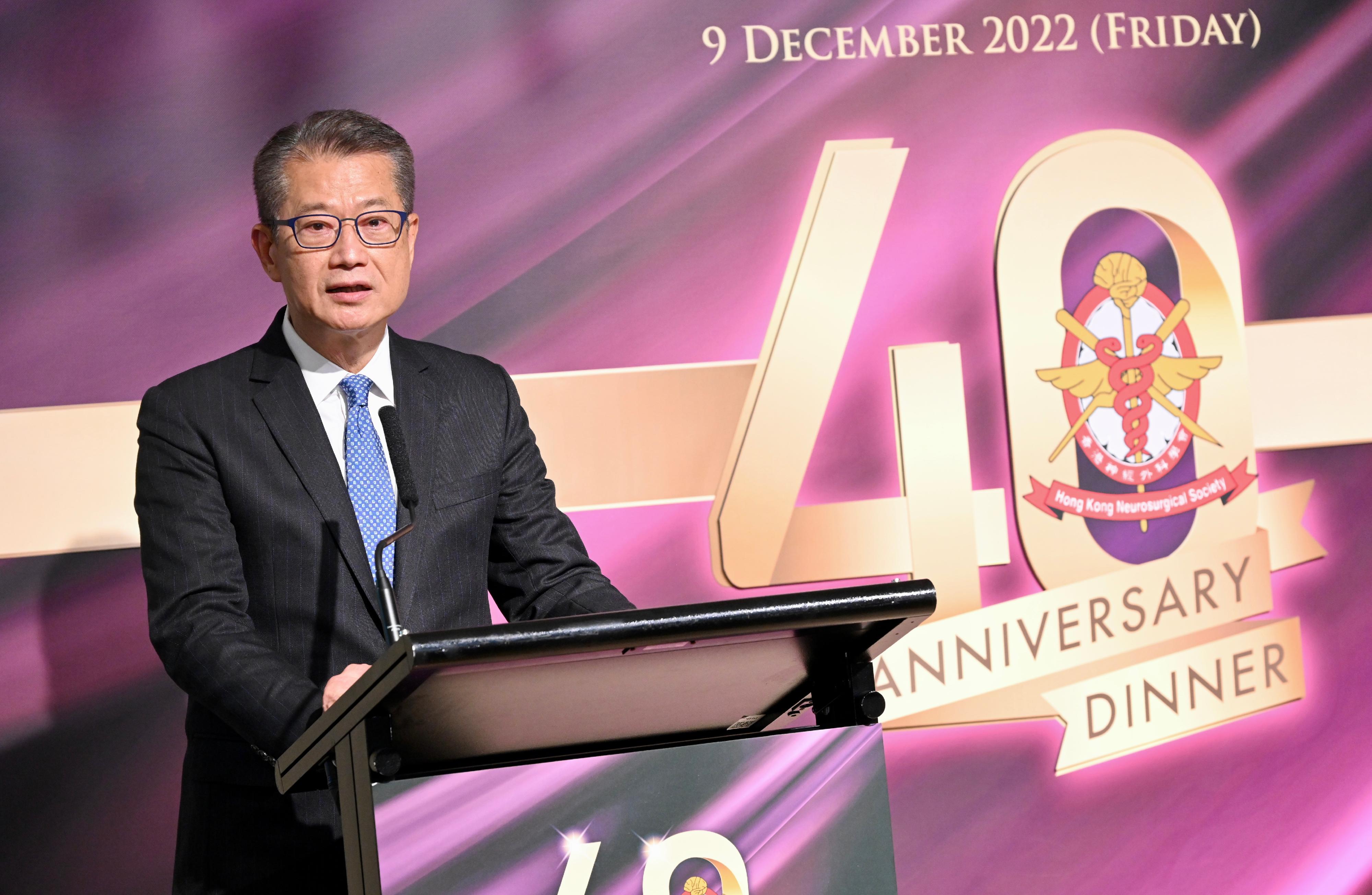
Following is the speech by the Financial Secretary, Mr Paul Chan, at the 40th Anniversary Dinner of the Hong Kong Neurosurgical Society today (December 9):
Michael (President of the Hong Kong Neurosurgical Society, Dr Michael Lee), David (Legislative Council Member Dr David Lam), CS (Dean of Medicine, University of Hong Kong, Professor Lau Chak-sing), Professor Leung (President of the Hong Kong Academy of Medicine, Professor Gilberto Leung), distinguished guests, ladies and gentlemen,
Good evening.
I am delighted to join such a distinguished gathering of medical professionals to celebrate the 40th Anniversary of the Hong Kong Neurosurgical Society. Please allow me to congratulate you on this auspicious occasion.
The history of neuroscience can be traced back thousands of years, to the ancient Egyptians, who knew things about medical research.
In Hong Kong, origins of the science are a little more recent.
One starting point would be the arrival in the 1950s of Hong Kong’s first neurosurgeon, Dr Wen Hsiang Lai. In 1981, Dr Wen became the founding President of the HKNS and the rest, as they say, is history! Dr Wen is remembered as the “Father of Neurosurgery” in Hong Kong.
Dr Wen also contributed to establishing the Research Institute of Neurosciences in Guangzhou in 1988. His vision for improving the standard of neurosurgery in Hong Kong and southern Mainland continues today and, I would say, is gathering pace.
And I would venture to say that Dr Wen’s vision and efforts, and indeed those of many of you here, in contributing to the medical development in Hong Kong and the Mainland together, still inspire modes of medical co-operation between Hong Kong and other cities in the Greater Bay Area (GBA) and well beyond.
On a strategic level, the distinctive advantages of Hong Kong under the “one country, two systems” policy, have made Hong Kong the unique platform connecting the Mainland and the rest of the world. That includes connecting people, capital, knowledge and expertise, legal and professional standards, and much else.
This strategic role provides valuable insights into the opportunities of medical development in the GBA that may be embraced by Hong Kong, as our economic integration with the region continues to deepen. To set the scene, as you may all know, GBA is one of the wealthiest and most affluent regions in the country. Hong Kong, Macao and the other nine sister cities in the GBA together have a population of 86 million, and a per capita GDP at around USD 22,000.
Which means that the GBA is a huge consumer market. Its affluence and high income also mean that there is a growing demand for quality medical services. Hong Kong’s medical sector, with its excellent reputation in terms of both standards and integrity, is well positioned to grasp the opportunities in the GBA.
In terms of extending our world class-standard medical services to the GBA, the University of Hong Kong (HKU)-Shenzhen Hospital, opened in 2012, is a pioneer of its sort. The Medical Centre of the Chinese University of Hong Kong (CUHK), Shenzhen, which commenced construction in 2019 and is expected to come into operation in 2026, is another example.
The two Hong Kong medical schools, which are within the top 50 universities in the world, are making more inroads and opening new frontiers. Last year, CUHK established a medical school in Shenzhen, and HKU plans to commission one, to provide basic medical training in medicine for local students.
For specialist training, the Shenzhen-Hong Kong Medical Specialist Training Centre established by the Hong Kong Academy of Medicine in 2019, will continue to assist the Mainland in setting up a specialist training system and provide training to the trainers.
And the Hospital Authority is actively driving forward projects to deepen exchanges and collaboration with health-related institutions in the GBA, including doctors, nurses, Chinese medicine practitioners and allied health professionals.
There is also great potential for Hong Kong-registered drugs and Chinese medicine to be used or sold in the GBA too. Authorities concerned are working on them.
But beyond medical services and medicine, I wish to point out that healthcare research collaboration with the GBA is an area with boundless potential.
Indeed, the HKSAR Government spares no effort in developing our city’s capacity for innovation and technology, and research.
For example, in 2018, we launched the flagship project of “InnoHK Research Clusters”. Under this initiative, 28 laboratories have so far been established in the Hong Kong Science Park, fostering collaboration between local universities and more than 30 top‑notch universities and research institutions around the world. Among these laboratories, 16 are related to life and health sciences. Among them, Health@InnoHK focusses on healthcare related technologies.
In the Budget this year, I have set aside $10 billion to further promote the development of life and health technology in Hong Kong, including hardware, research talent, clinical trials and data application.
A key initiative is to set up the InnoLife Healthtech Hub in the Hong Kong‑Shenzhen Innovation and Technology Park (HKSITP), situated at the Lok Ma Chau Loop close to the boundary with Shenzhen. HKSITP is part of the wider Hong Kong-Shenzhen innovation and technology co-operation. This Park is recognised as one of the four most important innovation and technology platforms in the GBA development.
Our goal is to bring together elite research teams from the Mainland and all over the world. We will focus our efforts on R&D work as well as global research collaboration in the field of life and health sciences. This includes biomedicine, big data and artificial intelligence, which can be applied in various areas, such as prevention, diagnosis, drug discovery, advanced treatment and rehabilitation.
This year is the 40th anniversary of your Society. The profession has grown a lot with many breakthrough achievements. So has Hong Kong.
In the case of Hong Kong’s economic success over the past four decades, the firm support of our country is of utmost importance. At different development stages, the country had different needs, and Hong Kong had promptly transformed ourselves to satisfy those needs. We transformed ourselves from manufacturing in the 60s and 70s, to a service economy in the 80s and 90s, when the Mainland initiated the reform and opening up policy. We have further developed ourselves into an international financial centre when the Mainland rose to become the second largest economy in the world, and encouraged its enterprises to go global. Taking stock of the success of our financial services industry in the past three decades as an example, the key principle is playing to the full strength of our unique competitive advantages to serve the needs of the country. And in the process, we need to bear in mind two considerations.
First, our proposal to the Mainland authorities for policy support and priority market access for Hong Kong must be mutually beneficial. Therefore it is in their interest to support us. Otherwise, we couldn’t achieve much even by doubling efforts.
And second, in this time of challenging global order and heighted geopolitical situation, the needs of the country are also changing. We need to suitably adjust our position and areas of focus. Ladies and gentlemen, in advancing the development of our medical and healthcare services into the GBA, the same principle also applies.
Now, as you may know that the consultation for next year’s Budget has begun. Riding on the promising momentum of our medical and health research collaboration with the GBA, how can we do more to advance collaboration? What are the areas that should be strengthened? And how can we help medical professionals to better tap the tremendous opportunities ahead?
These are all valid questions for us to contemplate for next year’s Budget and beyond. I look forward to the valuable views from you and the Hong Kong Neurosurgical Society.
Last but not least, may I congratulate the Society once again on its 40th Anniversary. I know you will continue to be pioneers for the profession and for our city as we embrace a new chapter for development.
Christmas is around the corner, and I wish you all a happy festive season and a rewarding and blessed 2023. Thank you.