Tag Archives: China

image_pdfimage_print

Government releases Youth Development Blueprint (with photos/video)

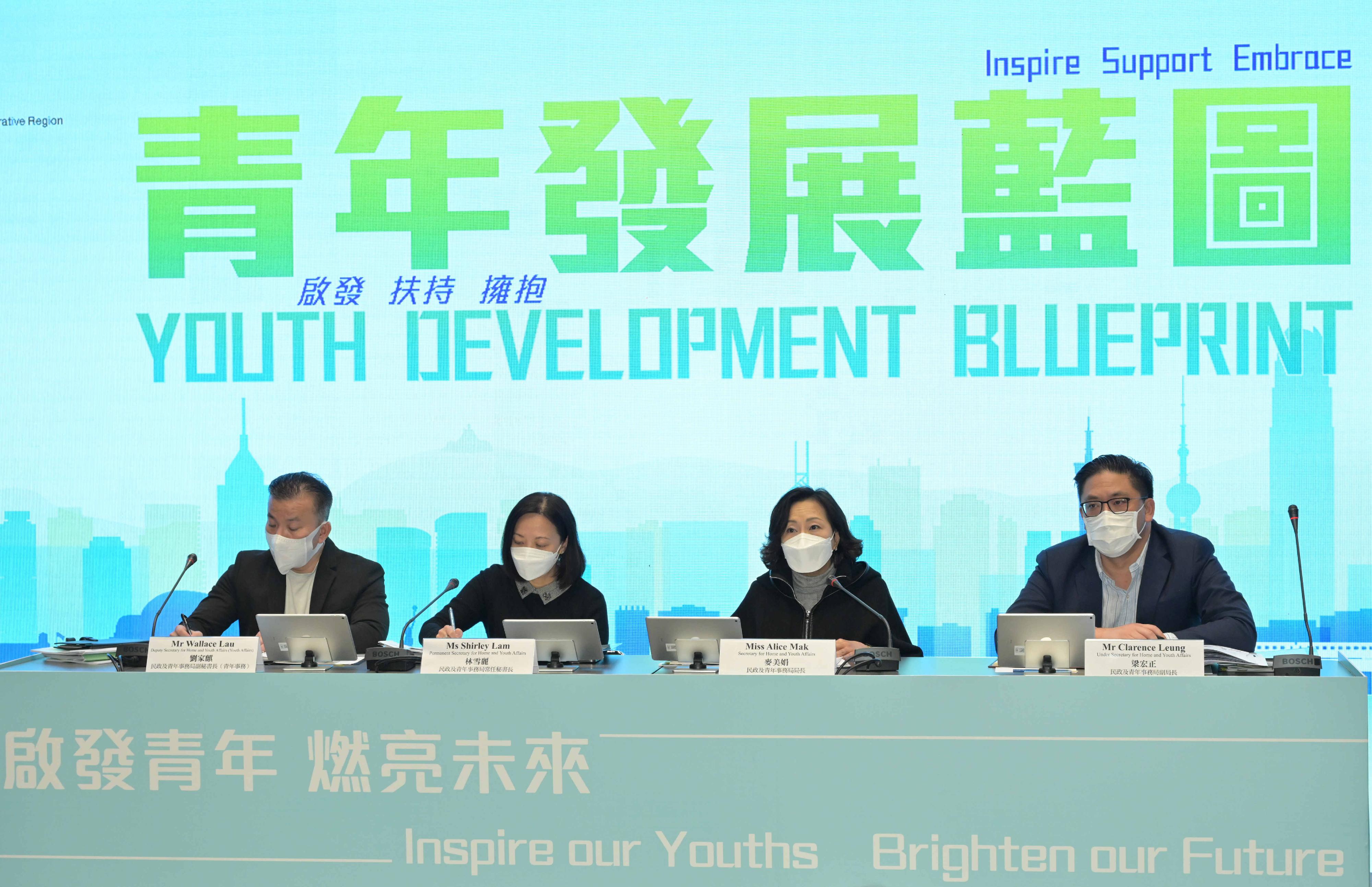
     The Government today (December 20) released the Youth Development Blueprint (Blueprint), outlining the overall vision and guiding principles for the Government’s long-term youth development work in the future. At this initial stage, more than 160 concrete actions and measures supporting youth development are put forward. 

     Releasing the Blueprint today, the Secretary for Home and Youth Affairs, Miss Alice Mak, said, “In his important speech delivered on July 1 and the Report to the 20th National Congress of the Communist Party of China, President Xi reiterated that ‘A nation will prosper only when its young people thrive’, ‘Hong Kong will prosper only when its young people thrive’, ‘Hong Kong will develop only when its young people achieve well-rounded development’, ‘Hong Kong will have a bright future only when its young people have good career prospects’. The Chief Executive stated in the Policy Address and his election manifesto that the Hong Kong Special Administrative Region Government will formulate the first edition of the Blueprint to summarise and outline the development direction of the youth work in the future.”  

     Youth development work covers a wide range of policy areas and stretches across the work of different policy bureaux. The Government will enhance the co-ordination and adopt a systematic and continuous approach to plan for and implement Hong Kong’s youth work, with a view to bringing young people together.  

     “Our vision is to nurture a new generation of young people with an affection for our country and Hong Kong, and equipped with global perspective, an aspiring mind-set and positive thinking. In this connection, we are committed to providing young people with an enabling environment to cherish hope for the future and strive for continuous growth, so that they can unleash their full potential in society and contribute to Hong Kong, the country and the world.”

     Having regard to the development stages of youths, the Blueprint includes the following four chapters which unveil the Government’s direction under the specific theme and propose corresponding actions and measures: 

1.  Exploration – Encouraging exploration, preparing for the future

  • Enhance national education, national security education, awareness in the rule of law and national pride;
  • Provide quality and diversified education, including enhancing life planning, promoting vocational and professional education and training, improving special education and promoting STEAM (Science, Technology, Engineering, ARts and Mathematics) education; and 
  • Promote exchange and internship outside Hong Kong to promote young people’s understanding of the country and the world. 

2.  Hope – Instilling hope, fulfilling dreams
  • Enable young people to capitalise on the opportunities brought by the National 14th Five-Year Plan, Guangdong-Hong Kong-Macao Greater Bay Area Development, the Belt and Road Initiative, etc, and integrate into the overall development of the country; 
  • Provide young people with more internship, employment and entrepreneurship opportunities in different fields and support their diversified career development; 
  • Enhance employability of young people and support continuing education for youth; and 
  • Address young people’s housing needs through a multi-pronged approach, which includes continuing to identify land for housing development, increasing supply of youth hostel places, and relaunching the Starter Homes Project for Hong Kong Residents.

3.  Empowerment – Resilience band whole-person development
  • Enhance youth welfare services; 
  • Support the community to enable young people’s whole-person development, instil positive thinking and foster team spirit through various services and activities including adventure activities and the annual Youth Festival; 
  • Strengthen moral education, promote family values and nurture positive values and attitudes; 
  • Promote sports, arts and culture and enrich diverse experiences; 
  • Strengthen support for youths on various fronts, including mental well-being; and
  • Support non-Chinese speaking youths.

4. Contribution – Youth engagement and contribution to society
  • Enhance youth participation in public affairs, including expanding the Member Self-recommendation Scheme for Youth to strengthen young people’s sense of responsibility and ownership; 
  • Enhance the platform for communicating with young people, including making use of the Internet and social media to listen and respond to the views of young people more effectively; and 
  • Encourage youth’s participating in volunteer work.

     To highlight the importance that the Government attaches to youth development, the Deputy Secretary for Home and Youth Affairs (Youth Affairs) will be designated as the Commissioner for Youth. The Commissioner will co-ordinate youth work in various areas within the Government, and represent the Government in liaising with different sectors to promote youth development work together. The Home and Youth Affairs Bureau (HYAB) will also establish a platform for youth engagement, including a new youth network and a youth-based mobile application. Separately, the HYAB will launch the “Youth Dashboard” to consolidate youth-related data and trends so that the Government can keep better tabs on the pulse of young people. 

     Since July this year, the HYAB, in collaboration with the Youth Development Commission (YDC), have organised and participated in over 170 consultation sessions reaching out to thousands of young people and stakeholders in youth work, and received over 190 written submissions. Miss Mak expressed her heartfelt gratitude to the YDC and different stakeholders for offering their valuable views, and to various bureaux and departments for their support and contribution in the preparation of the Blueprint. 

     The Blueprint signifies that the Government will continuously promote long-term youth development and will draw the community together to attach importance to the development of and care for young people. The HYAB welcomes young people and stakeholders to offer their views on the first edition of the Blueprint, so that the Government can continue to review and revise the contents and formulate updated edition as appropriate, and ensure that the Blueprint is a living document that can keep up with the times and respond to the needs of young people.

     The full text of the Blueprint has been uploaded to the dedicated website (www.youthblueprint.gov.hk).
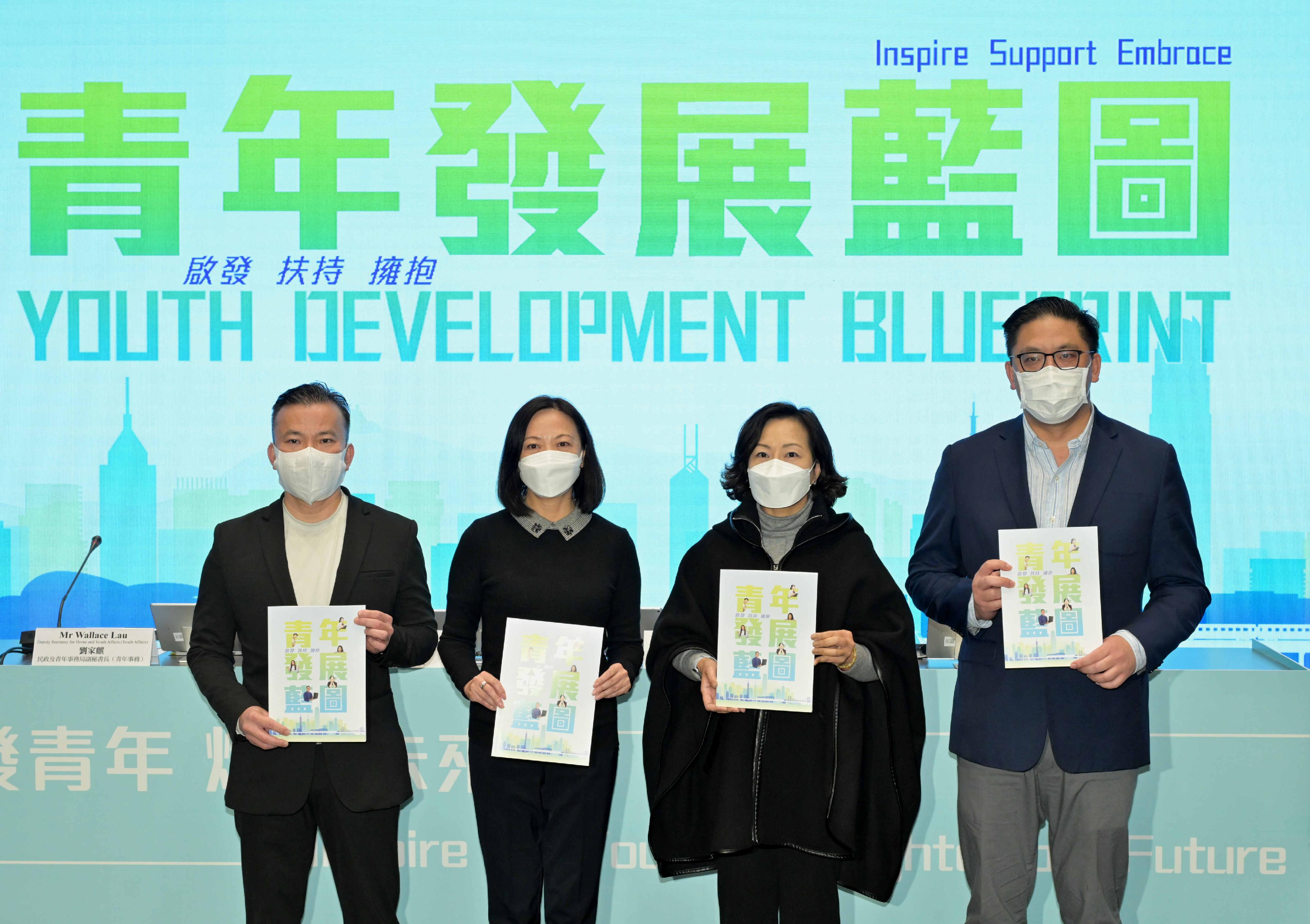
Photo  Photo  
read more

Government gazettes compulsory testing notice

     The Government exercises the power under the Prevention and Control of Disease (Compulsory Testing for Certain Persons) Regulation (Cap. 599J) and publishes in the Gazette a compulsory testing notice, which requires any person who had been present at 18 specified places during the specified period (persons subject to compulsory testing) to undergo a COVID-19 nucleic acid test.
 
     In view of a number of cases testing positive, 15 specified places are included in the compulsory testing notice. Furthermore, since some sewage samples collected in Ho Man Tin and Sau Mau Ping have tested positive, three specified places are included in the compulsory testing notice. The Government strongly reminds members of the public to strictly follow the compulsory testing requirements and undergo testing on time as required. Community testing centres (CTCs)/community testing stations (CTSs)/ad-hoc mobile specimen collection stations have been set up by the Government in different districts to facilitate testing to be conducted in compliance with the compulsory testing notice. The above compulsory testing requirement applies to those who have completed a COVID-19 vaccination course as well.
 
     Persons who have tested positive in the past three months (including positive cases tested either by nucleic acid tests recorded by the Department of Health (DH) or by rapid antigen tests (RATs) that have been self-declared to the DH) and young children aged under 3 do not need to undergo compulsory testing. For those who need to undergo compulsory testing, they must undergo nucleic acid tests in accordance with relevant compulsory testing notices and cannot use RATs to fulfil the requirement of such notices. In other words, a negative RAT result cannot be deemed as fulfilling the compulsory testing requirement. Furthermore, unless a person subject to compulsory testing has obtained a medical certificate proving that he or she is unfit to undergo testing using a sample taken through a “throat swab” because of health reasons, the person cannot provide a deep throat saliva sample to fulfil the compulsory testing requirement.
 
     Details of the compulsory testing notice are available on the Centre for Health Protection (CHP)’s website via the following link: www.chp.gov.hk/files/pdf/ctn_20221220.pdf.
 
     If any persons test positive under compulsory testing, such positive cases will be handled in the same manner as in those identified through other nucleic acid tests or self-declared through RATs. Their isolation arrangements (as well as the quarantine arrangements of their household members) are no different from other positive cases.
 
     Persons subject to compulsory testing in accordance with a compulsory testing notice must undergo professional swab sampling at any of the ad-hoc mobile specimen collection stations, CTCs/CTSs or recognised local medical testing institutions in order to fulfil the requirements for compulsory testing. Stool specimen may be used for testing when collecting respiratory specimen is not feasible for young children and those who are not suitable for respiratory specimen collection. For details on obtaining stool specimen bottles, please refer to the COVID-19 thematic website: www.coronavirus.gov.hk/pdf/Stool_bottle_collection_points.pdf.
 
     If the Tropical Cyclone Warning Signal No. 3 or above, the Red or Black Rainstorm Warning Signal or the post-super typhoon “extreme conditions” announcement by the Government is in force at any time during the period for undergoing the compulsory testing, the period for undergoing the compulsory testing will be extended for one day.
 
     Vaccines are highly effective in preventing severe cases and deaths from COVID-19. They can provide protection to those vaccinated to prevent serious complications and even death after infection. The Government appeals to persons who are not yet vaccinated to get vaccinated without delay. In view of the arrival of the Comirnaty Original/Omicron BA.4-5 bivalent vaccine in Hong Kong, members of the public may choose to receive the BioNTech bivalent vaccine when they make appointments through the online booking system to receive the third, fourth or fifth dose (or the second, third or fourth dose for recovered persons), while the Sinovac or the BioNTech ancestral strain vaccines can still be used. Eligible persons aged 60 or above with same-day tickets may choose the type of vaccine to be administered on site.
    
     CTCs/CTSs across the city provide free nucleic acid testing services for the public, including those who need to undergo compulsory testing, staff members of residential care homes for the elderly and residential care homes for persons with disabilities, visitors to public hospitals and residential care homes and all elderly people aged 60 or above. Persons who wish to undergo a free test just need to make an online booking or use the Testing Registration QR code in the “LeaveHomeSafe” mobile application for registration. 
 
     Booking services are available for all 86 CTC/CTSs. Members of the public can make bookings through the online booking system (booking.communitytest.gov.hk/form/index.jsp). Members of the public can also fill in their personal information in advance to obtain the Testing Registration Code QR code through the “LeaveHomeSafe” mobile application. They can present that QR code for scanning before testing at a service point thereafter, thus saving their time spent on registration and queueing.
 
     The opening date and service hours of the ad-hoc mobile specimen collection station are stated in the Annex.
 
     Persons subject to compulsory testing may choose to undergo testing via the following routes:
 
(a) For tests which require using a sample taken through “combined nasal and throat swabs” or “throat swab”
1. To visit any of the ad-hoc mobile specimen collection stations (see the list and target groups (if applicable) at www.coronavirus.gov.hk/eng/early-testing.html) for testing;
2. To attend any of the CTCs/CTSs (see the list at www.communitytest.gov.hk/en);
3. To self-arrange testing provided by private laboratories which are recognised by the DH and can issue SMS notifications in respect of test results (see the list at www.coronavirus.gov.hk/pdf/List_of_recognised_laboratories_RTPCR.pdf), and the relevant sample must be taken through “combined nasal and throat swabs” or “throat swab”; or
4. To use a specimen bottle distributed to the relevant specified premises by the CHP (if applicable), and return the specimen bottle with the stool sample collected per relevant guidelines.
 
(b) For persons holding a medical certificate issued by a registered medical practitioner proving that they are unfit to undergo testing using a sample taken through a “throat swab” because of health reasons
1. To obtain a deep throat saliva specimen collection pack from post offices, vending machines set up at MTR stations or designated general out-patient clinics (GOPCs) of the Hospital Authority and return the specimen to one of the designated specimen collection points (see the distribution points and times, and the specimen collection points and times, at www.coronavirus.gov.hk/eng/early-testing.html);
2. To undergo testing at any of the GOPCs of the Hospital Authority as instructed by a medical professional of the Hospital Authority; or
3. To self-arrange testing provided by private laboratories which are recognised by the DH and can issue SMS notifications in respect of test results.
 
     A Government spokesman cautioned that testing received at the Accident and Emergency Departments of the Hospital Authority, or testing provided by private laboratories which cannot issue SMS notifications in respect of test results, does not comply with the requirements of the aforementioned compulsory testing notice.
 
     “If persons subject to compulsory testing have symptoms, they should seek medical attention immediately and undergo testing as instructed by a medical professional. They should not attend the ad-hoc mobile specimen collection stations or the CTCs/CTSs.”
 
     Persons subject to compulsory testing must keep the SMS notifications containing the result of the test and the relevant medical certificate (if applicable) for checking by a law enforcement officer when the officer requires the persons to provide information about their undergoing the specified test.
 
     Any enquiries on compulsory testing arrangements may be addressed to the hotline at 6275 6901, which operates daily from 9am to 6pm.
 
     The Government will continue to trace possibly infected persons who had been to relevant premises, and seriously verify whether they had complied with the compulsory testing notices. Any person who fails to comply with the compulsory testing notices commits an offence and the maximum penalty upon conviction is a fine at level 4 ($25,000) and imprisonment for six months. The fixed penalty for discharging the liability is $10,000. The person may also be issued with a compulsory testing order requiring him or her to undergo testing within a specified time frame. Any person in breach of the compulsory testing order would be liable to a fine at level 5 ($50,000) and imprisonment for six months.
 
     The spokesman said, “The Government urges all individuals who are in doubt about their own health conditions, or individuals with infection risks (such as individuals who visited places with epidemic outbreaks or had contact with cases tested positive), to undergo testing promptly for early identification of infected persons.” read more

Cross-Agency Steering Group announces collaboration with CDP to enhance data availability and sustainability reporting in Hong Kong

The following is issued on behalf of the Hong Kong Monetary Authority:

     The Green and Sustainable Finance Cross-Agency Steering Group (Steering Group) today (December 20) announced that it has entered into a collaboration arrangement with CDP, an international non-profit organisation that runs the global environmental disclosure system for companies, to jointly enhance climate data availability and sustainability reporting in Hong Kong.

     The Steering Group and CDP will work together to:
 

  • enhance climate and environmental disclosure, improve data availability and accessibility in Hong Kong;
  • support capacity building and upskilling, to facilitate local companies in disclosing high-quality climate and other environmental-related data in line with existing and upcoming global standards and best practice; and
  • facilitate data flow, to provide financial institutions with better data resources to assess climate and environmental related risks, and supporting the real sector in the transition towards carbon neutrality.
 
     As part of this collaboration, the Steering Group and CDP have developed a Climate and Environmental Risk Questionnaire for Non-listed companies/small and medium-sized enterprises (SMEs) (SME Questionnaire) (Note). This is a first cross-sector reporting template designed for first-time reporting corporates in Hong Kong, especially SMEs. The template comes in three versions (Annexes 1 to 3) with different level of granularity, to cater for variation in the reporting corporates’ size and sophistication. The easy-to-use template is intended to aid corporates’ sustainability reporting processes and raise their sustainability visibility to lenders, investors and supply chain clients so to better access sustainability financing. It will also facilitate financial institutions’ collection and assessment of company-level data for risk assessment and relevant business decisions.

     To encourage take up, the Steering Group and CDP have developed comprehensive guidance and learning materials for the use of the template, and will arrange targeted capacity building sessions starting in Q1 2023. The Steering Group will also work with the financial institutions and industry bodies to deploy the questionnaire, facilitate data collection and encourage corporates’ adoption of the questionnaire. It is developing a data portal to collect and allow financial institutions to access relevant corporate data, subject to consent. 
 
     Co-Chair of the Steering Group and the Chief Executive of the Hong Kong Monetary Authority, Mr Eddie Yue, said, “Data is a critical factor in promoting the adoption of sustainable finance by financial institutions and corporates. With the launch of this collaboration with CDP, we are taking in important step in broadening our data effort to include SMEs, an important and previously hard-to-reach segment of our economy. We look forward to working with CDP to encourage the use of this template and further enhance Hong Kong’s sustainable finance ecosystem.”
 
     Co-Chair of the Steering Group and Acting Chief Executive Officer of the Securities and Futures Commission, Ms Julia Leung,  said, “Companies worldwide are increasingly setting climate goals and actively considering their respective decarbonisation pathways. This collaboration with CDP will enhance the availability and accessibility of comparable and reliable value chain data, which will not only benefit companies that are seeking to understand their current climate footprints and chart the way forward, but also contribute positively to the global emissions reduction agenda.”

     Managing Director for APAC of CDP Mr Donald Chan, said, “SMEs make up a significant proportion of the global economy and their activity will be essential to the net-zero transition. So, it is crucial that SMEs are equipped with the tools and resources needed to not only commit to and accelerate environmental action, but to ensure their own long-term business viability. As the world’s only independent global environmental disclosure system, CDP is committed to supporting SMEs to do so. We are delighted to partner with Steering Group on this pivotal project to drive more, and better, disclosure and action in Hong Kong and improve data quality for all real economy actors.”
 
Note: The SME Questionnaire is aligned with the Task Force on Climate-related Financial Disclosures (TCFD) framework. It was developed with the support of the Data Working Group under the Centre for Green and Sustainable Finance (member list). There are three versions of SME Questionnaire developed to cater for different size and need of companies. The Steering Group will continue to review and update the questions periodically with CDP’s assist, in line with global standards.

About the Green and Sustainable Finance Cross-Agency Steering Group

     Established in May 2020, the Steering Group is co-chaired by the Hong Kong Monetary Authority and the Securities and Futures Commission. Members include the Environment and Ecology Bureau, Financial Services and the Treasury Bureau, Hong Kong Exchanges and Clearing Limited, Insurance Authority and the Mandatory Provident Fund Schemes Authority. The Steering Group aims to co-ordinate the management of climate and environmental risks to the financial sector, accelerate the growth of green and sustainable finance in Hong Kong and support the Government’s climate strategies.

About the Centre for Green and Sustainable Finance

     The Centre for Green and Sustainable Finance is a cross-sector platform launched by the Steering Group in July 2021. The Centre co-ordinates the efforts of financial regulators, relevant government agencies, industry stakeholders and academia in capacity building and to improve data availability for the financial industry.
 
About CDP

     CDP is a global non-profit that runs the world’s environmental disclosure system for companies, cities, states and regions. Founded in 2000 and working with more than 680 financial institutions with over US$130 trillion in assets, CDP pioneered using capital markets and corporate procurement to motivate companies to disclose their environmental impacts, and to reduce greenhouse gas emissions, safeguard water resources and protect forests. Nearly 20 000 organisations around the world disclosed data through CDP in 2022, including more than 18 700 companies worth half of global market capitalisation, and over 1 100 cities, states and regions. Fully TCFD aligned, CDP holds the largest environmental database in the world, and CDP scores are widely used to drive investment and procurement decisions towards a zero carbon, sustainable and resilient economy. CDP is a founding member of the Science Based Targets initiative, We Mean Business Coalition, the Investor Agenda and the Net Zero Asset Managers initiative. Visit cdp.net or follow @CDP to find out more. read more