Tag Archives: China

image_pdfimage_print

FEHD strives to crack down on sale of chilled or frozen meat disguised as fresh meat (with photo)

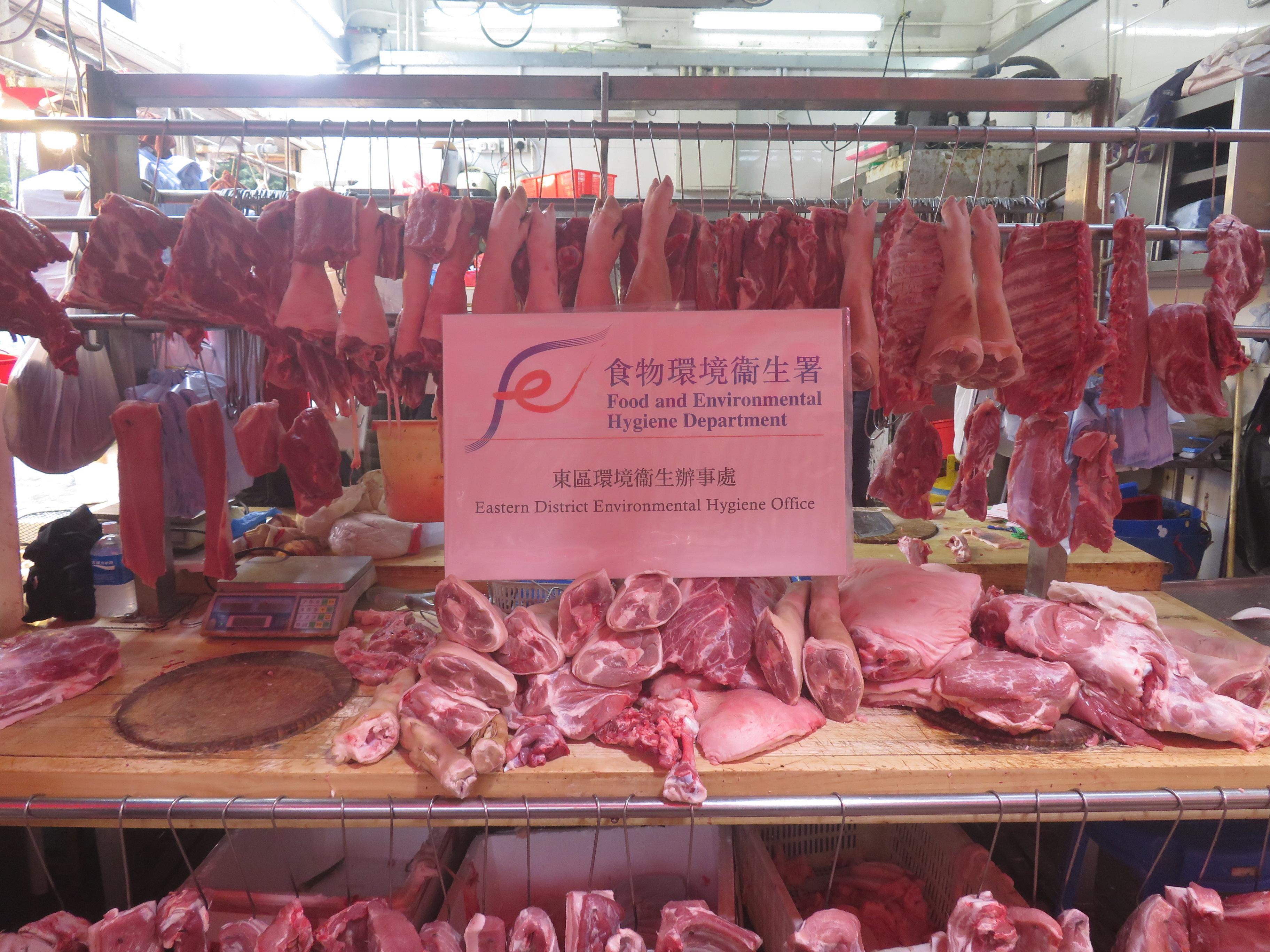
     The Food and Environmental Hygiene Department (FEHD) has all along been committed to combating the sale of chilled or frozen meat disguised as fresh meat, and raided two licensed fresh provision shops (FPSs) in Kam Wa Street, Shau Kei Wan suspected of selling chilled meat as fresh meat today (December 20).

     During the operation, FEHD officers raided the two licensed FPSs, and marked and sealed around 220 kilograms of suspected chilled pork for further investigation. Samples were taken for testing for preservatives and prosecution will be taken out if sufficient evidence is collected. The licensee of the FPSs is suspected of breaching the licensing condition for the display and sale of chilled meat as fresh meat, and the FEHD is proceeding with the cancellation of the FPSs’ licences.

     FEHD officers also initiated a total of four prosecutions against the licensee of the FPSs for dirtiness at the premises and dirtiness of equipment. In addition, verbal warnings were also given to the licensee of the two FPSs for non-compliance with the relevant licensing condition for failing to provide delivery notes for inspection.

     An FEHD spokesman said, “Selling of chilled or frozen meat disguised as fresh meat breaches the licensing condition and causes food safety problems. Also, the operation of these profiteers is unfair to other shops that comply with the requirements.”

     The spokesman added, “Anyone selling chilled meat or frozen meat without permission commits an offence and is liable to a maximum fine of $50,000 and six months’ imprisonment on conviction. The department will continue to conduct regular inspections at licensed FPSs and market meat stalls, and will actively handle the complaints received. In detecting any irregularities, the FEHD will carry out immediate investigations and take appropriate enforcement action. In addition, the FEHD also proactively investigates suspected violations from time to time and conducts surprise inspections and enforcement action as necessary. If there is sufficient evidence, prosecutions will be initiated and follow-up action will be taken on the breach of licensing conditions or tenancy agreements. The licences of FPSs breaching the licensing conditions may be cancelled, while the tenancies of market meat stalls breaching the tenancy agreements may be terminated.”

     The spokesman stressed that the FEHD is very concerned and has been committed to combating the sale of chilled or frozen meat disguised as fresh meat by taking stringent enforcement action against the violations.

Photo  
read more

Government relaxes certain social distancing measures

     The Government announced today (December 20) that earlier relaxation of certain social distancing measures will be made with effect from December 22, taking into account the latest epidemic development and socio-economic needs.
 
     The epidemic situation in Hong Kong has recently reached a plateau. The number of daily new cases peaked at some 17 000 cases on December 15, and hovered around 15 000 to 16 000 for the following few days. Although the number of hospitalised patients infected with COVID-19 has risen, the proportion of those in critical or serious conditions has remained stable.
 
     Having considered the public health risks while balancing the needs for social and economic activities, the Government was of the view that there is room to make earlier relaxation of certain social distancing measures, including:

(a) lifting the restriction on capacity for catering premises, bars/pubs and scheduled premises;
(b) lifting the headcount limit in banquet activities;
(c) lifting the requirements for patrons to conduct rapid antigen tests (RATs) pursuant to relevant regulations under the Prevention and Control of Disease Ordinance (Cap. 599), i.e. (i) patrons of bars/pubs, (ii) patrons of clubs/nightclubs, (iii) participants in banquets, (iv) passengers of “cruise-to-nowhere” itineraries, and (v) participants in local group tours will no longer be required to conduct RATs; and
(d) allowing eating and drinking in (i) outdoor areas of places of public entertainment and event premises, (ii) outdoor areas of sports premises, and (iii) mahjong-tin kau premises. 

     Relevant requirements on the Vaccine Pass and mask-wearing will be maintained. The Government will closely monitor the epidemic development and, on the premise of safeguarding public health, consider continuing to relax social distancing measures in order to resume citizens’ daily lives to normalcy in an orderly manner.
 
     Details on the restrictions under the Prevention and Control of Disease (Requirements and Directions) (Business and Premises) Regulation (Cap. 599F) to be in force during the period from December 22, 2022 to January 11, 2023 are set out in Annex. Specific measures include:
 
(I) Catering business
 
(1) The maximum number of persons per table for catering premises is 12, and that for bars/pubs is 6.
 
(2) Mask-wearing requirement during photo-taking on stage at events held at catering premises and bars/pubs is exempted. Furthermore, live performance and dancing activity are allowed in catering premises and bars/pubs, on the premise that relevant performers must conduct an RAT on the same day before entering the premises for performance or rehearsal, wear masks as far as practicable, and keep a distance of at least 1.5 metres from the audience or patrons (or with effective partition). Performers and the audience or patrons should not mingle on the premises. Participants of dancing activity must wear masks while they are dancing.
 
(3) Other requirements and restrictions on catering premises and bars/pubs remain in force, including that all patrons, when they are away from the table, must not consume food or drink and must wear a mask in general. Operators of catering premises and bars/pubs are required to use the latest “QR Code Verification Scanner” mobile application provided by the Government to scan the QR code of a patron’s vaccination record, medical exemption certificate or recovery record.
 
(II) Scheduled premises
 
(4) For swimming pools, sports premises, fitness centres, beauty parlours and massage establishments, bathhouses, party rooms, clubs/nightclubs, karaoke establishments and cruise ships (namely “cruise-to-nowhere” itineraries), managers must comply with the relevant restrictions under Cap. 599F. In particular, the number of persons per group is capped at 12 in general. All staff members involved in the operation of scheduled premises must conduct an RAT once every three days before entering the premises. The maximum number of persons per table for clubs/nightclubs is six. 
 
(5) Staff members and patrons alike must wear a mask at all times save for exempted circumstances. Mask-wearing requirement during photo-taking on stage at events held at scheduled premises is exempted. Users are allowed not to wear masks when they are exercising in sports premises as well as fitness centres which meet the requirement on air change. Patrons/spectators/users may eat and drink in (a) performance venues, (b) cinema houses, (c) outdoor areas of places of public entertainment (including theme parks and racecourses), event premises and sports premises, as well as (d) mahjong-tin kau premises.
 
(6) Live performance and dancing activity are allowed in clubs/nightclubs, cinemas, museums, as well as meeting rooms/function rooms in club-houses and hotels/guesthouses, on the premise that relevant performers must conduct an RAT on the same day before entering the premises for performance or rehearsal, wear masks as far as practicable, and keep a distance of at least 1.5 metres from the audience or patrons (or with effective partition). Performers and the audience or patrons should not mingle on the premises. Participants of a dancing activity must wear masks while they are dancing.
 
(7) For club-houses and hotels/guesthouses, managers must continue to comply with the relevant restrictions under Cap. 599F, and the catering premises, bars/pubs and scheduled premises therein must comply with all applicable requirements.
 
(III) Mask-wearing requirement
 
(8) The mandatory mask-wearing requirement under the Prevention and Control of Disease (Wearing of Mask) Regulation (Cap. 599I) will be extended. A person must wear a mask all the time when the person is boarding or on board a public transport carrier, is entering or present in an MTR paid area, or is entering or present in a specified public place. Persons are allowed not to wear masks if they are present in outdoor public places in country parks and special areas as defined in section 2 of the Country Parks Ordinance (Cap. 208), or are conducting strenuous physical activity (e.g. exercising or jogging) in outdoor public places.
 
(9) Under Cap. 599I, if a person does not wear a mask in accordance with the requirement, an authorised person may deny that person from boarding a public transport carrier or entering the area concerned, as well as require that person to wear a mask and disembark from the carrier or leave the said area. A person in contravention of the relevant provision commits an offence and the maximum penalty is a fine at level 3 ($10,000). Authorised public officers may issue fixed penalty notices to persons who do not wear a mask in accordance with the requirement and such persons may discharge liability for the offence by paying a fixed penalty at $5,000.
 
(IV) Group gatherings
 
(10) Unless exempted, group gatherings of more than 12 persons in public places is prohibited. The requirement is also applicable to group gatherings in catering premises, bars/pubs and scheduled premises regulated under Cap. 599F in which the relevant requirements or restrictions are not complied with.
 
(11) Subject to relevant requirements, local group tours with no more than 100 persons may be conducted. The relevant requirements include (i) relevant staff have received three doses of vaccine, and conducted an RAT on the same day before the commencement of local group tour activities, and (ii) all tour participants have fulfilled the prevailing Vaccine Pass requirements.
 
(12) Any person who participates in a prohibited group gathering; organises a prohibited group gathering; owns, controls or operates the place of such a gathering; and knowingly allows the taking place of such a gathering commits an offence under the Prevention and Control of Disease (Prohibition on Gathering) Regulation (Cap. 599G). Offenders are liable to a maximum fine of $25,000 and imprisonment for six months. Persons who participate in a prohibited group gathering may be issued fixed penalty notices and they may discharge liability for the offence by paying a fixed penalty at $5,000.
 
     A Government spokesman said, “The Government will continue to uphold the principles of science-based and targeted anti-epidemic measures, proper management of risks and citizen-focused facilitation, and suitably adjust social distancing measures. We urge citizens to receive COVID-19 and seasonal influenza vaccines as early as practicable, thereby lowering the incidence of severe illness upon infection. This will alleviate the burden on the public healthcare system and allow Hong Kong to keep progressing along the path to normalcy steadily.” read more

FEHD strives to ensure food safety of oysters to be eaten in raw state (with photos)

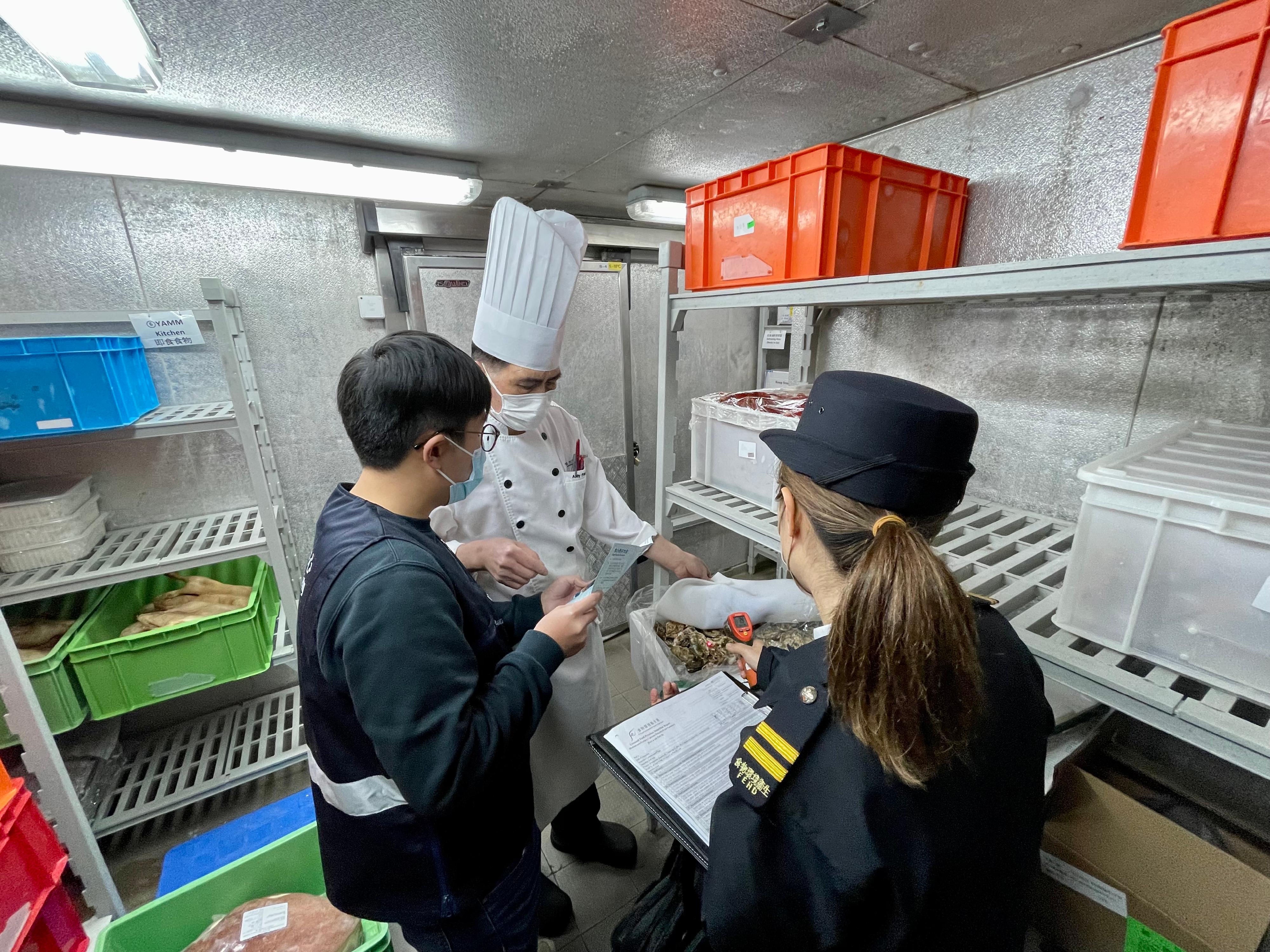
     To safeguard food safety and protect public health, the Centre for Food Safety and the Environmental Hygiene Branch of the Food and Environmental Hygiene Department (FEHD) have enhanced inspections before the Christmas holidays to various licensed food premises across the territory to ensure that oysters to be eaten in a raw state (raw oysters) be stored at the proper temperature.

     A spokesman for the FEHD said today (December 20), “The FEHD has launched a series of operations since last Friday (December 16) and stepped up inspections in various districts. No irregularities have been detected so far. Health advice was also given, and food safety pamphlets were distributed to operators and staff of food premises regarding the proper way of storing and handling raw oysters.”

     As stipulated under the permit/licensing condition of the restricted food permit or written permission issued by the FEHD, all raw oysters ready for immediate consumption shall be kept in a refrigerator or compartment of a refrigerator separated from other food items at a temperature between zero and four degrees Celsius. If a breach of the aforesaid condition is found, FEHD officers will, depending on the actual circumstances, issue verbal warnings or warning letters, and may even consider cancellation of the permits/licences of relevant premises.

     The spokesman reminded that as oysters feed by filtering a large volume of seawater and absorbing suspended food particles therein, bacteria (e.g. Vibrio parahaemolyticus and Vibrio vulnificus) and viruses (e.g. norovirus and Hepatitis A virus) may accumulate in them if they are grown in or harvested from contaminated water. Consuming oysters without thorough cooking might risk direct intake of these microorganisms. Susceptible groups, such as pregnant women, young children, the elderly and people with weakened immune systems or liver diseases, should avoid eating them.

     In addition, the CFS held a trade talk earlier to remind food businesses to follow Good Hygiene Practices when handling and serving oysters. If raw oysters are served, food handlers are urged to take heed of the following: 
 

  • Keep the raw oysters cool at 4°C or below all the way before eating to inhibit bacterial growth; 
  • Prevent cross-contamination of foods during storage by keeping raw oysters in a closed container in a designated refrigerator;
  • Practise good hygiene at all times, including washing hands and using clean and separate utensils for handling oysters; and
  • Use clean protective gloves when handling or shucking oysters to prevent injury and infection.

     “However, these measures are not all fail-safe,” the CFS spokesman added. “Thorough cooking is the most effective way to reduce the risk of foodborne illness.”

     The CFS has issued new food safety advice that provides the public with information on the food safety risks of raw oysters as well as a set of trade guidelines to assist the food businesses in implementing appropriate food safety measures when serving oysters to be eaten raw. For the sake of food safety, the public, especially susceptible populations, should cook oysters thoroughly before eating. Details of the advice and guidelines are available on CFS’s website (www.cfs.gov.hk/oyster/).

     The FEHD will continue to step up inspections to ensure that the licensing/permit conditions are observed by the licensees/permit holders or relevant operators, and the hygienic standards stipulated in the laws are met.
Photo  Photo  
read more

Four persons sentenced for violating anti-epidemic regulations

     Four persons were sentenced by the Magistrates’ Courts today (December 20) for violating the Prevention and Control of Disease Regulation (Cap. 599A), the Compulsory Quarantine of Certain Persons Arriving at Hong Kong Regulation (Cap. 599C) or the Prevention and Control of Disease (Disclosure of Information) Regulation (Cap. 599D).

     The first two cases involved a 16-year-old man and a 59-year-old man, who were earlier issued with a compulsory quarantine order. Before the expiry of the quarantine order, the 16-year-old man left the place of quarantine twice on May 30 whereas the 59-year-old man left the place of quarantine on May 25. The former was charged with two counts of contravening sections 32(1) and (3) of Cap. 599A and was sentenced by the Eastern Magistrates’ Courts today to imprisonment for seven days, suspended for 12 months for each of the charges with three days imprisonment of one of the charges to run consecutively. The latter was charged with contravening sections 8(1) and (5) of Cap. 599C and was sentenced by the Kwun Tong Magistrates’ Courts today to imprisonment for seven days, suspended for 12 months and was fined $5,000.

     The third case involved a 26-year-old man who earlier tested positive for COVID-19 and was issued with an isolation order. Before the end of the isolation period, he left the place of isolation on May 28. He was charged with contravening sections 23(1), (3) and (5) of Cap. 599A and was sentenced by the Tuen Mun Magistrates’ Courts today to imprisonment for seven days, suspended for 12 months and was fined $5,000.

     The fourth case involved a 26-year-old man who earlier tested positive for COVID-19 through a rapid antigen test. He provided a false residential address to a health officer through the “Declaration System for Individuals Tested Positive for COVID-19 Using Rapid Antigen Test” on April 15. During the subsequent enquiry by an authorised officer on April 17, he provided false or misleading information. He was charged with two counts of contravening sections 3(4) and (5) of Cap. 599D and was sentenced by the Kowloon City Magistrates’ Courts today to a probation order for 12 months for each of the two charges, with the sentences to run concurrently.

     A spokesman for the Department of Health said that co-operation of and support by members of the public play a critical role in the anti-epidemic work. They must strictly observe relevant requirements in order to fight the pandemic and minimise the risk of transmission in the community. The spokesman reiterated that resolute actions will be taken against anyone who breaches the relevant regulations. read more

Youth Development Commission welcomes Government’s release of Youth Development Blueprint

     The Youth Development Commission (YDC) warmly welcomes the Youth Development Blueprint (Blueprint) released by the Government today (December 20).

     The Vice-Chairman of the YDC, Mr Kenneth Leung, said, “I am pleased that the Government outlines the overall vision and guiding principles for the long-term youth development work in future through the Blueprint, providing a clear direction for the Government, the business sector and the community to collaborate in promoting youth development work. Besides, I support that the Blueprint puts forward corresponding actions and measures having regard to the development stages of youths to support the diverse needs of young people at different stages and with different backgrounds, so that the younger generation will see hope.”

     He expressed appreciation of the Government’s acceptance of suggestions raised by members of the YDC, and said that the YDC would work proactively and closely with the Government and other stakeholders to strengthen the cross-bureaux and cross-sectoral co-ordination role of the YDC to complement the implementation and execution of the Blueprint.

     Chaired by the Chief Secretary for Administration, Mr Chan Kwok-ki, the YDC strives to enhance policy co-ordination within the Government for promoting youth development and enable a more holistic and effective examination of and discussion on issues of concern to young people. Since its establishment, the YDC has implemented a wide spectrum of programmes to promote youth exchange, internship, entrepreneurship, life planning and more, so as to actively promote the all-round development of young people, help them develop positive values, and enable them to become a new generation with national pride, a sense of ownership and responsibility, and with an aspiration and willingness to strive for the future of our country and of Hong Kong. Since July this year, the Home and Youth Affairs Bureau, in collaboration with the YDC, have organised and participated in over 170 consultation sessions reaching out to thousands of young people and stakeholders in youth work to assist the Government in formulating the Blueprint. read more