Tag Archives: China

image_pdfimage_print

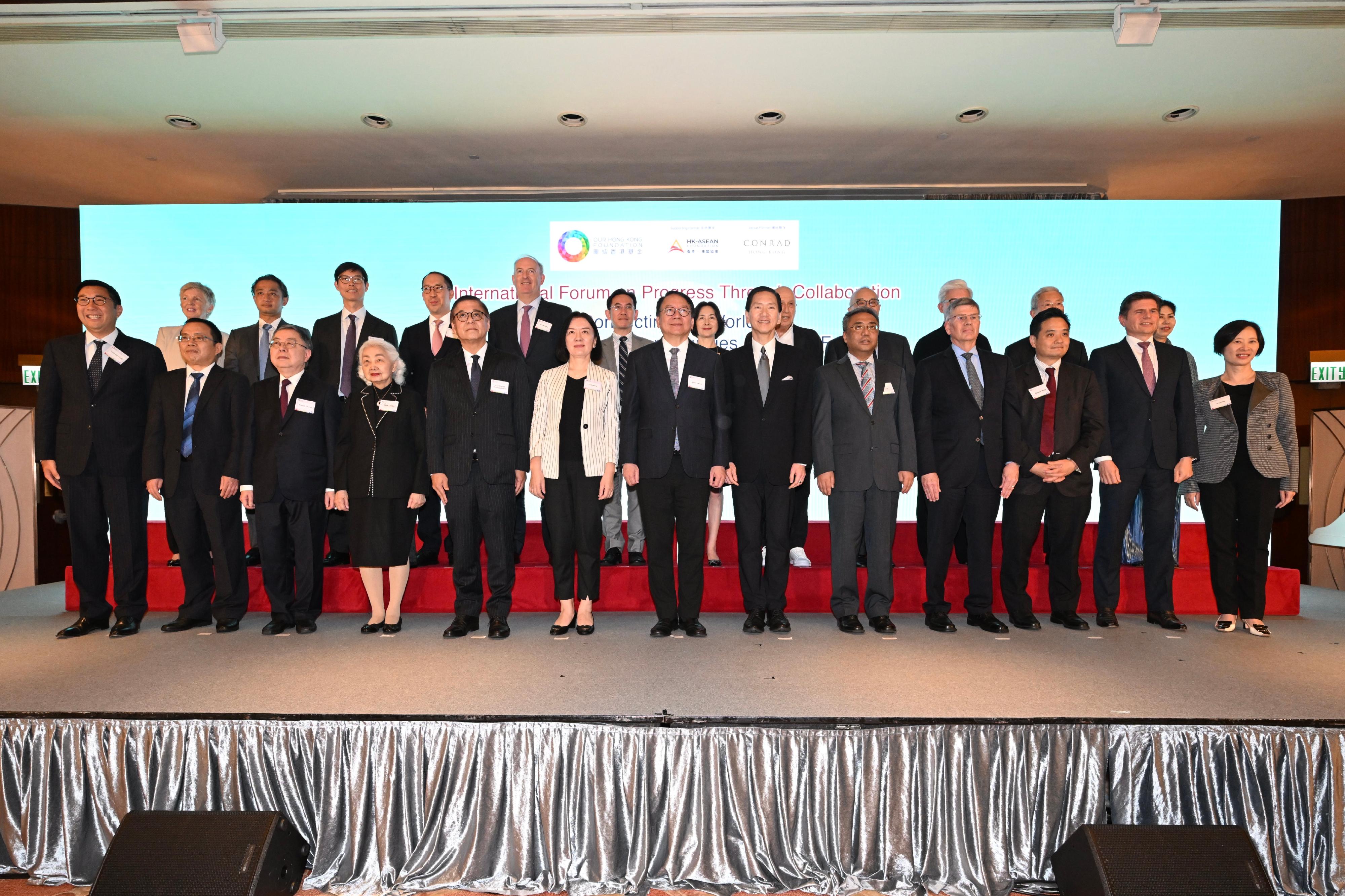
Speech by CS at Our Hong Kong Foundation International Forum on Progress through Collaboration (English only) (with photos/video)

     Following is the speech by the Chief Secretary for Administration, Mr Chan Kwok-ki, at Our Hong Kong Foundation International Forum on Progress through Collaboration today (April 17):

Deputy Director Lu Xinning (Deputy Director of the Liaison Office of the Central People’s Government in the Hong Kong Special Administrative Region (HKSAR)), Deputy Commissioner Yang Yirui (Deputy Commissioner of the Office of the Commissioner of the Ministry of Foreign Affairs of the People’s Republic of China in the HKSAR), Bernard (Executive Vice Chairman of Our Hong Kong Foundation, Mr Bernard Chan), distinguished guests, ladies and gentlemen,
 
     Good afternoon. I am glad to join you all today at the International Forum on Progress Through Collaboration. This forum could not be timelier. With the strong support of our motherland, and the concerted efforts of the HKSAR Government and society at large, Hong Kong has resumed full normality after three years of the pandemic. 
 
     Having resumed normal travel with Mainland China and the international world, Hong Kong is back on stage and back in business – in the business of making great progress through collaboration. 
 
     Just now, the Chief Executive has updated us on certain policy areas – including financial services, business and trade, innovation and technology, legal and dispute resolution services – that our Government is putting in efforts, leveraging the city’s strengths under the “one country, two systems” principle. 
 
     At the core of our work is collaboration with the business, academic and research sectors alike, to drive Hong Kong’s “eight hubs” development as underpinned by the National 14th Five-Year Plan.    
 
     Our collaboration is cross-sectoral. An example with promising prospects is the development of fintech. The growth in the number of fintech companies speaks for itself – from no more than 180 five years ago to over 800 to date. 
 
     We are also pleased to note that many of them are founded by talent worldwide – from Mainland China, France, Israel, the UK, and other places. 
 
     And to support sustainable fintech development, we are providing start-ups with seed funding, investor matching, incubation and professional support services; launching regulatory sandboxes in collaboration with Mainland authorities; and taking bold initiatives, such as issuing early this year the first ever tokenised government green bonds.
 
     Speaking of green finance, opportunities are tremendous likewise. As the Chief Executive has noted, a recent initiative is the international carbon marketplace named “Core Climate”, launched by HKEX (Hong Kong Exchanges and Clearing Limited) last October, to enable effective trading of voluntary carbon credits and instruments across Asia and beyond.
 
     From a macro perspective, our Government is establishing a Green Technology and Finance Development Committee to produce an action agenda. This agenda will cover, among other things, green certification and green standard setting, converging the Mainland and international standards. 
 
     No less important, our collaboration is multicultural. Hong Kong is developing into an East-meets-West centre for international cultural exchange to tell good Hong Kong stories worldwide. 
 
     At centre stage is the West Kowloon Cultural District. It is home to two world-class museums – M+ museum and the Hong Kong Palace Museum, as well as Xiqu Centre, combining the East with the West, and the ancient with the modern. 
 
     Other infrastructural projects of the city, to be completed in the near future, include the East Kowloon Cultural Centre to support art tech development and the Kai Tak Sports Park to provide world-class venues for international sports events.  
 
     Speaking of events, we are welcoming the launch or return of various mega events in Hong Kong. The recent ones include Art Basel Hong Kong, the Hong Kong Sevens, Entertainment Expo Hong Kong and the Digital Economy Summit. Leisure and business travellers are coming in to boost our economy. Their visits also help enhance our city’s cosmopolitan image. 
 
     All such hardware and software add to the ecosystem of Hong Kong’s arts and culture, and creative industries. To enrich this ecosystem, our Government is working with industry leaders – through the newly formed Culture Commission – to map out a development blueprint.
 
     Looking beyond the city, our collaboration is regional as well as international. With our motherland’s Guangdong-Hong Kong-Macao Greater Bay Area development and Belt and Road Initiative, Hong Kong actively plays the role as a “super connector” between Mainland China and the rest of the world. 
 
     As the Chief Executive has mentioned, our Government is stepping up collaboration with Shenzhen to develop the Shenzhen-Hong Kong Innovation and Technology Co-operation Zone, as well as ASEAN (Association of Southeast Asian Nations) member states to seek early accession to the Regional Comprehensive Economic Partnership. 
 
     We are determined to achieve these goals by upholding Hong Kong’s competitive strengths, including a highly open and internationalised market, the rule of law, robust infrastructure and the free flow of capital, information and people.
 
     And to take our city’s “eight hubs” development to new heights, I and the Financial Secretary are respectively driving inter-bureau efforts to proactively bring in top-notch talent and strategic enterprises from around the world.   
 
     Our enhanced package of talent admission schemes – with application procedures streamlined, requirements relaxed, and new initiatives introduced – has been well-received.
 
     A prime example is our newly launched Top Talent Pass Scheme, targeting high-income professionals and graduates from the world’s top 100 universities. Over 20 000 applications were received in just a quarter’s time, and nearly 12 000 of them approved as of late March. 
 
     The internationalised nature of the scheme can be seen by the wide-ranging locations of the top universities where the talent in the approved cases graduated. They range from Mainland China, Singapore and South Korea to the US, Australia, the UK and also Canada.  
 
     At the same time, a dedicated Office for Attracting Strategic Enterprises has been set up to draw enterprises of strategic value to our economy by tailoring incentive packages. We are also breaking new ground by setting up a fund of around US$4 billion to co-invest in them or their projects. 
 
     Our target sectors include life and health technology, AI, data science, fintech, advanced manufacturing and new energy technology. The office’s active discussion with relevant enterprises is underway, with good news to be announced in good time. 
 
     Ladies and gentlemen, as Hong Kong advances from stability to prosperity, new opportunities surely await. My thanks go to Our Hong Kong Foundation for organising this forum to present some of these opportunities and chart a new future for Hong Kong. 
 
     I wish you all a rewarding forum and the best of business. Thank you.

Photo  Photo  
read more

Hong Kong Customs combats unfair trade practices at online shop

     Hong Kong Customs on April 14 arrested a man suspected of engaging in wrongly accepting payments when selling luxury handbags on the Internet, in contravention of the Trade Descriptions Ordinance (TDO).
      
     Customs earlier received a number of reports alleging that an online shop owner sold luxury handbags through an online shop but failed to supply the ordered goods within the specified date or a reasonable period after accepting payments from customers. Also, no refund was offered.

     After investigation, Customs officers arrested a 25-year-old man suspected to be connected with the case. He is the registered owner of the aforementioned online shop.

     An investigation is ongoing and the arrested man has been released on bail pending further investigation.

     Customs has all along been concerned about illegal online sales activities. It has strived to combat unfair trade practices on websites to protect consumer interests.

     Customs reminds traders to comply with the requirements of the TDO. Under the TDO, any trader commits an offence if at the time of payment acceptance, the trader intends not to supply the product or intends to supply a materially different product, or there are no reasonable grounds for believing that the trader will be able to supply the product within a specified or reasonable period. The maximum penalty upon conviction is a fine of $500,000 and imprisonment for five years.

     Customs appeals to consumers that they should stay vigilant in regard to online shopping and procure products at reputable shops. Consumers should also beware of whether the online payment methods provided by the online stores are secure, and keep the transaction receipts and related documents, which can become basic information in case a complaint is lodged in the future.

     Members of the public may report any suspected violations of the TDO to Customs’ 24-hour hotline 2545 6182 or its dedicated crime-reporting email account (crimereport@customs.gov.hk). read more

Hong Kong Customs detects sea smuggling case involving cigarettes and seizes suspected illicit cigarettes worth about $74 million (with photo)

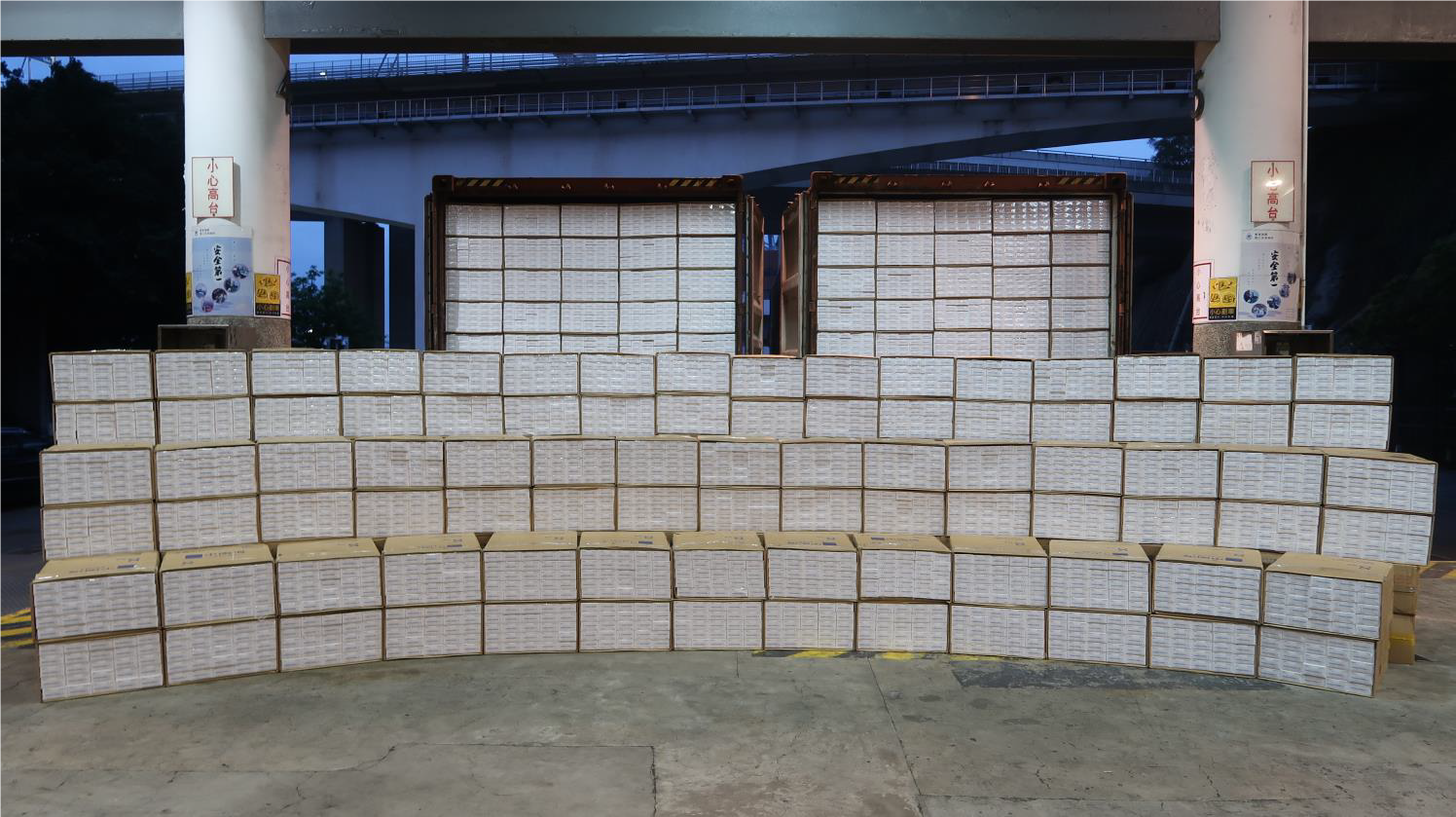
     â€‹Hong Kong Customs on April 13 detected a suspected illicit cigarette smuggling case involving a barge in the waters off Tsing Yi. About 20 million suspected illicit cigarettes with an estimated market value of about $74 million and a duty potential of about $50 million were seized.
 
     Through risk assessment, intelligence analysis and data analysis, Customs on the evening of April 12 intercepted a suspicious barge in the waters off Tsing Yi. The next day, upon inspection, Customs officers seized the batch of suspected illicit cigarettes inside two 40-foot containers on board the barge.
 
     During the operation, Customs officers arrested three men, aged between 24 and 54, suspected to be connected with the case.
 
     An investigation is ongoing. Customs will continue to trace the source and the flow of the illicit cigarettes. The likelihood of further arrests is not ruled out.
 
     Customs will continue its risk assessment and intelligence analysis for interception at source as well as through its multipronged enforcement strategy targeting storage, distribution and peddling to spare no effort in combating illicit cigarette activities.
 
     Smuggling is a serious offence. Under the Import and Export Ordinance, any person found guilty of importing or exporting unmanifested cargo is liable to a maximum fine of $2 million and imprisonment for seven years.
 
     Customs reminds members of the public that it is an offence to buy or sell illicit cigarettes. Under the Dutiable Commodities Ordinance, anyone involved in dealing with, possession of, selling or buying illicit cigarettes commits an offence. The maximum penalty upon conviction is a fine of $1 million and imprisonment for two years.
      
     Members of the public may report any suspected illicit cigarette activities to Customs’ 24-hour hotline 2545 6182 or its dedicated crime-reporting email account (crimereport@customs.gov.hk).

Photo  
read more

CHP investigates case of Legionnaires’ disease in hospital

     The Centre for Health Protection (CHP) of the Department of Health is today (April 17) investigating a case of Legionnaires’ disease (LD) in Hong Kong Sanatorium & Hospital (HKSH).

     The male patient, aged 74 with underlying illnesses, was admitted to HKSH on March 22. He developed fever, a drop in blood pressure and oxygen desaturation on April 12. His clinical diagnosis was septic shock and pneumonia. He is currently in stable condition.

     His sputum specimen tested positive for Legionella species upon laboratory testing. Initial enquiries revealed that the patient had no travel history during the incubation period.

     “Epidemiological investigations with HKSH are ongoing to identify potential sources of infection, high-risk exposure and clusters, if any. Relevant water samples and environmental swabs will be collected from potential sources for laboratory testing,” a spokesman for the CHP said.

     Tracing of contacts including staff and in-patients in the relevant ward is ongoing and those identified will be put under medical surveillance. The CHP has provided health advice against LD to staff and in-patients, including those with weakened immunity who should use sterile or boiled water for drinking, tooth brushing and mouth rinsing. The water supply system of the subject floor will be disinfected urgently. An investigation is ongoing.

     Legionellae are found in various environmental settings and grow well in warm water (20 to 45 degrees Celsius). They can be found in aqueous environments such as water tanks, hot and cold water systems, cooling towers, whirlpools and spas, water fountains and home apparatus which support breathing. People may become infected when they breathe in contaminated droplets (aerosols) and mist generated by artificial water systems, or when handling garden soil, compost and potting mixes.
 
     Immunocompromised persons should:
      

  • Use sterile or boiled water for drinking, tooth brushing and mouth rinsing;
  • Avoid using humidifiers, or other mist- or aerosol-generating devices. A shower may also generate small aerosols; and
  • If using humidifiers, or other mist- or aerosol-generating devices, fill the water tank with only sterile or cooled freshly boiled water, and not water directly from the tap. Also, clean and maintain humidifiers/devices regularly according to manufacturers’ instructions. Never leave stagnant water in a humidifier/device. Empty the water tank, wipe all surfaces dry, and change the water daily. 
     
     The public should observe the health advice below:
 
  • Observe personal hygiene;
  • Do not smoke and avoid alcohol consumption;
  • Strainers in water taps and shower heads should be inspected, cleaned, descaled and disinfected regularly or at a frequency recommended by the manufacturer;
  • If a fresh-water plumbing system is properly maintained, it is not necessary to install domestic water filters. Use of water filters is not encouraged as clogging occurs easily, which can promote growth of micro-organisms. In case water filters are used, the pore size should be 0.2 micrometres (µm) and the filter needs to be changed periodically according to the manufacturer’s recommendations;
  • Drain and clean water tanks of buildings at least quarterly;
  • Drain or purge for at least one minute infrequently used water outlets (e.g. water taps, shower heads and hot water outlets) and stagnant points of the pipework weekly or before use;
  • Seek and follow doctors’ professional advice regarding the use and maintenance of home respiratory devices and use only sterile water (not distilled or tap water) to clean and fill the reservoir. Clean and maintain the device regularly according to the manufacturer’s instructions. After cleaning/disinfection, rinse the device with sterile water, cooled freshly boiled water or water filtered with 0.2 µm filters. Never leave stagnant water in the device. Empty the water tank, keep all surfaces dry, and change the water daily; and
  • When handling garden soil, compost and potting mixes: 
  1. Wear gloves and a face mask;
  2. Water gardens and compost gently using low pressure;
  3. Open composted potting mixes slowly and make sure the opening is directed away from the face;
  4. Wet the soil to reduce dust when potting plants; and
  5. Avoid working in poorly ventilated places such as enclosed greenhouses.

     â€‹The public may visit the CHP’s LD page, the Code of Practice for Prevention of LD and the Housekeeping Guidelines for Cold and Hot Water Systems for Building Management of the Prevention of LD Committee, and the CHP’s risk-based strategy for prevention and control of LD. read more