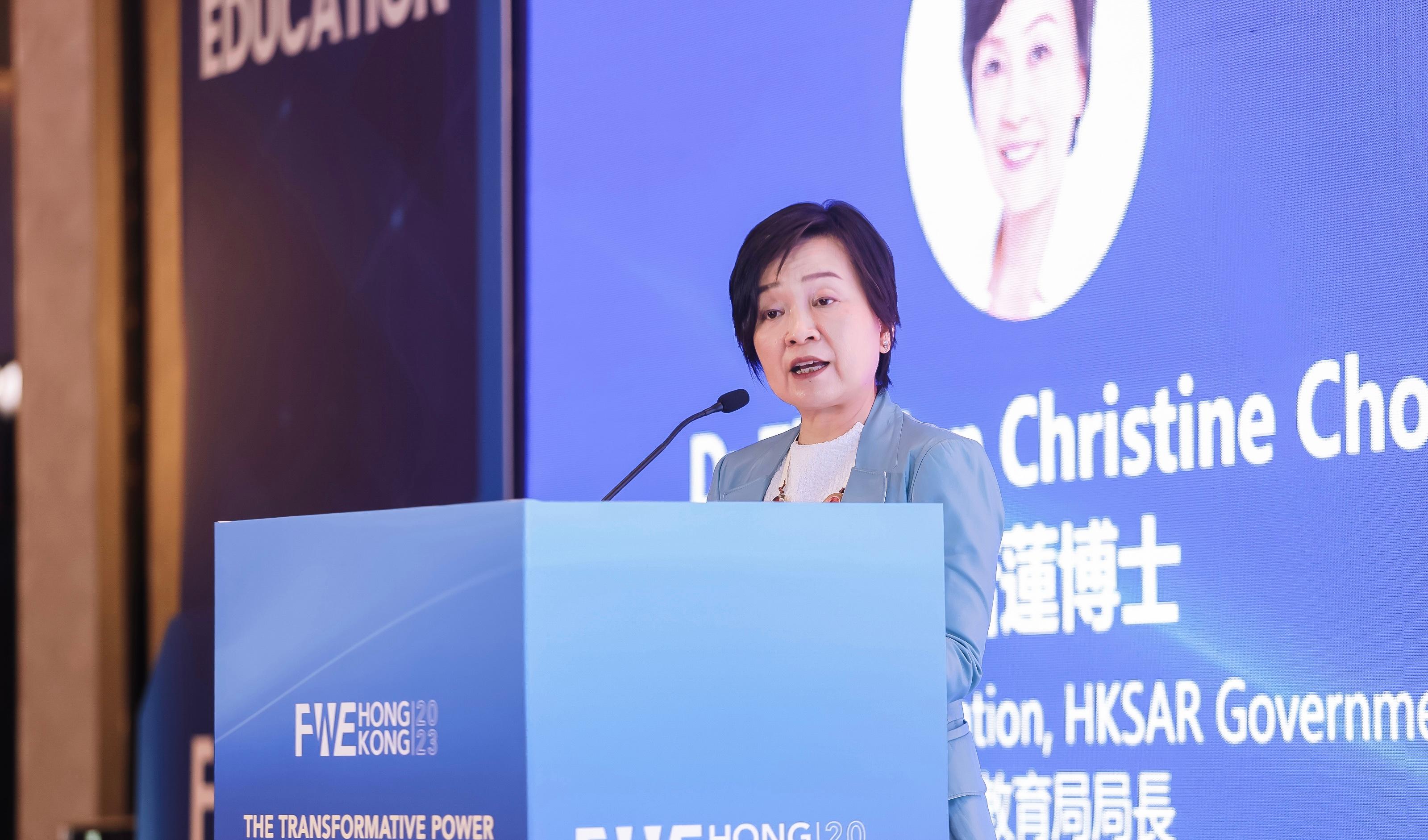
Following is the keynote speech by the Secretary for Education, Dr Choi Yuk-lin, at the panel session entitled “Linking Industry and Education” at the Forum for World Education Hong Kong Regional Conference 2023 today (May 26):
Dear honorable guests,
Good afternoon. It gives me great pleasure to join you all at the Regional Conference of the 2023 Forum for World Education here in Hong Kong today, exchanging views on how we have learned from the disruption caused by the pandemic and consider longer term challenge and change.
The theme of this Conference is “The Transformative Power of International Education for a Better World”, and the session this afternoon will focus on “Linking Industry and Education”. It is indeed a very timely and imminent issue facing every policy maker around the world, including us in Hong Kong. As innovation and technological advancements sweep through the world, the workplace is undergoing rapid transformation. Many jobs will require entirely different skillsets or even become non-existent in the not-too-distant future, while many completely novel jobs will evolve. It is therefore of utmost importance that we should rethink our education strategies and take a proactive approach in equipping our young talent with skills that are relevant and applicable in the future, in order to enable our younger generations to realise their potentials and showcase their talents, maintain the competitiveness of our city and continue to create strong impetus for our future development.
The HKSAR (Hong Kong Special Administrative Region) Government strongly believes that the prospects of individuals, the well-being of families, the qualities of people and the progress of civilisation all hinge on education. Through providing quality and diversified education pathways, we cater for the learning needs of students at different stages and helps them become lifelong learners who are virtuous and able, with knowledge and insights, a sense of responsibility, a global perspective, positive values and attitudes, love for the country and the city, as well as being ready for future challenges and opportunities. Among others, we have been according priority to promoting the Vocational and Professional Education and Training (VPET) pathway as a preferred choice, with a view to enabling young people to acquire work skills for the future, applied knowledge in innovation and technology, and critical soft skills for career progression in the new digital age, achieving “masters of each trade”.
In fact VPET has always been a key driver of manpower development in Hong Kong for meeting the needs of the ever-changing economy. We have all along been committed to providing quality, flexible, and diversified study pathways with multiple entry and exit points for young people with different aspirations and abilities through VPET. To strengthen our efforts in promoting VPET in a more targeted manner, the Chief Executive announced in his Policy Address last year that we would step up our efforts through the strategy of fostering industry-institution collaboration and diversified development, adopting a multi-pronged approach at different levels to further promote VPET as a pathway parallel to conventional academic education, encouraging the alignment of classroom education with industry needs, encouraging collaboration between businesses and education institutions, and providing diversified learning and employment opportunities, with a view to enhancing the VPET progression pathway to nurture more high-quality talent with applied skills.
We recognise that the VPET pathway comprises education opportunities at different levels of the education system, from secondary school, diploma qualification to undergraduate studies and beyond. In addition to our on-going efforts, including enabling our students to have early exposure to VPET through applied learning subjects, we have been bold in embarking on new endeavours to strengthen the VPET progression pathway. Among others, we have launched the Pilot Project on the Development of Applied Degree Programmes, which aims to address the concern about the lack of articulation opportunity at degree level in our education system. Through the Pilot Project, we support and encourage post-secondary institutions in launching applied degree programmes, which should be equivalent to those of conventional academic degrees in standard and level, while applied degrees should have an applied focus blending theory and practice, provide substantial internships and work-based learning experience, and with strong industry involvement and recognition, thereby preparing graduates for a specific trade or industry readily. We are pleased to note that the first phase of the Pilot Project has received very positive response from the tertiary sector, the industries, as well as other stakeholders, and the four programmes which are in disciplines with keen manpower needs, namely nursing; testing and certification; horticulture, arboriculture and landscape management; and gerontology, have been successfully launched last year. Building on the positive experience and to further promote the concept of applied degrees, we are working with a number of post-secondary institutions to launch the second phase of the Pilot Project, and the second batch of the applied degree programmes are expected to be launched in 2024 the earliest. We are confident that the continued development of applied degrees in Hong Kong will further strengthen the positioning of VPET at degree level and complement our VPET progression pathway.
In addition, the Government has also completed the Review on the Sub-degree Education in Hong Kong, which aims to support our policy to develop the VPET progression pathway in parallel to the traditional academic pathway. We are pleased to note that, as demonstrated in the results of our consultation with stakeholders and the Legislative Council, our community unanimously agrees that there should be a sharper differentiation between the two sub-degree qualifications, which are the associated degrees which support students’ articulation to academic degrees, and the higher diplomas which have a strong emphasis on VPET. Taking on board the valuable advice we have received, we have also revamped the design and structure of higher diplomas, such as ensuring the close collaboration between programme providers and industry partners at different stages of the design and delivery of the programmes such that the curriculum could support the needs of industries; providing sufficient work-based/project-based learning and placement opportunities to enable students to apply their knowledge in real world situations; and providing clear information about articulation and progression pathways, relevant industry and professional recognition, etc to allow students to learn about the graduate destination.
Apart from the various new efforts made within the education system, we are also committed to telling the good stories of Hong Kong and VPET, in particular after we have overcome the challenges of the pandemic. By organising an array of events and activities, we strive to enhance the public’s positive understanding of VPET and promote its professional image. The “Future Skills Community Event” organised by the Vocational Training Council (VTC) with the support of the Government last December was a successful case in point to showcase the talent of our VPET students and the opportunities that VPET may bring about. I am also thrilled that the Hong Kong delegation, which comprise VPET students from the VTC and other VPET organisations in Hong Kong, put up a marvelous performance in the “WorldSkills Competition 2022 Special Edition”, which is considered the “Skills Olympics”, bringing home 13 medals, including one gold and 12 medallions for excellence, which was a really exceptional result. The Government will continue support our young talent to realise their unique gifts and talents and rattle the stars through VPET.
The importance of VPET is beyond doubt. To enable the success of VPET development, there are also works to do to assist students to identify their interests, strengths and weakness, and thereby developing a clear mind on their aspirations and future development pathway. This self-identification process count on the Life Planning Education.
Life planning is an ongoing and lifelong process for personal fulfillment, with different foci at different stages of the life time. At the schooling stage, life planning education is one of the key components in promoting whole-person development, with the objectives of enabling students’ self-understanding, personal planning, goal setting, as well as self-reflection and revision, and equipping students with the knowledge of various study, career and training pathways, work ethics and the working world.
The key learning elements of life planning education include “Self Understanding and Development”, “Career Exploration”, and “Life Planning and Management”. We always encourage schools to deliver life planning education and career guidance service flexibly through various modes, such as life planning related lessons and workshops, career-related experience learning activities, individualised career guidance programmes, etc, within the school timetable or outside school hours. Since 2014, we have been providing enhanced support to secondary schools in the implementation of life planning education to better prepare students with the knowledge, skills and attitude to make informed choices in accordance with their interests, abilities and orientations in face of the available multiple pathways, including VPET, upon graduating from secondary schools. To this end, we have adopted a series of measures to support schools in implementing life planning education. These measures include the provision of additional manpower to school, enhancement of professional training for teachers through structured training courses and thematic seminars, development of online resources, such as the Life Planning Information Website, to provide students with updated information on different industries and multiple pathways, as well as handy tools for students to undertake career aptitude assessments and create learning portfolio, encouragement of greater participation of different sectors of the community in our Business-School Partnership Programme (BSPP) to provide students with various career exploration activities, etc.
As what I have just mentioned, “Career Exploration” is one of the key elements of life planning education. We have been collaborating with various business corporations, government departments and community organisations through the BSPP to provide students with diversified career exploration activities, such as workplace visits, career talks, workshops, work experience programmes, etc. The BSPP leads students out of the classroom so that they can learn about different industries and gain a wider perspective of the career-world. Up till now, over 8 800 career exploration activities, covering more than 30 industries, have been co-organised with more than 500 BSPP partners, benefiting more than 1.3 million student participants.
This school year, to further widen students’ exposure and enhance life planning education, we have launched BSPP 2.0 with more business partners covering more industries. We have been actively liaising with major chambers of commerce, professional bodies as well as small and medium enterprises to encourage more organisations to join the programme. As such, a greater number and variety of career exploration and work experience activities are provided to help students gain a better understanding of the workplace. As at April this year, we have successfully recruited more than 100 organisations having newly joined the programme. Among these organisations, 20 of them are emerging industries such as artificial intelligence, 3D printing, biotechnology and testing and certification.
BSPP 2.0 is expected to provide students with more and a wider range of career exploration activities. Among various career exploration activities, work experience programmes have been well received among students. We have mobilised different sectors to take part in work experience programmes. A series of Holiday Work Experience Programmes are being arranged during major school holidays. A series of Holiday Work Experience Programmes, which lasted for one to five days, were arranged during Christmas, Lunar New Year and Easter holidays from December 2022 to May 2023, offering about 800 quotas for students. Summer Holiday Work Experience Programme will be launched from June to August this year. Through first-hand experience of the actual operation in the workplace, senior secondary students can explore their interests and career orientations, and know more about the actual operation of different enterprises and the day-to-day work of different job positions.
With the concerted efforts from the business sector, I am confident that life planning education could help our students map their study and career pathways at an earlier stage and help nurture a pool of talents to contribute to the ongoing development of our city.
The Government will continue to spare no effort to provide quality and diversified education on both academic as well as vocational and professional training. With a sense of responsibility, visions and love for the country and the city, we stand ready to ride the wind and waves and breakthrough all the challenges.
I wish you all a wonderful afternoon. Thank you.