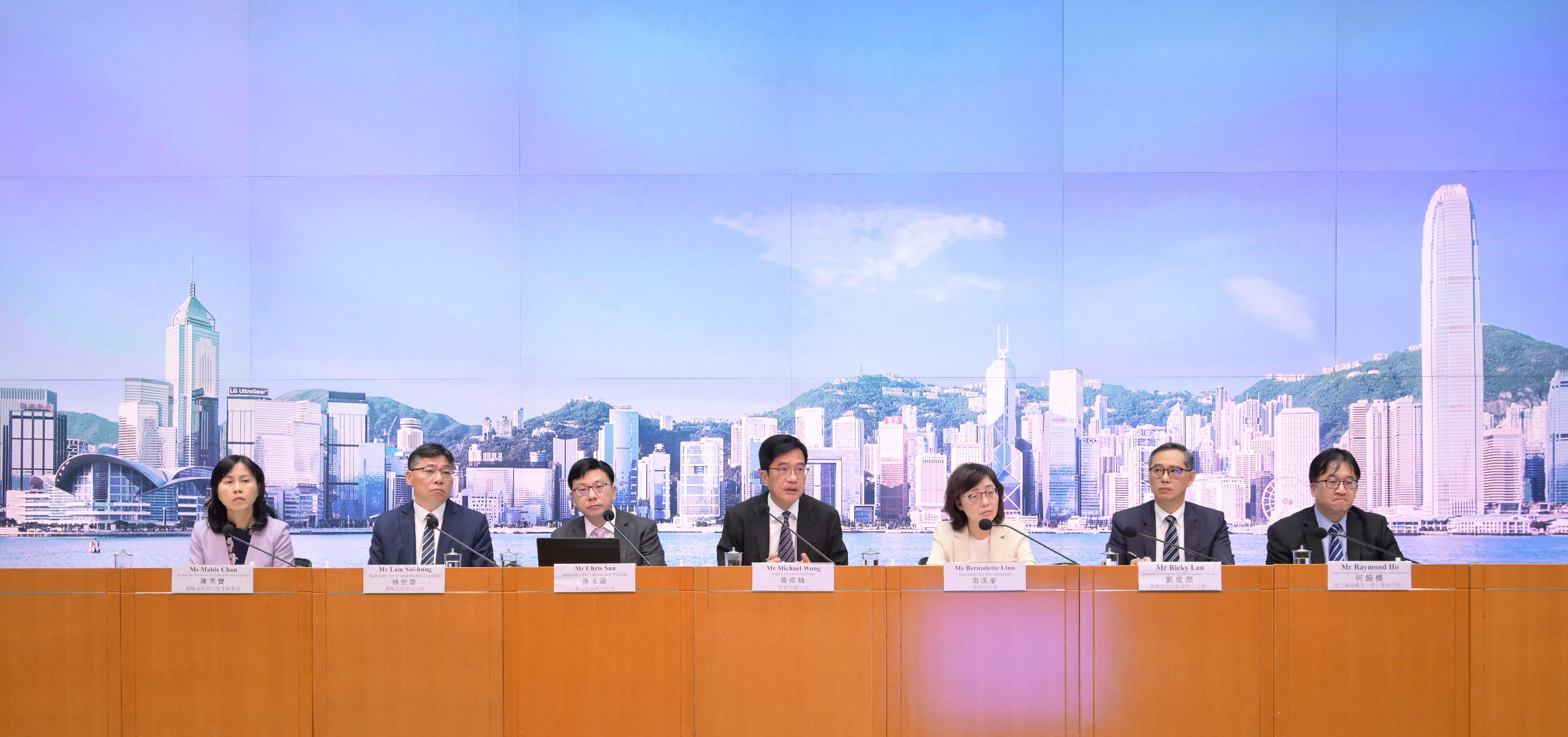
The Deputy Financial Secretary, Mr Michael Wong, held a press conference on the Government’s measures on importation of labour this afternoon (June 13). The Secretary for Transport and Logistics, Mr Lam Sai-hung; the Secretary for Development, Ms Bernadette Linn; the Secretary for Labour and Welfare, Mr Chris Sun; the Permanent Secretary for Transport and Logistics, Ms Mable Chan; the Permanent Secretary for Development (Works), Mr Ricky Lau; and the Deputy Commissioner for Labour (Labour Administration), Mr Raymond Ho, also attended. Following is the transcript of remarks of the press conference:
Reporter: Good afternoon. Firstly, we want to ask a little bit more about the timeline. When will the Government expect this new imported labour scheme to start? When would these 20 000 people be expected to arrive in Hong Kong to start their work? And also, we’d like to clarify a little bit more about the targeted imported labour, whether the Government is only targeting to import labour from the Mainland? Or is it also open to people from other regions as well? And, whether these imported labour will be granted permanent residency in the future? Is there any possibility for that and what’s the Government’s rationale? And lastly, whether the Government has any plans to expand the currently allowed quotas for these imported labour in the future? Would it cover other sectors as well?
Deputy Financial Secretary: First of all, regarding the timing, for the two sector-specific schemes, we look forward to receiving applications in July. So, in a few weeks’ time. We hope to be able to complete processing applications within about two months. That’s our pledge. For the enhanced Supplementary Labour Scheme, because the number of job categories is more, we look forward to starting receiving applications within the third quarter. So, it’s before September. To be able to process the applications, the current timeline is about five months. We hope to be able to shorten it to around three months.
We don’t expect to fully utilise the quota in the first year, so it will be a progressive process, but we do believe that the quotas may be fully utilised sometime next year. The schemes are not just open to Mainland workers. But our experience in the past has been that it will mainly be Mainland workers because of the geographic proximity and convenience.
With regard to residency, while they are in Hong Kong, they will be non-permanent Hong Kong residents. The situation is quite similar to other imported workers under the current Supplementary Labour Scheme, so their status would not change from non-permanent Hong Kong residents to permanent Hong Kong residents. In other words, after they finish their work contracts in Hong Kong, they will leave.
We do not have any specific predictions about future developments. We will monitor the situation closely. We will look at the need of our economy. We will also look at the impact of the various new arrangements and new schemes before determining the next steps.
Reporter: I’d like to ask if you have a ballpark estimate for the total number of additional foreign workers allowed under the quota? And for the ESLS, will there be an expanded quota or will it still be on a first-come, first-served basis? And when will you evaluate if you will further extend that after two years?
Deputy Financial Secretary: On the three sector-specific schemes, including the one for care workers that’s already in place, when the quotas are all fully utilised, we’ll be talking about 27 000 imported workers. So that’s when the quotas are all fully utilised.
Reporter: Are 27 000 workers more than previous years?
Deputy Financial Secretary: I wouldn’t say that. It’s hard to compare that way. Under the three schemes, together, the total quota stands at 27 000. And as I said before, we do not expect the quotas to be all fully utilised within the next few months. So it will be sometime next year. But then of course, we have to look at the market situation very carefully.
Your other question pertains to the ESLS (Enhanced Supplementary Labour Scheme). For that, basically each application that comes in will have to be critically evaluated by colleagues from our Labour Department. For that scheme, we do not have an upper limit. But if you look at what actually happened in the past, for the time being, the number of workers imported under the Supplementary Labour Scheme, if we excluded the care worker sector, we’re talking about between 1 000 and 2 000. So it’s not that many.
(Please also refer to the Chinese portion of the transcript.)