Tag Archives: China

image_pdfimage_print

LCQ18: Promoting organ donation

     Following is a question by the Hon Elizabeth Quat and a written reply by the Secretary for Health, Professor Lo Chung-mau, in the Legislative Council today (June 14):
 
Question:
 
     It is learnt that at present there are nearly 3 000 patients awaiting organ donation in Hong Kong, but Hong Kong is one of the places in the world with lowest deceased organ donation rates, and the waiting time for organ transplant is also becoming increasingly long. During the period between 2015 and 2019, the average waiting time for kidney, liver and heart transplants increased from 51, 43 and 16.1 months to 54, 43.8 and 26 months respectively, and about 150 patients unfortunately died of illness while waiting for transplant in the same period. In this connection, will the Government inform this Council:
 
(1) of (i) the number of patients waiting for organ transplant, (ii) the average waiting time for organ transplant and (iii) the number of patients who died of illness while waiting for transplant, during the period between 2019 and 2022, with a breakdown by year and the organ the donation of which was awaited;
 
(2) whether it has plans to set up additional street counters in the 18 ‍districts across the territory and enlist the assistance of the District Services and Community Care Teams to conduct publicity, so as to raise the awareness and willingness of members of the public towards organ donation; if so, of the details;
 
(3) given that at present, although some members of the public have expressed their wish to donate organs after death, their decision of organ donation after death is still subject to the consent of their family, whether the Government will consider revising the mechanism and making reference to the mode of wills, so as to give legal effect to the donation wishes expressed by organ donors before death; if so, of the details; if not, the reasons for that;
 
(4) as it is learnt that in respect of the issue of establishing a standing organ transplant mutual assistance mechanism with the Mainland, some people have recently misinterpreted the country’s organ donation and transplant mechanism on the Internet, and promoted the idea that registered organ donors should scrutinise the identity of the recipients and even incited others to cancel organ donation registration, of the measures put in place by the Government to combat and clarify such online false statements, so as to increase public confidence in the establishment of a standing organ transplant mutual assistance mechanism with the Mainland; and
 
(5) as it is learnt that members of the public who have not registered for organ donation are able to file application for withdrawal of donation via the website of Centralised Organ Donation Register (CODR), and any person can make repeated registrations for other persons, and there are views that such acts will disrupt CODR and increase the burden of administrative work on government personnel, whether the Government will study redesigning the registration and withdrawal process and the system of the CODR website, as well as enhancing the security of the website; if so, of the details; if not, the reasons for that?
 
Reply:
 
President,
 
     The consolidated reply, in consultation with the Department of Health (DH) and the Hospital Authority (HA), to the various parts of the question raised by the Hon Elizabeth Quat is as follows:
 
(1) The number of patients waiting for organ transplant, average waiting time and the number of deaths while waiting for transplant from 2019 to 2022 are listed at Annex.
 
(2) Over the years, the Government has all along been committed to building a culture that is supportive of organ donation with a view to promoting the trend of organ donation in society and giving patients awaiting organ transplant an extra chance to live a new life.
 
     The Health Bureau (HHB), together with the DH and the HA, have been working with multiple professional community partners in promoting organ donation on various fronts by different means, including setting-up of promotion booths by the DH in venues such as government buildings/offices, exhibitions and activities, schools, hospitals, etc. for more than 4 300 times from 2021 to April 2023. The DH is committed to building a culture which is more receptive to and advocates organ donation in society with a view to encouraging more people to register on the Centralised Organ Donation Register (CODR), such that more patients awaiting an organ transplant will be given a new lease of life. Besides, the HA has conducted a series of media seminars and sessions to strengthen public understanding of organ donation and transplant so as to dispel any concern that they may have.
 
     The HHB, the DH and the HA would continue with the publicity strategies and collaborate with various sectors through various channels in the future. These include setting up organ donation promotion booths in different districts across the city to foster public education and promotion in a multi-pronged approach, setting up street counters in 18 districts across Hong Kong through active liaison with the Home Affairs Department, strengthening publicity through the District Health Centres, as well as exploring the use of the District Services and Community Care Teams to take forward the promotion activities, in a bid to build a culture which is more receptive of and advocates organ donation in society and enhance public awareness of and willingness for organ donation. 
 
(3) Hong Kong has been adopting an “opt-in” system for cadaveric organ donations. Members of the public can carry signed Organ Donation Cards as an expression of wish to donate organs after death, but what is more important is that such wish should be made known to the family members. Under the existing mechanism, even if a deceased person has indicated his/her wish to donate organs after death, organ donation co-ordinators would seek the consent of the family members of the deceased. Should there be any objection from the family members of the deceased, the relevant transplant surgery will not be performed.
 
     Apart from Organ Donation Cards, the DH launched the CODR computer system in 2008 to provide members of the public with an additional convenient means to clearly indicate one’s wish for organ donation so that family members and medical staff are aware of the expressed wish. Whenever the HA encounters cases concerning patients with potential brain death, organ donation co-ordinators of the HA would ascertain if the deceased has expressed a wish for organ donation on the CODR, and would approach his/her family members after declaration of brain death. Organ donation co-ordinators would then explain the details of organ donation to the family members and convey to them the deceased’s wish so as to seek their consent to the donation of the deceased’s organs as soon as possible, thereby saving lives of patients who are in need of organ transplant. Experience shows that most people, upon learning their beloved family member’s wish to donate organs after death, are more willing to respect and honour such wishes. The record on the CODR is merely an expression of wish and does not bear any legal effect or binding force.
 
     As regards the adoption of a legislative approach like drawing on overseas experiences to introduce mechanisms such as “automatic organ donation after death” and “opt-out systems”, or suggestions like providing Organ Donation Cards or the CODR with legal effect so that it can form part of a will, this is very different from the existing organ donation regime. Organ donation is a selfless and generous act of benevolence. The Government is of the view that organ donation should be promoted through strengthening education and publicity, thus it is not an appropriate juncture to consider mandatory legislations. As a matter of fact, regarding such a controversial topic, mandatory implementation of organ donation through legislative means without sufficient consensus in society may be counterproductive as it may deter those who would like to express their wish for donation. This should be given careful consideration. The Government has no plan to provide the CODR with any legal effect by legislative means at this stage.
 
(4) The Government noticed some remarks distorting organ donation and even urging others to withdraw registration for organ donation on the Internet recently, going against the spirit of selfless love in organ donation. The HHB expresses regret and condemns such act. As a matter of fact, the nation has made remarkable achievements worldwide in human organ donation work in recent years, while the China Organ Transplant Response System (COTRS) is also highly recognised by the World Health Organization and The Transplantation Society. Besides, the Government has explained on various occasions earlier that the second-tier organ transplant mutual assistance mechanism under discussion with the Mainland would adopt the principle of “Hong Kong organs for Hong Kong use”, whereby the cross-boundary mutual assistance mechanism would only be activated when the donated organs of the deceased in the Mainland or Hong Kong Special Administrative Region could not be successfully matched with patients in the respective places. Arrangements such as Hong Kong’s allocation of cadaveric organ donation and queuing arrangement for patients would in no way be affected.
 
     The DH recently observed some abnormalities in the figures relating to withdrawal filed via the website of the CODR. The Police also carried out an arrest operation recently in regard to the alleged illegal use of others’ personal information for withdrawal of registrations. The Government appeals to members of the public to keep supporting the selfless and generous act of organ donation and not to hastily withdraw the registration based on false information and misunderstanding which goes against their original intention to save lives and jeopardises the hard-earned atmosphere in support of organ donation in Hong Kong over the years. The HHB will, in collaboration with the medical sector, continue to strengthen explanatory work, so that members of the public can understand more about and support organ donation, thus bringing more hope to the patients.
 
(5) The Government all along attaches great importance to the protection of privacy for personal data.
 
     The DH has been closely monitoring the operation of the CODR system and enhancing the CODR system in a timely manner. Since late April last year, members of the public can choose to register on the CODR online using “iAM Smart”. Moreover, since late May this year, they can use the “Centralised Organ Donation Register (Enquiry of Registration Status)” service of the application to connect to the CODR system, enabling them to check whether they have registered on the CODR.
 
     Meanwhile, the DH is reviewing the procedures of registration and withdrawal application on the CODR system. The system would be updated and relevant procedures would be enhanced at an appropriate time after considering factors including personal privacy and identity verification. read more
LCQ2: Kwu Tung North and Fanling North New Development Areas

     Following is a question by the Hon Lau Kwok-fan and a reply by the Secretary for Development, Ms Bernadette Linn, in the Legislative Council today (June 14):

Question:

     The Northern Metropolis comprises a number of new development areas (NDAs). It is learnt that, among the NDAs, the development of Kwu Tung North (KTN) and Fanling North NDAs is being taken forward at full steam. They are expected to be the earliest completed NDAs in the Northern Metropolis and are also one of the sources of the Government’s housing supply in the medium-to-long term, with the first resident intake already taken place. In this connection, will the Government inform this Council:

(1) given that in respect of in-situ land exchange applications for land in the aforesaid NDAs under the Enhanced Conventional New Town Approach, the deadline for acceptance of binding basic terms offer for land exchange is the end of this month, but it is learnt that at present, some applications are still being processed, whether the authorities will consider extending the relevant deadline; if so, of the planned period of extension; if not, the reasons for that;

(2) given that, as announced by the authorities earlier on, applicants of the aforesaid land exchange applications may opt for premium assessment on the basis of standard rates, but there are views that there has been an apparent downward adjustment in land premium of private residential sites since the announcement of the standard rates, whether the authorities will consider revising the previously announced standard rates and establishing an adjustment mechanism; and

(3) given that the Chief Executive proposed in the 2022 Policy Address that government offices in central business districts with no specific location requirements would be relocated to the Northern Metropolis, and the Government has also reserved a site in KTN NDA for the construction of a government complex, of the authorities’ anticipated time of completion and commissioning of the complex and whether they will consider increasing the provision of commercial sites in the vicinity of the complex, so as to drive the development of the NDA as a whole?

Reply: 

President,

     The Kwu Tung North (KTN)/Fanling North (FLN) New Development Area (NDA) is the first NDA project in the Northern Metropolis to enter construction stage with works commenced in 2019. Population intake of the first batch of private housing development started from the end of last year, while the tender for another two private residential sites was awarded in 2021. The bulk of population intake of public housing development is expected in 2026.

     My reply to various parts of Hon Lau’s question is as follows:

(1) An Enhanced Conventional New Town Approach (ENCTA) is adopted for the KTN/FLN NDA, i.e. the Government will in principle resume all private land planned for developments and carry out site formation works and infrastructure construction, before allocating the land for various purposes including disposal of land for private developments. However, under this approach, for sites planned for private developments, the Government allows in-situ land exchange applications from the current land owners subject to their meeting of the specified criteria and conditions, and requires applicants to accept the land exchange conditions (including the premium) before a deadline specified by the Government. This would save the need for land resumption and tender of sites, and expedite the development programme through participation of land owners.

     The application procedures for in-situ land exchange within the first phase development of the area were completed in 2017. A total of two applications were approved. 

     As for the remaining phase development, the Lands Department (LandsD) announced the arrangement for land exchange applications in February last year. As of end of May this year, seven land exchange applications, which involve an estimated supply of about 9 000 private housing units in total, were accepted for further processing.

     The Government originally stipulates June 30 this year as the deadline for applicants to accept the land exchange conditions. Upon review, without affecting the development programme of the NDA, the Government will extend the deadline to December 31 this year to allow more time for both sides to conclude the discussion.

(2) The Government announced in March last year the standard rates applicable to the KTN/FLN NDA. If the applicants choose to adopt standard rates in the premium assessment, the time required by both sides for premium assessment and negotiation for each site under the conventional mechanism can be saved. As land exchange applications for NDAs are required to be completed within a specified time period, there is generally no need to adjust the promulgated standard rates in view of the time-criticalness.

     However, in view of the substantial changes in the economy and property market since the promulgation of the standard rates in March last year, the industry generally considers that the standard rates formulated for the area at that time has become out of tune with the market and may not be a real option. In fact, among the seven aforesaid applications, the applicants of five cases have still opted for the conventional premium assessment and the LandsD has to conduct premium assessment for the sites as per the established practice. For the other two cases, the applicants have not made their choice on which land premium assessment option to go for so far. Upon considering the objective market data, we consider that there are grounds for the Government to downward adjust the standard rates for the area to reflect the market changes during this period, such that the standard rates could serve as a meaningful option and realise the policy intention to expedite premium assessment procedures and subsequent developments.

     The LandsD will issue practice notes on the extension of deadline and the adjustment of standard rates as soon as possible. The applicants will also be notified at the same time and be allowed to choose their premium assessment mechanism afresh. We hope that these reasonable adjustments in the deadline and standard rates will facilitate timely conclusion of the applications and enable works to commence as soon as possible.

(3) The Government will relocate certain government offices currently in the central business districts of the metro area with no specific location requirements to the Northern Metropolis with a view to driving the development of the area. Amongst others, the Government has reserved land in the KTN NDA for the development of a sizable Government complex. Currently, the site is still occupied by some residential care homes for the elderly which are in operation. Upon accommodating the affected eligible elderly residents in the new multi-welfare service complex in the vicinity, we will immediately commence the site formation works in 2024 and the superstructure works for the Government complex in 2026, and will compress the development programme as far as possible.
 
     At present, the aforesaid development sites in the vicinity of the Government complex are mainly planned for high-density residential development and mixed commercial/residential development with public transport interchange where ancillary commercial uses such as restaurants, retail and services, etc, are allowed. The estimated floor area for these commercial uses in the area is about 300 000 square metres. In view of the suggestion in the Northern Metropolis Development Strategy released in 2021 to consolidate innovation and technology (I&T) sites in San Tin Technopole, the Government is reviewing the land uses of a few sites originally proposed for I&T use in the KTN NDA. Site formation works for these sites are expected to commence progressively from 2024. We note Hon Lau’s views and will consider in the study whether these sites are suitable to be rezoned for commercial use.

     I conclude with these remarks, President. read more

LCQ6: Attracting strategic enterprises

     Following is a question by the Hon Martin Liao and a reply by the Deputy Financial Secretary, Mr Michael Wong, in the Legislative Council today (June 14):

Question:

     To attract enterprises and investments more proactively and aggressively with a view to enhancing Hong Kong’s competitiveness and speeding up industry development, the 2022 Policy Address proposed the establishment of the Office for Attracting Strategic Enterprises (OASES). OASES commenced full operation on December 23 last year. In addition, to dovetail with the work of OASES, the Government has also set up Dedicated Teams for Attracting Businesses and Talents in the Mainland and overseas offices to proactively reach out to target enterprises. In this connection, will the Government inform this Council:

(1) of the promotion strategies adopted by OASES in the past six months since it came into operation, as well as the situation of its contacts with strategic enterprises, including the number of enterprises, the industries involved and the prime concerns of the enterprises about setting up their operations in Hong Kong, etc.;

(2) of the details of the special facilitation measures already implemented by OASES and being considered for adoption by the authorities, covering such aspects as land, financing, tax and investment, etc.; and

(3) whether it has formulated an evaluation mechanism to measure the effectiveness of the efforts to attract strategic enterprises; if so, of the details; if not, the reasons for that?

Reply:

President,

     The Government has been attaching great importance to the work of attracting enterprises and investment. One of the key objectives is to make every effort to further advance the development of science and technology in Hong Kong and move towards high-quality development. The Chief Executive announced in his Policy Address in October 2022 to establish the Office for Attracting Strategic Enterprises (OASES), led by the Financial Secretary, to attract high-potential and representative strategic enterprises from around the globe, particularly those from industries of strategic importance, including life and health technology, artificial intelligence and data science, financial technology (Fintech), and advanced manufacturing and new-energy technology.

     OASES commenced full operation in December 2022. Its main tasks include drawing up a list of target enterprises and providing steer to the Dedicated Teams for Attracting Businesses and Talents (Dedicated Teams) in Mainland and overseas to reach out to and negotiate with these enterprises. OASES also formulates attractive special facilitation measures for the target enterprises, including premises for setting up their operations in Hong Kong, research and supporting facilities, financial subsidy and grants, recruiting and attracting talents, aiming to provide tailor-made proposals for these enterprises.

     Our reply to the Hon Martin Liao’s question is as follows:

(1) Over the years, Invest Hong Kong (InvestHK) has been the key Government department responsible for inward investment promotion. To speed up the development of the technology industry in Hong Kong and move towards high-quality development, OASES has immediately commenced work after its establishment to proactively meet with different companies and organisations from industries of strategic importance. In about six months since its establishment, OASES has met with more than 150 enterprises, many of which are leaders in their respective industries, as well as companies engaging in cutting-edge technologies. OASES and relevant bureaux are evaluating the business development proposals submitted by different strategic enterprises.

     Looking forward, OASES will continue to engage and discuss with different strategic enterprises on the target list. It is estimated that OASES will meet with around 300 strategic enterprises by the end of 2023. At the same time, OASES has begun promotional work in Mainland and overseas markets to strengthen the promotion of new policies in attracting enterprises, as well as new measures, advantages and latest developments that will be of interest to the enterprises, such as the Loop, the Northern Metropolis, the development of Kau Yi Chau Artificial Islands, and the Guangdong-Hong Kong-Macao Greater Bay Area (GBA). Each Dedicated Team will also continue to persuade high-quality companies to set up their operations in Hong Kong through different methods and channels (such as organising or participating in different events, internet platforms and social media, etc.).

     To further support and promote related work, the Government established the Advisory Committee on Attracting Strategic Enterprises in February 2023 and has since held two meetings. Its members comprise leaders from the business sector and community and they have provided advice to the Government on the overall strategy of the work on attracting strategic enterprises. Members discussed the upcoming work plan and priorities in attracting strategic enterprises, and emphasised the need to leverage on the many opportunities of the Mainland, especially the market size and other advantages of the GBA, during investment promotion activities.

     Based on experience thus far, enterprises of different scale, industries and business plans have different areas of concerns when deciding whether to set up their operations in Hong Kong. These concerns include issues related to land, financing, talents and immigration facilitating measures. In terms of policy, companies in the life and health technology and artificial intelligence and data science place emphasis on cross-border data flow; Fintech companies are more concerned with licensing policies and requirements; and advanced manufacturing and new-energy technology are interested to learn more about Government policies on new-energy and cargo clearance etc.

(2) As strategic enterprises would have various concerns on whether to set up their operations in Hong Kong, we would formulate tailor-made plans in accordance with their needs. In general, the $30 billion Co-Investment Fund set aside and established by the Financial Secretary would consider co-investing in the enterprises, taking into account their potential to drive industry development in Hong Kong. In terms of land, OASES at present mostly recommends strategic enterprises to consider the Hong Kong Science and Technology Park and Cyberport when establishing their presence in Hong Kong. As more land will be available in the Northern Metropolis in the near future, more options would be available for the strategic enterprises. OASES also provides employees of target enterprises with one-stop facilitation services in areas such as visa application and education arrangement for their children, etc. In recent months, OASES, through the Immigration Department, has handled over 20 cases related to talent schemes or visa facilitation.

     To ensure smooth negotiation and to secure the best interests for Hong Kong, the discussion process and contents must remain confidential. Relevant details would not be disclosed.

(3) According to the 2022 Policy Address, in respect of Hong Kong’s overall efforts on attracting enterprises and investment, the Government aims to attract at least 1 130 companies to set up or expand their operations in Hong Kong from 2023 to 2025. OASES is working closely with InvestHK and other bureaux and departments to achieve this target. When attracting enterprises that will bring in relatively significant economic benefits to Hong Kong, quality and quantity are of equal importance. I would even say that quality is more important than quantity. We stress the importance of transparency and OASES will release the number of enterprises it has met and other information every year for public information. We believe this will also allow other strategic enterprises to understand more about the work of OASES and enhance their interest in investing in Hong Kong.

     Thank you, President. read more

Hong Kong Customs seizes suspected methamphetamine worth about $16 million at airport (with photo)

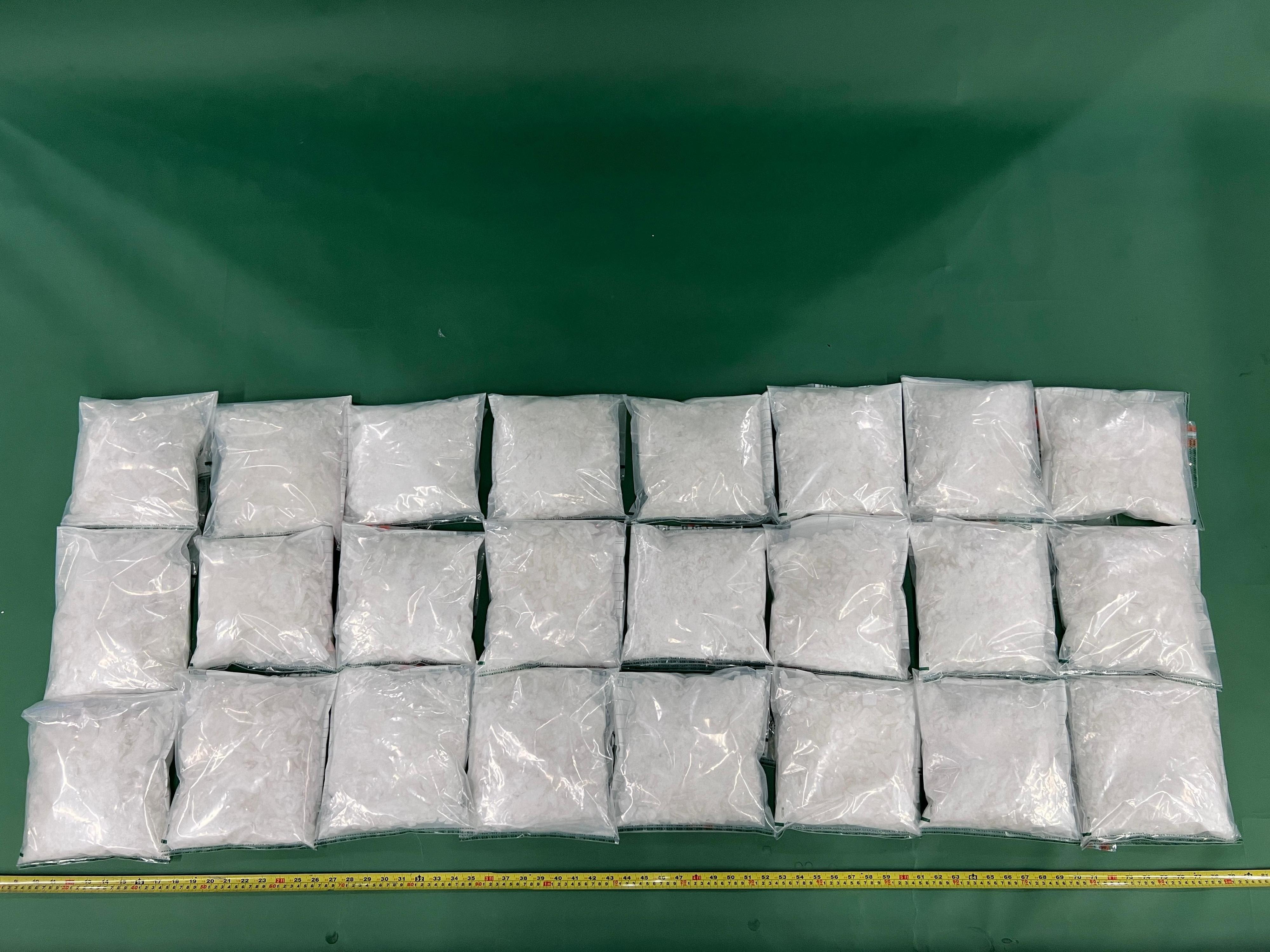
     Hong Kong Customs on June 12 seized about 24 kilograms of suspected methamphetamine with an estimated market value of about $16 million at Hong Kong International Airport. 

     Through risk assessment, Customs officers on that day inspected an air consignment that had arrived in Hong Kong from Mexico and found the batch of suspected methamphetamine concealed inside eight radiators. A 45-year-old male truck driver suspected to be connected with the case was arrested at the scene. After investigation, the arrested man has been released on bail pending further investigation.

     After a follow-up investigation, Customs officers yesterday (June 13) further arrested a 17-year-old young woman suspected to be connected with the case in Tuen Mun.  

     An investigation is ongoing.

     Customs reminds members of the public to stay alert and not to participate in drug trafficking activities for monetary return. They must not accept hiring or delegation from another party to carry controlled items into and out of Hong Kong. They are also reminded not to carry unknown items for other people, nor to release their personal data or home address to others for receiving parcels or goods.

     Under the Dangerous Drugs Ordinance, trafficking in a dangerous drug is a serious offence. The maximum penalty upon conviction is a fine of $5 million and life imprisonment.

     Young people should especially pay attention to the fact that drug trafficking is a serious criminal offence. Criminal conviction will result in grave repercussions for their future and they should not take risks in the hope that they will not be caught.

     Customs will continue to step up enforcement actions against drug trafficking activities through air cargo, postal parcel and express courier channels, as well as maintain close contact with Hongkong Post and the logistics industries, with a view to intercepting the inflow of drugs to Hong Kong.

     Members of the public may report any suspected drug trafficking activities to Customs’ 24-hour hotline 2545 6182 or its dedicated crime-reporting email account (crimereport@customs.gov.hk).

Photo  
read more

LCQ20: Project Strategy and Governance Office

     Following is a question by the Hon Lai Tung-kwok and a written reply by the Secretary for Development, Ms Bernadette Linn, in the Legislative Council today (June 14):
 
Question:
 
     In 2019, the Development Bureau upgraded the Project Cost Management Office (PCMO) and renamed it the Project Strategy and Governance Office (PSGO) to holistically strengthen the governance of public works projects. PSGO starts the vetting process immediately upon the inception of a project, so as to seize all opportunities to optimise the project design to reduce costs. In this connection, will the Government inform this Council:
 
(1) of the specific details of the strategies and measures implemented respectively by PCMO and PSGO for reducing the costs of public works projects;
 
(2) of the total number of public works projects examined by PSGO in the past three years and the total cost savings achieved, and set out in a table the amounts of cost savings by public works project;
 
(3) apart from signing Memoranda of Understanding on cooperation with the Centre for Public Project Management of Singapore and the Infrastructure and Projects Authority of the United Kingdom respectively to foster mutual collaboration and enhance the delivery capability and performance of public works projects, whether PSGO has plans at present to strengthen cooperation with the relevant authorities of the Mainland or other places; if so, of the details; if not, the reasons for that; and
 
(4) as there are views that in recent years, the Government has been actively taking forward projects to relocate to or provide in caverns suitable government facilities, but the costs of cavern development projects are on the high side and such projects may not be cost-‍effective, of the specific work carried out by PSGO in the past three years to optimise the design of cavern development projects for reducing costs?
 
Reply:
 
President,
 
     The Government has been continuously investing in capital works to improve people’s quality of life, enhance Hong Kong’s long-term competitiveness and promote its economic development. With long-term planning, relevant projects are implemented in a timely and orderly manner. The annual capital works expenditure was maintained at the level of about $80 billion over the past few years and is expected to grow continuously to exceed $100 billion in the coming years. Taking into account construction works in the private sector, the annual total construction output was maintained at the level of about $250 billion over the past few years and is forecast to reach about $300 billion annually.
 
     In view of the challenges of high construction cost and the ageing construction labour force faced by Hong Kong in recent years, the Development Bureau (DEVB) established the Project Cost Management Office (PCMO) in June 2016 and upgraded it to become the Project Strategy and Governance Office (PSGO) in April 2019 for implementing strategic initiatives and enhancing capabilities in cost surveillance and project governance.
 
     My reply to the four parts of the Hon Lai’s question is as follows:
 
(1) The main task of the PSGO is to vigorously scrutinise cost estimates of major projects under planning and design stage. While not compromising the functionality, quality and safety of works, the PSGO scrutinises project cost estimates in accordance with the principle of “fitness-for-purpose and no frills” through the implementation of various initiatives under the following four areas, for enhancing the performance of infrastructure projects:
 
(i) Strengthening cost management 

     The PSGO follows up on project development and design optimisation from inception stage and continuously monitors the performance of the projects during construction stage, and implement suitable measures for cost saving;
 
(ii) Implementing strategic initiatives 

     The PSGO uplifts productivity and efficiency in order to reduce project costs through taking forward various strategic initiatives, including the implementation of “Construction 2.0” and promotion for wider adoption of high productivity construction methods such as Modular Integrated Construction and Multi-trade Integrated Mechanical, Electrical and Plumbing, as well as digital technology and new construction materials;
 
(iii) Enhancing collaboration with industry stakeholders

     The PSGO conducts exchanges and collaborates with local industry (including the Construction Industry Council, professional institutions, universities and trade unions etc.) as well as the Mainland and international stakeholders with a view to learning from and drawing on the experience of different places in tackling challenges such as declining productivity of labour force and rising costs, and formulating proposals to resolve the problems faced by the construction industry in Hong Kong; and
 
(iv) Enhancing project delivery capability 

     The PSGO is committed to enhancing the mindset and capability of project officers in order to implement relevant strategic initiatives.  In this connection, the Centre of Excellence for Major Project Leaders (CoE) was established in 2019, and the Major Projects Leadership Programme and the Project Delivery Capability Programme, launched under the CoE, provide training for major project leaders and mid-tier managers respectively and enable them to deliver projects with an innovative mindset and better leadership skills, thereby enhancing project performance.
 
(2) Over the past three financial years, the PSGO examined a total of about 180 capital works projects which were subject to funding approval by the Finance Committee of the Legislative Council and successfully saved more than $67 billion of construction cost out of the total original estimate of about $440 billion, details of which are tabulated below. As the data involves internal financial information, we thus provided the relevant figures according to the financial year:
 

Financial Year Number of projects examined Original estimate Saving in construction cost
2022-23 52 about $95 billion about $13 billion
2021-22 78 about $180 billion about $29 billion
2020-21 54 about $165 billion about $25 billion
 
(3) The DEVB signed a Memorandum of Understanding with the Ministry of Finance of Singapore and the Infrastructure and Projects Authority, part of the Cabinet Office and HM Treasury of the United Kingdom in December 2022 and February 2023 respectively to enhance expertise and experience exchanges in infrastructure project management and delivery. Besides, we have all along maintained communication and active exchanges with relevant Mainland counterparts, including the Department of Housing and Urban-Rural Development of Guangdong Province, the Guangzhou Municipal Housing and Urban-Rural Development Bureau and the Bureau of Public Works of Shenzhen Municipality, to have discussions on a range of issues such as innovation and technology, manpower demand and construction standards. On another front, the PSGO has been liaising and communicating with international organisations that promote infrastructure development, such as the World Economic Forum and the Global Infrastructure Hub, to learn from and draw on their experience with a view to consolidating Hong Kong’s leading position in implementing infrastructure projects.
 
(4) To support the need for sustainable development of Hong Kong, it is the established policy of the Government to adopt a multi-pronged approach to explore land resources. The hilly and hard rock terrain of Hong Kong makes it highly suitable for development of caverns under appropriate geological conditions. The Government is proactively taking forward a number of cavern projects for relocating/accommodating suitable government facilities with a view to releasing land for housing and other uses. These facilities include sewage treatment works, fresh water/salt water service reservoirs, warehouses, material testing laboratories, archives centres, etc. The relocation of suitable government facilities to caverns can release existing valuable sites for housing or other uses to meet society’s needs on the one hand, and relocate facilities that are incompatible with the environment nearby and land uses on the other, for improvement of urban layout and environmental quality of the district.
 
     Accommodating new government facilities in caverns in a cost-effective manner can also save the use of surface land, thereby achieving a more valuable and effective land arrangement. Besides, the unique features of caverns are suitable for facilities which require a secure and stable operating environment. When assessing the effectiveness of cavern development projects, we will take into consideration the environmental and social benefits, development cost and other factors in a holistic manner.
 
     To lower the construction cost of cavern developments, the PSGO coordinates with the Geotechnical Engineering Office, cavern project teams, consultant firms and international experts to optimise the design in accordance with the principle of “fitness-for-purpose and no frills”. For example, the team has introduced a globally leading cavern design approach adopted from Nordic countries to optimise cavern design and reduce the cavern excavation volume and thus the construction cost. Innovative technologies and advanced construction methods are also adopted to expedite the progress of works. We also collaborate with the Nano and Advanced Materials Institute to develop brand new vibration-resistant materials to further reduce the construction cost and raise the works efficiency, with a view to shortening the construction time. We will continue to study different measures to further reduce the construction cost and fast-track the construction process of cavern works. read more