Tag Archives: China

image_pdfimage_print

LCQ3: Enhancing regulation of building works in private buildings

     Following is a question by the Hon Rock Chen and a reply by the Secretary for Development, Ms Bernadette Linn, in the Legislative Council today (June 21):
 
Question:
 
     It has been reported that part of a structural wall (commonly known as “core wall”) in a unit of a private housing court in Tseung Kwan O is suspected to have been removed, and such alteration may affect the structural safety of the building. In this connection, will the Government inform this Council:
 
(1) given that under the Buildings Ordinance, applications to the Buildings Department (BD) are required for any works involving the removal of core walls in private buildings, of the respective numbers of the relevant applications received, approved and rejected by the BD in the past three years, and the reasons for such applications being rejected; of the respective numbers of persons arrested, prosecuted and convicted for failing to submit applications before carrying out the relevant works;
 
(2) given that the aforesaid incident was exposed by netizens only after the relevant video had been uploaded onto a property viewing website, and as private buildings are private places, how the authorities detect and combat illegal building works carried out in private buildings, and whether they will strengthen cyber patrols and enforcement efforts; and
 
(3) as there are views that Hong Kong does not have a mandatory licensing and registration system for the interior design industry, and hence it cannot guarantee that interior design proposals comply with the building safety requirements, whether the authorities will consider establishing a licensing and registration system for the industry, so as to enhance the safety standard of the relevant works and the professional image of the industry; if so, of the details; if not, the reasons for that?
 
Reply:
 
President,
 
     My response to the three parts of the question from the Hon Chen is as follows:
 
(1) According to the Buildings Ordinance (BO) (Cap. 123), removal or alternation of structure is an alternation and addition (A&A) work which requires prior approval from the Buildings Department (BD). The numbers of applications received for structural A&A works by the BD in 2020 to 2022 ranged from around 1 800 to 2 200. The numbers of applications approved ranged from around 1 500 to 1 900, whereas the numbers of applications rejected ranged from around 40 to 70. Since a single application may involve different and multiple A&A works, the BD does not maintain separate statistics on applications on removal of structural walls. However, in order to endeavour to organise some general information within the short timeframe, the BD checked the cases processed last month, which showed that the BD approved a total of 17 applications for plans involving structural changes and additions to domestic units, one of which involved the removal of structural wall.
 
     Except for exempted works, we regard any A&A works without the prior approval of the BD or not following the streamlined procedures under the Minor Works Control System as unauthorised building works (UBWs). The BD may issue a removal order under the BO requiring the demolition or rectification of the UBWs by the owner. The BD does not maintain separate enforcement statistics in respect of removal of structural walls. For reference, in the three years between 2020 and 2022, the BD issued around 8 200 to 16 300 removal orders yearly; the number of prosecution cases were around 2 800 to 3 600 yearly and there were around 1 600 to 2 100 convictions yearly. The prosecution and conviction figures may not correspond to the removal orders issued in the same year.
 
(2) Generally, the BD take enforcement action of the BO through large-scale operations or sampling inspections, reports from the public, media reports, as well as referrals by government departments. With recent experience learnt, the BD will also pay close attention to online information, such as videos promoting housing units and fitting-out services on social media. If the BD finds suspected UBWs, investigations will be initiated and appropriate actions will be taken proactively according to the findings.
 
     Anyone may be subject to criminal prosecution if they breach the BO or its subsidiary regulations. Besides, if building professionals or registered contractors have been convicted by court of an offence relating to building works, or has been negligent or has misconducted themselves in building works, the BD may undertake disciplinary actions, including a reprimand, a fine or suspension from the registers kept by the BD.
 
(3) Interior design includes space planning, selection of materials and furniture, decoration and display, etc. These tasks per se do not necessarily involve construction works. We think that, regarding whether to enhance enforcement of this sector, we need to adhere to the risk-based principle, take into account effective deployment of enforcement resources, and avoid over-regulating which would hinder the development of that particular sector and even bring inconvenience to users of the public. We consider it more pragmatic to continue to focus on the regulation of works carrying certain risks, and the building professionals or registered contractors who carry out these works. The works I just mentioned are those works that require prior approval by the BD or minor works.
 
     Another pragmatic and very important work is to enhance public education and the law-abiding awareness of the sector. To this end, the BD will arrange talks with professional institutes about the points to note when carrying out interior fitting-out works. The BD will also step up publicity and education targeted at owners’ corporations, the property management industry, and the interior design and fitting-out industry. Following this incident, we acknowledge that some members of the public may be concerned whether their homes have illegal A&A works, or that they do not know how to check the plans to determine the location of the structural walls. In this regard, the BD will soon launch a telephone hotline to receive and answer public inquiries on related matters. The BD will also arrange for those in need to visit its Building Information Centre and demonstrate how to obtain relevant building plans and understand relevant basic information therein, including how to distinguish between structural walls and non-structural walls. Talks will be held at the Building Information Centre and online on inspection of building plans.
 
     Owners should consult building professionals before commencing interior fitting-out works to ensure that the works are carried out in accordance with the BO and its subsidiary legislations. Besides, owners and building professionals should check the terms of the deeds of mutual covenant and other relevant documents to see if any restrictions are specified therein, e.g. whether there is need to seek consent from the owners’ corporations or property management agencies before they can conduct certain kinds of works. read more

Government welcomes passage of Stamp Duty (Amendment) (No. 2) Bill 2023

     The Government welcomes the passage of the Stamp Duty (Amendment) (No. 2) Bill 2023 by the Legislative Council today (June 21), which implements a measure to trawl for talent as announced in the 2022 Policy Address by introducing a refund mechanism under the Buyer’s Stamp Duty (BSD) and the New Residential Stamp Duty (NRSD) regimes to attract talent from around the world to stay in Hong Kong for long-term development, thereby enriching the talent pool of Hong Kong.
 
     The Deputy Chief Secretary for Administration, Mr Cheuk Wing-hing, said, “The refund mechanism will bring the overall stamp duty charged on eligible incoming talents on par with that charged on first-time home buyers who are Hong Kong permanent residents (HKPRs), hence reducing the cost of home purchase for those incoming talents who are able and wish to buy residential properties in Hong Kong. We believe that this measure will help incentivise incoming talents to purchase homes and reside in Hong Kong in the long run, which would inject impetus to the growth of Hong Kong.”
 
     Under the refund mechanism, for an eligible incoming talent who has entered Hong Kong under a designated talent admission scheme, acquired a residential property in Hong Kong on or after October 19, 2022 (i.e. the date of announcement of the 2022 Policy Address), and subsequently becomes an HKPR, he/she can apply for a refund of the BSD and the NRSD paid for the residential property which, at the time it was purchased, was the applicant’s only residential property (save for replacing property) and the applicant still holds on the date of the application for refund. The Ad Valorem Stamp Duty at Scale 2 rates (i.e. the rates applicable to first-time home buyers who are HKPRs) will still be payable.
 
     The amended Ordinance will be published in the Gazette on June 30, 2023, and the Inland Revenue Department will start accepting refund applications from incoming talent upon its gazettal. read more

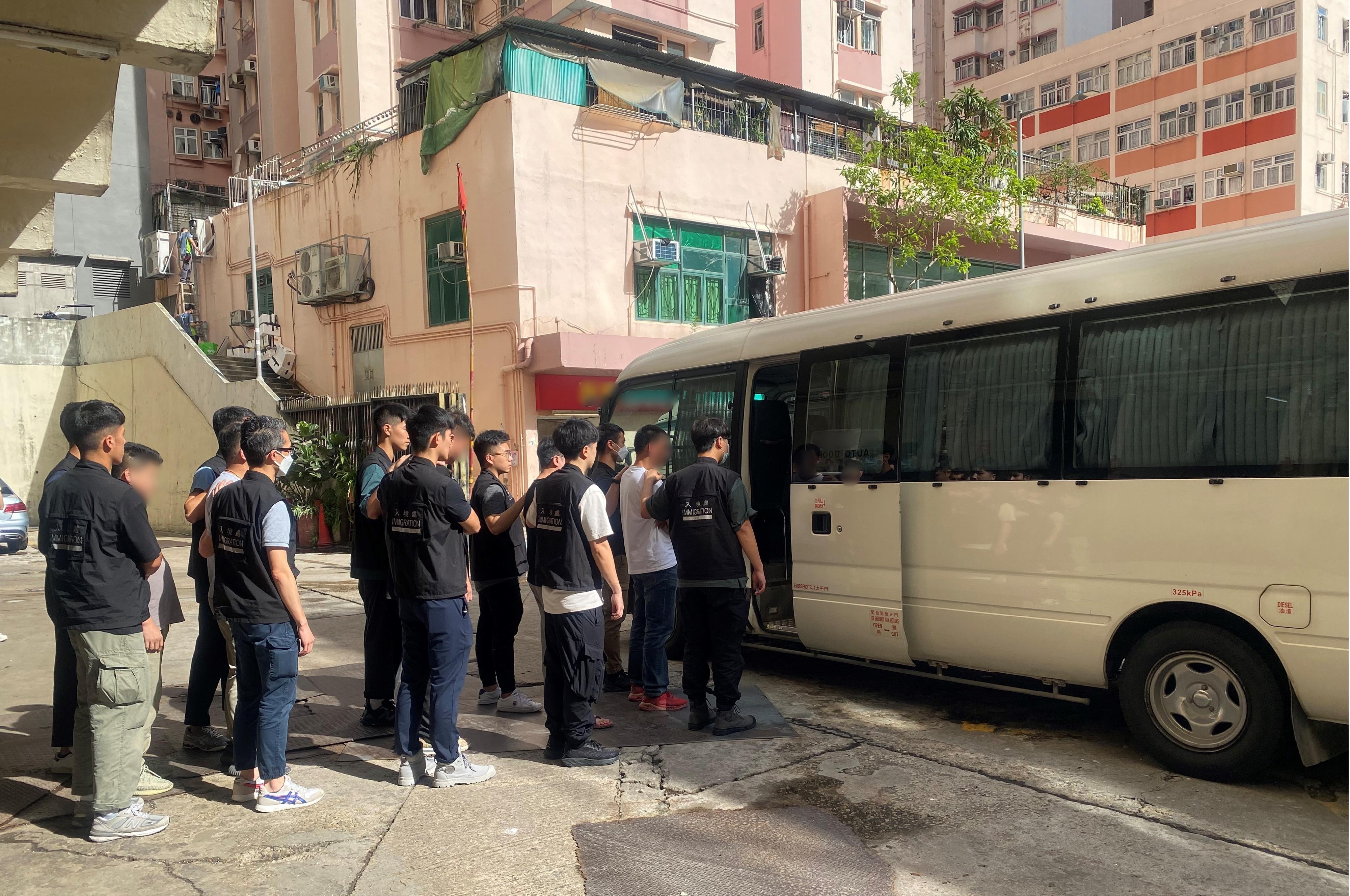
11 persons arrested during anti-illegal worker operations (with photos)

     The Immigration Department (ImmD) mounted a series of territory-wide anti-illegal worker operations codenamed “Lightshadow” and “Twilight”, and joint operations with the Hong Kong Police Force codenamed “Windsand” for two consecutive days from June 19 to yesterday (June 20). A total of 10 suspected illegal workers and one suspected employer were arrested.
 
     During the anti-illegal worker operations, ImmD Task Force officers raided 40 target locations including car parks, commercial buildings, premises under renovation, a residential building, restaurants and warehouses. Seven suspected illegal workers and one suspected employer were arrested. The arrested suspected illegal workers comprised seven men, aged 22 to 45. Among them, two men were holders of recognisance forms, which prohibit them from taking any employment. One man, aged 32, was suspected of employing the illegal workers and was also arrested.
 
     Furthermore, during the operation “Windsand”, three Mainland visitors comprising one man and two women, aged 38 to 45, were arrested for breaching their condition of stay by being involved in suspected illegal parallel trading activities at Po Shek Wu Road and San Wan Road in Sheung Shui district. The goods mainly included daily necessities and health products.
 
     An ImmD spokesman said, “Any person who contravenes a condition of stay in force in respect of him or her shall be guilty of an offence. Also, visitors are not allowed to take employment in Hong Kong, whether paid or unpaid, without the permission of the Director of Immigration. Offenders are liable to prosecution and upon conviction face a maximum fine of $50,000 and up to two years’ imprisonment. Aiders and abettors are also liable to prosecution and penalties.”
 
     The spokesman warned, “As stipulated in section 38AA of the Immigration Ordinance, an illegal immigrant, a person who is the subject of a removal order or a deportation order, an overstayer or a person who was refused permission to land is prohibited from taking any employment, whether paid or unpaid, or establishing or joining in any business. Offenders are liable upon conviction to a maximum fine of $50,000 and up to three years’ imprisonment.”
 
     The spokesman reiterated that it is a serious offence to employ people who are not lawfully employable. Under the Immigration Ordinance, the maximum penalty for an employer employing a person who is not lawfully employable, i.e. an illegal immigrant, a person who is the subject of a removal order or a deportation order, an overstayer or a person who was refused permission to land, has been significantly increased from a fine of $350,000 and three years’ imprisonment to a fine of $500,000 and 10 years’ imprisonment to reflect the gravity of such offences. The director, manager, secretary, partner, etc, of the company concerned may also bear criminal liability. The High Court has laid down sentencing guidelines that the employer of an illegal worker should be given an immediate custodial sentence.
 
     According to the court sentencing, employers must take all practicable steps to determine whether a person is lawfully employable prior to employment. Apart from inspecting a prospective employee’s identity card, the employer has the explicit duty to make enquiries regarding the person and ensure that the answers would not cast any reasonable doubt concerning the lawful employability of the person. The court will not accept failure to do so as a defence in proceedings. It is also an offence if an employer fails to inspect the job seeker’s valid travel document if the job seeker does not have a Hong Kong permanent identity card. Offenders are liable upon conviction to a maximum fine of $150,000 and to imprisonment for one year. In that connection, the spokesman would like to remind all employers not to defy the law by employing illegal workers. The ImmD will continue to take resolute enforcement action to combat such offences.
 
     Under the existing mechanism, the ImmD will, as a standard procedure, conduct an initial screening of vulnerable persons, including illegal workers, illegal immigrants, sex workers and foreign domestic helpers, who are arrested during any operation with a view to ascertaining whether they are trafficking in persons (TIP) victims. When any TIP indicator is revealed in the initial screening, the ImmD officers will conduct a full debriefing and identification by using a standardised checklist to ascertain the presence of TIP elements, such as threats and coercion in the recruitment phase and the nature of exploitation. Identified TIP victims will be provided with various forms of support and assistance, including urgent intervention, medical services, counselling, shelter or temporary accommodation and other supporting services. The ImmD calls on TIP victims to report crimes to the relevant departments immediately.

Photo  Photo  
read more