Tag Archives: China

image_pdfimage_print

SITI attends press conference of International Science, Technology and Innovation Forum of Boao Forum for Asia 2025 Hong Kong Conference in Hainan (with photos)

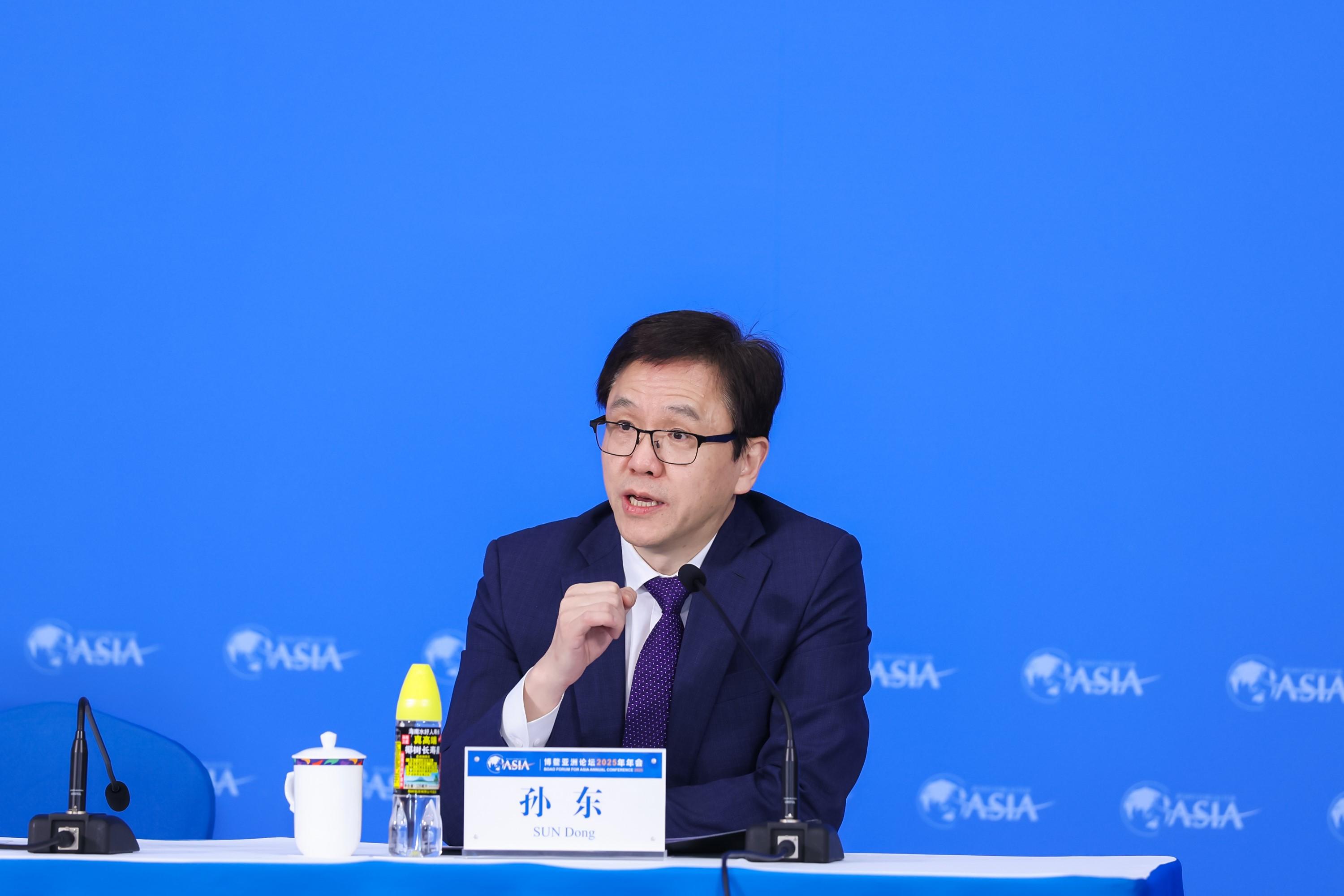
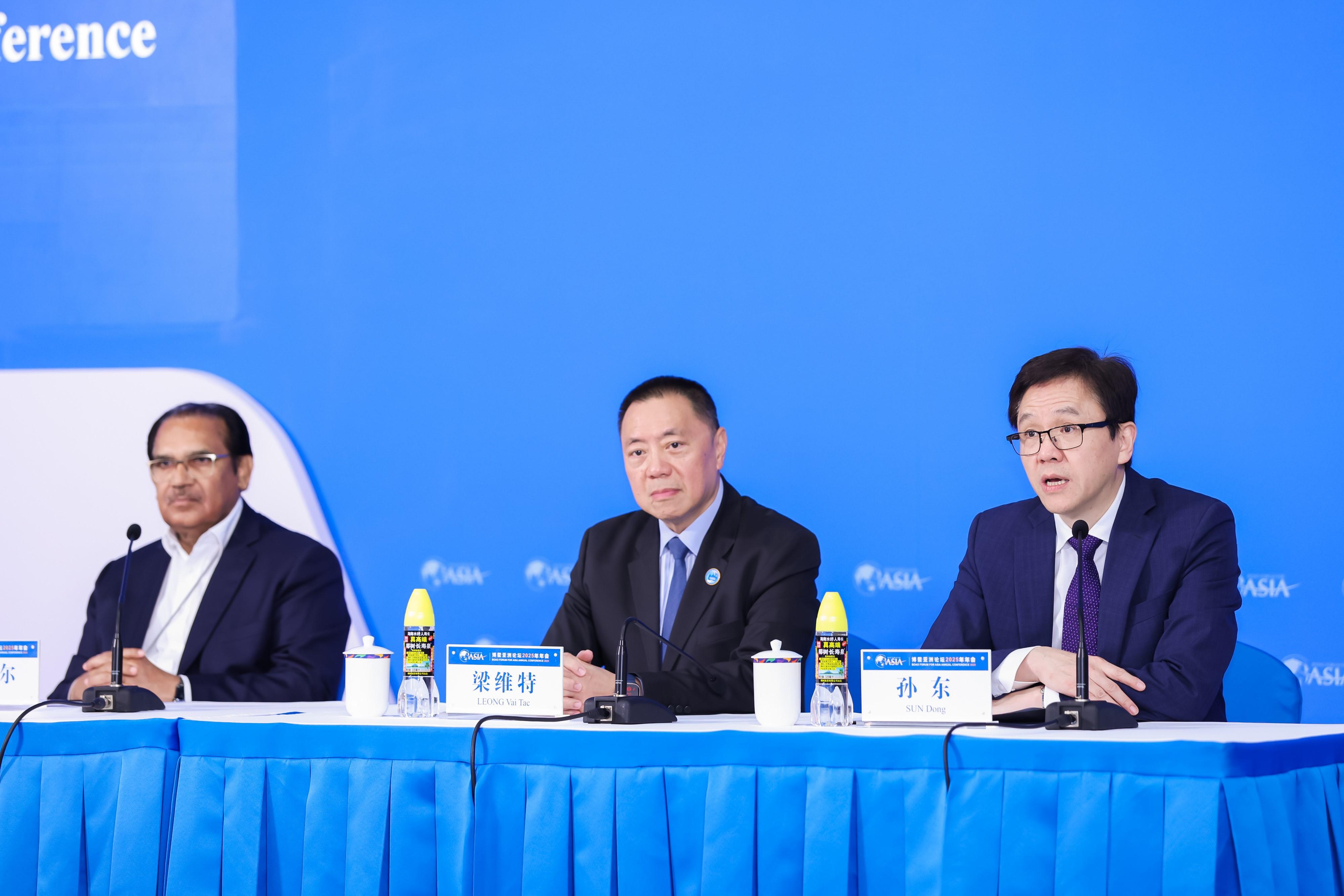
     â€‹The Secretary for Innovation, Technology and Industry, Professor Sun Dong, attended a press conference for the International Science, Technology and Innovation Forum (ISTIF) of the Boao Forum for Asia (BFA) 2025 Hong Kong Conference in Hainan this morning (March 26), together with the Executive Chairman of the BFA ISTIF, Mr Leong Vai-tac, to provide more details on the Hong Kong Conference to be held in June.
      
     The BFA initiated the ISTIF in 2019, with a mission to strengthen global science and technology governance, promote international science and technology innovation and co-operation, lead the direction in rule making of emerging technologies, and contribute to the United Nations 2030 Agenda for Sustainable Development. Since then, three editions have been held and the ISTIF has become a premier platform for exchanges, dialogues, and co-operation in the field of science and technology innovation.
      
     The BFA and the Hong Kong Special Administrative Region (HKSAR) Government will jointly host the ISTIF 2025 Hong Kong Conference at the Hong Kong Convention and Exhibition Centre on June 6 and 7. Under the theme of “Transitioning Towards the Future: Powered by Science and Technology Innovation”, the Conference is expected to attract around 800 participants from the Mainland and overseas, including top-notch experts, scholars, government and business leaders to exchange views on the latest trends in global innovation and technology (I&T) development, the development and emerging opportunities in frontier technological fields, and to inject new impetus into the I&T development of the country and the world at large.
      
     Mr Leong said that the Conference will highlight the unique characteristics of the BFA, the Greater Bay Area (GBA) and Hong Kong, promote the transformation of research and development outcomes, foster pragmatic collaboration, and serve as an international platform bridging government, business, academic and research sectors, jointly contributing to Asia’s development and addressing global challenges through international exchanges and collaboration in the I&T field.
      
     Professor Sun said that it is a great honour for the HKSAR Government to cohost the Hong Kong Conference with the BFA in Hong Kong. He said, “Hosting the Hong Kong Conference by the HKSAR Government does not only continue the ISTIF’s tradition of staging the event in Guangdong-Hong Kong-Macao GBA cities, but also reaffirms Hong Kong’s advantages as a highly internationalised city and its pivotal role of bridging the country and the world as a dual platform.

     â€‹”Through the Hong Kong Conference, we endeavor to deepen regional and international I&T co-operation, further elevate Hong Kong’s profile in the international I&T arena, and accelerate the development of Hong Kong into an international I&T centre. Hong Kong will fully leverage its strengths as a ‘super connector’ and ‘super value-adder’, harnessing its advantages to create a high-quality international science and technology mega event.”
      
     The Conference will comprise the opening ceremony, a Hong Kong forum, sub-forums, panel discussions and round tables, with internationally renowned speakers who will share their insights on a wide range of topics, including global science and technology governance, sustainable development, innovation clusters, life sciences, future mobility, AI, quantum technology, financial innovation and youth leadership, contributing to the enhancement of international co-operation and global governance in science, technology and innovation.
      
     Professor Sun concluded his visit and returned to Hong Kong in the afternoon.

Photo  Photo  
read more

Housing Authority to pass on rates concession to tenants

The following is issued on behalf of the Hong Kong Housing Authority:
 
     The Hong Kong Housing Authority (HA) will pass on the rates concession for the first quarter of 2025-26, as set out in the Budget Speech of the Financial Secretary in February this year, to its domestic and non-domestic tenants, starting from April 2025. 
 
     “Following approval by the Subsidised Housing Committee of the HA, the apportioned amount of rates concession will be passed on to domestic tenants on a monthly basis over a three-month period from April 1, 2025, to June 30, 2025, by offsetting an equivalent amount of the monthly rent payable by them, subject to a ceiling of $500 for each rateable property,” a spokesman for the HA said today (March 26). For tenancies that do not cover the entire month, the transfer of the rates concession will be made on a pro-rata basis.
 
     “The rates concession passing-on arrangement will apply to all domestic lettings including interim housing licensees,” the spokesman said.
 
     “Similarly, the Commercial Properties Committee (CPC) of the HA approved that the rates concession for the first quarter of 2025-26 for the HA’s non-domestic properties (excluding car parks) will also be passed on to the non-domestic tenants/licensees on a ‘no loss, no gain’ principle. Their monthly rates from April to June 2025 will be waived subject to a ceiling of $500 for each rateable non-domestic property,” the spokesman said.
 
     Also, for the HA’s 18 single-operator markets, namely Ching Long, Choi Fook, Chun Yeung, Hoi Tat, Hung Fuk, Kwai Chung, Lei Muk Shue, Mun Tung, On Tai, Pak Tin, Queens Hill, Shek Mun, Shui Chuen O, Tin Yan, Yan Tin, Ying Tung, Kai Chuen and Ping Yan, the operators will also pass on the rates concession to their licensees in full.
 
     “Given the small amount of rates concession to individual car park users and the significant administrative costs involved for its distribution to these users, the CPC endorsed the exclusion of car parks from this exercise in line with the arrangements for passing on the rates concession in previous exercises. The rates concession for car parks received by the HA will be invested in enhancing the HA’s car park facilities, such as installation of electric vehicle charging facilities at suitable sites, replacement of energy-efficient lighting to promote environmental protection and upgrading of security systems,” the spokesman said. 
  
     The maximum total amount of rates concession to be passed on to domestic and non-domestic tenants/licensees by the HA is estimated to be about $397 million and $4.5 million respectively. They will be individually notified of the detailed arrangements by the Housing Department. read more

LCQ9: New Capital Investment Entrant Scheme

     Following is a question by the Hon Holden Chow and a written reply by the Secretary for Financial Services and the Treasury, Mr Christopher Hui, in the Legislative Council today (March 26):
 
Question:
 
     The Chief Executive announced in the 2024 Policy Address enhancements to the New Capital Investment Entrant Scheme (New CIES) to further strengthen Hong Kong’s status as an international asset and wealth management centre. The enhancement measures have taken effect from the 1st of this month. Regarding the implementation of New CIES, will the Government inform this Council:
 
(1) of the respective numbers of applications received and approved by the authorities since the launch of New CIES;
 
(2) whether the authorities have compiled statistics on the types of approved investment of the integrated financial assets of the applicants since the launch of New CIES, together with a breakdown in table form by total investment amount (in descending order);
 
(3) as the scope of investment of New CIES has been extended to cover single residential properties with a transaction price of no less than $50 million since October 16 last year, whether the authorities have compiled statistics on the number of transactions involving the sale and purchase of such residential properties since that date;
 
(4) from the implementation of New CIES to the effective date of the enhancement measures, whether the authorities have compiled statistics on the total number of applicants or their dependants who have set up family offices in Hong Kong during this period; if so, of the details; and
 
(5) whether the authorities have plans on when to review the effectiveness of the enhancement measures, and further enhance New CIES where necessary, for example, by lowering the threshold for the permissible investment in single residential properties of no less than $50 million to no less than $30 million, so that the attractiveness of New CIES can be enhanced?
 
Reply:
 
President,
 
     The New Capital Investment Entrant Scheme (New CIES) opened for application from March 2024, with the aim to further enrich the talent pool and attract new capital to Hong Kong. In consultation with Invest Hong Kong and the Immigration Department (ImmD), the reply to various parts of the question is as follows:
 
     Since the launch of the New CIES to end-February 2025, the New CIES has received 918 applications, approved 868 applications for Net Asset Assessment and 386 applications for Assessment on Investment Requirements. The ImmD granted “approval-in-principle” for 756 applications, enabling the applicants to enter Hong Kong as visitors to make the committed investment, and granted “formal approval” for 341 applications. If all applications received are approved, it is estimated that they will bring more than HK$27 billion to Hong Kong.
 
     Under the New CIES, applicants must invest a minimum of HK$30 million in the permissible investment assets, including investing a minimum of HK$27 million in the permissible financial assets and/or real estate (subject to a cap of HK$10 million), and placing HK$3 million into a new Capital Investment Entrant Scheme Investment Portfolio (CIES Investment Portfolio). Among the 386 approved applications for Assessment on Investment Requirements as of end-February 2025, no applicant has made investment in residential real estate under the New CIES. Excluding the sum for investing in the CIES Investment Portfolio, the approved investment distribution is as follows:
 

  Investment amount
(HK$ Million)
Eligible collective investment schemes 5,171
Equities 3,570
Debt securities 1,773
Non-residential real estate 18
Certificates of deposits 9
Ownership interest in limited partnership funds 7
Total 10,548
 
     Except for the applicants’ investment in Hong Kong under the New CIES, the Government does not maintain the data on the investments made by applicants in Hong Kong (including residential real estate) outside the New CIES. Furthermore, before the enhancement measures took effect, it was not required for the applicant and his/her dependents to declare family office setups in Hong Kong, hence the Government does not maintain data on family offices established in Hong Kong by the applicant or his/her dependents.
 
     To enhance the attractiveness of the New CIES and developmental strengths of Hong Kong’s asset and wealth management industry, with effect from October 16, 2024, applicants under the New CIES are allowed to invest in residential properties, provided that the transaction price of a single property is HK$50 million or above. The total investment amount in real estate (the aggregate of all residential and non-residential properties) which is counted toward fulfilling the minimum investment threshold is subject to an aggregate cap of HK$10 million. The Government also announced a series of enhancement measures to the New CIES in January 2025. Effective on March 1, 2025, the measures include:
 
(a) relaxing the requirements on the fulfillment of net asset requirement (NAR): An applicant under the New CIES is only required to demonstrate that he/she has net assets or net equity to which he/she is absolutely beneficially entitled with a market value of not less than HK$30 million net throughout six months (two years before the enhancement) preceding the application. Net assets or net equity jointly owned with the applicant’s family member(s) can also be taken into consideration for the calculation of the NAR for the respective portion which is absolutely beneficially entitled to the applicant; and
 
(b) allowing the holding of permissible investment assets through a Family-owned Investment Holding Vehicle (FIHV) or a Family-owned Special Purpose Entity (FSPE) under an FIHV: Investments made through an eligible private company wholly owned by an applicant can be counted towards the applicant’s eligible investment in the New CIES. An eligible private company refers to a holding company incorporated or registered in Hong Kong which is wholly owned by an applicant in the form of an FIHV or an FSPE under an FIHV managed by an eligible single family office as defined in Section 2 of Schedule 16E to the Inland Revenue Ordinance (Cap. 112). The enhancement will create synergy between the New CIES and establishment of family offices in Hong Kong.
 
     The Government will continuously review the operation of the New CIES and suitably evaluate its effectiveness. read more

LCQ16: Pilot Rehabilitation Programme for Employees Injured at Work

     Following is a question by the Hon Lam Chun-sing and a written reply by the Secretary for Labour and Welfare, Mr Chris Sun, in the Legislative Council today (March 26):
 
Question:
 
     The Government launched a three-year Pilot Rehabilitation Programme for Employees Injured at Work (the Pilot Programme) on September 23, 2022, to facilitate injured workers’ early recovery and return to work. In this connection, will the Government inform this Council:
 
(1) of the current staff establishment and strength of the Work Injury Rehabilitation Office (WIRO), which is responsible for implementing the Pilot Programme, as well as the average number of cases followed up by each of its case manager;
 
(2) of (i) the number of reported work injury cases received by the Labour Department (LD) in each of the past three years and this year to date and, among them, (ii) the number of cases identified as eligible for participating in the Pilot Programme (and its percentage), and (iii) the number of cases participating in the Pilot Programme (and its percentage in the total number of cases eligible for participating in the Pilot Programme), and set out in Table 1 a‍ breakdown by (a) construction industry, (b) catering and hotel industry (the industry covered since May last year), and (c) ‍transportation and logistics industry (the industry covered since May last year);

Table 1

Case category 2022 2023 2024 This year to date
(a) (b) (c) (a) (b) (c) (a) (b) (c) (a) (b) (c)
(i)                        
(ii)   Not applicable   Not applicable            
(iii)                
Total                        

(3) in respect of the cases participating in the Pilot Programme mentioned in (2)(iii), of (i) the types of work injury sustained by the injured workers involved, and (ii) the time taken between they agreed to participate in the Pilot Programme and received their first medical consultation from the case doctors, together with a breakdown by industry (i.e. (i) construction industry, (ii) catering and hotel industry, and (iii) transportation and logistics industry);

(4) given that in the reply to a question raised by a Member of this Council on the Estimates of Expenditure 2024-2025, the Government has indicated that the authorities will (a) ‍analyse and compare the data of the participants of the Pilot Programme against (b) the data of the injured employees who sustain similar work injuries but have not participated in the Pilot Programme, so as to assess the effectiveness of the Pilot Programme, of the respective numbers and ratios of cases ‍in which the employees referred to in the aforesaid (a) and (b) have ‍recovered after treatment, as well as the respective average time‍ taken for recovery, together with a breakdown by industry (i.e.‍ (i)‍ construction industry, (ii) catering and hotel industry, and (iii)‍ transportation and logistics industry);

(5) among the cases participating in the Pilot Programme mentioned in (2)(iii), of the number of those in which employees have recovered after treatment, and set out in Table 2 a breakdown and the respective percentages of such cases by return-to-work status (i.e. (i) engaging in the same kind of work, (ii) engaging in work of a different nature, (iii) return-to-work status under follow-up, and (iv) unable to return to work during the follow-up period for the time being) and the industry to which they belong (i.e. (a) construction industry, (b) catering and hotel industry, and (c) transportation and logistics industry); the main reasons for cases of return-to-work status still being followed up and those of not being able to return to work during the follow-up period for the time being;

Table 2
Return-to-work status Industry
(a) (b) (c)
(i)      
……      
(iv)      
Total      

(6) of the respective numbers and nature of enquiries and complaints received by the authorities about the Pilot Programme since its implementation; and
 
(7) whether it will consider extending the Pilot Programme to cover more industries, including those with higher risks of work injury such as the manufacturing and retail industries, as well as extending or regularising the Pilot Programme, so as to benefit more injured workers in need; if so, of the details; if not, the reasons for that?
 
Reply:
 
President,

    The Labour Department (LD) launched the Pilot Rehabilitation Programme for Employees Injured at Work (Pilot Programme) in September 2022. The Pilot Programme adopts a case management approach to provide timely and coordinated private out-patient rehabilitation treatment services for participating injured employees to facilitate their early recovery and return to work. Starting from May 9, 2024, the industry coverage of the Pilot Programme has been expanded to the catering and hotel industry and the transportation and logistics industry in addition to the original construction industry, with the aim of benefiting more injured employees. 

     My reply to the Hon Lam Chun-sing’s question is as follows:

(1) As at February 2025, the Work Injury Rehabilitation Office (WIRO) set up by service contractor of the Pilot Programme comprises a total of 10 administrative and professional staff, 11 case managers and three clerical staff. They are responsible for arranging and co-ordinating the rehabilitation treatment services provided under the Pilot Programme, providing case management and return-to-work facilitation services to participants as well as monitoring and administering the day-to-day operation of the Pilot Programme.

     Each Pilot Programme participant is assigned with a case manager who will follow up the case and provide support until the employee’s injury has reached maximum medical improvement (i.e. recovered) and the employee has returned to work, or until two months after the employee has recovered, whichever is earlier. As at February 2025, a total of 1 803 admitted cases have been or are being followed up by the 11 case managers of the WIRO, which means each case manager has managed about 160 cases on average.
 
(2) and (3) According to the Employees’ Compensation Ordinance (ECO), an employer must notify the Commissioner for Labour of any work accident within 14 days after the accident occurs or after it comes to his knowledge. The LD and the WIRO will, based on the reported work injury cases, preliminarily identify injured employees who are suitable for the Pilot Programme, proactively invite them to participate in the Pilot Programme and arrange interviews to ascertain their eligibility for and willingness to participate in the Pilot Programme. Thereafter, the case manager will schedule an appointment for the employee to meet with the case doctor. Once the case doctor ascertains after clinical assessment that the employee’s injury is suitable for treatment under the Pilot Programme, the relevant rehabilitation treatment will begin immediately. The injuries of the participants mainly involve contusion/bruise, sprain/strain and fracture, etc., accounting for about 80 per cent of all cases.

     As at February 2025, a total of 1 803 injured employees participated in the Pilot Programme. The relevant admission rates (Table 1) and time required for first medical consultation (Table 2) are as follows:

Table 1
  2022 2023 2024 2025 (as at February)
Industry# (a) (a) (a) (b) (c) (a) (b) (c)
(i) Reported work injury cases* 4 466 3 291 3 273 4 570 3 053 375 615 435
(ii) Cases preliminarily identified as suitable for participation in the Pilot Programme 697
^
2 498 1 717 586
@
656
@
148 121 102
(iii) Admitted cases and rate (iii/ii) 131
(19%)
524
(21%)
470
(27%)
250
(43%)
273
(42%)
52
(35%)
55
(45%)
48
(47%)
# (a) construction industryï¼›(b) catering and hotel industryï¼›(c) transportation and logistics industry
* Numbers of non-fatal employees’ compensation claims involving incapacitation of employees for more than three days as a result of work injuries reported under the ECO and received by the LD
^ The Pilot Programme was launched on September 23, 2022.
@ The Pilot Programme was expanded to the catering and hotel industry and the transportation and logistics industry on May 9, 2024.

Table 2
Time from preliminary identification to first medical consultation Construction industry Catering and hotel industry Transportation and logistics industry Number of participants
(Rate)
Seven days or below 483 93 92 668 (37%)
Above seven days to 14 days 502 135 147 784 (43%)
Above 14 days to 21 days 105 49 43 197 (11%)
Above 21 days 87 28 39 154 (9%)
Total 1 177 305 321 1 803

(4) The LD has conducted a preliminary evaluation on the first two years of operation of the Pilot Programme (i.e. from September 2022 to September 2024), and compared the data of the injured construction employees participating in the Pilot Programme against that of the injured construction employees who sustained similar work injuries but did not participate in the Programme. The findings show that the participants had a higher rate (75 per cent vs 62 per cent) of reaching maximum medical improvement (i.e. recovered) upon treatment during the evaluation period and the median time required for recovery was also shorter (123 days vs 192 ‍days), which met the objective of the Pilot Programme. Besides, the majority of participants were satisfied with the case management and rehabilitation treatment services provided under the Pilot Programme. Since many cases in the catering and hotel industry and the transportation and logistics industry are still being followed up, the LD will analyse the participants from these two industries in the future evaluation.

(5) Under the Pilot Programme, if participants have not returned to work within two months after recovery, the case manager will obtain updates on their return-to-work (RTW) status in the subsequent three months. As at February 2025, a total of 1 354 employees’ injuries have reached maximum medical improvement upon treatment (i.e. recovered). Their RTW status is as follows:
 
Return-to-work status Construction industry Catering and hotel industry Transportation and logistics industry Aggregate figures
Perform same type of work* Number of participants
(Rate)
388
(43%)
107
(51%)
131
(57%)
626
(46%)
Perform other types of work* Number of participants
(Rate)
78
(9%)
7
(3%)
17
(7%)
102
(8%)
RTW status still being followed up Number of participants
(Rate)
106
(12%)
71
(34%)
59
(26%)
236
(17%)
Yet to RTW as at the end of follow-up Number of participants
(Rate)
254
(28%)
14
(7%)
21
(9%)
289
(21%)
Unable to contact for RTW follow-up Number of participants
(Rate)
86
(9%)
12
(6%)
3
(1%)
101
(7%)
Total 912 211 231 1 354
* Irrespective of employment with the original or a different employer

     In cases where participants have not returned to work during the follow-up period, the majority cited personal reasons (such as considering themselves not yet suitable to resume work or preferring to take more rest), followed by medical considerations (such as undergoing treatment for other injuries), while some were in search for a job or on work trial, etc.
 
(6) As at February 2025, the WIRO received 232 enquiries mainly seeking information on the Pilot Programme’s content and eligibility for participation. There were also three complaints that mainly concerned the performance of individual rehabilitation professional or case manager.

(7) The LD has no plan to expand the Pilot Programme to more industries at present. The LD will continue to closely monitor the operation of the Pilot Programme, collect relevant information and data for analysis and evaluation, draw conclusion from the experiences gained during the implementation of the Pilot Programme and its effectiveness, and consider the direction for future development based on the results. read more