Tag Archives: China

image_pdfimage_print

Institutions and permanent offices qualified for interim measure applications announced

     The Department of Justice (DoJ) announced today (April 2) the following updated list of qualifying arbitral and dispute resolution institutions and permanent offices under Article 2(1) of the Arrangement Concerning Mutual Assistance in Court-ordered Interim Measures in Aid of Arbitral Proceedings by the Courts of the Mainland and of the Hong Kong Special Administrative Region (Arrangement) effective from April 2, 2025, (listed in arbitrary order):

* Hong Kong International Arbitration Centre
* Hong Kong Maritime Arbitration Group
* South China International Arbitration Center (HK)
* eBRAM International Online Dispute Resolution Centre
* Shanghai International Arbitration (Hong Kong) Center
* Asia Pacific International Arbitration Chamber Hong Kong Arbitration Center
* AALCO Hong Kong Regional Arbitration Centre
* China International Economic and Trade Arbitration Commission Hong Kong Arbitration Center
* International Court of Arbitration of the International Chamber of Commerce – Asia Office

     Under the Arrangement signed on April 2, 2019, between the DoJ and the Supreme People’s Court, parties to arbitral proceedings seated in Hong Kong and administered by eligible arbitral institutions which have been designated would be able to apply for interim measures from the relevant Mainland courts.

     The designation for institutions or permanent offices qualified under Article 2(1) of the Arrangement will be valid for a period of two years from the date of designation, ending on April 1, 2027, subject to further application for designation upon expiry. 

     Depending on the circumstances and operational considerations, the DoJ may update the list or consider future applications from time to time.

     For details, please visit the DoJ website. read more

Development Bureau invites market to submit expressions of interest for three island and coastal tourism projects

     The Development Bureau (DEVB) today (April 2) invites the market to submit expressions of interest (EOIs) within three months for eco-tourism development proposals at ex-Lamma quarry site, South Lantau Eco-Recreation Corridor, and Pak Nai and Tsim Bei Tsui.
           
     The Chief Executive announced in the 2024 Policy Address (PA) to promote island and coastal tourism in Hong Kong. Along with other initiatives to be spearheaded by the Culture, Sports and Tourism Bureau, the DEVB has been working on the land use and project planning aspects of three projects under large-scale land disposal, which are to develop the ex-Lamma quarry site into an area for resort and outdoor recreational uses; to develop Cheung Sha, Pui O, Shui Hau and Shek Pik into the South Lantau Eco-recreation Corridor; and to develop Tsim Bei Tsui and Pak Nai into eco-tourism nodes.  

     This is the first time in recent years that the Government has initiated large-scale land disposal for the building of new tourism and recreation areas. The Government is also striving to make full use of corporate participation and market forces in the implementation. All three projects are on islands or coastal destinations in rural settings with rich natural resources and water bodies. They all present opportunities for the Government to collaborate with the private sector in promoting tourism and recreational developments while capitalising on local and rural characteristics.  

     A spokesman for the DEVB said, “We are also launching these three EOIs before commencing any statutory planning process. This goes to demonstrate the Government’s goodwill to garner feedback from the market before finalising development requirements. It is believed that this process would help ensure the ultimate development schemes to be more attuned to market interests and considerations.”

     The three projects have different positionings and content, accommodating varying market interests: 
     
Ex-Lamma Quarry Site

     Its tranquil seaside location in a rural island setting, wealth of tourism and recreation resources particularly a large man-made lake, and proximity to the urban area have rendered this site suitable for development as a high-end lakefront and hillside resort, to be complemented by a world-class marina and low-rise luxury housing. The initiative aims to help promote yacht tourism on the one hand, and also help support the development of island hopping in Hong Kong. For this EOI, we will consult the market on ways to optimise the use of the site by suitably incorporating the above-mentioned elements in its overall development and synergising with other attractions in the area. On implementation, it is proposed to adopt a single-developer approach for this project. In other words, the 25-hectare site would be sold by public tender to one single developer or consortium. This approach could facilitate a more co-ordinated and holistic design for the entire development, and expedite the provision of necessary infrastructure by leveraging market forces, while enabling the future developer to enjoy a high degree of flexibility in land-use allocation.

South Lantau Eco-Recreation Corridor

     The South Lantau Eco-recreation Corridor project aims to make good use of the rich natural ecological, cultural and historical resources along the southern coast of Lantau. It provides a variety of recreation and eco-tourism facilities in Cheung Sha, Pui O, Shui Hau and Shek Pik with a view to shaping South Lantau into a one-of-a-kind leisure and recreation destination as well as bringing more experiences to the general public and tourists. On implementation, developers or consortiums may adopt a cluster approach to develop the entire areas or only focus on individual or multiple ecological and recreational facilities. This approach not only enhances the flexibility of project implementation, but also accelerates the development of the eco-recreation corridor.

Tsim Bei Tsui and Pak Nai Eco-tourism Nodes
     
     The proposal to develop two Eco-tourism Nodes at Tsim Bei Tsui and Pak Nai was generally supported in the public engagement exercise on the Broad Land Use Concept Plan for the Lau Fau Shan area in 2024, with the former to be positioned as a “Thematic Activity Node” and the latter a “Tranquil Scenic Node”. This EOI exercise aims to collect market proposals based on the more detailed development parameters for these two Nodes the Government has formulated following the public engagement. On implementation, given the substantial sizes of the two Eco-tourism Nodes (87 hectares for Tsim Bei Tsui and 33 hectares for Pak Nai), the future developer(s) may develop and operate the whole or part(s) of the Tsim Bei Tsui Eco-tourism Node, the whole or part(s) of the Pak Nai Eco-tourism Node, or the whole or part(s) of both Eco-tourism Nodes.  In other words, there can be more than one developer.

     “These three projects have different development scales, characteristics, objectives, timelines and deliverables (a table summarising major parameters is at the Annex). Through the three EOI exercises, we hope to collect market views and suggestions on the respective developments early in order to formulate appropriate development parameters and implementation details for incorporation into statutory plans and land tender documents.”

     “We would also like to have market feedback on alternative implementation approaches that can help speed up the developments. For example, in the case of ex-Lamma quarry site, we are proposing to launch the land tender right after the Government’s substantial completion of the statutory planning process, while facilitating the successful bidder to complete the remaining statutory procedures with our assistance and support. Such an approach can allow the successful bidder to start a detailed design and other preparatory works while the remaining statutory procedures are underway,” the spokesman added.

     The Invitation Documents for the EOIs have been uploaded onto the following websites:

(a) Tsim Bei Tsui and Pak Nai Eco-tourism Nodes (www.nm.gov.hk/en/high-end-professional-services-and-logistics-hub#c2);
(b) Ex-Lamma Quarry site (www.devb.gov.hk/en/issues_in_focus/index.html); and
(c) South Lantau Eco-recreation Corridor (www.lantau.gov.hk/en/our-projects/leisure-and-recreation/eco-recreation-corridor/index.html). 
      
     Interested parties must submit their EOIs by noon on July 2 (Wednesday).
    
     The DEVB will hold three briefing sessions, one for each of the EOI invitations on April 14 (Monday). For details of the briefings, please refer to the respective Invitation Documents for the three EOIs.
           
     Taking account of the views and suggestions received through the EOI exercises, the DEVB will suitably refine the development parameters and requirements for the three projects. The land tender arrangements and timings will be firmed up thereafter, with reference to the market feedback received. read more

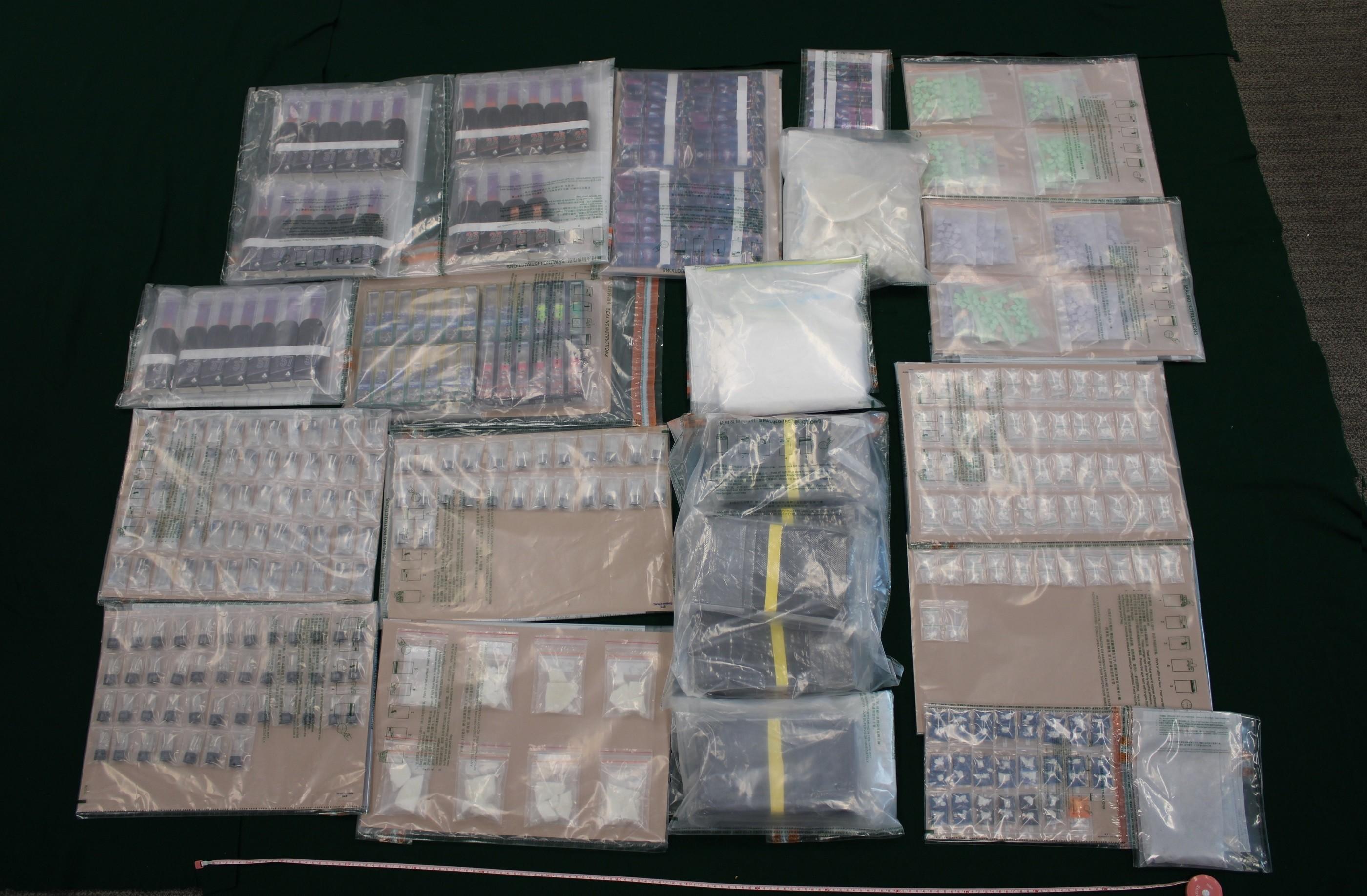
Hong Kong Customs shuts down dangerous drugs distribution centre with seizure of “space oil drug” and other kinds of narcotics (with photo)

     Hong Kong Customs yesterday (April 1) in Wong Tai Sin shut down a suspected dangerous drugs distribution centre, seizing different kinds of suspected narcotics including the “space oil drug”, a batch of electronic cigarette devices and suspected drug packaging paraphernalia with a total estimated market value of about $7 million. Two men suspected to be connected with the case were arrested.
      
     During an anti-narcotics operation conducted in the vicinity of Wong Tai Sin yesterday, Customs officers intercepted a 19-year-old man and found about 1.1 kilograms of suspected crack cocaine, 1kg of suspected cocaine, 1 500 tablets of suspected ecstasy, 100 grams of suspected ecstasy powder, and 102 electronic cigarette devices containing suspected cannabis oil inside a suitcase carried by him. He was then arrested. Customs officers later escorted the arrested man to a nearby public housing unit where he lived for a search, and further seized 129 suspected “space oil drug” capsules, about 5kg of suspected cocaine, about 200g of suspected crack cocaine, 80 electronic cigarette devices, and a batch of drug packaging paraphernalia. Another man, aged 54, inside the unit was also arrested.
      
     An investigation is ongoing.
      
     Customs will continue to step up enforcement and stringently combat against trafficking of the “space oil drug”. If public rental housing units are found to be involved in drug trafficking crimes, Customs will notify the Housing Department for follow-up action after the conclusion of court proceedings.
      
     Under the Dangerous Drugs Ordinance, trafficking in a dangerous drug is a serious offence. The maximum penalty upon conviction is a fine of $5 million and life imprisonment.
      
     Members of the public may report any suspected drug trafficking activities to Customs’ 24-hour report hotline 182 8080 or its dedicated crime reporting email account (crimereport@customs.gov.hk) or online form (eform.cefs.gov.hk/form/ced002).

Photo  
read more

LCQ18: Reducing risk of unintentional injuries among elderly

     Following is a question by Professor the Hon Chow Man-kong and a written reply by the Secretary for Health, Professor Lo Chung-mau, in the Legislative Council today (April 2):

Question:

     The Action Plan to Strengthen Prevention of Unintentional Injuries in Hong Kong (the Action Plan) released by the Government in 2015 indicated that the number of deaths due to unintentional injuries, commonly known as accidents, accounted for 44.8 per cent of the number of registered deaths in 2013, and such injuries could also lead to premature death. There are views that it is necessary for the Government to enhance home safety for the elderly aged 65 and above, particularly those living alone, so as to reduce the risk of unintentional injuries among the elderly. In this connection, will the Government inform this Council:

(1) apart from the Injury Survey 2008 and the Report of Unintentional Injury Survey 2018 (the 2018 Report) released by the Department of Health in 2010 and 2021 respectively, whether the Government has collected data on unintentional injuries among the elderly over the past five years through various channels, such as (i) 999 Emergency Calls, (ii) the number of visits to accident and emergency departments, and (iii) the emergency call systems (e.g. Safety Bell) provided by commercial or non-commercial organisations; if so, of the details, including the numbers of elderly persons who have sought assistance through the channels in (i) to (iii) for reasons such as (a) falls, (b) sprains, and (c) being struck at home, as well as their respective percentage; if not, the reasons for that;

(2) given that a total of 16 specific actions have been proposed in the Action Plan, of the implementation of each of these specific actions by the authorities over the past 10 years;

(3) as there are views that it is only through continuous monitoring of unintentional injuries that the situation over different periods of time can be reflected, and in response to the aging population trend in Hong Kong, whether the authorities have considered changing the current practice of conducting surveys only once every 10 years, and expeditiously commissioning a research institution to launch a new round of survey based on the 2018 Report to collect information on the latest modes and trends of unintentional injuries among the elderly, particularly trends relating to home accidents, so as to facilitate the formulation of relevant preventive measures and appropriate allocation of resources to better safeguard the personal safety and well-being of the elderly; if so, of the details; if not, the reasons for that; and

(4) whether it will consider taking the initiative to install elderly facilities (e.g. handrails and non-slippery floor tiles in bathrooms) in all public rental housing units (especially older ones) where elderly people live alone, and following the example of Singapore in launching subsidy schemes to provide owners of subsidised sale flats, including those under the Home Ownership Scheme, with subsidies for installing elderly facilities at home, thereby reducing the risk of home accidents among the elderly and better preparing Hong Kong to head towards an ageing society; if so, of the details, including whether it has assessed the expenditure involved; if not, the reasons for that?

Reply:

President,

     Since 2008, the Government formulated a strategic framework to prevent and control non-communicable diseases (NCDs) and set up the Steering Committee on Prevention and Control of Non-Communicable Diseases (Steering Committee) to steer the work on NCD prevention and control. Three working groups have been established under the Steering Committee to make recommendations on specific priority areas for action, including the Working Group on Injuries established in 2012. The working group has drawn up the Action Plan to Strengthen Prevention of Unintentional Injuries in Hong Kong (Action Plan) in 2015 with an aim to reduce unintentional injuries. In response to the updates of relevant recommendations from the World Health Organization, the Government will continue to review the targets of prevention and control of NCDs set in “Towards 2025: Strategy and Action Plan to Prevent and Control Non-communicable Diseases in Hong Kong” and formulate prevention and control strategies after 2025.

     The reply, in consultation with the Department of Health (DH) and the Housing Bureau, to the question raised by Professor the Hon Chow Man-kong is as follows:

(1), (2) and (3) The Action Plan was published by the DH in 2015. According to the information in the Action Plan, in 2013, the registered deaths attributed to injuries accounted for 4.3 per cent of the total deaths in Hong Kong, of which the number of deaths attributed to unintentional injuries (commonly known as accidents) accounted for 44.8 per cent of the total number of registered deaths attributed to injuries. In other words, 1.9 per cent of the total deaths were attributed to unintentional injuries.

     Since the launch of the Action Plan, the DH collaborated with other Government bureaux and departments as well as social partners to implement all specific actions in the Action Plan towards the four priority areas (i.e. falls, sports injuries, domestic injuries other than falls and drowning) in phases. Specific actions include strengthening injury surveillance, improving public awareness and empowering the public’s ability to make informed decisions on injury prevention to reduce the burden of injuries to Hong Kong. To raise the public awareness on injury prevention, the DH has devised intervention measures by adopting a life-course framework, covering different stages of life from early childhood through the elderly years and introduced a series of health promotion programmes targeting different age groups. The DH has disseminated relevant information on injury prevention via different channels such as posters, pamphlets, websites and social media, including publishing an electronic handbook Domestic Safety Handbook, introducing safety precautions while using household appliances and furniture; producing relevant information related to sports injury, and promote information regarding drowning prevention to the public.

     Besides, targeting the risk of unintentional injuries among elderly, the Elderly Health Service (EHS) under the DH carried out the follow actions:

(1) send Visiting Health Teams to conduct integrated assessment including the risk of fall for Residential Care Homes for the Elderly (RCHEs) throughout the city every year, to help in the planning of fall prevention programmes tailored to their needs;

(2) conduct health talks surrounding the subject of injury prevention at Elderly Health Centres, community centres and RCHEs. These talks are developed by a multi-disciplinary healthcare team including doctors, nurses, physiotherapists and occupational therapists, and tailor-made for community dwelling elders and those living in the RCHEs as well as their carers; and 

(3) together with social welfare organisations, District Elderly Community Centres and Neighbourhood Elderly Centres, through the Community Carer Capacity Building Programme, to equip volunteers with knowledge and conduct home visits for elderly persons, with a view to identifying elderly with high risk of fall, carrying out environment assessment and offering environment modifications recommendations, so as to reduce the risks of fall for community dwelling elders. Elderly identified with high risk of fall will be referred to occupational therapists in the EHS for follow up.

     The DH will continue to review and enhance injury surveillance and public education.

     Meanwhile, District Health Centres/District Health Centre Expresses (DHCs/DHCEs) also promote fall prevention awareness, and osteoporosis and osteoporotic fracture prevention measures through health education, including promotion of calcium and vitamin D intake, weight-bearing exercise, fall prevention, and healthy lifestyles. For elderly at high risk, DHCs/DHCEs will provide muscle strength and balance training, and offer advice on mobility aids and gadgets, home safety measures and home modification according to their needs. Besides, DHCs/DHCEs will collaborate with local community organisations and healthcare providers to provide information on osteoporosis or make referrals for persons who are interested or in need.

     In terms of injury surveillance, in addition to conducting the city-wide injury survey decennially, the DH also collects, analyses and publishes mortality and discharge statistics every year, enabling relevant stakeholders to understand the situation of unintentional injuries among Hong Kong residents. The proportion of unintentional injuries out of registered deaths and inpatient discharges (including deaths) in the past three years are as follows:
 

  Registered deaths due to unintentional injuries Inpatient discharges (including deaths) due to unintentional injuries (Note)
Year Percentage of total registered deaths Percentage of total registered deaths aged 65 or above Percentage of total inpatient discharges Percentage of total inpatient discharges aged 65 or above
2021 1.7 per cent 1.4 per cent 4.5 per cent 4.3 per cent
2022 1.5 per cent 1.2 per cent  4.3 per cent  4.2 per cent
2023 1.9 per cent  1.5 per cent  4.5 per cent  4.4 per cent
Note: Including Hospital Authority hospitals and private hospitals inpatients.
Data source:The DH and the Hospital Authority.

     The DH does not maintain other statistics requested in the question.

(4) The Hong Kong Housing Authority (HA) always upholds the values of “Caring” and keeps abreast of the times to actively explore feasible measures to facilitate the needs of the elderly, and to create a liveable and inclusive living environment which fosters residents’ greater sense of belonging based on actual need. The above aligns with the Government’s ageing in place policy. The Action Group of the Housing Department, led by the Secretary for Housing, formulated the “Well-being design” guide for the development of public spaces, facilities and estate environment in future public housing projects. The guide, which was completed and launched in September 2024, is gradually applied to newly built public housing projects. The same design concepts have also been introduced to existing public estates to enhance relevant facilities. Taking into account the needs of different age groups and family compositions, the guide which covers eight well-being concepts such as “Age-Friendliness” and “Intergenerational & Inclusive Living”, aim at enhancing the safety of elderly residents and promoting mutual support among family members of different ages.

     In terms of the design, in fact, since 2002, the HA has adopted the “Universal Design Concept” in new public housing projects, such as subsidised sale flats including the Home Ownership Scheme. The Concept was not only applied to different common areas but also inside flats so as to provide a suitable living environment for residents of all ages. The relevant provisions include non-slip floor tiles in the kitchen and bathroom; lever-type door handles, faucets of sink units and shower heads; larger switches and doorbell buttons at reachable heights; lean benches at lift lobbies of every floor in residential buildings for use by the elderly and the needy while waiting for lifts; voice synthesisers in lifts to cater for the needs of the hearing-impaired elderly; ramps at common areas to facilitate residents’ access. In order to facilitate the needs of the elderly and residents who are physically-challenged, since 2021, the HA has provided grab bars in the shower areas of all new flat units.

     The HA will continue to review and enhance the design of public housing to cater for the needs of the elderly.

     As for the existing public rental housing (PRH), the HA endeavours to enhance and optimise barrier-free access and facilities in existing PRH estates to meet the needs of PRH residents, especially the needs of elderly and persons with disabilities for barrier-free access. In addition, the HA undertakes to provide home adaptations or modification works in PRH flats of eligible elderly residents in need to facilitate their daily lives. The works include, where practicable, installing a ramp at the entrance of the flat; widening the doorway of the bathroom; laying non-slip floor tiles on suitable floor surfaces; converting the bath tub to a shower area; installing grab bars in the bathroom or installing visual fire alarm systems. If a resident simply requests the installation of grab bars and installation of shower area in the bathroom or the replacement of lever-type faucets, the HA will directly arrange the related works for free under the streamlined arrangement. For other adaptation or modification works, the HA will arrange the works according to the advice from relevant professionals including doctors, physiotherapists or occupational therapists to ensure that the works meet the actual needs of individual residents.

     Moreover, the HA offers subsidy for the emergency alarm system (EAS) (also known as the Safety Bell) to eligible elderly households to cater for their needs. Starting from February 2021, in addition to traditional EAS, the HA has extended the subsidy for EAS to cover mobile EAS, such as mobile phones and watches equipped with EAS, installation of dedicated EAS mobile app on smart phones, and products with fall detection function. The elderly households may purchase the said devices on their own. Successful applicants will be given a one-off subsidy of not more than $2,500 to cover the actual expenses on a reimbursement basis. read more

LCQ19: Promoting staging of international convention and exhibition activities in Hong Kong

     Following is a question by the Hon Tang Fei and a written reply by the Secretary for Commerce and Economic Development, Mr Algernon Yau, in the Legislative Council today (April 2):

Question:

     It is learnt that the Government has actively organised a number of major international conferences, summits, exhibitions and related activities after the epidemic, with a view to promoting economic recovery in Hong Kong and consolidating Hong Kong’s international status. In this connection, will the Government inform this Council:

(1) whether it has compiled statistics on the following information in respect of each of the major international conferences, summits and exhibitions organised in Hong Kong in the past three years: (i) the theme, (ii) the number of participants, and (iii) the proportions of overseas and Mainland participants;

(2) whether it has assessed the actual effectiveness of the major international events mentioned in (1) on the Hong Kong economy, such as the business opportunities created for local industries including hotel, tourism, retail and catering; and

(3) whether it has studied how to enhance Hong Kong’s influence in the international arena through organising major international conferences and summits, so as to consolidate Hong Kong’s status as an international trading centre and Asia’s business hub and further strengthen Hong Kong’s role as a “super connector”; if so, whether it can provide specific examples?

Reply:

President,

     The convention and exhibition (C&E) industry is crucial to Hong Kong as an international trade centre. Every year, Hong Kong hosts many large-scale international conventions and exhibitions (for example, the Hong Kong International Jewellery Show, Cosmoprof Asia, the Belt and Road Summit etc), covering different industries/themes, including electronics, jewellery, gifts, watches and clocks, lighting etc. The number and attendance of the C&E events held in Hong Kong’s two dedicated venues for mega C&E events (viz. the Hong Kong Convention and Exhibition Centre (HKCEC) and the AsiaWorld-Expo (AWE)) in the past three years are as follows:
 

  2022 2023 2024
Number of C&E events About 150 About 320 About 350
Attendance* About 3.52 million About 6.87 million About 9.17 million
*The HKCEC and the AWE do not have the breakdown figures on participants from overseas and the Mainland.
 
     These C&E events have attracted numerous participants (including exhibitors and buyers), not only benefitting the C&E industry but also bringing in high-spending business travellers that drive economic activities in such related sectors as accommodation, catering, retail and entertainment, thereby benefitting various industries and bringing important contributions to Hong Kong’s economy. According to the statistics of the Hong Kong Tourism Board, there were about 1.42 million overnight C&E visitors in 2024 and their per capita spending was about $7,800.
 
     In 2025, it is estimated that the HKCEC and the AWE will organise over 140 conventions and 180 exhibitions in total, including large-scale international exhibitions and conferences such as Art Basel Hong Kong 2025, Routes World 2025 and the Asia Financial Forum.
 
     In view of the contribution of C&E events to Hong Kong’s overall economy, the Hong Kong Special Administrative Region (HKSAR) Government launched the Incentive Scheme for Recurrent Exhibitions (ISRE) in July 2023 which was very well received. As announced in the 2024 Policy Address, the HKSAR Government would allocate an additional provision of $500 million for implementing the ISRE 2.0, subsidising venue rentals of eligible exhibitions organised by private organisers at specified venues (including the Central Harbourfront Event Space and relevant parts of the West Kowloon Cultural District which are newly included in the ISRE 2.0, apart from the HKCEC and the AWE). The ISRE 2.0 will focus on attracting new and recurrent international exhibitions of a large scale to further promote the development of the C&E industry and the mega event economy, thereby generating overall economic benefits for Hong Kong. The ISRE 2.0 will be launched on July 1 this year subject to the Legislative Council’s funding approval.
 
     Hong Kong is the world’s 10th largest trading entity in merchandise trade and has developed into the region’s premier C&E hub. The international large-scale C&E events held here will help enhance Hong Kong’s image as an international C&E hub, foster overall economic development and trade, and promote Hong Kong’s brands in various industries to assist Hong Kong enterprises in tapping the Mainland and international markets, while reinforcing Hong Kong’s position as an international trade centre and fully demonstrating our role as the “super connector” and “super value-adder” between the Mainland and the rest of the world. The HKSAR Government will continue to promote the development of the C&E industry and attract more international large-scale C&E events to be staged in Hong Kong. read more