CHP announces one new melioidosis case
The Centre for Health Protection (CHP) of the Department of Health today (May 16) announced that one new melioidosis case was recorded in the past week (May 9 to 15). The case involves a 75-year-old … read more


The Centre for Health Protection (CHP) of the Department of Health today (May 16) announced that one new melioidosis case was recorded in the past week (May 9 to 15). The case involves a 75-year-old … read more
The Census and Statistics Department (C&SD) published today (May 16) the May 2025 issue of the “Hong Kong Monthly Digest of Statistics” (HKMDS).
Apart from providing up-to-date statistics, this issue also contains a feature article entitled “Currency Composition of Hong Kong’s International Investment Position, 2020 to 2024”.
“Currency Composition of Hong Kong’s International Investment Position, 2020 to 2024”
International Investment Position (IIP) is an important statistic in the system of macroeconomic accounts that summarises the external position of an economy with the rest of the world. It is a balance sheet showing an economy’s stock of external financial assets and liabilities at a particular time point. The difference between the total value of external financial assets and liabilities is the net IIP of an economy, which provides a measure of net financial claims on non-residents plus gold bullion held as monetary gold.
In recent years, international community, such as the G20 Data Gap Initiative co-ordinated by the International Monetary Fund, has been advocating for the compilation of currency composition of IIP. In response to the initiatives and the needs of data users, the Census and Statistics Department has compiled and disseminated the statistics on the currency composition of Hong Kong’s IIP on a quarterly basis since the reference period of the first quarter of 2020, with data series backcasted to the reference period of the first quarter of 2017.
This feature article briefly introduces the data source for compiling the statistics in Hong Kong and the use of the statistics in assessing the external position. It also highlights the salient features of the currency composition of Hong Kong’s IIP from 2020 to 2024.
For enquiries about this feature article, please contact the Balance of Payments Branch (1) of the C&SD (Tel: 3903 6990; email: bop@censtatd.gov.hk).
Published in bilingual form, the HKMDS is a compact volume of official statistics containing about 130 tables. It collects up-to-date statistical series on various aspects of the social and economic situation of Hong Kong. Topics include population; labour; external trade; National Income and Balance of Payments; prices; business performance; energy; housing and property; government accounts, finance and insurance; and transport, communications and tourism. For selected key statistical items, over 20 charts depicting the annual trend in the past decade and quarterly or monthly trend in the recent two years are also available. Users can download the Digest at the website of the C&SD (www.censtatd.gov.hk/en/EIndexbySubject.html?pcode=B1010002&scode=460).
Enquiries about the contents of the Digest can be directed to the Statistical Information Dissemination Section (1) of the C&SD (Tel: 2582 4738; email: gen-enquiry@censtatd.gov.hk). read more
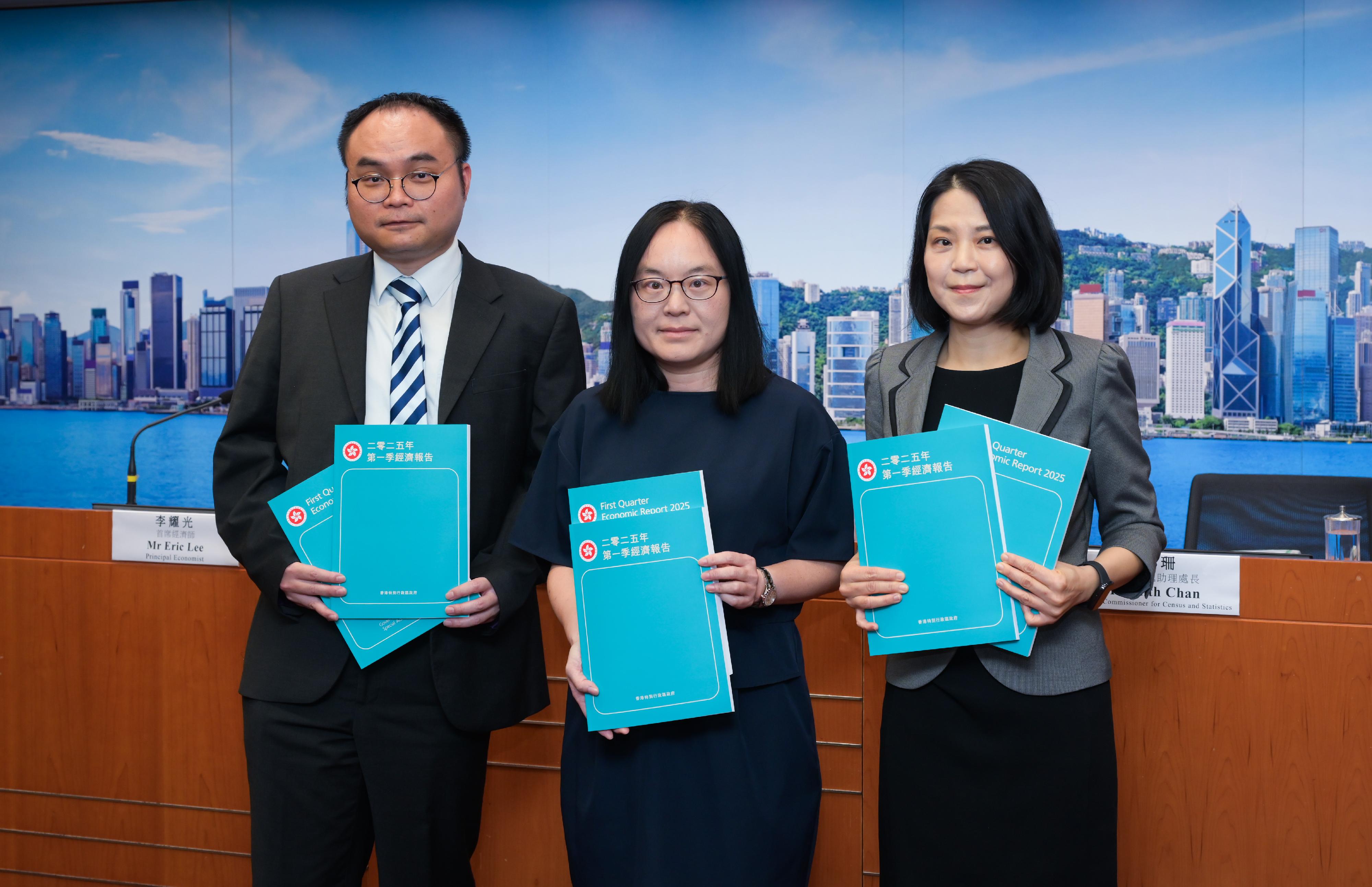
The Government released today (May 16) the First Quarter Economic Report 2025, together with the revised figures on Gross Domestic Product (GDP) for the first quarter of 2025.
The Acting Government Economist, Dr Cecilia Lam, gave an account of the economic performance in the first quarter of 2025 and the latest GDP and price forecasts for 2025.
Main points
* The Hong Kong economy expanded solidly in the first quarter of 2025, mainly supported by visible increases in exports of goods and services, as well as the resumption of moderate growth in overall investment expenditure. Yet, private consumption expenditure continued to register a modest decline. Real GDP expanded by 3.1% year-on-year in the first quarter, picking up from the 2.5% growth in the preceding quarter. On a seasonally adjusted quarter-to-quarter basis, real GDP grew visibly by 1.9%.
* The global economy maintained steady growth in the first quarter. With broadly sustained external demand, as well as some front-loading of shipments in anticipation of tariff hikes by the United States in early April, Hong Kong’s total exports of goods saw visibly accelerated growth, up 8.4% year-on-year in real terms. Meanwhile, thanks to the further increase in visitor arrivals, growth in cross boundary traffic, and notable increase in cross-boundary financial and fund raising activities, total exports of services continued to expand visibly in the first quarter, by 6.6% year-on-year in real terms.
* Domestically, overall investment expenditure resumed moderate growth, rising by 2.8% year-on-year in real terms, underpinned by a visible increase in expenditure on acquisitions of machinery, equipment, and intellectual property products, as well as a sharp rise in costs of ownership transfer due to a markedly higher number of property transactions compared to the same period last year. Yet, private consumption expenditure continued to register a small decline of 1.1%, reflecting the lingering impact of changes in residents’ consumption patterns.
* The labour market remained tight in the first quarter. The seasonally adjusted unemployment rate stayed low at 3.2%, slightly higher than the 3.1% in the preceding quarter. The underemployment rate remained at a low level of 1.1%. Employment earnings continued to record solid growth.
* The local stock market once rallied in the first quarter, driven by the Mainland’s breakthrough development in artificial intelligence (AI) and the Central Government’s measures to stimulate the domestic economy as unveiled at the “two sessions”. However, the market cooled down towards the end of the quarter amid concerns over the United States’ trade policy outlook. The residential property prices remained soft.
* Consumer price inflation stayed modest in the first quarter. The underlying Composite Consumer Price Index (Composite CPI) increased by 1.2% over a year earlier, same as the increase in the preceding quarter. Price pressures on various major components stayed largely contained. Including the effects of the Government’s one-off relief measures, the headline Composite CPI increased by 1.6% over a year earlier, higher than the 1.4% increase in the preceding quarter.
* As international trade tensions have eased somewhat of late, the headwinds and uncertainties in the external environment have lessened to some extent. This may relieve part of the downward pressure on the global economic outlook. Moreover, the sustained steady growth of the Mainland economy amid more proactive fiscal policies and the moderately accommodative monetary policies should bode well for the performance of merchandise exports in Asia including Hong Kong. Sustained international trade flows, coupled with improving inbound tourism, are also expected to benefit Hong Kong’s exports of services. However, uncertainties in the trade policies of the United States persist, and its monetary policy trajectory going forward is still complicated. These may affect global financial conditions and investment sentiment. Apart from this, the change in consumption patterns of residents and visitors would still pose constraints on driving consumption in the domestic market, though sustained increase in employment earnings and the SAR Government’s various policies to promote mega events and tourism would help boost consumption sentiment.
* Taking into account the actual outturn in the first quarter and the latest developments of the global and local situation, the real GDP growth forecast for 2025 as a whole is maintained at 2%-3%, the same as that announced in the Budget. The Government will continue to closely monitor the situation.
* On the inflation outlook, overall inflation should remain modest in the near term as pressures from domestic costs and external prices should stay broadly in check. Considering that the inflation situation in the first quarter was broadly in line with earlier expectations, the forecasts for the underlying and headline consumer price inflation rates for 2025 are maintained at 1.5% and 1.8% respectively, the same as those announced in the Budget.
Details
GDP
According to the revised figures released today by the Census and Statistics Department, real GDP grew by 3.1% year-on-year in the first quarter of 2025 (same as the advance estimate), having increased by 2.5% in the preceding quarter. On a seasonally adjusted quarter-to-quarter comparison, real GDP rose by 1.9% in the first quarter (revised from the advance estimate of 2.0%), after a 0.9% increase in the preceding quarter (Chart).
The latest figures on GDP and its major expenditure components up to the first quarter of 2025 are presented in Table 1. Developments in different segments of the economy in the first quarter are described below.
External trade
Supported by broadly sustained external demand as well as some front loading of shipments in anticipation of tariff hikes by the United States in early April, total exports of goods posted accelerated year-on-year growth of 8.4% in real terms in the first quarter, following a 1.3% increase in the preceding quarter. Analysed by major market and by reference to external merchandise trade statistics, exports to the Mainland grew strongly in the first quarter over a year earlier. Exports to the United States rose back, while those to the European Union fell further. Exports to ASEAN markets soared, while those to high-income Asian economies showed mixed performance. On a seasonally adjusted quarter-to-quarter basis, total exports of goods increased notably by 10.2% in real terms in the first quarter.
Exports of services continued to expand visibly by 6.6% in real terms in the first quarter over a year earlier, after growing by 6.5% in the preceding quarter. Exports of all major service groups rose further. Specifically, exports of travel and transport services continued to expand, supported by the further increase in visitor arrivals and growth in cross-boundary traffic. Exports of financial services rose sharply, thanks to the notable increase in cross-boundary financial and fund raising activities. On a seasonally adjusted quarter-to-quarter basis, exports of services were virtually unchanged in real terms in the first quarter.
Domestic sector
Private consumption continued to be subject to the lingering impact of changes in residents’ consumption patterns in the first quarter. Private consumption expenditure declined modestly by 1.1% in real terms from a year ago, after a marginal decline of 0.2% in the preceding quarter. On a seasonally adjusted quarter to quarter basis, private consumption expenditure decreased by 1.6% in real terms. Meanwhile, government consumption expenditure increased by 1.2% in real terms in the first quarter over a year earlier, after rising by 2.1% in the preceding quarter. On a seasonally adjusted quarter to quarter basis, government consumption expenditure increased by 0.5% in real terms.
Overall investment expenditure in terms of gross domestic fixed capital formation resumed moderate growth in the first quarter, rising by 2.8% year-on-year in real terms, after a modest decline of 0.7% in the preceding quarter. Within the total, expenditure on machinery, equipment, and intellectual property products increased visibly. The costs of ownership transfer rose sharply due to a markedly higher number of property transactions compared to the same period last year. Yet, expenditure on building and construction declined moderately.
The labour sector
The labour market remained tight in the first quarter of 2025. The seasonally adjusted unemployment rate stayed low at 3.2%, slightly higher than the 3.1% in the preceding quarter. The underemployment rate remained at a low level of 1.1%. The median monthly employment earnings of full-time employees in nominal terms increased by 6.4% year-on-year in the first quarter.
The asset markets
After staying largely range-bound in January 2025, the local stock market rallied after the Chinese New Year holidays through mid-March, as market sentiment was fuelled by the Mainland’s breakthrough development in AI and the Central Government’s measures to stimulate the domestic economy as unveiled at the “two sessions”. However, the market cooled down towards the end of the quarter amid concerns over the United States’ trade policy outlook. The Hang Seng Index (HSI) hit a three-year high of 24 771 on March 19, before retreating somewhat to close the first quarter at 23 120, up 15.3% from end-2024. In early April, trade tensions escalated abruptly due to the significant increase in import tariffs by the United States, and the global financial markets were volatile at that time. The HSI also fell in tandem, but it has recently resumed its uptrend.
The residential property prices remained soft in the first quarter. Market sentiment turned more cautious towards the end of March amid growing external uncertainties from the United States’ trading and monetary policies. Overall flat prices fell by 2% in the first quarter. The index of home purchase affordability improved slightly further to around 59% in the first quarter alongside easing flat prices during the quarter, but remained above the long-term average of 56% over 2005 2024. The number of transactions, in terms of the total number of sale and purchase agreements for residential property received by the Land Registry, retreated by 19% from the preceding quarter to 12 193 in the first quarter, but was 24% higher than the level a year ago. On the other hand, overall flat rentals continued to show resilience, edging up by 0.4% during the first quarter. As to the non-residential property market, it remained generally weak in the first quarter, with trading activities across major market segments showing mixed performance, as well as prices and rentals declining further.
Prices
Consumer price inflation stayed modest in the first quarter of 2025. The underlying Composite CPI increased by 1.2% over a year earlier in the first quarter, same as the increase in the preceding quarter. Within this, food prices as a whole increased mildly. Private housing rentals saw a slightly accelerated increase. Price pressures on other major components stayed largely contained. Including the effects of the Government’s one-off relief measures, the headline Composite CPI increased by 1.6% over a year earlier, higher than the 1.4% increase in the preceding quarter. The headline inflation rate was higher than its underlying counterpart in the first quarter, as the electricity charges subsidy provided by the Government was smaller compared with the same period last year.
Latest GDP and price forecasts for 2025
As international trade tensions have eased somewhat of late, the headwinds and uncertainties in the external environment have lessened to some extent. This may relieve part of the downward pressure on the global economic outlook. Moreover, the sustained steady growth of the Mainland economy amid more proactive fiscal policies and the moderately accommodative monetary policies should bode well for the performance of merchandise exports in Asia including Hong Kong. Sustained international trade flows, coupled with improving inbound tourism, are also expected to benefit Hong Kong’s exports of services. However, uncertainties in the trade policies of the United States persist, and its monetary policy trajectory going forward is still complicated. These may affect global financial conditions and investment sentiment. Apart from this, the change in consumption patterns of residents and visitors would still pose constraints on driving consumption in the domestic market, though sustained increase in employment earnings and the SAR Government’s various policies to promote mega events and tourism would help boost consumption sentiment.
Taking into account the actual outturn in the first quarter and the latest developments of the global and local situation, the real GDP growth forecast for 2025 as a whole is maintained at 2%-3%, the same as that announced in the Budget (Table 2). The Government will continue to closely monitor the situation. For reference, the latest growth forecasts by private sector analysts range between 1.0% to 2.5%.
On the inflation outlook, overall inflation should remain modest in the near term as pressures from domestic costs and external prices should stay broadly in check. Considering that the inflation situation in the first quarter was broadly in line with earlier expectations, the forecasts for the underlying and headline consumer price inflation rates for 2025 are maintained at 1.5% and 1.8% respectively, the same as those announced in the Budget (Table 2).
The First Quarter Economic Report 2025 is now available for online download, free of charge at www.hkeconomy.gov.hk/en/situation/index.htm. The Report of the Gross Domestic Product by Expenditure Component, which contains the GDP figures up to the first quarter of 2025, is also available for browse and download, free of charge on the homepage of the Census and Statistics Department, www.censtatd.gov.hk.
The Centre for Health Protection (CHP) of the Department of Health today (May 16) reported the latest number of dengue fever (DF) cases, and urged the public to maintain strict environmental hygiene, mosquito control and p… read more
Forty-one landlords of subdivided units (SDUs), who contravened Part IVA of the Landlord and Tenant (Consolidation) Ordinance (Cap. 7) (the Ordinance), pleaded guilty and were fined a total of $88,400 on May 9 and today (May 16) at the Eastern Magistrates’ Courts. Since the Ordinance came into force, the Rating and Valuation Department (RVD) has strengthened enforcement actions and has prosecuted a total of 1 040 cases to date. Among the 706 cases dealt with by the court, all were successfully convicted, which involved a total of 613 SDU landlords with fines ranging from $400 to $34,800, amounting to a total of $1,721,310. In addition, 334 cases are pending hearing.
The offences of these 41 landlords include (1) failing to submit a Notice of Tenancy (Form AR2) to the Commissioner of Rating and Valuation within 60 days after the term of the regulated tenancy commenced; and (2) requesting the tenant to pay money other than the types permitted under the Ordinance (including requiring the tenant to pay an amount of rent for the second-term tenancy exceeding the maximum amount of rent permitted under the Ordinance). One of the landlords committed eight offences under (1) and (2) and was fined $9,200.
The RVD earlier discovered that the landlords failed to comply with the relevant requirements under the Ordinance. Upon an in-depth investigation and evidence collection, the RVD prosecuted against the landlords.
A spokesman for the RVD reiterated that SDU landlords must comply with the relevant requirements under the Ordinance, including prohibiting landlords from doing any act calculated to interfere with the peace or comfort of members of the tenant’s household, with the intention of causing the tenant to give up occupation of the SDU; or requiring the tenant to pay an amount of rent for the second-term tenancy exceeding the maximum amount of rent permitted under the Ordinance, and also reminded tenants of their rights under the Ordinance, including a four-year (i.e. two years plus two years) security of tenure. He also stressed that the RVD will continue to take resolute enforcement action against any contraventions of the Ordinance. Apart from following up on reported cases, the RVD has been adopting a multipronged approach to proactively identify, investigate and follow up on cases concerning landlords who are suspected of contravening the Ordinance. In particular, the RVD has been requiring landlords of regulated tenancies to provide information and reference documents of their tenancies for checking whether they have complied with the requirements of the Ordinance. If a landlord, without reasonable excuse, refuses to provide the relevant information or neglects the RVD’s request, the landlord commits an offence and is liable to a maximum fine at level 3 ($10,000) and to imprisonment for three months. Depending on the actual circumstances, and having regard to the information and evidence collected, the RVD will take appropriate actions on individual cases, including instigating prosecution against suspected contraventions of the Ordinance. In addition, the RVD has started a new round of publicity and education work to enhance public awareness about key offences and penalties, emphasising that the RVD proactively checks whether landlords have committed the offences under the Ordinance.
To help curb illegal acts as soon as possible, members of the public should report to the RVD promptly any suspected cases of contravening the relevant requirements. Reporting can be made through the telephone hotline (2150 8303), by email (enquiries@rvd.gov.hk), by fax (2116 4920), by post (15/F, Cheung Sha Wan Government Offices, 303 Cheung Sha Wan Road, Kowloon), or in person (visiting the Tenancy Services Section office of the RVD at Room 3816-22, 38/F, Immigration Tower, 7 Gloucester Road, Wan Chai, Hong Kong, and please call 2150 8303 to make an appointment). Furthermore, the RVD has provided a form (Form AR4) (www.rvd.gov.hk/doc/en/forms/ar4.pdf) on its website to facilitate SDU tenants’ reporting to the RVD.
The RVD reminds that pursuant to the Ordinance, a regulated cycle of regulated tenancies is to comprise two consecutive regulated tenancies (i.e. the first-term tenancy and second-term tenancy) for an SDU, and the term of each regulated tenancy is two years. A tenant of a first-term tenancy for an SDU is entitled to be granted a second-term tenancy of the regulated cycle, thus enjoying a total of four years of security of tenure. The RVD has been issuing letters enclosing relevant information to the landlords and tenants concerned of regulated tenancies in batches, according to the expiry time of their first-term tenancies, to assist them in understanding the important matters pertaining to the second-term tenancy, and to remind them about the procedures that need to be followed about two months prior to the commencement of the purported second-term tenancy as well as their respective obligations and rights under the Ordinance. These landlords and tenants may also visit the dedicated page for the second-term tenancy on the RVD’s website (www.rvd.gov.hk/en/tenancy_matters/second_term_tenancy.html) for the relevant information, including a concise guide, brochures, tutorial videos and frequently asked questions. The landlords and tenants concerned are also advised to familiarise themselves with the relevant statutory requirements and maintain close communication regarding the second-term tenancy for handling the matters properly and in a timely manner according to the Ordinance.
For enquiries related to regulated tenancies, please call the telephone hotline (2150 8303) or visit the RVD’s webpage (www.rvd.gov.hk/en/our_services/part_iva.html) for the relevant information. read more