Tag Archives: China

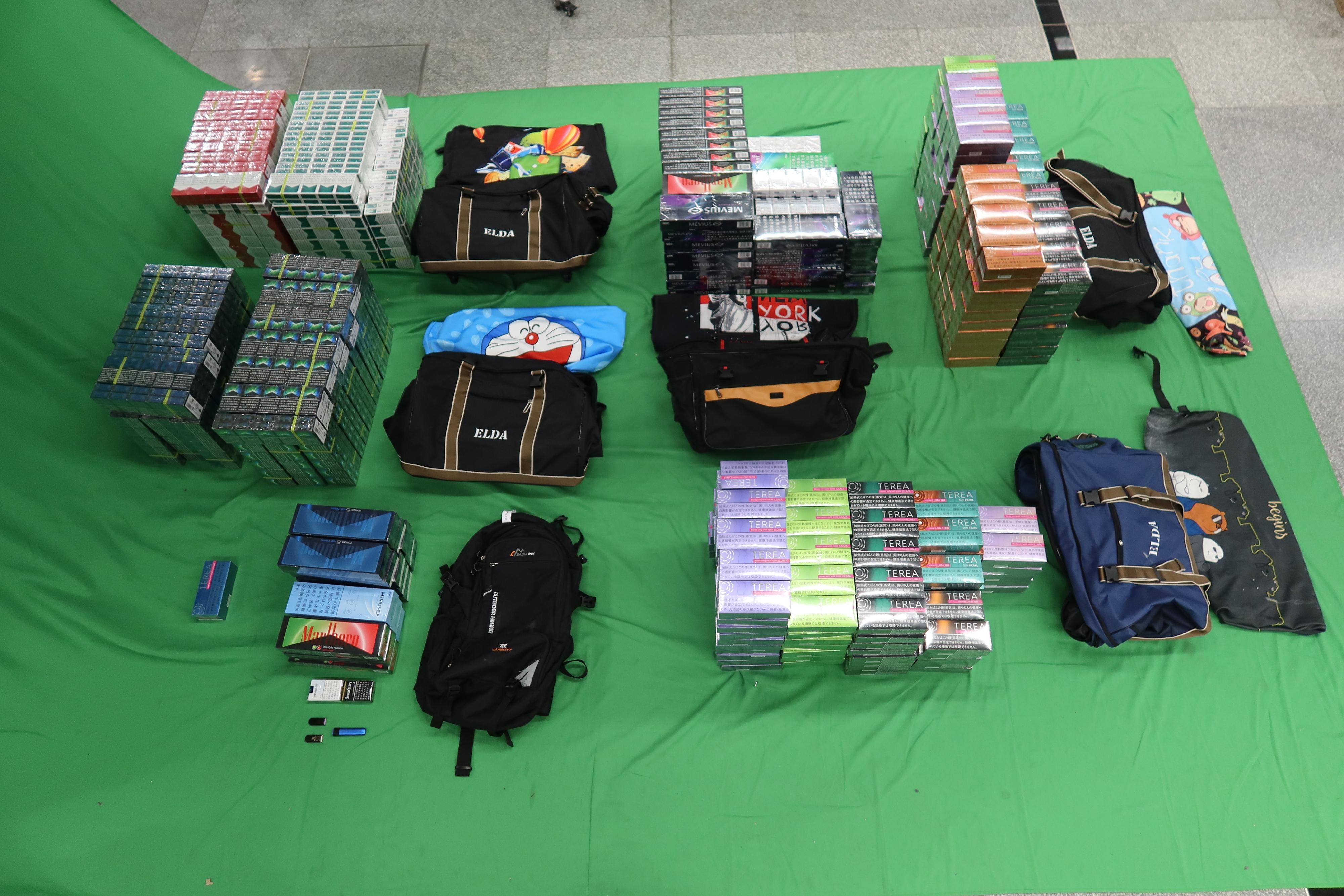
Two incoming passengers convicted and jailed for possessing and dealing with duty-not-paid cigarettes and importing alternative smoking products (with photo)

     â€‹Two incoming male passengers were sentenced to four and six months’ imprisonment respectively, with a fine of $1,000, at the West Kowloon Magistrates’ Courts today (June 18) for possessing and dealing with duty-not-paid cigarettes and failing to declare them to Customs officers, as well as for importing alternative smoking products, in contravention of the Dutiable Commodities Ordinance (DCO) and the Import and Export Ordinance (IEO).

     Customs officers intercepted two incoming male passengers, both aged 44, at Hong Kong International Airport on March 11. A total of about 57 000 duty-not-paid cigarettes and about 68 200 alternative smoking products, with an estimated market value of about $440,000 and a duty potential of about $190,000 in total, were seized from their personal baggage. They were subsequently arrested.

     Customs welcomes the sentence. The custodial sentence has imposed a considerable deterrent effect and reflects the seriousness of the offences. 

     Under the DCO, tobacco products are dutiable goods to which the DCO applies. Any person who imports, deals with, possesses, sells or buys illicit cigarettes commits an offence. The maximum penalty upon conviction is a fine of $1 million and imprisonment for two years. 

     Under the IEO, any person who imports an alternative smoking product into Hong Kong commits an offence. The maximum penalty upon conviction is a fine of $2 million and imprisonment for seven years.

     Members of the public may report any suspected illicit cigarette activities to Customs’ 24-hour hotline 182 8080 or its dedicated crime-reporting email account (crimereport@customs.gov.hk) or online form (eform.cefs.gov.hk/form/ced002).

Photo  
read more

LCQ14: Family-friendly facilities in public and private premises

     Following is a question by Dr the Hon Ngan Man-yu and a written reply by the Secretary for Health, Professor Lo Chung-mau, in the Legislative Council today (June 18):

Question:

     It is learnt that the research team of the Equal Opportunities Commission has conducted an access audit of babycare and lactation (B&L) facilities in shopping malls and government premises in Hong Kong, with the findings revealing that some shopping malls and government premises has not yet provided B&L rooms, and some existing babycare areas do not comply with the suggested size set out in the Buildings Department’s Practice Note on “Provision of Babycare Rooms and Lactation Rooms in Commercial Buildings” (Practice Note). As regards family-friendly facilities in public and private premises, will the Government inform this Council:

(1) whether it knows the number, distribution and floor area ratio of B&L facilities in public and private premises, and the proportion of such facilities that complies with the suggested size in the Practice Note, together with a breakdown of such figures by the 18 districts across the territory;

(2) whether it has already commenced a study on measures to promote the provision of B&L facilities in public premises, including introducing mandatory requirements for newly-built public facilities (e.g. libraries, parks, beaches, sports venues) to provide B&L facilities, and motivating existing public facilities to renovate and retrofit B&L facilities as appropriate; if so, of the details; if not, the reasons for that; and

(3) whether, in addition to providing floor area ratio concessions, it has considered implementing policy incentives to encourage private premises to provide B&L facilities and family-friendly parking spaces, as well as using administrative measures or legislation to promote the development of such facilities in the long term; if so, of the details; if not, the reasons for that?

Reply:

President,

     International literature and researches showed that breastmilk is the ideal food for infants. Breastmilk is safe, clean and contains antibodies which can help prevent many common childhood illnesses. Breastfed children perform better in intelligence tests, are less likely to be overweight or obese, and are less prone to have diabetes later in life.

     The Government has all along been promoting, protecting and supporting breastfeeding through a multi-pronged approach. The Government has set up a Committee on Promotion of Breastfeeding in 2014. Members include representatives from relevant professional healthcare bodies, academia as well as representatives of the organisations that have participated in the promotion of breastfeeding. The Committee provides specific recommendations on strategies and action plans to strengthen the promotion, protection and support for breastfeeding. Its objectives are to enhance the sustainability of breastfeeding and promote breastfeeding as the norm for babycare widely accepted by the general public. In addition to fostering the establishment of Breastfeeding Friendly Premises in public places such that breastfeeding mothers can breastfeed their children or express milk anytime, the Government also implements the Baby-Friendly Health Facility accreditation in the Maternal and Child Health Centres (MCHCs) and public hospitals to enhance the professional support to breastfeeding mothers after discharge from hospitals. At present, a total of 15 MCHCs have been accredited as Baby-Friendly Health Facilities. Besides, all eight public hospitals with obstetrics departments and one private hospital were accredited as Baby-Friendly Hospitals.

     In consultation with the Department of Health (DH), the Hospital Authority (HA), as well as relevant policy bureaux and government departments, the consolidated reply to the question raised by Dr the Hon Ngan Man-yu is as follows:

(1) According to the DH’s record, as at June 15, 2025, there were a total of 422 babycare rooms in the premises of government departments or public organisations (a breakdown of the numbers are at Annexes 1 and 2), which include various types of venues, such as hospitals, MCHCs, cultural and recreational facilities, community halls and shopping centres of housing estates.

     To promote the provision of babycare rooms in private commercial buildings, the Buildings Department (BD) issued the Practice Note on the Provision of Babycare Rooms in Commercial Buildings in February 2009 and had made further updates in November 2018 to encourage the provision of babycare rooms for the public and lactation rooms for staff in private commercial buildings. In June 2024, the BD updated the requirements for Building Environmental Assessment Method Plus certification and gross floor area (GFA) concessions to allow development projects seeking certification to secure the points and GFA concession through the provision of babycare rooms and breastfeeding rooms.

(2) and (3) The Government has been actively promoting the provision of more babycare and breastfeeding facilities in both public and private premises through various policy measures.

     The Government developed the Advisory Guidelines on Babycare Facilities in August 2008 to encourage the provision of babycare rooms in public venues managed by the Government. To enhance the provision of babycare and breastfeeding facilities, the Government mandated the provision of babycare and breastfeeding facilities in the newly completed government premises since early 2019. Regarding the public facilities mentioned in part 2 of the question, the Leisure and Cultural Services Department has included babycare rooms as a standard provision in accordance with relevant requirements, and will provide babycare facilities in planning for new major cultural and recreational facilities, as well as venue renovation works.

     Additionally, since 2017, the Government has included requirements for the provision of babycare rooms and/or lactation rooms in the Conditions of Sale of new commercial land sale sites (excluding land designated for hotel use only). The Conditions of Sale specify detailed requirements, including the area and number of babycare rooms and/or lactation rooms that shall be provided in these commercial development projects. As at the end of May 2025, the Government incorporated these requirements in the Conditions of Sale of eight new commercial sites.

     Meanwhile, the Government will continue to work closely with various sectors of the society to strengthen the professional support for breastfeeding mothers in the healthcare sector while stepping up publicity on breastfeeding in the community through various channels, with a view to fostering a proactive culture of support for breastfeeding in the community and creating a friendly environment conducive to breastfeeding. Key initiatives include – 

(i) among the 29 MCHCs currently providing services under the DH, 15 of them have been accredited as Baby-Friendly Health Facilities. Accreditation procedures have also commenced gradually for the remaining MCHCs. The MCHCs will formulate infant feeding policies and action plans, provide training for staff members, continue monitoring the implementation of breastfeeding support measures, etc. The DH will continue to expedite the accreditation of Baby-Friendly Health Facilities for MCHCs to strengthen the professional support offered by the healthcare institutions and staff members to breastfeeding mothers;

(ii) continuing to follow up on the relevant work with the working group under the Committee on Promotion of Breastfeeding to enhance and reinforce the breastfeeding-friendly measures at hospitals with obstetrics departments (including public and private hospitals);

(iii) encouraging the implementation of the Breastfeeding Friendly Workplace policy with guidelines issued for employers and employees with specific advice on supporting breastfeeding to support working mothers to continue breastfeeding after returning to work; and

(iv) stepping up publicity and advocacy for breastfeeding through mass media, social media platforms, large-scale events, etc. Among others, the DH, in collaboration with the HA, the Hong Kong Private Hospitals Association, the Hong Kong Committee for United Nations Children’s Fund, and the Baby Friendly Hospital Initiative Hong Kong Association, organised the large-scale Breastfeeding Symposium in November 2024, which brought together local and overseas experts to share with representatives of the public and private healthcare sectors, healthcare professionals and other stakeholders the various issues related to breastfeeding, including policies and professional support.

     To further support breastfeeding, the Government put forward in the Chief Executive’s 2023 Policy Address the establishment of a breast milk bank and the related mechanism for breast milk donation in 2025. Such arrangement aims to provide breast milk for infants and young children who cannot be breastfed by their biological mothers, and especially, to minimise the chance of severe illness in premature and severely-ill babies. The Hong Kong Breast Milk Bank, located at the Hong Kong Children’s Hospital, commenced operations on January 6, 2025, obtained ISO 22000 certification in April of the same year, and began supplying pasturised donor breast milk to all nine public hospitals in Hong Kong with neonatal intensive care units in March 2025. Currently, there are more than 230 registered breast milk donors. Over 900 litres of breast milk have been collected, providing optimal nutrition for extremely premature and severely-ill newborn babies. Meanwhile, neonatal intensive care units in public hospitals have already distributed pasturised donor breast milk to 120 infants with clinical needs.

     Meanwhile, having consulted the relevant policy bureaux and government departments, the Government currently does not have any relevant definitions and measures on the use of parking spaces as family-friendly facilities. read more

LCQ13: Separation of prescribing from dispensing of drugs

     Following is a question by the Hon Shiu Ka-fai and a written reply by the Secretary for Health, Professor Lo Chung-mau, in the Legislative Council today (June 18):

Question:

     It is learnt that the system of separating prescribing from dispensing of drugs (SPD) (i.e. doctors are responsible for consultation and prescription while patients go to community pharmacies for dispensing of drugs with their prescriptions) has been implemented worldwide for many years. There are views that such a system has the positive effects of enhancing drug safety and professional segregation of duties, avoiding limitations in the use of drugs, promoting patient triage, reducing conflicts of interests and lowering healthcare costs, etc. However, despite local pharmacies and the pharmaceutical trade as well as members of the community have been striving for implementing the system in Hong Kong for more than two decades, the Government has not given definite responses so far. In this connection, will the Government inform this Council:

(1) whether it has studied which places in the Mainland and overseas have already implemented or are currently planning to implement SPD and its effectiveness;

(2) as there are views pointing out that the arrangement of doctors being responsible for consultation and prescription and pharmacists for dispensing drugs has already been implemented in public and private hospitals in Hong Kong, and that pharmacists, who are the last professional gatekeepers for members of the public before taking drugs, have greatly reduced the risk of drug-related medical incidents, of the reasons for not extending the arrangement to all levels of the healthcare system by the authorities (including allowing the dispensing of drugs in qualified community pharmacies to patients with prescriptions by doctors in public hospitals or private medical practitioners);

(3) whether it studied or took specific actions in the past decade to implement SPD in Hong Kong; if so, of the details (including the reasons for not implementing the relevant system in Hong Kong over the years); if not, the reasons for that; and

(4) whether it will make reference to the successful experience of other places where SPD has been implemented, with a view to implementing the system in Hong Kong as early as possible; if so, of the details and implementation timetable; if not, the reasons for that?

Reply:

President,

     In consultation with the Department of Health (DH), the Primary Healthcare Commission (PHC Commission) and the Hospital Authority (HA), the reply to the various parts of the question raised by the Hon Shiu Ka-fai is set out below. 

     Generally, “Separation of Prescribing from Dispensing of Drugs” (SPD) means that, under normal circumstances, doctors are only allowed to diagnose and prescribe medicines for patients, while the role of drug dispensing must be carried out separately by registered pharmacists or dispenser under registered pharmacist’s supervision. In other words, implementation of SPD arrangement statutorily designates drug dispensing, which has all along been able to be performed by doctors, to be separately performed by registered pharmacists, and at the same time requires that drug dispensing cannot be carried out in doctor (including family doctor) clinics without the presence of a registered pharmacist.

     The Government notes that some European and American countries, as well as neighbouring regions (including Korea and China’s Taiwan region), have adopted the mode of SPD. The main objective is to enable doctors and pharmacists to focus on their professional areas, with a view to enhancing medication safety. Nevertheless, there are specified exemptions in these places that allow doctors to supply medicines to patients who attend medical consultations. Meanwhile, the implementation experience of these places also shows that SPD may potentially reduce the convenience of the public in obtaining medications, increase medical cost, and bring about significant changes in people’s healthcare-seeking habits. In fact, healthcare systems (including the division of labour between consultation and dispensing drugs) vary across the world. It is crucial to formulate appropriate policies in the light of local professional development, social needs and city planning. By taking into account the local conditions and balancing the division of labour among various professions with public convenience, the distribution of healthcare resources can be effectively optimised, and the efficiency and safety of healthcare services can be enhanced as a whole. 

     At present, public hospitals, public clinics as well as private hospitals in Hong Kong have adopted the arrangement that doctors are responsible for consultation and prescription, while pharmacists are responsible for the dispensing of drugs, to meet the practical needs. As regards private doctor clinics, patients have the right to request prescriptions from private doctors and have their drug dispensed by pharmacists at licensed pharmacies in the community. The Government has always attached great importance to the safety of drug dispensing in private clinics. For patient protection, the Code of Professional Conduct (the Code) formulated by the Medical Council of Hong Kong includes provisions regarding the dispensing of drugs to patients. According to section 9.2 of the current Code (revised in October 2022), if a doctor dispenses medicine to patients, it is the doctor’s personal responsibility to ensure that the drugs are dispensed strictly in accordance with the prescription and are properly labelled before they are handed over to the patients. Doctors should establish suitable procedures and observe the provisions of the Good Dispensing Practice Manual issued by the Hong Kong Medical Association to ensure that drugs are properly labelled and dispensed. 

     Hong Kong has a high standard of medical professionalism, and the existing legislation and the relevant regulatory measures for healthcare personnel have been effective in safeguarding drug safety. When considering any changes in consultation and drug dispensing arrangements, emphasis should be placed on the co-operation among doctors, pharmacists and other healthcare professionals, and the well-being of patients should be the primary consideration. The implementation of SPD in Hong Kong will have far-reaching implications on the role of doctors in the current healthcare system, the manpower demand for healthcare professions and the ancillary facilities, as well as the arrangement and cost-effectiveness of primary healthcare services, etc, which must be considered on a long-term basis.

     The Government currently has no plan to make SPD mandatory, but will enable family doctors and other healthcare professions in the community to enhance their collaboration in the provision of comprehensive and coherent primary healthcare services while taking forward primary healthcare reform, including continuing to implement a series of “medical-pharmaceutical collaboration” arrangements to make good use of the licensed pharmacies and pharmacists in the community. This will further facilitate the public’s access to medical consultation and dispensing of medicines, reduce medical cost, ensure the consultation and medication safety, and provide the public with choices of drug dispensing arrangements. Specific examples include:

(A) Pharmacists have been playing an active role in the primary healthcare system at different levels, including supporting family doctors in monitoring drug compliance, and collaborating with healthcare professions such as nurses in health promotion and health education to assist in the prevention and management of diseases, promotion of drug safety, smoking cessation and vaccination under a complementary and collaborative model. However, the existing professional pharmaceutical services and drug dispensing services in the community are not fully utilised, and the role of pharmacists in primary healthcare could be enhanced. The Government is promoting the establishment of community-based multi-disciplinary healthcare teams in accordance with the Primary Healthcare Blueprint, in which the role of pharmacists in multi-disciplinary healthcare management will be enhanced. At the same time, the Government will also promote the development of community pharmacies so that members of the public can choose to receive drug counselling services in the community, thereby achieving the goal of “treating mild cases in the community”. Specific measures include:

(i) The Government is preparing to develop a community drug formulary in the fourth quarter of 2025 and will launch the community pharmacy programme (CPP) by phases starting from the fourth quarter of 2026 to enable the public to obtain affordable primary healthcare drugs more conveniently through family doctors and community pharmacies. In the process, pharmacists will also regularly review the dosage and efficacy of the drugs taken by patients to improve their use of medication and reduce drug wastage;

(ii) The PHC Commission is formulating the Guideline of Practice for Community Pharmacy to establish service standards and quality assurance for community pharmacies, and to standardise the collaborative model between community pharmacies and primary healthcare service providers. The PHC Commission will also arrange training courses for pharmacists, pharmacy students and professionals, which will be incorporated into the requirements of the Pharmacy and Poisons Board of Hong Kong for recognising continuing education in the future , in preparation for the formulation of the Primary Care Directory (PCD) which will cover pharmacists; and

(iii) The District Health Centres (DHCs) will form a network with community pharmacies to enhance the dispensing of drugs in the community and pharmaceutical consultation services, so as to strengthen the role of DHCs as a hub for primary healthcare services, while at the same time providing professional pharmaceutical services to members of the public.

(B) Under the current HA medication delivery service, patients can arrange to have their medications delivered to their home or a specified address, or choose to collect them at a pharmacy in collaboration with the HA after their consultation. Users are required to pay for the medications and the delivery fee. After implementation of the CPP, pharmacists under the CPP will also be able to provide eligible HA patients with drug refill services for drugs on the designated drug list, including drugs to be taken when needed and drugs for chronic diseases, and may dispense the drugs in batches to patients. Patients are only required to pay the HA’s medication fees with no additional delivery fees.

(C) Medication management is a vital part of patient care. Under the five-year development plan of “eHealth+”, the Government will integrate the medication records and related healthcare services of various healthcare providers through data connectivity on the eHealth platform. The Government will also explore the introduction of ePrescription to enable secure, real-time and bi-directional connectivity of medication records among healthcare providers, pharmacies and relevant stakeholders, thereby enhancing prescription accuracy, process efficiency and medication safety. To support the relevant development, the Government has submitted the Electronic Health Record Sharing System (Amendment) Bill 2025 to the Legislative Council this year to provide a clear legal framework for electronic medical documents issued or authenticated through eHealth. Where appropriate, the Government may designate eHealth as the only platform for issuance of certain medical documents to facilitate centralised management and support usage process.

     Under the community drug formulary and CPP mentioned above, as an essential platform for supporting primary healthcare services, “eHealth+” will serve as a critical bridge between the HA, community pharmacies and relevant healthcare providers. The Government will support the future co-ordinated development of community pharmacies and primary healthcare services by connecting and integrating the medication records of the HA and various healthcare providers, facilitating medication management processes such as medication prescription and drug dispensing. In addition, service providers in the aforementioned sub-guidelines of the PCD are required to register with eHealth to facilitate data sharing, with a view to enhancing the continuity of healthcare services.

(D) For secondary and tertiary healthcare involving hospital and specialist services, the Government has been striving to enhance price transparency of private healthcare services, such that citizens could gain access to more comprehensive price information before making medical decisions according to their needs and better prepare for their expenses. On May 9, 2025, the Health Bureau briefed the Panel on Health Services of the Legislative Council on the preliminary legislative proposals and long-term enhancement measures, including the promotion of standardisation of the scope of healthcare services and chargeable items, covering the monitoring of drug prescription and charging. The Government is progressively engaging with stakeholders, including the healthcare sector, the insurance industry, patient organisations and academic institutions, to conduct more in-depth consultation on the details of the ideas, with a view to introducing the draft regulation in 2026 and implementing relevant enhancement measures by phases. read more
FS attends 2025 Lujiazui Forum (with photos)

     The Financial Secretary, Mr Paul Chan, attended the 2025 Lujiazui Forum in Shanghai today (June 18) and witnessed the signing of the Action Plan for Collaborative Development of Shanghai and Hong Kong International Financial Centres.
 
     The Lujiazui Forum is an international high-level dialogue platform that discusses major issues in the financial sector. This year, the forum was jointly organised by the Shanghai Municipal Government, the People’s Bank of China, the National Financial Regulatory Administration, and the China Securities Regulatory Commission. Themed “Financial Opening-Up and Cooperation for High-Quality Development in a Changing Global Economy”, the forum has brought together government officials, financial regulators, industry leaders, renowned think tanks and scholars from multiple countries to discuss topics such as global monetary policy, capital market development, financial technology and innovation, and inclusive finance. The plenary session this afternoon will include a session on deepening the co-operation and development of Shanghai and Hong Kong as international financial centres. 
 
     Mr Chan, as one of the key guests, attended the forum’s opening ceremony and morning plenary session. 
 
     Before the opening ceremony, Mr Chan and the Executive Vice Mayor of the Shanghai Municipal People’s Government, Mr Wu Wei, jointly witnessed the signing of the Action Plan for Collaborative Development of Shanghai and Hong Kong International Financial Centres, by the Secretary for Financial Services and the Treasury, Mr Christopher Hui, and the Director-General of the Shanghai Office for Advancing International Financial Center Development and Director of the Shanghai Municipal Financial Regulatory Bureau, Mr Zhou Xiaoquan.
 
     The Action Plan covers six areas with a total of 38 measures, including deepening the interconnectivity between Mainland and Hong Kong financial markets, enhancing the linkage and co-operation of the two places’ capital markets, supporting eligible Shanghai enterprises to list and raise funds in Hong Kong, and strengthening collaboration in areas such as commodity trading, reinsurance, green finance and fintech. The aim is to further leverage the financial opening up, development and risk management advantages of the two cities, enhance cross-boundary and offshore financial co-operation, and promote the co-ordinated development of the two international financial centres. 
 
     In his speech at the ceremony, Mr Chan said that the Action Plan further specifies the directions of co-operation between Hong Kong and Shanghai, thereby injecting new and richer content into multi-level and multi-field financial collaboration. It includes, first, new measures to deepen financial interconnectivity; second, highlighting support for Mainland enterprises to go global; and third, promoting standard alignment and financial innovation. With strong support from the country, Hong Kong and Shanghai, as two international financial centres, will join forces to create greater synergy and collaborative benefits, thus making greater contributions to the country’s development as a financial powerhouse while also injecting Chinese wisdom and strength into the development of the global financial market. 
 
     Yesterday (June 17), upon arriving in Shanghai, Mr Chan attended an international exchange dinner hosted by the China Finance 40 Forum. Attendees included leaders from domestic and international financial institutions, regulatory bodies, think tanks and academia. At the dinner, Mr Chan shared how Hong Kong is striving to promote high-quality financial development amid global political and economic changes. This includes advancing financial market reforms to better attract global capital to support the development of the real economy, supporting the prudent advancement of Renminbi internationalisation, embracing financial innovation including digital assets, and providing comprehensive, high value-added services for Mainland enterprises’ international development. The goal is to better contribute to the country’s financial reform and high-level opening up while creating opportunities for global investors and businesses. 
 
     Mr Chan departed for Hong Kong around noon today.

Photo  Photo  Photo  Photo  Photo  
read more