Tag Archives: China

image_pdfimage_print

LCQ18: Planning of site of former St. Joseph’s Home for the Aged

     Following is a question by the Hon Tang Ka-piu and a written reply by the Secretary for Development, Ms Bernadette Linn, in the Legislative Council today (May 21):
 
Question:
 
     According to the Approved Ngau Chi Wan Outline Zoning Plan No. ‍S/K12/18, the site of the former St. Joseph’s Home for the Aged is zoned for use as Comprehensive Development Area. It has been reported that in July last year, the Buildings Department (BD) granted the building plan for the site (the building plan), approving the construction of five 54-storey buildings (the project), which involves about 137 000 square metres of residential gross floor area (GFA) and about 63 000 square metres of non-‍residential GFA. In this connection, will the Government inform this Council:
 
(1) of the number of residential units, the population capacity, the number of parking spaces (set out by vehicle type), the number of loading and unloading spaces (set out by vehicle type), the commercial floor area, the floor area of community facilities (set out by proposed uses) and the open space area of the project, as well as the respective anticipated dates of intake/commissioning of such residential units, parking spaces and various facilities;
 
(2) as it has been reported that the proposed numbers of podium floors and building floors as well as the proposed non-residential GFA in the building plan are different from the information stated in the developer’s application for planning permission A/K12/42 submitted to the Town Planning Board (TPB) in 2021, and that according to the information on TPB Statutory Planning Portal 3, the applicant of the planning permission had withdrawn the application, of which application for planning permission or other documents the BD had based in granting the building plan;
 
(3) given that there are three Grade 2 historic buildings within the area of the project, whether it knows the plans put in place by the developer of the project to conserve and revitalise such buildings;
 
(4) given that according to the application for planning permission A/K12/42 submitted by the developer of the project, a 24-hour barrier-free pedestrian link connecting Choi Hung MTR Station and Choi Wan Estate is proposed to be provided in the project, whether it is still planned to construct such a pedestrian link under the building plan; if so, of the details; if not, the reasons for that;
 
(5) as there are views that the additional population to be generated by the project will add to the burden on Clear Water Bay Road, Choi Hung Interchange and Choi Hung MTR Station, and taking into account the developments of the public housing at Ngau Chi Wan Village and the Choi Hung Estate redevelopment project, whether the authorities have assessed the impact of the project on the traffic in the vicinity when vetting and approving the project; if so, of the plans in place to avoid the traffic in the vicinity of the project and the congestion at Choi Hung Station from worsening, in particular, how to avoid bringing additional traffic flow to Clear Water Bay Road, and whether it will consider making good use of the land vacated after the demolition of Choi Hung Estate to improve the traffic congestion at Choi Hung Interchange; and
 
(6) whether, in vetting and approving the project, the authorities have considered the land space that may be required for the Smart and Green Mass Transit System in East Kowloon to be set up with a station in the vicinity of the project and even have to be extended to the west, and requested the developer to reserve the relevant land; if so, of the details; if not, the reasons for that?
 
Reply:
 
President:
 
     Replies to the Hon Tang Ka-piu’s questions are as follows:
 
(1) and (2) The site of the former St. Joseph’s Home for the Aged is zoned “Comprehensive Development Area” in the relevant outline zoning plan. According to the Town Planning Ordinance, developers must submit a Master Layout Plan (MLP) to the Town Planning Board (TPB) for approval through a planning application. The plan should set out the floor space for different uses, the layout and height of buildings, and information about the public facilities, etc. Only after the planning application is approved may developers proceed with the development, including the construction works.
 
     As pointed out by the questions, the developer has withdrawn its planning application submitted in 2021. In fact, the developer has submitted, and obtained approval for, a number of planning applications in the past, and the MLP currently in effect is planning application A/K12/34-2 approved by the TPB in February 2010. The building plan approved by the Buildings Department (BD) in July 2024 was based on this approved planning application.
 
     According to the MLP under planning application A/K12/34-2, the proposed development includes five residential towers of 54 stories, involving 2 058 flats and an estimated population of around 5 800 residents, a seven-storey podium for shops, restaurants, residential care home for the elderly, kindergarten, recreational facilities, and carparking facilities, as well as a four-level basement with shops and carpark. The proposed development will provide around 530 private car parking spaces, around 60 motorcycle parking spaces, around 80 light goods vehicles parking spaces, and one light bus parking space. It will also provide around 50 loading/unloading bays, among which five are for the residential portion while more than 40 are for the shops and restaurants. In terms of floor area, the gross floor area (GFA) of the proposed development is around 201 000 metre square, among which domestic and non-domestic GFA are around 137 000 and 63 800 metre square respectively. The non-domestic GFA includes around 53 500 metre square of commercial GFA and around 4 600 metre square of community facility GFA. The public open space will be no less than 2 200 metre square.
 
     We have no information on the latest intake date of the development (e.g. residential flats). According to the land lease, before the end of the building covenant period set out in the land lease (i.e. September 30, 2028), the developer has to complete the construction of the minimum GFA stipulated (i.e. 60 per cent of the maximum GFA allowed) and secured the occupation permit from the BD. The land lease also stipulates that certain facilities need to be completed by a certain date, such as the public light goods vehicles parking spaces, as well as the footbridge to Choi Wan Estate, etc.
 
(3) The Villa, Gate House, and Dormitory A of the former St. Joseph’s Home for the Aged were confirmed by the Antiquities Advisory Board as Grade 2 historic buildings in February 2010. When the TPB approved planning application A/K12/34-2 in 2010, one of the approval conditions requires the owner(s) to submit and implement a conservation management plan (CMP) for the three historic buildings. According to the CMP submitted by the owner(s) in 2013, the three historic buildings will be preserved in-situ and revitalised for adaptive reuse. A heritage exhibition area will be set out to display relevant artifacts and public visit arrangements will be formulated. The Antiquities and Monuments Office will continue to provide professional technical advice from the heritage conservation perspective to the owner(s) and relevant government departments to ensure proper conservation of the three historic buildings.
 
(4) As aforementioned, the MLP currently in effect is planning application A/K12/34-2 approved in 2010. The land lease, which is based on the said MLP, has stipulated that the developer is responsible for the design, construction, and maintenance of the footbridge linking the development to Choi Wan Estate, and the footbridge should be barrier-free and accessible round the clock. According to the land lease, the developer only has to reserve space for and construct the connection of the pedestrian link to Choi Hung MTR Station.
 
(5) The Transport and Logistics Bureau (TLB) advised that the developer has already conducted traffic impact assessment for the development concerned when making planning applications in the past, and supplemented information/updated the assessment subsequently in view of developments in the district, so as to ensure that the development concerned will not have significant impacts on local traffic. The last update of the assessment was in March 2024. When updating traffic impact assessment, the developer took into consideration planned and due-for-completion development projects nearby. For example, the updated assessment has taken into account the Ngau Chi Wan Village public housing project. According to the traffic impact assessment updated in March 2024, the development concerned will not cause insurmountable traffic impacts upon implementation of related traffic improvement measures.
 
     To facilitate the implementation of the development, the developer will carry out a series of traffic improvement measures, which mainly include:
 
(i) Provision of new bus laybys on Clear Water Bay Road (on the kerbside outside the development) to facilitate relocation of the existing bus and minibus stops outside Ngau Chi Wan Market to the new bus laybys and the nearby public transport terminus, so as to alleviate the traffic congestion outside Ngau Chi Wan Market caused by boarding/alighting of bus and minibus passengers;
 
(ii) Construction of a covered footbridge across Clear Water Bay Road for connection to New Clear Water Bay Road (near Sau Man House, Choi Wan (1) Estate) and the existing covered footbridge across Clear Water Bay Road, removal of the existing at-grade pedestrian crossing at the junction of Clear Water Bay Road and New Clear Water Bay Road, and adjustment of the traffic signal control at the junction to meet the future traffic demand and to increase the traffic capacity of the junction; and
 
(iii) Extension of the existing Ping Ting Road East by constructing an elevated carriageway to connect to the vehicular access of the development, and implementation of traffic management plan at the internal carpark in order to effectively divert some of the traffic away from the vehicular access at Clear Water Bay Road.
 
     In response to the Government’s request, the developer will allocate sufficient space for accommodating vehicles heading to the retail facilities to wait within the boundary of the development for access to the carpark, so as not to affect nearby traffic.
 
     Furthermore, the traffic impact assessment for the redevelopment of Choi Hung Estate conducted by the Government will take into account the traffic impact arising from the aforementioned private development, and will also take the opportunity of redeveloping Choi Hung Estate to explore feasible options to improve road traffic at Choi Hung Interchange and surrounding areas.
 
(6) The TLB advised that the proposed Choi Hung East Station of the Smart and Green Mass Transit System in East Kowloon will be located on the east side of the development concerned, and space will be reserved in the design to retain the feasibility of extending the system to the northwest in the future. Following the principle of minimising impact on private land, the Government will maintain close communication and collaboration with the developer of the development concerned to facilitate the construction works of the system. read more

LCQ1: Combating the offence of shopfront extension

     Following is a question by Dr the Hon Lo Wai-kwok and a reply by the Secretary for Environment and Ecology, Mr Tse Chin-wan, in the Legislative Council today (May 21):

Question:

     In 2023, the fixed penalty for the offence of shopfront extension was increased to $6,000. However, some members of the public have reflected that law enforcement officers have not issued fixed penalty notices (FPNs) in accordance with the Fixed Penalty (Public Cleanliness and Obstruction) Ordinance when enforcing the law, but have instead instituted prosecution by way of summons under the Summary Offences Ordinance. If a defendant pleads guilty by letter and the court accepts the plea, the fine imposed under the Magistrates Ordinance will not exceed $2,000. In this connection, will the Government inform this Council:

(1) of the respective numbers of FPNs and summonses issued by the Government for the aforesaid offence since the increase in the fixed penalty, along with the respective amounts of fines involved; the respective numbers of first-time and repeated offenders among these cases, how many times each repeated offender has committed the offence, and the amount of fines imposed on each occasion; the number of convicted persons sentenced to a fine of $6,000 or more, or to imprisonment, and the fines and terms of imprisonment imposed;

(2) whether it has regularly reviewed the criteria for issuing FPNs and summonses by law enforcement officers, including how discretionary powers are exercised; if so, of the details; if not, the reasons for that; and

(3) whether it has studied ways to ensure proportionality between penalties and offences, as well as consistency in sentencing in the course of the enforcement and adjudication of the aforesaid offence, and further explored the possibility of increasing the penalty to enhance its deterrent effect, including the introduction of progressive fixed penalty; if so, of the details; if not, the reasons for that?

Reply:

President,

     Shopfront extension not only affects road access and environmental hygiene, it also causes nuisance to pedestrians and traffic. It is one of the environmental hygiene and street management issues of major concern to the public. At present, if the Food and Environmental Hygiene Department (FEHD) found shopfront extension situation during inspections, the offenders would be issued with fixed penalty notices in accordance to the Fixed Penalty (Public Cleanliness and Obstruction) Ordinance (Cap. 570), or prosecuted for “obstruction of public places” under the Summary Offences Ordinance (Cap. 228).

     To more effectively sustain environment cleanliness, we have conducted a comprehensive review on environmental hygiene-related legislations and put forward relevant amendments. At the end of 2023, the fixed penalty level for shopfront extension, among other offences, was increased from $1,500 to $6,000; and the maximum fines which may be imposed by the Court was raised from Level 2 ($5,000) to Level 4 ($25,000). If shops made repeated violation within a short period, the FEHD can issue multiple fixed penalty notices to further increase the cost of non-compliance. After the new penalty has taken effect for a year, the number of fixed penalty notices issued against shopfront extensions was 90 per cent less than that in the previous year. At the end of 2024, we further introduced the second-stage legislative amendments to enhance enforcement effectiveness and efficiency, including to introduce new clauses on shopfront extension under the Public Health and Municipal Services Ordinance (Cap. 132), allowing the FEHD to require shops to remove obstructing articles without requiring police presence, and in cases where no owners of the articles have come forward, the department to remove the articles. The second-stage legislative amendments were passed by the Legislative Council after its third reading on May 8 this year and will take effect on August 17.

     My responses to the question raised by Dr the Hon Lo Wai-kwok are as follows:

(1) We increased the fixed penalty levels and maximum penalty that the Court may imposed for “obstruction of public places” in 2023. Since the new penalty level took effect until March 31 this year, the FEHD issued 1 593 fixed penalty notices of $6,000 each against retail shops causing “obstruction of public places”. The FEHD does not maintain a record of individuals receiving multiple fixed penalty notices. During the same period, the FEHD issued summonses to 29 offenders involving 36 prosecutions, of which 32 cases have been concluded with convictions. The fines range from $300 to $6,500, with five cases of $6,000 fine or above. Among the 29 offenders, four had committed violations for two to five times, with fines ranging from $500 to $6,500.

(2) In general, enforcement by fixed penalty notices is targeted at cases which are simple, straightforward, clear-cut and capable of being easily established, such as when shop operators were caught red-handed and admit to illegal shopfront extension. Where a case is contentious, more serious or complicated, they would be prosecuted by issuing summonses, such as when shops causing obstruction are also suspected of deploying staff to conduct illegal hawking activities on the street outside the shop, thus involving also illegal hawking offences; or involving repeated offenders. Sometimes enforcement officers cannot easily identify the offenders of shopfront extension on-site and need further investigation and some cases also require police assistance, such as when offenders refuse to show identification documents or assault enforcement officers. Some people also obstruct and impede officers in the discharge of their duties in a deliberately abusive manner. In these situations, enforcement officers will issue summonses or even make arrests, and refer the cases to the Court for judgment according to evidence.

     The FEHD has extensive experience in handling shopfront extension cases and has established guidelines and provided training for frontline staff. Frontline staff will, according to the guidelines, make prosecution decisions based on the actual circumstances and specific evidence of each case, and report to supervisors according to guidelines. Currently, 98 per cent of shopfront extension by retail shops are handled by issuing fixed penalty notices.

     I have personally reviewed all the 36 summon cases. Among them, 31 cases involved more than one offences requiring handling by summonses, three cases involved disputes requiring police assistance, one involved a repeat offender who had previously received 18 fixed penalty notices and another involved serious large-scale obstruction. All these cases complied with the enforcement guidelines.

(3) During the first-stage legislative review, considering that the number of fixed penalty notices issues for “obstruction of public places” nearly doubled from 2019 to 2021, from about 7 600 to nearly 14 900, and the number of complaints increased from about 15 000 to over 23 500 during the same period, we increased the penalty levels to strengthen deterrent effect. As mentioned earlier, since the new penalty levels took effect at the end of 2023, there has been notable improvement in shopfront extension situations with visible results.

     In light of this, when taking forward the second-stage legislative amendments, we considered that there is, at this stage, no need to introduce a progressive penalty system. We can first observe the overall effect of the legislative amendments in deterring shopfront extension. If necessary, we can further review whether to introduce progressive penalty system or further increase the maximum penalties that courts can impose in the future.

     As regards the penalties imposed for cases prosecuted by summons, the Court makes judgment according to circumstances of individual cases. Prosecution officers will provide necessary information to the Court, including case details, conviction records of offenders and relevant case statistics. To better assist the Court in making judgments, the FEHD will explore with the Department of Justice whether there is room for improvement in how the prosecution presents cases and provides information. In addition, if the penalty of an individual case is clearly too lenient, the Government will seek Court’s review through the Department of Justice.

     Thank you, President. read more

LCQ3: Abolition of offsetting arrangement of Mandatory Provident Fund

     Following is a question by the Hon Edmund Wong and a reply by the Secretary for Labour and Welfare, Mr Chris Sun, in the Legislative Council today (May 21):

Question:

  The abolition of the use of the accrued benefits derived from employers’ mandatory contributions to the Mandatory Provident Fund (MPF) to offset severance payment and long service payment (the abolition of offsetting arrangement) took effect on the 1st of this month. The Government has indicated earlier on that it is not worried that the arrangement would trigger a wave of layoffs. In this connection, will the Government inform this Council:

(1) as there are views pointing out that the current business environment is far worse than before, whether the Government will conduct again a comprehensive assessment of the impact of the abolition of offsetting arrangement (e.g. whether it will trigger a wave of layoffs); if it will conduct such an assessment, of the timetable; if not, the reasons for that;

(2) as the Subsidy Scheme for Abolition of MPF Offsetting Arrangement will last for 25 years, when the Government plans to conduct a review to ascertain that the funding of the scheme will be sufficient to meet the long-term needs; whether it will consider entrusting the relevant funding to the Hong Kong Monetary Authority for investment in order to generate steady returns, thereby obviating the need to seek approval from this Council for supplementary provisions; and

(3) as it has been reported that the authorities have earlier on conducted a consultation on increasing the minimum and maximum levels of income for MPF contributions, whether the Government will, in the light of the overall business environment and the impact of the abolition of offsetting arrangement, consider withholding the adjustment to the relevant income levels; if so, of the details; if not, the reasons for that?

Reply:

President,

  After years of discussion and refinements, the abolition of the arrangement of using the accrued benefits derived from employers’ mandatory contributions under the Mandatory Provident Fund (MPF) system to offset employees’ severance payment (SP) and long service payment (LSP) (the abolition of offsetting) has garnered general support from the community, so as to improve employees’ retirement protection. The abolition of offsetting took effect on May 1 this year. On the same day, the Government also launched the 25-year Subsidy Scheme for Abolition of MPF Offsetting Arrangement (SSA) with financial commitment of $33.6 billion to share out employers’ financial burden and assist them to adapt to the policy change.

  My reply to the Member’s question is set out below:

(1) The abolition of offsetting will not lead to dismissal of employees owing to significant increase in the operating costs of enterprises. With reference to past statistics, the total sum of SP and LSP offset by employers accounts for only about 0.5 per cent of enterprises’ total wage bills, while wage bills are but a fraction of the total operating expenses of enterprises. Hence, the abolition of offsetting is not a determining factor for cessation of business or dismissal of employees.

     The Government has been reiterating that dismissing existing employees prior to implementation of the abolition of offsetting cannot save SP/LSP expenses, because:

(i) Under the Employment Ordinance, the maximum amount of an employee’s SP/LSP is $390,000. As the law stipulates that the abolition of offsetting has no retrospective effect, an employer may still use the accrued benefits derived from his MPF contributions during employees’ whole employment periods to offset employees’ SP/LSP incurred before the transition date, viz. May 1 this year. SP/LSP of newly-hired employees, on the other hand, will cumulate from scratch to the maximum amount of $390,000, and none of the sum can be offset by employers’ mandatory contributions.

(ii) SP/LSP incurred from an existing employee’s employment period pre-transition is calculated on the basis of the employee’s wages of the last month before the transition date. Therefore, the amount of pre-transition SP/LSP will have been locked down and will not increase no matter how much longer the employee will be employed and whether there will be any increase in his salary thereafter.

  We emphasise that manpower is a valuable asset of an enterprise. The termination compensation should not be a major factor for an employer’s consideration of dismissal. The Labour Department (LD) will continue to monitor the situation after the abolition.

(2) In estimating the financial commitment for the SSA, the Government had commissioned an actuarial consultant. In arriving at the total sum, the consultant made reference to the offsetting claim dataset provided by the Mandatory Provident Fund Schemes Authority (MPFA), projected the number of subsidy applications to be received and the amount of SP/LSP involved in those applications, and took into account the economic cycles during the 25-year subsidy period. 

  The total subsidy payout will hinge on the actual number of subsidy applications received and the amount of SP/LSP involved in those applications. The Government will closely monitor the disbursement of subsidies and, where necessary, follow the established procedure to handle the funding arrangement. Since the subsidy ratio will decrease over time, the subsidy payout sum in the later part of the subsidy period will be less than that in the earlier part of the subsidy period. It is premature to consider the sufficiency of the funding for the SSA at this point in time. When seeking funding approval from the Finance Committee (FC) of the Legislative Council in November last year, the Government pledged to review the operation of the SSA five years after the implementation of the abolition of offsetting.

  The $33.6 billion approved by the FC in November last year for the implementation of the SSA is the Government’s maximum commitment amount that may be used. It is not allocated to the LD’s account in one go. The LD, in accordance with the Government’s established procedures and based on the cashflow requirement in each financial year, will request funds from that year’s Government budget. The funds will then be allocated to the LD’s account from the General Revenue Account according to the SSA’s disbursement schedule to meet the subsidy payout expenditures. Any balance of the commitment amount yet to be allocated will remain in the Government’s fiscal reserve to generate investment income.

(3) Under the Mandatory Provident Fund Schemes Ordinance, the MPFA is required to conduct a review of the minimum and maximum levels of relevant income for MPF contributions not less than once in every four years.

  The MPFA is conducting a review of the minimum and maximum levels of relevant income for MPF contributions for the next review cycle (i.e. 2022-2026). In conducting the review, the MPFA must, according to the law, take into account the relevant employment earnings statistics and other relevant factors such as social and economic conditions, labour market conditions, business environment for enterprises in particular small and medium enterprises, and impacts (such as financial burden) on employees/self-employed persons. The MPFA will submit the review report to the Government. The Government will carefully examine the report thereafter. read more

S for Housing continues visit to Paris (with photos)

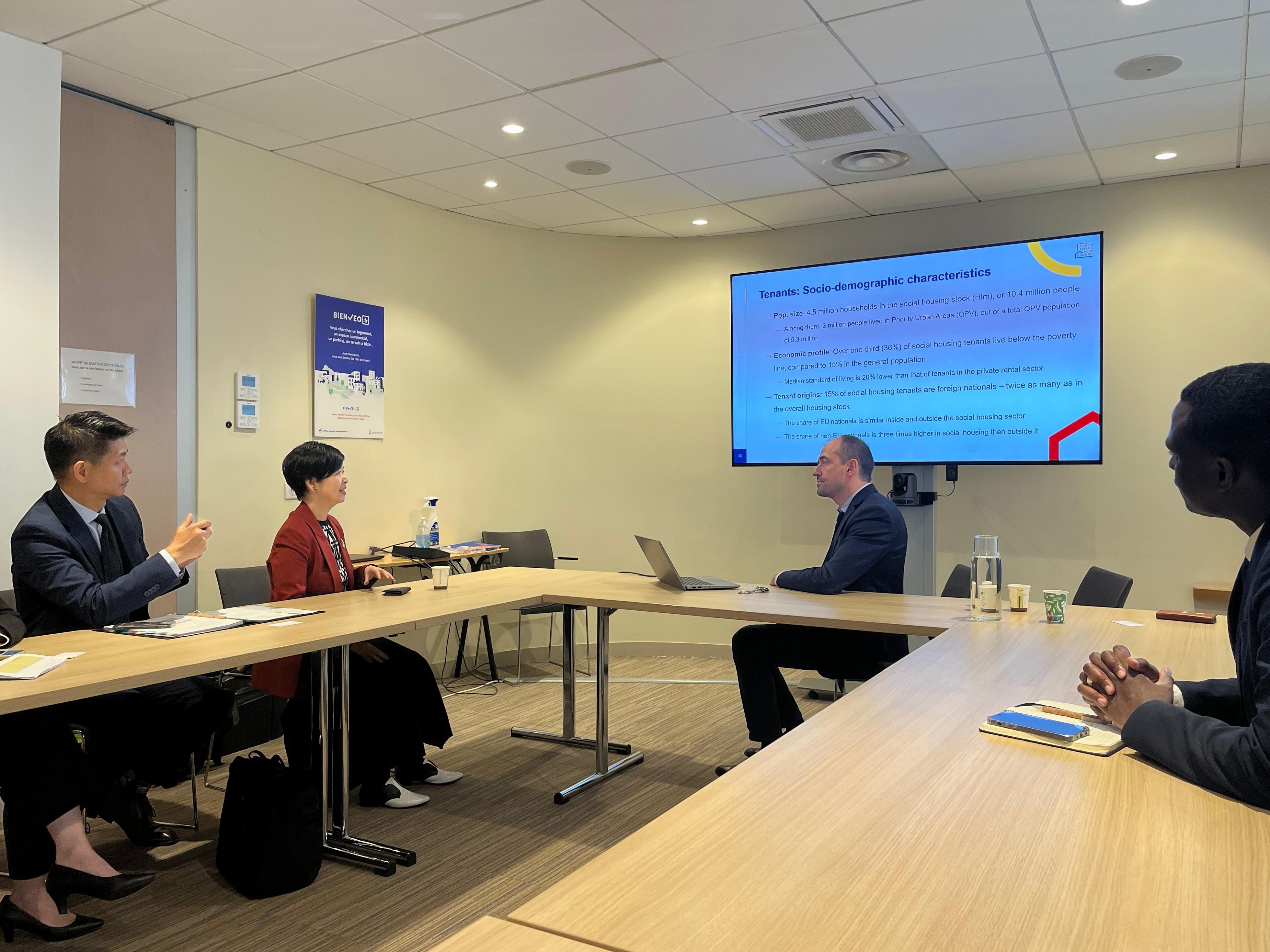
     The Secretary for Housing, Ms Winnie Ho, continued her visit to Paris, France, yesterday (May 20, Paris time). She visited the headquarters of a local social housing association, L’Union sociale pour l’habitat (USH), in the morning and met with the Director of Economic and Financial Studies at the USH, Mr Christophe Bellégo, to learn about the organisation’s work, including conducting research and analysis on local housing issues, and contributing to their government’s policy formulation.
 
     Ms Ho shared in the meeting the work of the Housing Bureau (HB) and the Hong Kong Housing Authority (HKHA). She said that housing is the greatest concern among all key issues of the current-term Hong Kong Special Administrative Region Government, and that the HB strives to formulate suitable housing policies and deliberate on different measures to address housing issues to cater for the housing needs of different social strata. The policy initiatives include building expeditiously Light Public Housing (LPH) and transitional housing to improve the living conditions of people living in inadequate housing at the soonest.
 
     She said that the HKHA, established over 50 years ago, has long been providing affordable rental housing to low-income families with housing needs. It continuously enhances the housing ladder to help low- to middle-income families gain access to subsidised home ownership, encouraging them to move up the housing ladder and thus enhance people’s sense of contentment and happiness. Ms Ho presented to the participants of the meeting the “Well-being design” guide launched by the HB and the HKHA last year, which covers eight well-being concepts, namely “Health & Vitality”, “Green Living and Sustainability”, “Age-Friendliness”, “Intergenerational & Inclusive Living”, “Family & Community Connection”, “Urban Integration”, “Upward Mobility” and “Perception & Image”. It serves as a reference for the future design of new public housing estates and the improvement works of existing estates to create a more comfortable and vibrant living environment for its residents. Apart from housing construction, to continuously enhance the management efficiency and service quality of its nearly 200 public housing estates, the Housing Department has been actively promoting smart estate management and bringing in new technologies to help optimise estate management and building maintenance services so that residents can enjoy a better living environment.
 
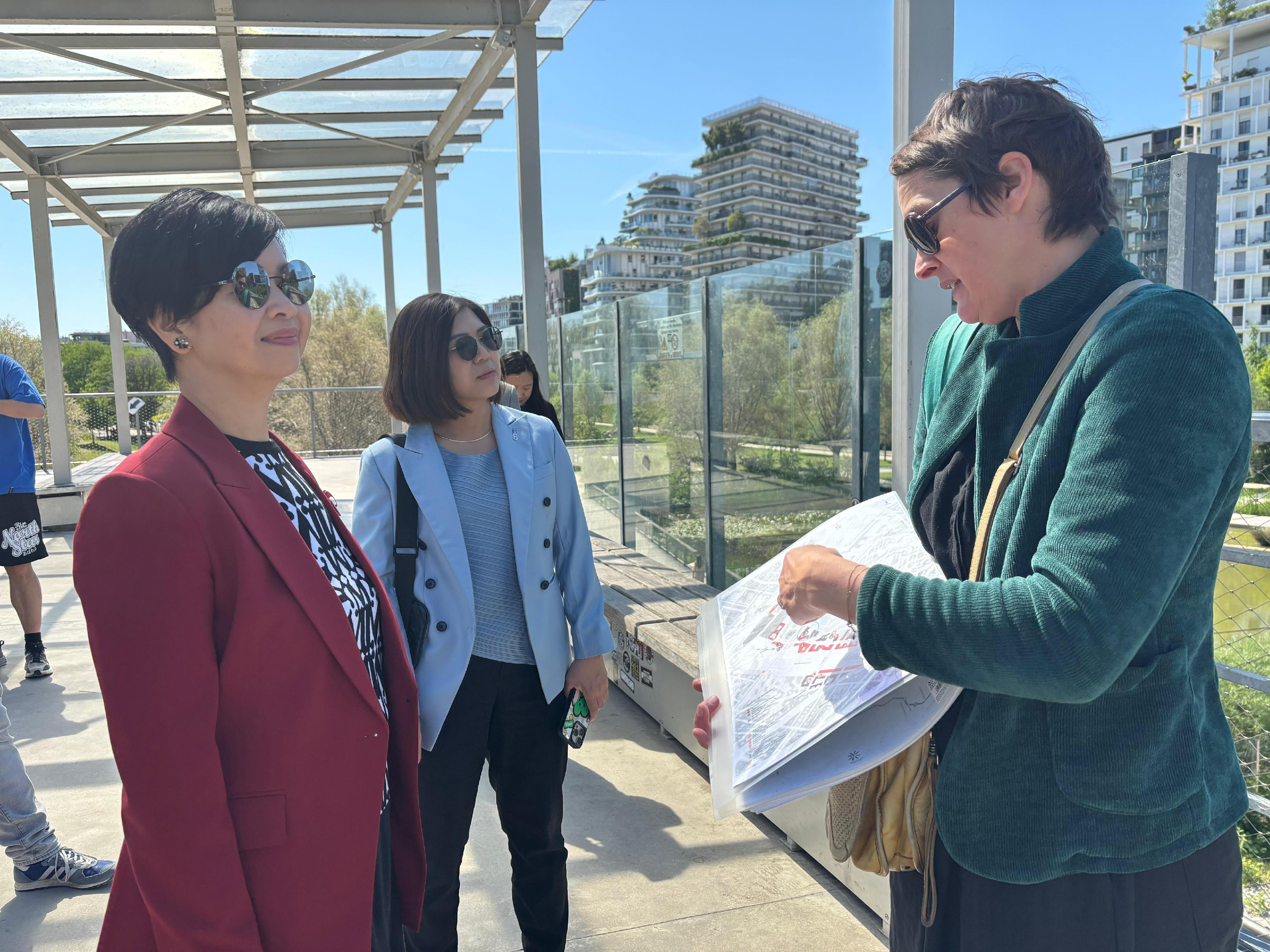
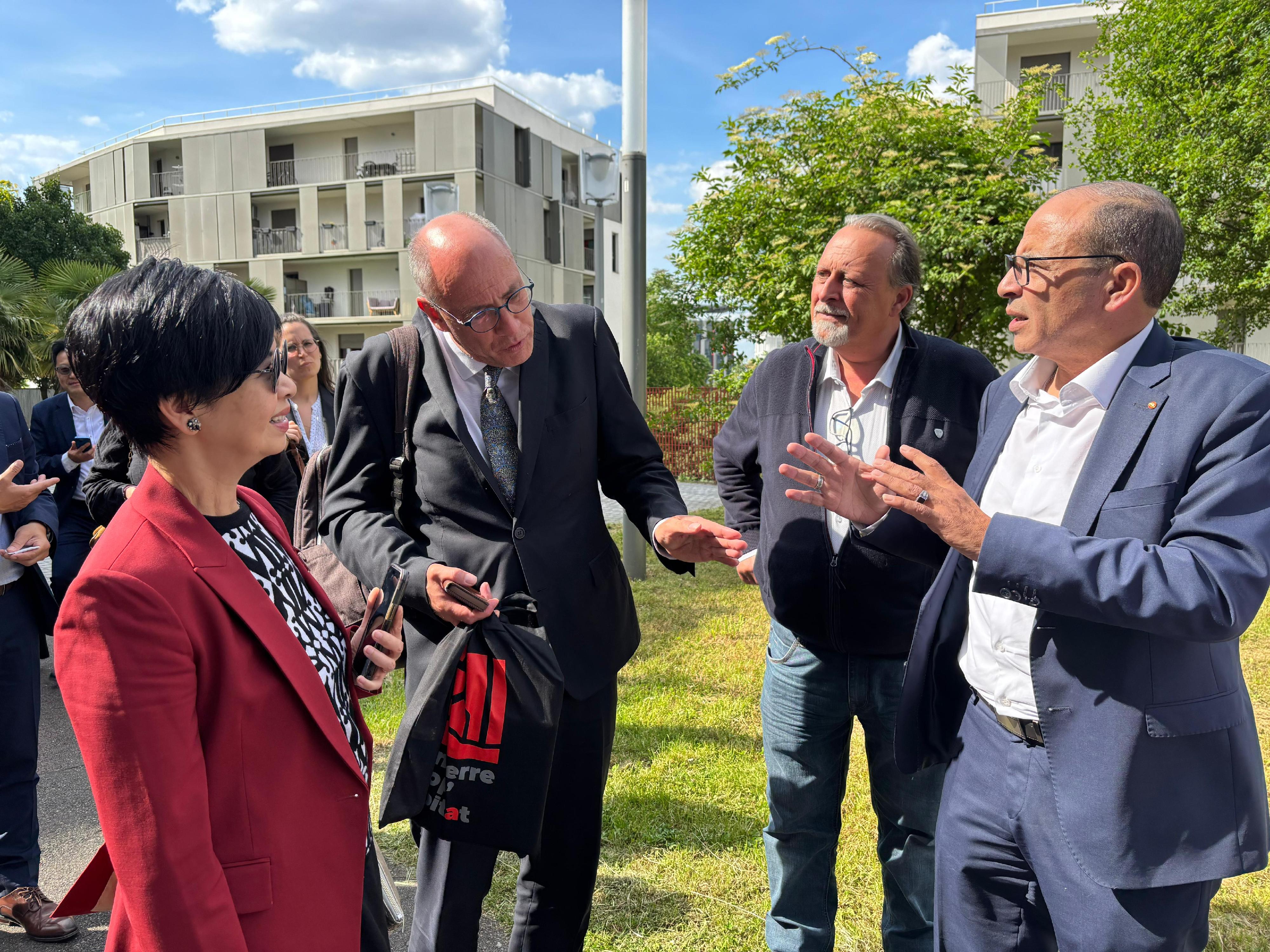
     Guided by the USH, Ms Ho visited two eco-neighbourhoods in Paris, Clichy-Batignolles and Ecoquartier Nanterre Université. Clichy-Batignolles is a sustainable urban development project transforming a former rail yard into a mixed-use area with social and private housing, commerce and retail, restaurants, community facilities and a park. Ecoquartier Nanterre Université preserves green spaces while redeveloping the old district. The project has provided various types of social and private housing as well as relevant ancillary facilities, creating a more vibrant neighbourhood and promoting inclusivity. Ms Ho said that the HKHA also attached importance to promoting low carbon and energy-saving buildings, green spaces and connectivity with the nearby community when planning and developing new public housing projects.
 
     In the afternoon, Ms Ho called on the Chinese Ambassador to France, Mr Deng Li, to share Hong Kong’s latest housing policies and initiatives, which included promoting the development of housing construction technologies by leveraging the power of the Greater Bay Area. She also learned about Hong Kong’s strengths as a “super connector” and a highly international city during the conversation with the Ambassador.
 
     Ms Ho will continue her visit today (May 21, Paris time) and meet with the local trade to promote Hong Kong’s innovative construction technologies.

Photo  Photo  Photo  Photo  Photo  Photo  Photo  Photo  
read more

LC: Speech by CS in presenting Government Minute in response to Report No. 83 of Public Accounts Committee

     â€‹Following is the speech (translated from Chinese) by the Chief Secretary for Administration, Mr Chan Kwok-ki, in presenting the Government Minute in response to Report No. 83 of the Public Accounts Committee in the Legislative Council today (May 21):

President,

     Laid on the table today is the Government Minute (GM) responding to Report No. 83 of the Public Accounts Committee (PAC) presented to the Legislative Council (LegCo) on February 19, 2025.

     I welcome the Report of the PAC and am grateful for the time and efforts devoted by the Chairman of the PAC, Mr Shiu Ka-fai, and members of the PAC. The Government accepts the PAC’s various recommendations and sets out in detail in the GM the specific responses of the relevant bureaux and departments (B/Ds). The PAC conducted public hearings on the chapters on “Nano and Advanced Materials Institute” and “Tuen Mun – Chek Lap Kok Link”. I would like to highlight the key follow-up measures taken and progress made by the Government and relevant organisations in response to the PAC’s recommendations.

Nano and Advanced Materials Institute

     First, the Nano and Advanced Materials Institute (NAMI). Regarding project management, NAMI would set both ambitious and feasible targets in comprehensive consideration of factors such as economic environment, market demand, NAMI’s technological development, business development plans and human resources. To improve patent management, NAMI will conduct regular market demand analyses, strengthen co-operation with universities, research institutes and enterprises, enhance market promotion and brand building. To improve the level of laboratory safety management, NAMI has enhanced the inspection procedures and requirements. For any non-compliance identified, remedial actions or improvement measures must be documented by staff of NAMI in detail and submitted to Research and Development (R&D) Director and Chief Technology Officer for endorsement.

     The Innovation and Technology Commission (ITC) would continue to encourage NAMI to liaise with the industry to explore room of co-operation, as well as promote wider participation from the industry in R&D. On the other hand, NAMI would also endeavour to transfer technology to the industry and promote commercialisation of project deliverables etc, convincing the industry with actual results that the applied R&D work of NAMI can help address enterprises’ pain points as well as improve their productivity and competitiveness. The ITC raised the target “Level of Industry and Other Income” to 40 per cent in 2024-25, and would explore the possibility of further raising the target to 50 per cent in the long run with a view to further encouraging R&D Centres to strengthen co-operation with the industry.

     The ITC agreed that there was room for improvement in NAMI’s relevant guidelines in business travel arrangements, claims for subsistence allowances and entertainment expenses. NAMI revised the guidelines in the fourth quarter of 2024, which clearly set out the corresponding approval mechanism and arrangements for staff at all levels; optimised the approval procedures for modification of business travel arrangement due to personal reasons/overspending of subsistence allowances and entertainment expenses; specified the NAMI staff to guest ratio for entertainments, and so on. The new guidelines stipulate that all subsistence allowances and entertainment expenses involving the Chief Executive Officer must be approved by the Chairperson of the Board. The new guidelines also clearly state that employees should avoid modifying the itinerary of business trips due to personal reasons and need to bear the additional costs involved.

     The ITC has implemented a series of control measures for R&D projects funded by the Innovation and Technology Fund, including: (i) assessing whether the estimates of expenditure set out in the project proposals are reasonable and meet the actual R&D needs when reviewing NAMI’s applications; (ii) requiring NAMI to submit progress/final reports and audited accounts for launched projects to facilitate assessment on project deliverables and spending; and (iii) requiring NAMI to return all unspent funds to the Government upon project completion. The ITC will continue to follow the principle of prudent financial management and control the operating expenditure of the R&D Centres in order to ensure the proper use of public money in fostering innovation and technology.

Tuen Mun – Chek Lap Kok Link (TM-CLKL)

     As regards the TM-CLKL project, it comprises eight inter-related works contracts and the scale of works is large and complex. On the supervision of consultants of public works projects, the Development Bureau (DEVB) will reflect the consultants’ performance in their quarterly performance assessment reports at various implementation stages of public works projects in order to take appropriate regulatory actions when necessary, including suspending the consultant’s eligibility to tender or removing the consultant from the list of consultants. Besides, the consultancy agreement for public works projects has clearly stipulated that the consultants shall indemnify the Government for any claims, damages, losses or expenses arising from their professional negligence in their performance of duties or provision of services to protect the Government’s interests. The DEVB will continue to review the performance evaluation system for consultants and, where necessary, introduce enhancement measures to prompt consultants to improve their service performance.

     Regarding the tender evaluation mechanism, the past performance scores of public works consultants and contractors currently account for 20 to 40 per cent of their technical scores in future tenders, which has considerable impact on their chances of winning future tenders. In addition, the DEVB has already established a mechanism to deal with public works consultants and contractors who seriously violate regulations or whose performance is extremely unsatisfactory, including suspending their eligibility to tender or removing their names from the relevant approved lists of consultants and contractors. The DEVB believes that the relevant measures can effectively drive consultants and contractors to improve their service quality so as not to affect their chances of winning tenders in the future.

     Regarding the management of works contracts, works departments have made more extensive use of the “New Engineering Contract” form in public works contracts in accordance with the prevailing guidelines issued by the DEVB. “New Engineering Contract” introduces an early warning mechanism to encourage the client’s representatives and contractors to identify and raise potential risks that may affect the project at an early stage, and to jointly negotiate and work out the best solution to facilitate the smooth implementation of the project according to the prescribed framework and timeframes in the contract in the event of any difficulties or problems encountered during construction. On the other hand, the Highways Department has now adopted Building Information Modelling technology and relevant software in the early planning and design stages of the projects to enhance the accuracy of quantity surveying, and is actively exploring the use of new technologies for site investigation, such as geophysical survey technology, to better ascertain the geological conditions and estimate the associated project costs.

     Regarding the management, operation, and maintenance of the Tuen Mun-Chek Lap Kok Tunnel, the Transport Department (TD) will continuously review and assess the staff manning of the tunnel operator, and will timely require the operator to adjust its human resources plan to ensure that manning at all levels meets the requirements of the management agreement. At the same time, the TD will continuously review and, as necessary, refine the criteria for evaluating the overall performance of the operator and the process for preparing quarterly reports to ensure that assessments are completed on time. It will also work with the Electrical and Mechanical Services Department to improve the use of heavy recovery vehicles in the tunnel as mentioned in the report. Furthermore, the TD will continue to explore the application of new technologies to assist the operator in identifying out-of-gauge vehicles, with a view to enhancing traffic safety and management efficiency.

     For the traffic management of TM-CLKL and the relevant road sections in Tuen Mun, the TD will actively and continuously keep under review the traffic conditions in the area and will implement appropriate and effective traffic management measures in a timely manner.

     We understand that the Audit Commission and the PAC are concerned that surplus in the provisions for price adjustments in some of the works contracts had to be deployed to cover additional costs incurred due to unforeseen circumstances under the TM-CLKL project, and have urged works departments of the Government to adhere to the resource allocation originally planned in works projects during their implementation. The DEVB and the Financial Services and the Treasury Bureau (FSTB) are reviewing the current mechanism for utilising resources for public works projects, including areas for optimisation in contingency expenses and price adjustment provisions. The DEVB and the FSTB also plan to strengthen the existing supervisory mechanism and regularly report to the LegCo on the use of provisions for price adjustments in public works projects, so as to further ensure the proper use of resources and to enhance the transparency of resource utilisation and allocation. In addition, the Government has widely adopted parallel tendering arrangement to increase the accuracy of approved project estimates for public works projects. We are confident that the actual total expenditure of this project will remain within the total approved estimate of about $46.7 billion and there will be no cost overrun for the whole project.

     President, I would like to thank the PAC again for its efforts and suggestions. The B/Ds concerned will strictly adhere to their responses and implement various improvement measures as set out in the GM with full efforts.

     Thank you, President. read more