Very Hot Weather Warning issued
Attention TV/radio announcers: Please broadcast the following as soon as possible: The Hong Kong Observatory has issued the Very Hot Weather Warning. To prevent heat stroke, avoid pro… read more


Attention TV/radio announcers: Please broadcast the following as soon as possible: The Hong Kong Observatory has issued the Very Hot Weather Warning. To prevent heat stroke, avoid pro… read more
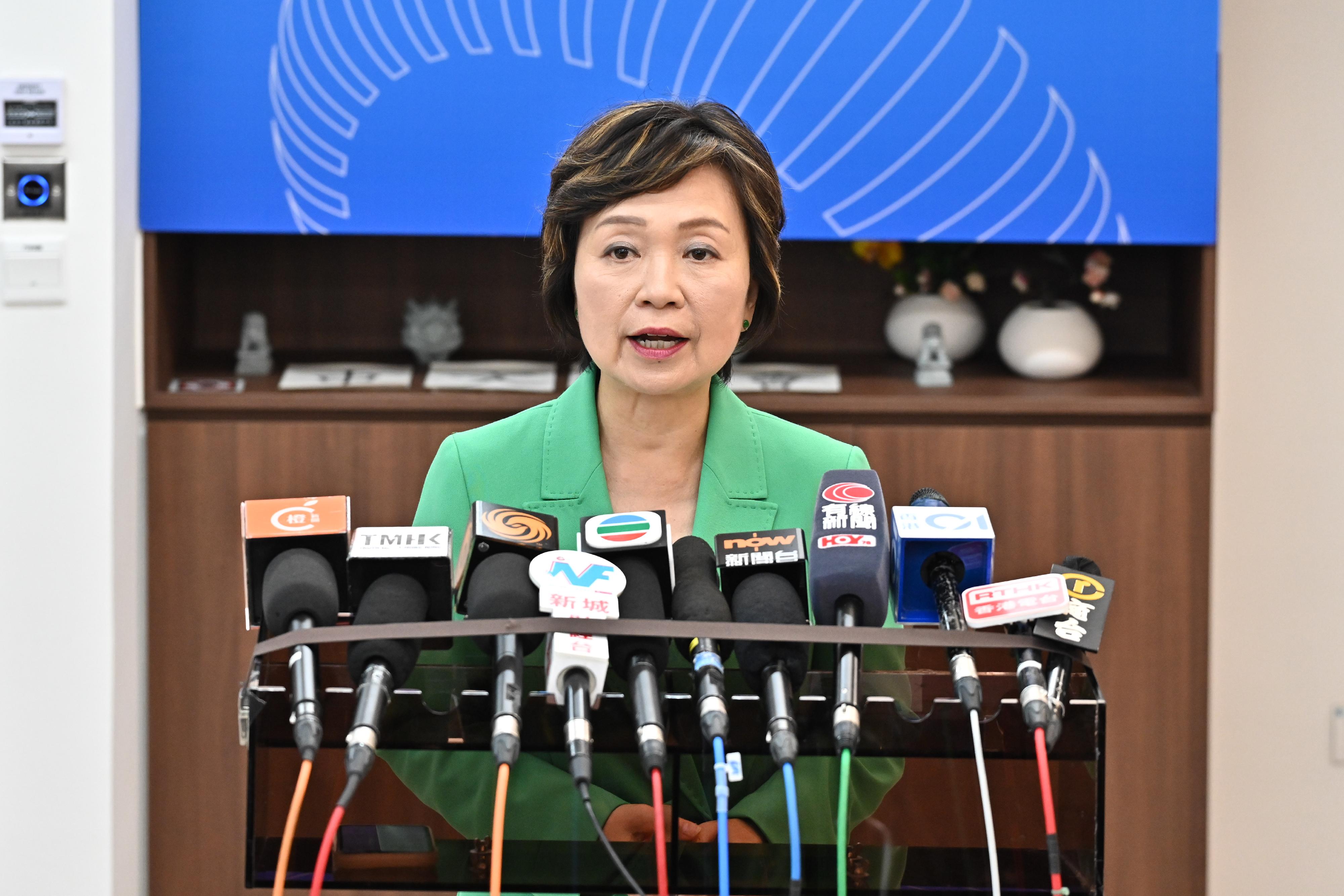
Following is the transcript of remarks by the Secretary for Education, Dr Choi Yuk-lin, at a media session after her visit to Jockey Club Ti-I College to give encouragement to this year’s candidates of the Hong Kong Diploma of Secondary Education Examination today (July 17):
Reporter: Are there any factors that led to the increase of the number of top scorers in the examination this year? How effective is the Citizenship and Social Development subject given that it only requires students to pass the subject? Will you worry that students are studying half of the subject? Does it make it easier for students to achieve top scores?
Secretary for Education: For the C&S (Citizenship and Social Development) subject, we have standards-referenced reporting for assessment. The result doesn’t mean that it is easier (for students to achieve good scores) than before. It’s not comparable because this is a newly adapted curriculum. We appreciate very much the efforts of teachers and students and that they achieved good scores.
For the factors that led to the good performance this year, we have just finished the optimisation of four core subjects and we have created more space for our students to have the opportunities to choose one or two more elective subjects. They can explore their interests and abilities, and fully develop their potentials. I think this is why they got better results than last year.
(Please also refer to the Chinese portion of the transcript.)
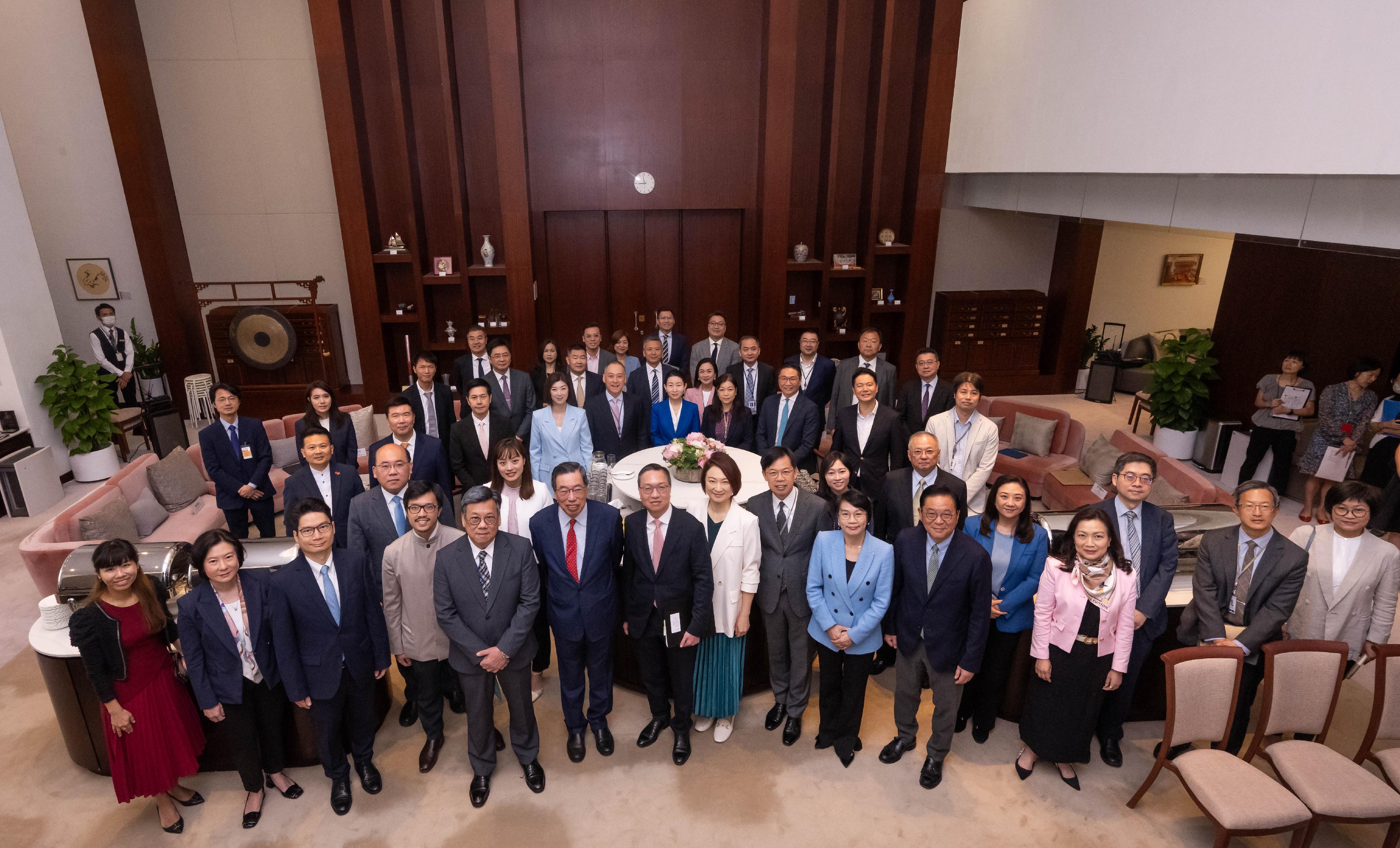
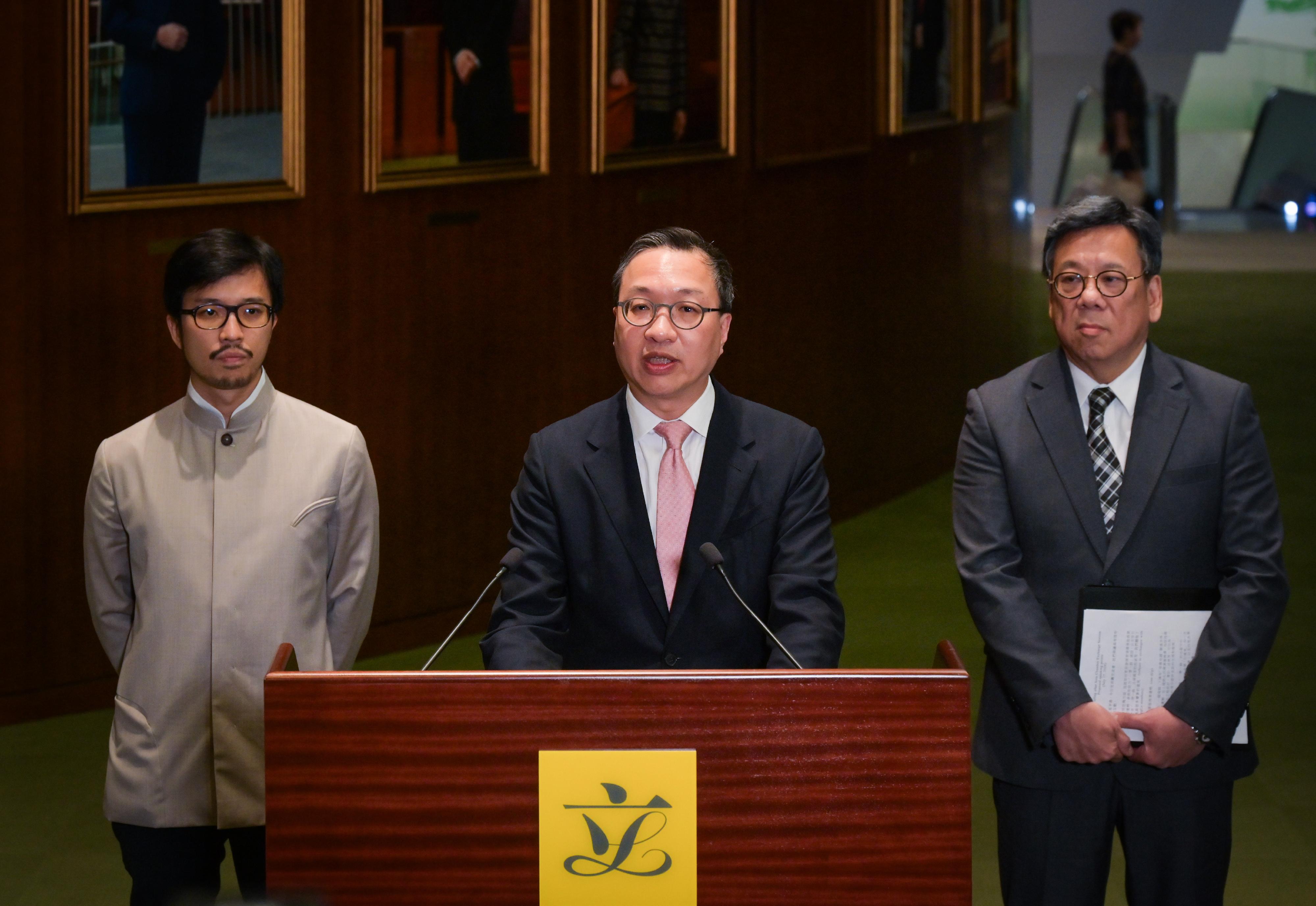
The Secretary for Justice, Mr Paul Lam, SC, together with the Secretary for Commerce and Economic Development, Mr Algernon Yau; and the Commissioner for Belt and Road, Mr Nicholas Ho, met the media after attending the Ante Chamber exchange session at the Legislative Council this morning (July 17). Following is the transcript of remarks:
Reporter: Can you recap in English what you have discussed in the Ante Chamber? How will the Government do to increase its attractiveness and also its plan to get into RCEP?
Secretary for Justice: I try to summarise very quickly the gist of the discussion in the Ante Chamber. The focus today concerns the Belt and Road Initiative (BRI), or to be more specific, how Hong Kong can participate in the BRI in a more proactive manner. We have invited colleagues from different bureaux, including the Commerce and Economic Development Bureau, the Innovation, Technology and Industry Bureau, the Financial Services and the Treasury Bureau and other colleagues. Among other things, I think the Central People’s Government takes the views that Hong Kong, in future, should focus firstly on enhancing Hong Kong’s role as a platform for providing professional services, for example, to serve as an international legal service centre. Secondly, to promote financial services and to enhance Hong Kong’s status as an international financial centre, in particular, in the area of green finance; and thirdly, to strengthen Hong Kong’s status as an international cultural exchange centre, for example, to promote or expand the Belt and Road scholarship, which will benefit students or young people from countries belonging to the Belt and Road and to organise more cultural activities which could improve the mutual understanding between different cultures and between different people. As to more specific measures, perhaps I can invite Mr Yau to provide more details.
Secretary for Commerce and Economic Development: The Belt and Road Office is organising activities in co-ordination with the Central Government such as visits to the Belt and Road countries, taking enterprises and the professional services abroad and meeting different sectors to promote Hong Kong and our advantages. Under “one country, two systems”, we have a very good setup in our legal system – we use the common law, the rule of law, free flow of capital. People from the Belt and Road countries would be very interested. Our professional services, such as legal, accountancy, architecture, innovation and technology, are all providing our advantages for people to look at. These visits would be able to expand our influence in those Belt and Road countries.
Regarding your question on RCEP (Regional Comprehensive Economic Partnership), we are working very hard with the RCEP members in getting their support, and hopefully they will go through their normal process and give the accession as quickly as possible.
In the future, the Commerce and Economic Development Bureau will work hard on improving the CEPA (Mainland and Hong Kong Closer Economic Partnership Arrangement) arrangements with the Mainland, and seeking to the RCEP accession. The Belt and Road Office will again take the delegation overseas and lead them to engage with the Belt and Road countries’ counterparts to promote the benefits and advantages of Hong Kong.
At the end of this month, the Chief Executive is leading a delegation to go to Laos, Vietnam and Cambodia. The whole purpose is to foster closer connection with the new economies to promote Hong Kong and to provide more opportunities for enterprises and the professional services to go overseas. Thank you.
(Please also refer to the Chinese portion of the transcript.)
Following is a question by the Hon Chau Siu-chung and a written reply by the Secretary for Labour and Welfare, Mr Chris Sun, in the Legislative Council today (July 17):
Question:
The Government launched the Reimbursement of Maternity Leave Pay Scheme (the Scheme) on April 1, 2021, through which employers can apply for reimbursement of the statutory maternity leave pay paid to employees in respect of the 11th to 14th weeks. In this connection, will the Government inform this Council:
(1) of the numbers of applications under the Scheme in each of the past three years and this year to date, and set out in Table 1 a breakdown by the monthly salaries of the employees involved and the respective percentages of the applications concerned;
Table 1
| Monthly salary of employees involved |
Number of applications (percentage) | ||
| 2021 | …… | This year to date | |
| Below $10,000 | |||
| $10,000 to below $20,000 | |||
| …… | |||
| Above $150,000 | |||
| Total | |||
| Result of application | Number of applications (percentage) | ||
| 2021 | …… | This year to date | |
| Approved | |||
| Rejected | |||
| Withdrawn | |||
| Total | |||
| Reimbursement amount | Number of applications approved (percentage) | ||
| 2021 | …… | This year to date | |
| Below $10,000 | |||
| $10,000 to below $20,000 | |||
| …… | |||
| $80,000 | |||
| Total | |||
| Type of industry of employers involved | Number of applications approved (percentage) | ||
| 2021 | …… | This year to date | |
| Catering | |||
| Construction | |||
| Education services | |||
| Finance | |||
| Health services | |||
| Hotel and accommodation | |||
| Import/export | |||
| Information and communications | |||
| Insurance | |||
| Manufacturing | |||
| Professional service, administrative and other business support service activities | |||
| Real estate | |||
| Retail | |||
| Social work activities | |||
| Storage | |||
| Transport, postal and courier services | |||
| Wholesale | |||
| Work within domestic households | |||
| Other personal services | |||
| Others | |||
| Total | |||
| Result of application | Number of applications (%) |
|||
| 2021 | 2022 | 2023 | 2024 (Up to June) |
|
| Approved | 5 405 (98.2%) |
7 480 (96.9%) |
6 820 (94.7%) |
3 507 (94.4%) |
| Rejected | 6 (0.1%) |
0 (0.0%) |
3 (0.1%) |
2 (0.1%) |
| Application withdrawn | 91 (1.7%) |
243 (3.1%) |
375 (5.2%) |
208 (5.6%) |
| Total | 5 502 (100%) |
7 723 (100%) |
7 198 (100%) |
3 717 (100%) |
| Reimbursement amount |
Number of applications approved (%) |
|||
| 2021 | 2022 | 2023 | 2024 (Up to June) |
|
| Below $10,000 | 475 (8.8%) |
580 (7.8%) |
393 (5.8%) |
165 (4.7%) |
| $10,000 to below $20,000 | 2 809 (52.0%) |
3 670 (49.1%) |
3 134 (46.0%) |
1 586 (45.2%) |
| $20,000 to below $30,000 | 1 084 (20.1%) |
1 566 (20.9%) |
1 618 (23.7%) |
821 (23.4%) |
| $30,000 to below $40,000 | 482 (8.9%) |
742 (9.9%) |
746 (10.9%) |
418 (11.9%) |
| $40,000 to below $50,000 | 267 (4.9%) |
447 (6.0%) |
421 (6.2%) |
218 (6.2%) |
| $50,000 to below $60,000 | 106 (2.0%) |
194 (2.6%) |
201 (2.9%) |
128 (3.6%) |
| $60,000 to below $70,000 | 60 (1.1%) |
100 (1.3%) |
121 (1.8%) |
56 (1.6%) |
| $70,000 to below $80,000 | 39 (0.7%) |
55 (0.7%) |
57 (0.8%) |
21 (0.6%) |
| $80,000 | 83 (1.5%) |
126 (1.7%) |
129 (1.9%) |
94 (2.7%) |
| Total | 5 405 (100%) |
7 480 (100%) |
6 820 (100%) |
3 507 (100%) |
​Following is a question by Professor the Hon William Wong and a written reply by the Secretary for Education, Dr Choi Yuk-lin, in the Legislative Council today (July 17):
Question:
It has been reported that, with the worsening situation of low birth rate in Hong Kong, primary and secondary schools are facing “class reduction and school closure” one after another. On the other hand, the Chief Executive has proposed in the 2023 Policy Address to build Hong Kong into an international hub for post-secondary education. There are views that Hong Kong’s primary and secondary basic education also have significant advantages in developing international education (including teachers having all undergone high-quality and systematic training, and the curriculum being taught in both languages of Chinese and English, etc.), and the Government should make good use of such advantages and introduce policies to alleviate the impact of low birth rate, replenish the sources of students and nurture talents for the long-term development of Hong Kong. In this connection, will the Government inform this Council:
(1) of the respective numbers of Mainland and overseas students currently enrolled in international schools at primary and secondary levels;
(2) whether it will consider constructing new school premises or converting the premises of some primary and secondary schools which have been closed or are likely to be closed, as well as providing additional supporting facilities (e.g. hostels), so as to operate primary and secondary schools dedicated to absorb Mainland and overseas students;
(3) whether it has plans to promote and admit students to local primary and secondary schools (including international schools and schools dedicated to offering Mainland curriculum) in the Mainland, neighbouring Chinese-populated regions and overseas, so as to increase the sources of students for various types of schools in Hong Kong; and
(4) whether it has plans to, while building Hong Kong into an international hub for post-secondary education, build Hong Kong into an international hub for primary and secondary education; if so, of the details; if not, whether it will consider the plans concerned?
Reply:
President,
The Chief Executive’s 2023 Policy Address outlined the direction to develop Hong Kong into an international post-secondary education hub and a cradle of future talents. This policy is based on the fact that Hong Kong has world-renowned universities and outstanding research talents, thus focusing only on post-secondary education. Regarding primary and secondary education, parents are provided with diverse and quality choices under the education system of Hong Kong.
The Government provides 12 years’ free primary and secondary education to eligible children through public sector schools. Non-local students who come to live in Hong Kong with their parents (including those who come to Hong Kong under various talent admission schemes) may also choose to enrol in any local public sector schools, Direct Subsidy Scheme schools or private schools (including international schools) that suit them, provided they meet the relevant eligibility requirements. We are glad to see that Hong Kong’s diverse and quality education is also one of the factors attracting talents to Hong Kong.
Faced with a structural decline in school-age population, the Government accords top priority to the interests of students when planning for the future development of education. Aiming for a “soft landing”, we review the policies and effectiveness of utilisation of public resources, and adjust the number of schools in a gradual and orderly manner to ensure a healthy and sustainable education ecosystem and optimal use of public resources. As to non-public sector schools, they may also admit overseas students in accordance with prevailing policies, should they provide adequate supporting arrangements.
Our reply to the questions raised by Professor the Hon William Wong is as follows:
(1) The numbers of non-local students in international schools in the 2023/24 school year are tabulated as follows:
| Level | Non-local students | ||
| Mainland students | Other non-local students | Total | |
| Primary | 1 209 | 13 497 | 14 706 |
| Secondary | 1 008 | 11 676 | 12 684 |
| Total | 2 217 | 25 173 | 27 390 |