Tag Archives: China

image_pdfimage_print

Consumer Price Indices for May 2025

     The Census and Statistics Department (C&SD) released today (June 20) the Consumer Price Index (CPI) figures for May 2025. According to the Composite CPI, overall consumer prices rose by 1.9% in May 2025 over the same month a year earlier, slightly smaller than the corresponding increase (2.0%) in April 2025. Netting out the effects of all Government’s one-off relief measures, the year-on-year rate of increase in the Composite CPI (i.e. the underlying inflation rate) in May 2025 was 1.0%, also smaller than that in April 2025 (1.3%). The smaller increase was mainly due to the decreases in inbound and outbound transport fares as well as the charges for package tours.

     On a seasonally adjusted basis, the average monthly rate of change in the Composite CPI for the 3-month period ending May 2025 was -0.1%, the same as that for the 3-month period ending April 2025. Netting out the effects of all Government’s one-off relief measures, the corresponding rates of change were 0.1% and 0.0%.   

     Analysed by sub-index, the year-on-year rates of increase in the CPI(A), CPI(B) and CPI(C) were 2.8%, 1.6% and 1.2% respectively in May 2025, as compared to 2.6%, 1.8% and 1.6% respectively in April 2025. Netting out the effects of all Government’s one-off relief measures, the year-on-year rates of increase in the CPI(A), CPI(B) and CPI(C) were 1.3%, 0.8% and 0.8% respectively in May 2025, as compared to 1.4%, 1.1% and 1.2% respectively in April 2025.   

     On a seasonally adjusted basis, for the 3-month period ending May 2025, the average monthly rates of change in the CPI(A), CPI(B) and CPI(C) were all -0.1%. The corresponding rates of change for the 3-month period ending April 2025 were -0.2%, -0.1% and -0.1% respectively. Netting out the effects of all Government’s one-off relief measures, the average monthly rates of change in the seasonally adjusted CPI(A), CPI(B) and CPI(C) for the 3-month period ending May 2025 were 0.1%, 0.1% and 0.0% respectively, and the corresponding rates of change for the 3-month period ending April 2025 were all 0.0%.

     Amongst the various components of the Composite CPI, year-on-year increases in prices were recorded in May 2025 for electricity, gas and water (19.7%), housing (2.9%), transport (2.2%), miscellaneous services (1.4%), meals out and takeaway food (1.3%), miscellaneous goods (0.5%), and alcoholic drinks and tobacco (0.5%).   

     On the other hand, year-on-year decreases in the components of the Composite CPI were recorded in May 2025 for clothing and footwear (-5.3%), durable goods (-2.3%), and basic food (-1.4%).   

     Taking the first 5 months of 2025 together, the Composite CPI rose by 1.7% over a year earlier. The respective increases in the CPI(A), CPI(B) and CPI(C) were 2.4%, 1.5% and 1.3% respectively. The corresponding increases after netting out the effects of all Government’s one-off relief measures were 1.2%, 1.5%, 1.1% and 1.0% respectively.   

     For the 3 months ending May 2025, the Composite CPI rose by 1.8% over a year earlier, while the CPI(A), CPI(B) and CPI(C) rose by 2.4%, 1.6% and 1.3% respectively. The corresponding increases after netting out the effects of all Government’s one-off relief measures were 1.1%, 1.4%, 1.0% and 0.9% respectively.   

     For the 12 months ending May 2025, the Composite CPI was on average 1.8% higher than that in the preceding 12-month period. The respective increases in the CPI(A), CPI(B) and CPI(C) were 2.3%, 1.6% and 1.4% respectively. The corresponding increases after netting out the effects of all Government’s one-off relief measures were 1.2%, 1.3%, 1.1% and 1.1% respectively. 

Commentary

     A Government spokesman said that consumer price inflation stayed modest in recent months. The underlying Composite CPI increased by 1.0% over a year earlier in May, giving an increase of 1.2% in the first five months of the year. Price pressures on various major components were contained in general.

     Looking ahead, overall inflation should remain modest in the near term. Pressures from domestic costs and external prices should stay broadly in check. The Government will monitor the situation closely.

Further information

     The CPIs and year-on-year rates of change at section level for May 2025 are shown in Table 1. The time series on the year-on-year rates of change in the CPIs before and after netting out the effects of all Government’s one-off relief measures are shown in Table 2. For discerning the latest trend in consumer prices, it is also useful to look at the changes in the seasonally adjusted CPIs. The time series on the average monthly rates of change during the latest 3 months for the seasonally adjusted CPIs are shown in Table 3. The rates of change in the original and the seasonally adjusted Composite CPI and the underlying inflation rate are presented graphically in Chart 1.

     More detailed statistics are given in the “Monthly Report on the Consumer Price Index”. Users can browse and download this publication at the website of the C&SD (www.censtatd.gov.hk/en/EIndexbySubject.html?pcode=B1060001&scode=270).

     For enquiries about the CPIs, please contact the Consumer Price Index Section of the C&SD (Tel: 3903 7374 or email: cpi@censtatd.gov.hk). read more

Hong Kong’s Balance of Payments and International Investment Position statistics for first quarter of 2025

     The Census and Statistics Department (C&SD) released today (June 20) the preliminary Balance of Payments (BoP) and International Investment Position (IIP) statistics of Hong Kong for the first quarter of 2025. This release also included the preliminary External Debt (ED) statistics of Hong Kong for the same period.

I. Balance of Payments

     Hong Kong recorded a BoP deficit of $85.4 billion (10.7% of Gross Domestic Product (GDP)) in the first quarter of 2025. Reserve assets correspondingly decreased by the same amount. This was against a BoP surplus of $31.4 billion (3.8% of GDP) in the fourth quarter of 2024.

Current account

     The current account recorded a surplus of $125.2 billion (15.7% of GDP) in the first quarter of 2025. This reflects that Hong Kong’s savings was greater than its investment, enabling Hong Kong to accumulate external financial assets (such as equity securities or debt securities) as a buffer against global financial volatilities. Compared with the current account surplus of $95.3 billion (12.4% of GDP) in the first quarter of 2024, the increase in surplus was mainly due to the increases in net inflow of primary income and services surplus.

     The goods deficit decreased to $3.0 billion in the first quarter of 2025, compared with $6.2 billion in the same quarter of 2024. Over the same period, the services surplus increased from $44.7 billion to $54.9 billion. The primary income inflow and outflow amounted to $521.3 billion and $441.6 billion respectively, thus yielding a net inflow of $79.7 billion in the first quarter of 2025, compared with a net inflow of $61.3 billion in the same quarter of 2024.

Financial account

     An overall increase in financial non-reserve assets amounting to $245.8 billion (30.7% of GDP) was recorded in the first quarter of 2025, compared with an overall increase of $102.5 billion (12.3% of GDP) in the fourth quarter of 2024. The overall increase recorded in the first quarter of 2025 was due to the net increases in other investment, portfolio investment and direct investment, partly offset by the net decrease in financial derivatives.

     In the first quarter of 2025, reserve assets decreased by $85.4 billion, as against an increase of $31.4 billion in the fourth quarter of 2024.

II. International Investment Position

     At the end of the first quarter of 2025, both Hong Kong’s external financial assets and liabilities stood at a very high level, amounting to $54,485.1 billion (17.0 times of GDP) and $37,562.2 billion (11.7 times of GDP) respectively, a typical feature of a prominent international financial centre.

     Hong Kong’s net external financial assets (i.e. assets minus liabilities) amounted to $16,922.9 billion (5.3 times of GDP) at the end of the first quarter of 2025, compared with $15,872.9 billion (5.0 times of GDP) at the end of the fourth quarter of 2024. Hong Kong’s net external financial assets to GDP ratio is one of the largest in the world, which provides the economy with a strong cushion against sudden external shocks.

III. External Debt

     At the end of the first quarter of 2025, Hong Kong’s gross ED amounted to $14,948.8 billion (4.7 times of GDP). Compared with $14,830.0 billion (also 4.7 times of GDP) at the end of the fourth quarter of 2024, gross ED increased by $118.8 billion. This was mainly attributable to the increases in ED of other sectors and ED of the banking sector, partly offset by the decrease in debt liabilities in direct investment (intercompany lending).

     As one of the world’s major financial centres, Hong Kong has a significant amount of ED held against the local banking sector arising through normal banking businesses. At the end of the first quarter of 2025, 53.3% of Hong Kong’s ED was attributable to the banking sector. Other ED mainly consisted of ED of other sectors (29.3%) and debt liabilities in direct investment (intercompany lending) (16.2%).

Further information

     BoP is a statistical statement that systematically summarises, for a specific time period (typically a year or a quarter), the economic transactions of an economy with the rest of the world (i.e. between residents and non-residents).

     IIP is a balance sheet showing the stock of external financial assets and liabilities of an economy at a particular time point. The difference between the total value of external financial assets and liabilities is the net IIP of the economy, which provides a measure of net financial claims on non residents plus gold bullion held as monetary gold.

     Gross ED, at a particular time point, is the outstanding amount of those actual current, and not contingent, liabilities that are owed to non-residents by residents of an economy and that require payment of principals and / or interests by the debtors at some time points in the future.

     Table 1 presents Hong Kong’s BoP. Table 2 presents the detailed current account and capital account, while Table 3 presents the detailed financial account. Table 4 shows Hong Kong’s IIP, and Table 5 shows Hong Kong’s ED.
 
     Statistics on BoP, IIP and ED for the first quarter of 2025 are preliminary figures, which are subject to revision upon the availability of more data.

     The latest statistical tables of BoP (including seasonally adjusted current account), IIP and ED can be downloaded at the website of the C&SD (www.censtatd.gov.hk/en/scode260.html). Analysis of the statistics, together with the conceptual and methodological details, are presented in the publication Balance of Payments, International Investment Position and External Debt Statistics of Hong Kong, First Quarter 2025 published by the C&SD. Users can download the publication at the website of the C&SD (www.censtatd.gov.hk/en/EIndexbySubject.html?pcode=B1040001&scode=260).

     For enquiries about the BoP, IIP and ED statistics, please contact the Balance of Payments Section of the C&SD (Tel: 3903 6979 or email: bop@censtatd.gov.hk). read more

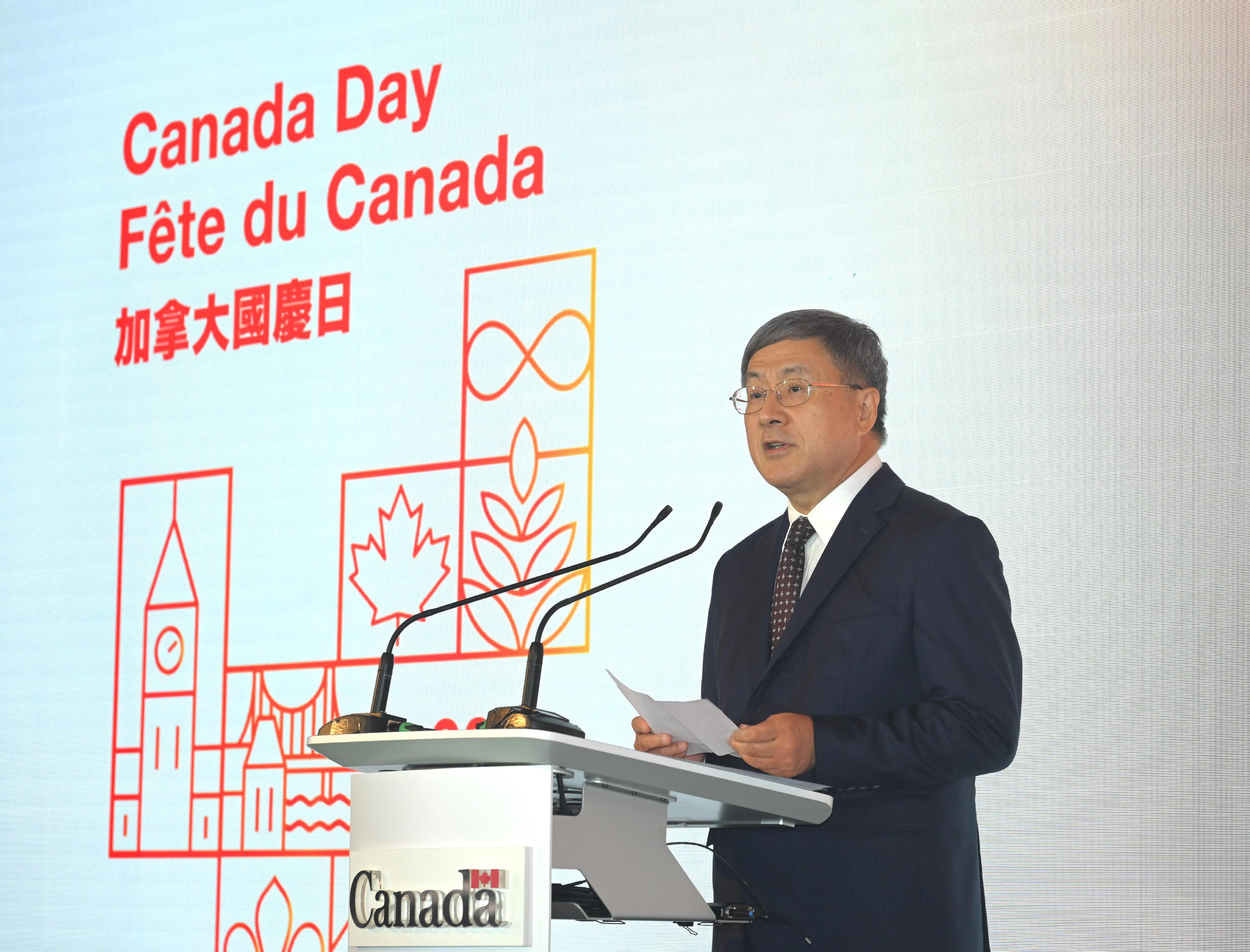
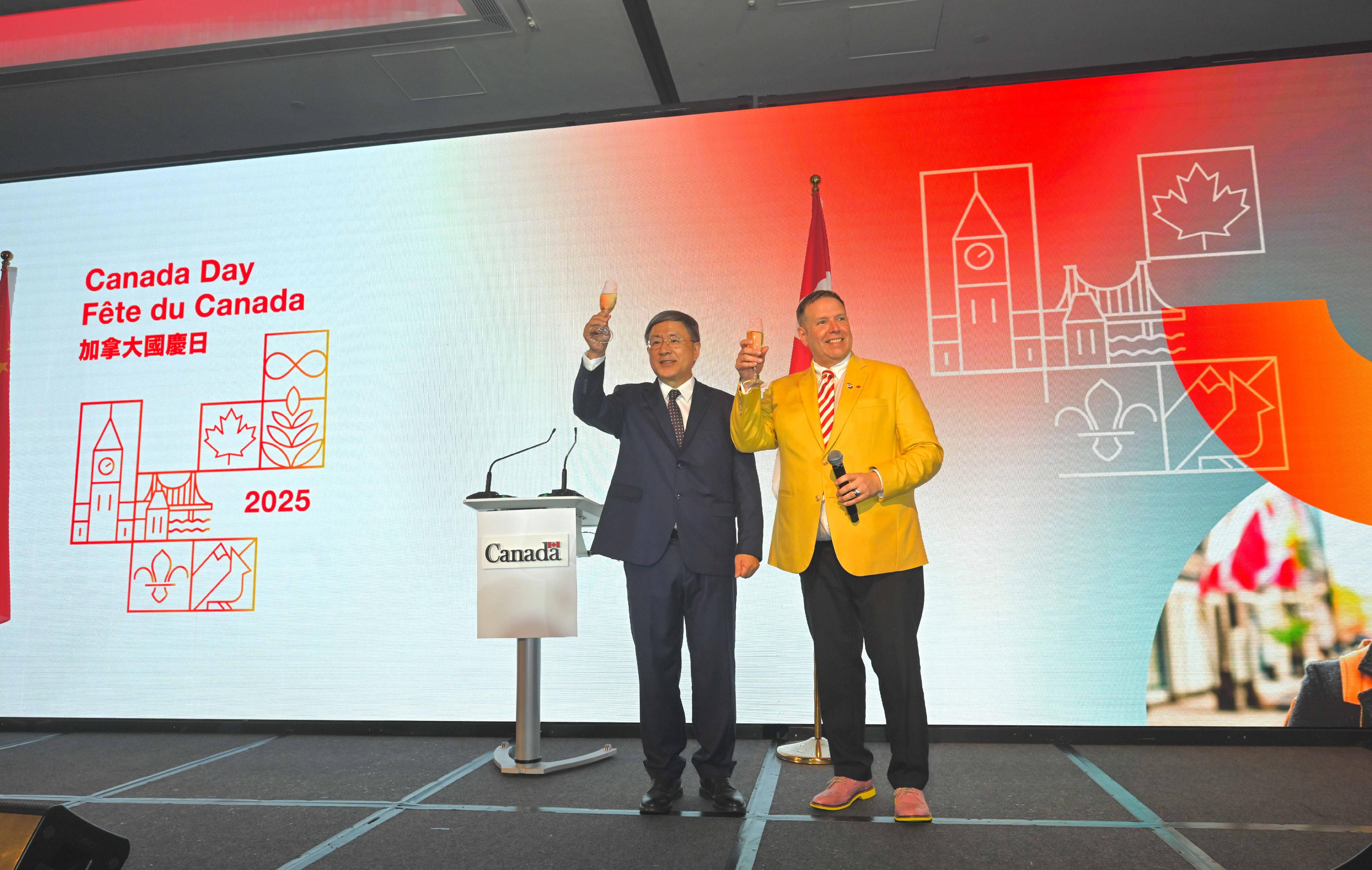
Speech by DCS at Canada Day Reception (English only) (with photos)

     Following is the speech by the Deputy Chief Secretary for Administration, Mr Cheuk Wing-hing, at the Canada Day Reception today (June 20):

Consul General Reeves (Consul General of Canada to Hong Kong and Macao, Mr Charles Edwin Reeves), Deputy Commissioner Li Yongsheng (Deputy Commissioner of the Office of the Commissioner of the Ministry of Foreign Affairs of the People’s Republic of China in the Hong Kong Special Administrative Region), distinguished guests, ladies and gentlemen,

     Good afternoon! It is a great pleasure to be here with you, in honour of Canada Day, the country’s 158th anniversary.  

     Today, we stand together to celebrate the deep and longstanding connections between the people of Canada and the Hong Kong SAR, who have forged strong ties from business and commerce to social, culture and family.  

     Less than two months ago, Canada held its federal election. I would like to take the opportunity to congratulate Canada on smoothly holding the election and returning its 24th Prime Minister. I am delighted to note that, just two weeks ago, Prime Minister Carney (Prime Minister of Canada, Mr Mark Carney) spoke on the phone with Premier Li Qiang of our country. Both leaders emphasised the enormous potential in China-Canada co-operation and their determination to reset bilateral ties. This augurs well for the bilateral relations between the two nations and between Canada and Hong Kong in the foreseeable future. 

     And there is so much to work together for – from safeguarding free trade and the multilateral trading system, to promoting sustainable development and building ties in any number of sectors. For this promising agenda, Hong Kong definitely has a role to play and contribute.  Under the great concept and national policy of “one country, two systems”, Hong Kong, as a Special Administrative Region of China, benefits from national programmes such as the Belt and Road Initiative and the Guangdong-Hong Kong-Macao Greater Bay Area.  Another good example is the country according Hong Kong the position of the “eight centres” in the National 14th Five-year Plan, which has opened up a wide array of new opportunities for the relevant sectors in Hong Kong, such as finance, I&T, trade, aviation, logistics, arts and cultures and so on. The opportunities are not only for Hong Kong; they are also open to overseas companies, including Canadian enterprises, which use Hong Kong as a “super connector” and “super value-adder” between Mainland China and the rest of the world.

     Canada has a strong presence in Hong Kong. There are about 100 Canadian firms maintaining offices in Hong Kong across a broad spectrum of sectors, of which 20 are financial institutions, and some – such as Manulife and Sun Life – have been doing business in the city for more than 100 years. The Canadian Chamber of Commerce in Hong Kong, with over 2 400 members, is also the largest Canadian Chamber outside Canada.  

     We thank the Canadian community and businesses for placing importance on Hong Kong.  I am pleased to say that, in spite of the many changes in the external environment, Hong Kong has maintained its resilience and robustness. We still rank as the world’s freest economy in the Economic Freedom of the World 2024 Annual Report; our IPO (initial public offering) market is bustling with the highest number of IPOs recorded worldwide last month, recording $76 billion raised from new share offerings so far in 2025; we are the largest offshore RMB business hub, handling 80 per cent of offshore RMB transactions; and just this week, we are ranked the world’s third most competitive economy in the 2025 IMD (International Institute for Management Development) World Competitiveness Ranking. In short, Hong Kong remains a favourable place to do business.

     In addition to doing businesses, it is heartening to see that our co-operation bears fruit in other areas such as arts and culture.   Last September, our Cultural and Creative Industries Development Agency organised a delegation to the Toronto International Film Festival, to promote location filming in Hong Kong; and six Hong Kong films were screened at the “Making Waves – Navigators of Hong Kong Cinema” touring film programme in Montreal in October. And in April this year, six Canadian films and co-productions were screened at the 49th Hong Kong International Film Festival.    

     I look forward to making more waves, to more Hong Kong-Canadian co-operation – not only in film and the creative industries, but also in business and finance and every other sector, for our economies, our communities and our flourishing future.

     Ladies and gentlemen, thank you for having me on this joyous occasion. Happy Canada Day!

     Thank you very much.

Photo  Photo  
read more