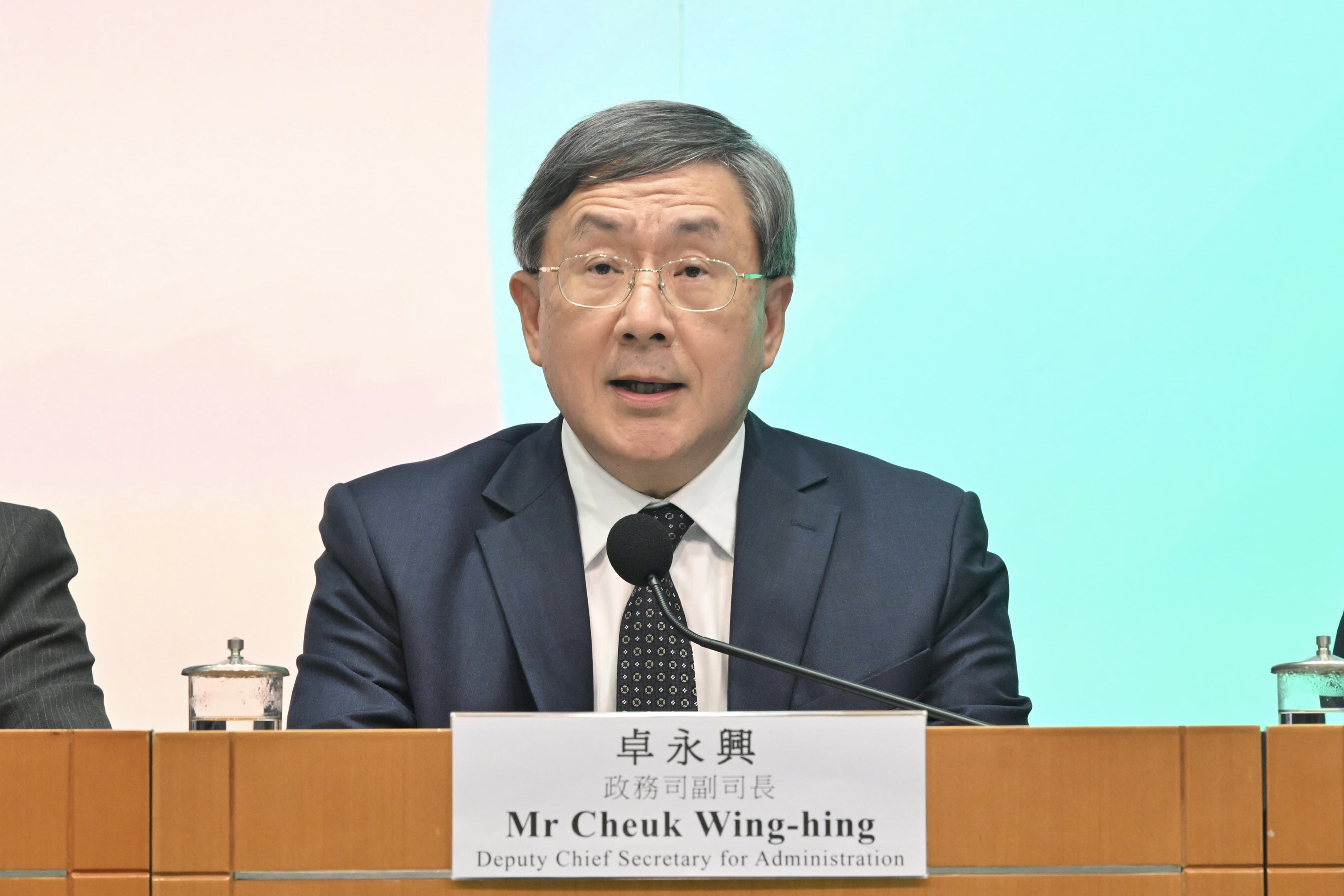
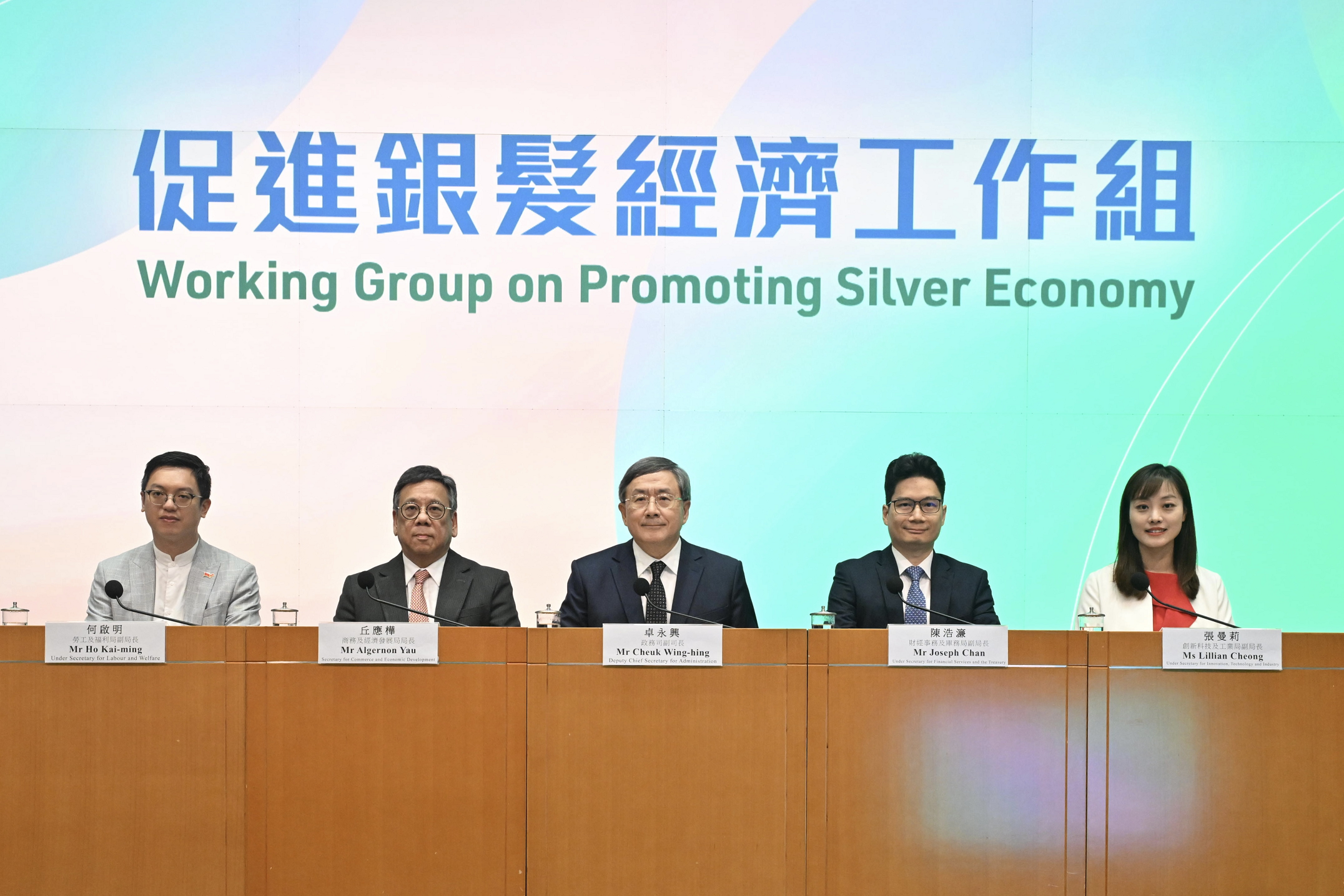
The Deputy Chief Secretary for Administration, Mr Cheuk Wing-hing, today (May 27) held a press conference to announce 30 measures to be implemented by the Working Group on Promoting Silver Economy (see presentation slides of the press conference). Also attending the press conference were the Secretary for Commerce and Economic Development, Mr Algernon Yau; the Under Secretary for Financial Services and the Treasury, Mr Joseph Chan; the Under Secretary for Labour and Welfare, Mr Ho Kai-ming; and the Under Secretary for Innovation, Technology and Industry, Ms Lillian Cheong.
Mr Cheuk said, “Population ageing is becoming an increasingly serious issue around the world, and the situation in Hong Kong is of particular concern. The Census and Statistics Department predicts that by 2043, more than one in every three Hong Kong residents will be an elderly person. In light of this demographic shift, we must actively address the various challenges brought about by an ageing population. At the same time, we should seize development opportunities amid the challenges, explore new industries and new businesses, and break new ground for Hong Kong in a time of change.
“The elderly account for a large proportion of Hong Kong’s population. With favourable financial conditions and purchasing power, they are a huge consumer group that cannot be overlooked, as they create a huge demand for silver economy related products and services. Boosting the silver economy will inject vitality into the local economy and promote overall economic development, as well as spurring the cultivation of high-quality silver products and service modes, so that the elderly can share the fruits of development.”
The Working Group has proposed 30 measures in five areas, namely: boosting “silver consumption”, developing “silver industry”, promoting “quality assurance of silver products”, enhancing “silver financial and security arrangements”, and unleashing “silver productivity”. This plentiful and practical series of measures involves collaboration across different bureaux and sectors. Jointly promoted by different policy bureaux and multiple organisations from different sectors, the measures aim to boost consumption among the elderly, develop silver products and services, and enhance the recognition of products and services through accreditation to drive sales, make good use of and safeguard the financial resources of the elderly, and attract the elderly to join the labour market, with a view to enhancing social productivity and building a silver-friendly society together.
(I) Boosting “silver consumption”
Owing to their health conditions and lifestyle practices, the elderly’s consumption needs are different from those of other consumers, with great consumption potential in areas including catering, personal hygiene and healthcare. The Government aims to boost “silver consumption” through various means, including exhibitions and retail concessions, electronic commerce, the Silver Summit, developing catering initiatives for the elderly, and protecting elderly consumers’ rights and interests.
The Commerce and Economic Development Bureau (CEDB) will take the lead in boosting “silver consumption”, and the 11 measures include:
- The exhibition industry will enhance silver economy elements in exhibitions;
- The exhibition industry will stage a new thematic exhibition on the silver economy;
- The retail sector will provide retail concessions to the elderly;
- The CEDB will facilitate the retail sector, through the Hong Kong Retail Management Association, in exploring the introduction of silver products and services;
- The Hong Kong Trade Development Council (HKTDC) will supply silver products via e-commerce platforms;
- The catering sector will launch the “Friends & Flavours” initiative to introduce meal options suitable for the elderly;
- The CEDB will support the business sector to promote Care Food together with the Hong Kong Council of Social Service (HKCSS);
- The food manufacturing industry will offer pre-packed food products that cater to the needs and preferences of the elderly;
- The CEDB will stage the Silver Summit with the HKCSS;
- The Consumer Council will enhance information on “silver consumption”; and
- The Customs and Excise Department will strengthen publicity and education work.
(II) Developing “silver industry”
The health and daily needs of the silver-haired group have led to a huge demand for products and services. Silver products (including gerontechnology products) have hence come into being.
The work of developing the “silver industry” is led by the Innovation, Technology and Industry Bureau. The four measures are:
- The Hong Kong Science and Technology Parks Corporation (HKSTPC), Cyberport and the Hong Kong Productivity Council will support their technology enterprises to develop gerontechnology;
- The Logistics and Supply Chain MultiTech R&D Centre and the Nano and Advanced Materials Institute will facilitate the realisation and commercialisation of gerontechnology-related research and development (R&D) projects;
- The HKSTPC and Cyberport will assist companies engaged in gerontechnology to collaborate with the elderly care industry, hospitals and clinics to connect gerontechnology product R&D with the needs of the elderly; and
- The Social Welfare Department will expand the household use of gerontechnology products.
(III) Promoting “quality assurance of silver products”
Quality assurance for products and services can enhance their acceptance and attractiveness, helping to establish brand value and expand sales network.
The work of promoting “quality assurance of silver products” is led by the CEDB. The four measures are:
- The HKCSS will launch the Care Food GBA Standard;
- The Federation of Hong Kong Industries will launch the Hong Kong Silver Q-Mark Product Scheme;
- The Development Bureau will launch the Voluntary Accreditation Scheme on Elderly-friendly Building Designs in the short term; and
- The Hong Kong Quality Assurance Agency will launch the Hong Kong Registration.
(IV) Enhancing “silver financial and security arrangements”
Elderly people in Hong Kong possess a certain degree of wealth, which provides the prerequisite for developing silver finance. The Government’s objective is to assist the elderly to best utilise their financial resources and financial management tools, and to protect their financial resources through a comprehensive package of measures.
There will be seven measures for enhancing the “silver financial and security arrangements”, which will be led by the Financial Services and the Treasury Bureau:
- To develop more cross-boundary elderly care insurance products by the insurance industry;
- To further promote the Three Instruments of Peace by the legal sector;
- To strengthen promotion of “HKMC Retire 3” and promote the further development of the local annuity market by the Hong Kong Mortgage Corporation Limited (HKMC);
- To step up financial planning education for the elderly by the HKMC, the Investor and Financial Education Council (IFEC), and the Mandatory Provident Fund Schemes Authority;
- To step up anti-financial scam education and publicity activities for the elderly by the IFEC;
- To strengthen banks’ anti-fraud capabilities by the Hong Kong Monetary Authority (HKMA); and
- To develop guidelines on elderly-friendly banking services by the HKMA and the banking sector.
(V) Unleashing “silver productivity”
The Government will encourage and assist more elderly persons to join the labour market through employment support and training, as well as the promotion of elderly-friendly employment practices, in a bid to unleash the labour force.
The Labour and Welfare Bureau (LWB) will take the lead in driving the measures for unleashing “silver productivity”, including:
- The Employees Retraining Board will roll out priority training consultation services and offer more dedicated training courses to address the needs of industries with keen manpower demand;
- The Labour Department (LD) will double the number of job fairs for older and middle-aged persons this year;
- The LWB will review the Re-employment Allowance Pilot Scheme and the Employment Programme for the Elderly and Middle-aged to further explore measures to encourage the employment of persons aged 60 or above; and
- The LD will step up the promotion of elderly-friendly employment practices.
Mr Cheuk said, “The silver economy holds tremendous business opportunities. With the joint efforts of the Government and various sectors, we can certainly expand the scale and industrial chain of the silver economy, enhance the quality of life for the elderly in all aspects, and increase their sense of contentment and happiness.”
The Chief Executive announced in his Policy Address 2024 the setting up of a Working Group on Promoting Silver Economy, led by the Deputy Chief Secretary for Administration, to implement measures in five areas, namely: boosting “silver consumption”, developing “silver industry”, promoting “quality assurance of silver products”, enhancing “silver financial and security arrangements” and unleashing “silver productivity”. Other members of the Working Group include the Secretary for Commerce and Economic Development (Deputy Leader); the Secretary for Labour and Welfare; the Secretary for Innovation, Technology and Industry; the Secretary for Financial Services and the Treasury; and the Secretary for Health.
read more