Tag Archives: China

image_pdfimage_print

Update on cases of Legionnaires’ disease

     The Centre for Health Protection (CHP) of the Department of Health today (September 2) reported the latest number of cases of Legionnaires’ disease (LD), and stressed the importance of using and maintaining properly designed man-made water systems, adding that susceptible groups should strictly observe relevant precautions.

     From August 25 to 31, the CHP recorded two community-acquired LD cases:
 

  1. A male patient, aged 64 with good past health, who lives in Kwun Tong District; and
  2. A male patient, aged 97 with underlying illnesses, who lived in Kwun Tong District, and passed away on August 26.

     “Epidemiological investigations are ongoing to identify potential sources of infection, high-risk exposure and clusters, if any,” a spokesman for the CHP said.

     As of August 31, 74 LD cases had been recorded this year. In 2023 and 2022, there were 121 and 80 cases respectively.

     “Men, people aged over 50, smokers, alcoholics and persons with weakened immunity are more susceptible to LD. Some situations may also increase the risk of infection, including poor maintenance of water systems; living in areas with old water systems, cooling towers or fountains; using electric water heaters, whirlpools and spas or hot water spring spas; and recent stays in hotels or vessels,” the spokesman said.

     Legionellae are found in various environmental settings and grow well in warm water (20 to 45 degrees Celsius). They can be found in aqueous environments such as water tanks, hot and cold water systems, cooling towers, whirlpools and spas, water fountains and home apparatus that support breathing. People may become infected when they breathe in contaminated droplets (aerosols) and mist generated by artificial water systems, or when handling garden soil, compost and potting mixes.

     Immunocompromised persons should:
 
  • Use sterile or boiled water for drinking, tooth brushing and mouth rinsing;
  • Avoid using humidifiers, or other mist- or aerosol-generating devices; and
  • If using humidifiers, or other mist- or aerosol-generating devices, fill the water tank with only sterile or cooled freshly boiled water, and not water directly from the tap. Also, clean and maintain humidifiers/devices regularly according to manufacturers’ instructions. Never leave stagnant water in a humidifier/device. Empty the water tank, wipe all surfaces dry, and change the water daily. 
     
     The public should observe the health advice below:
 
  • Observe personal hygiene;
  • Do not smoke and avoid alcohol consumption;
  • Strainers in water taps and shower heads should be inspected, cleaned, descaled and disinfected regularly or at a frequency recommended by the manufacturer;
  • If a fresh-water plumbing system is properly maintained, it is not necessary to install domestic water filters. Use of water filters is not encouraged as clogging occurs easily, which can promote growth of micro-organisms. In case water filters are used, the pore size should be 0.2 micrometres (µm) and the filter needs to be changed periodically according to the manufacturer’s recommendations;
  • Drain and clean water tanks of buildings at least quarterly;
  • Drain or purge for at least one minute infrequently used water outlets (e.g. water taps, shower heads and hot water outlets) and stagnant points of the pipework weekly or before use;
  • Seek and follow doctors’ professional advice regarding the use and maintenance of home respiratory devices and use only sterile water (not distilled or tap water) to clean and fill the reservoir. Clean and maintain the device regularly according to the manufacturer’s instructions. After cleaning/disinfection, rinse the device with sterile water, cooled freshly boiled water or water filtered with 0.2 µm filters. Never leave stagnant water in the device. Empty the water tank, keep all surfaces dry, and change the water daily; and
  • When handling garden soil, compost and potting mixes: 
  1. Wear gloves and a face mask;
  2. Water gardens and compost gently using low pressure;
  3. Open composted potting mixes slowly and make sure the opening is directed away from the face;
  4. Wet the soil to reduce dust when potting plants; and
  5. Avoid working in poorly ventilated places such as enclosed greenhouses.

     â€‹â€‹The public may visit the CHP’s LD page, the Code of Practice for Prevention of LD and the Housekeeping Guidelines for Cold and Hot Water Systems for Building Management of the Prevention of LD Committee, and the CHP’s risk-based strategy for prevention and control of LD. read more
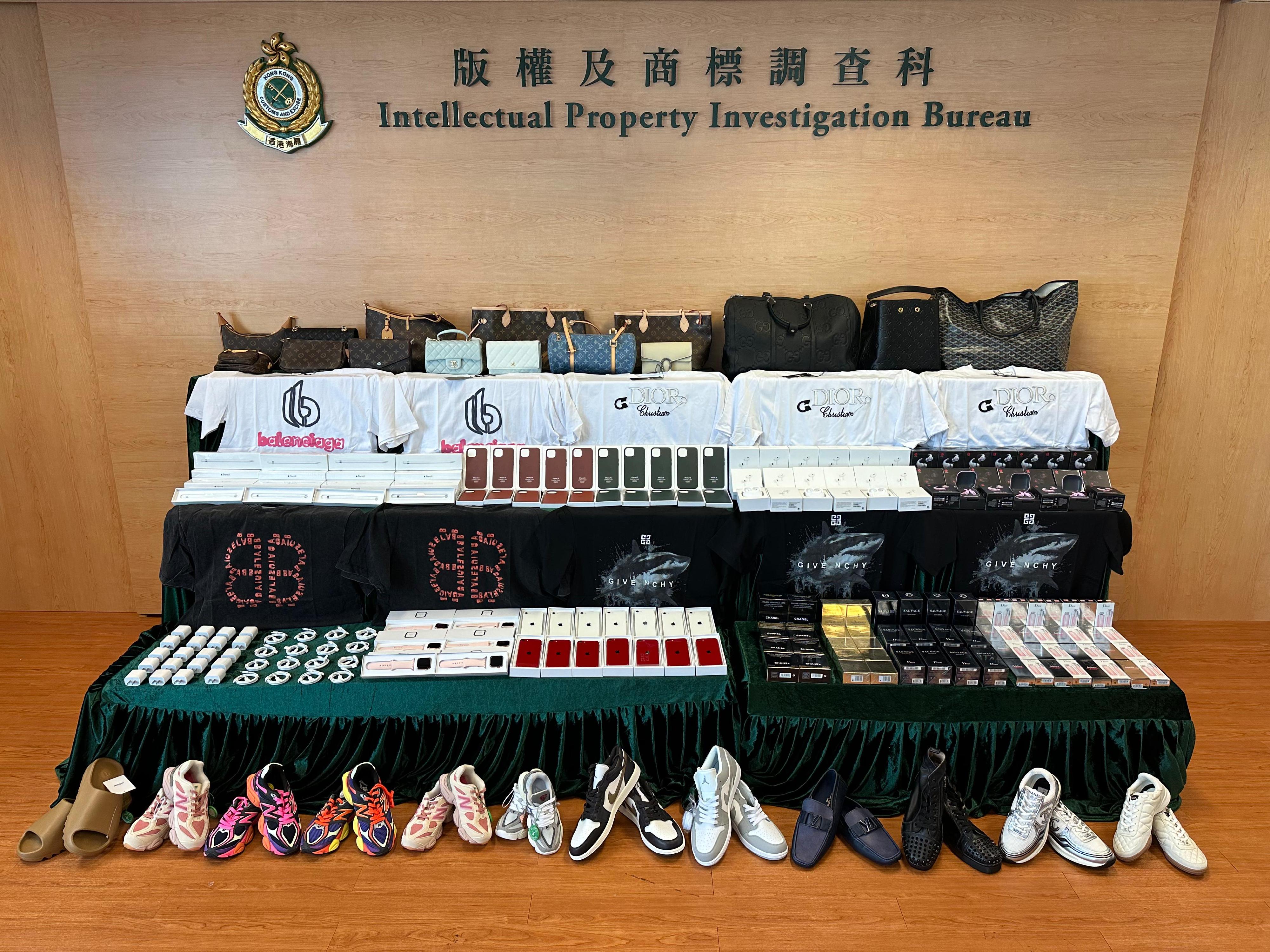
Hong Kong Customs teams up with Mainland and Macao Customs to combat cross-boundary counterfeit goods transshipment activities (with photo)

     Hong Kong Customs conducted a two-week joint enforcement operation with the Mainland and Macao Customs from August 19 to 30, during which inspection of goods across the three places and destined for North America, Europe, and countries and regions along the Belt and Road Initiative was stepped up, with a view to combating cross-boundary counterfeiting activities among the three places and with goods destined for overseas countries. During the operation, Hong Kong Customs detected 28 cases and seized about 25 000 items of suspected counterfeit goods with a total estimated market value of about $5.8 million. 
      
     Through intelligence analysis and in-depth investigations, Hong Kong Customs detected 25 cases in the operation at various local express couriers. Meanwhile, Customs officers conducted strike-and-search cargo inspections at three logistics companies located in Kwai Chung, resulting in the detection of three more cases.
      
     The suspected counterfeit goods seized by Hong Kong Customs in the operation included mobile phones and accessories, watches, personal care products, and footwear. The total estimated market value was about $5.8 million.
      
     Hong Kong Customs will continue to work closely with the Mainland Customs, Macao Customs and overseas law enforcement agencies to vigorously combat cross-boundary counterfeit goods transshipment activities through intelligence exchanges and joint enforcement actions.
      
     Under the Trade Descriptions Ordinance, any person who imports or exports any goods to which a forged trademark is applied commits an offence. The maximum penalty upon conviction is a fine of $500,000 and imprisonment for five years.
      
     Members of the public may report any suspected counterfeiting activities to Customs’ 24-hour hotline 2545 6182 or its dedicated crime-reporting email account (crimereport@customs.gov.hk) or online form (eform.cefs.gov.hk/form/ced002).

Photo  
read more

Effective Exchange Rate Index

     The effective exchange rate index for the Hong Kong dollar on Monday, September 2, 2024 is 103.9 (up 0.2 against last Saturday’s index).

     â€‹The effective exchange rate index for the Hong Kong dollar on Saturday, August 31, 2024 was 103.7 (same as last Friday’s index). read more

Inspection of aquatic products imported from Japan

     In response to the Japanese Government’s plan to discharge nuclear-contaminated water at the Fukushima Nuclear Power Station, the Director of Food and Environmental Hygiene issued a Food Safety Order which prohibits all aquatic products, sea salt and seaweeds originating from the 10 metropolis/prefectures, namely Tokyo, Fukushima, Ibaraki, Miyagi, Chiba, Gunma, Tochigi, Niigata, Nagano and Saitama, from being imported into and supplied in Hong Kong.
      
     For other Japanese aquatic products, sea salt and seaweeds that are not prohibited from being imported into Hong Kong, the Centre for Food Safety (CFS) of the Food and Environmental Hygiene Department will conduct comprehensive radiological tests to verify that the radiation levels of these products do not exceed the guideline levels before they are allowed to be supplied in the market.
      
     As the discharge of nuclear-contaminated water is unprecedented and will continue for 30 years or more, the Government will closely monitor and step up the testing arrangements. Should anomalies be detected, the Government does not preclude further tightening the scope of the import ban.
      
     From noon on August 30 to noon today (September 2), the CFS conducted tests on the radiological levels of 325 food samples imported from Japan, which were of the “aquatic and related products, seaweeds and sea salt” category, in the past three days (including last Saturday and Sunday). No sample was found to have exceeded the safety limit. Details can be found on the CFS’s thematic website titled “Control Measures on Foods Imported from Japan” (www.cfs.gov.hk/english/programme/programme_rafs/programme_rafs_fc_01_30_Nuclear_Event_and_Food_Safety.html).
      
     In parallel, the Agriculture, Fisheries and Conservation Department (AFCD) has also tested 150 samples of local catch for radiological levels. All the samples passed the tests. Details can be found on the AFCD’s website (www.afcd.gov.hk/english/fisheries/Radiological_testing/Radiological_Test.html).
      
     The Hong Kong Observatory (HKO) has also enhanced the environmental monitoring of the local waters. No anomaly has been detected so far. For details, please refer to the HKO’s website (www.hko.gov.hk/en/radiation/monitoring/seawater.html).
      
     From August 24, 2023, to noon today, the CFS and the AFCD have conducted tests on the radiological levels of 81 055 samples of food imported from Japan (including 51 868 samples of aquatic and related products, seaweeds and sea salt) and 18 650 samples of local catch respectively. All the samples passed the tests. read more