Effective Exchange Rate Index
The effective exchange rate index for the Hong Kong dollar on Thursday, May 29, 2025 is 103.6 (same as yesterday’s index). read more


The effective exchange rate index for the Hong Kong dollar on Thursday, May 29, 2025 is 103.6 (same as yesterday’s index). read more
In response to the Japanese Government’s plan to discharge nuclear-contaminated water at the Fukushima Nuclear Power Station, the Director of Food and Environmental Hygiene issued a Food Safety Order which prohibits all aquatic products, sea salt and seaweeds originating from the 10 metropolis/prefectures, namely Tokyo, Fukushima, Ibaraki, Miyagi, Chiba, Gunma, Tochigi, Niigata, Nagano and Saitama, from being imported into and supplied in Hong Kong.
For other Japanese aquatic products, sea salt and seaweeds that are not prohibited from being imported into Hong Kong, the Centre for Food Safety (CFS) of the Food and Environmental Hygiene Department is conducting comprehensive radiological tests to verify that the radiation levels of these products do not exceed the guideline levels before they are allowed to be supplied in the market.
As the discharge of nuclear-contaminated water is unprecedented and will continue for 30 years or more, the Government will closely monitor the situation and continue to implement the enhanced testing arrangements. Should anomalies be detected, the Government does not preclude further tightening the scope of the import ban.
From noon on May 28 to noon today (May 29), the CFS conducted tests on the radiological levels of 157 food samples imported from Japan, which were of the “aquatic and related products, seaweeds and sea salt” category. No sample was found to have exceeded the safety limit. Details can be found on the CFS’s thematic website titled “Control Measures on Foods Imported from Japan” (www.cfs.gov.hk/english/programme/programme_rafs/programme_rafs_fc_01_30_Nuclear_Event_and_Food_Safety.html).
In parallel, the Agriculture, Fisheries and Conservation Department (AFCD) has also tested 50 samples of local catch for radiological levels. All the samples passed the tests. Details can be found on the AFCD’s website (www.afcd.gov.hk/english/fisheries/Radiological_testing/Radiological_Test.html).
The Hong Kong Observatory (HKO) has also enhanced the environmental monitoring of the local waters. No anomaly has been detected so far. For details, please refer to the HKO’s website
(www.hko.gov.hk/en/radiation/monitoring/seawater.html).
From August 24, 2023, to noon today, the CFS and the AFCD have conducted tests on the radiological levels of 139 452 samples of food imported from Japan (including 91 778 samples of aquatic and related products, seaweeds and sea salt) and 32 038 samples of local catch respectively. All the samples passed the tests. read more
The interdepartmental working group on festival arrangements, led by the Chief Secretary for Administration, released the following information today (May 29) on the latest situation and arrangements for the upcoming Tuen Ng Festival long weekend of the Mainland.
During the upcoming Tuen Ng Festival long weekend of the Mainland (May 31 to June 2), the Immigration Department (ImmD) estimates that around 3.2 million passengers (including Hong Kong residents and visitors) will pass through Hong Kong’s sea, land and air control points. The ImmD, in consultation with the Shenzhen General Station of Exit and Entry Frontier Inspection and other Mainland authorities, estimates that around 2.73 million passengers will pass through land boundary control points. The number of outbound and inbound passengers using land boundary control points will be relatively higher on May 31 (Saturday) and June 1 (Sunday), with around 570 000 passengers and 540 000 passengers respectively.
The ImmD estimates that the passenger traffic at the Lo Wu Control Point, the Lok Ma Chau Spur Line Control Point and the Shenzhen Bay Control Point will be heavy, with a daily average forecast of about 230 000, 200 000 and 140 000 passengers respectively.
To cope with the anticipated heavy traffic during the festive period, the ImmD has minimised leave for frontline officers for flexible deployment and the operation of extra clearance counters and kiosks.
Furthermore, the ImmD, the Hong Kong Police Force, the Customs and Excise Department and the MTR Corporation Limited will set up a joint command centre at the Lo Wu Control Point to make necessary arrangements. The ImmD will also establish close communication with Mainland authorities, including the Shenzhen General Station of Exit and Entry Frontier Inspection. To ensure a smooth passenger traffic flow, passenger conditions will be closely monitored and appropriate traffic diversion plans will be adopted when necessary.
To avoid congestion and longer-than-usual waiting times for immigration clearance, the ImmD advises all land boundary passengers to plan in advance, avoid making their journeys during busy periods, and keep track of radio and TV broadcasts on traffic conditions at various control points. Furthermore, passengers may also check the estimated waiting times at each land boundary control point at any time or place via the Immigration Mobile Application (ImmD Mobile App). They can then plan their trips effectively and save time queuing at control points. The ImmD Mobile App can be downloaded free of charge from the Apple App Store (supports iOS version 12.0 or above), Google Play (supports Android version 8.0 or above), Huawei AppGallery (supports Android version 8.0 or above) and the APK file available on the ImmD website. Passengers can download the ImmD Mobile App by scanning the QR code (see Annex) or via the ImmD website, www.immd.gov.hk. In addition, information on public transport services to and from various control points is available on the Transport Department website at www.td.gov.hk.
For travellers making journeys to the Mainland, the ImmD reminds them to carry their proof of identity and valid travel documents for crossing the boundary. Hong Kong residents should also check the validity of their Home Visit Permits. Non-permanent residents must carry their valid smart identity card as well as their Document of Identity for Visa Purposes or valid travel document.
Holders of the acknowledgement receipt issued due to the reported loss or replacement of their Hong Kong identity cards, or children under 11 years old who hold Hong Kong identity cards, should carry a valid travel document or Re-entry Permit.
About 700 e-Channels have been installed at various control points. To further enhance the clearance efficiency of control points and allow more Hong Kong residents to use the fast and convenient e-Channel service, starting from March 31, the ImmD has adjusted the applicable age for e-Channel service for holders of smart identity cards. Eligible Hong Kong permanent residents aged 7 to 10 years old, who are at least 1.1 metres tall and hold a smart identity card and a valid Hong Kong Special Administrative Region Passport, can use the e-Channels without prior enrolment for self-service immigration clearance via face recognition technology at all control points. Moreover, the Contactless e-Channel service is available at all control points now. All eligible Hong Kong residents, after enrolment, can generate an encrypted QR code through the Contactless e-Channel mobile application to enter the e-Channel and then verify their identity with the facial verification technology for automated immigration clearance.
In addition, all control points have introduced self-service departures for visitors to Hong Kong (Smart Departure), which provides greater travel convenience for visitors. The service employs facial recognition technology for identity verification, which allows eligible visitors holding electronic travel documents to perform self-service departure clearance through Smart Departure e-Channels without prior enrolment.
Hong Kong residents who require assistance while travelling outside Hong Kong may call the 24-hour hotline of the Assistance to Hong Kong Residents Unit of the ImmD at (852) 1868, call the 1868 hotline using network data or use the 1868 Chatbot via the ImmD Mobile App, send a message to 1868 WhatsApp assistance hotline or 1868 WeChat assistance hotline or submit the Online Assistance Request Form.
The interdepartmental working group on festival arrangements is tasked with holistically co-ordinating and steering the preparatory work of various government departments for welcoming visitors to Hong Kong during the Tuen Ng Festival long weekend of the Mainland, as well as strengthening information dissemination to enable the public and visitors to plan their itineraries according to the latest situation. read more
The following is issued on behalf of the Hong Kong Monetary Authority: ​The Ministry of Finance will issue Renminbi Sovereign Bonds through the Central Moneymarkets Unit of the Hong Kong Monetary Authority (HKMA). Ple… read more
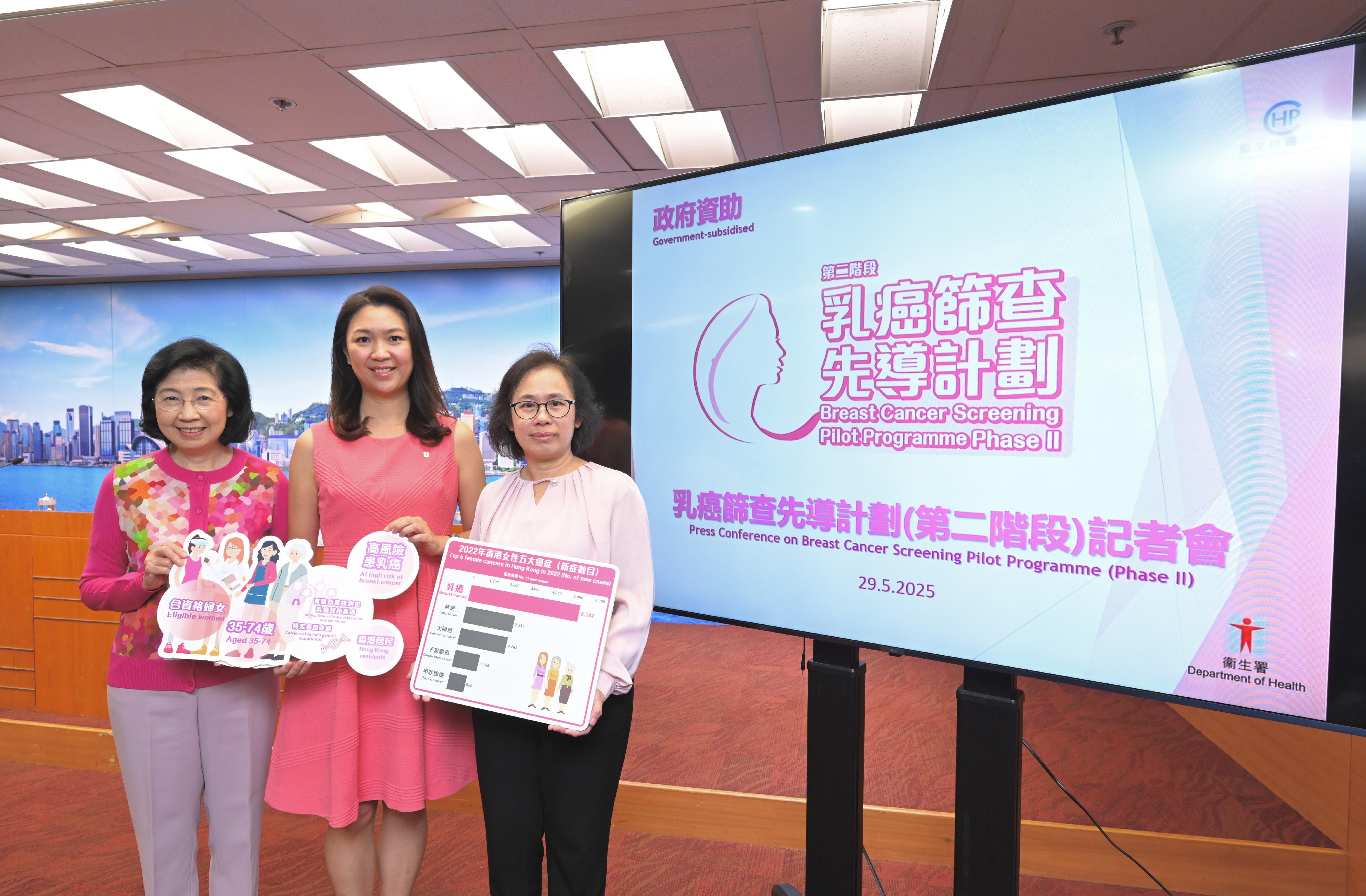
The Department of Health (DH) today (May 29) announced that Phase II of the Breast Cancer Screening Pilot Programme (BCSPP) will be launched on June 10 to provide subsidised breast cancer screening services to female Hong Kong residents aged 35 to 74 who are at high risk of developing breast cancer. The goal is to enhance the recovery rate of breast cancer patients through early detection and treatment.
Breast cancer is the most common cancer among females and the third leading cause of cancer deaths of females in Hong Kong. Over the past decade, the age-standardised incidence and age-standardised mortality rates of breast cancer have both increased. In 2022, there were 5 182 newly diagnosed invasive female breast cancer cases, accounting for 28.6 per cent of all new cancer cases in women in Hong Kong. In 2023, the disease led to 834 deaths among women, accounting for 13.1 per cent of female cancer deaths.
The Government attaches great importance to cancer prevention and control work. Based on the recommendations of the Cancer Expert Working Group on Cancer Prevention and Screening under the Cancer Coordinating Committee, the Government launched Phase I of the BCSPP as early as in 2021 and subsequently Phase II of the BCSPP will be launched in accordance with the risk-based approach of cancer prevention and control as set out in the “Chief Executive’s 2024 Policy Address”.
Details of Phase II of BCSPP
——————————-
Eligible persons are high-risk women aged 35 to 74 who are at high risk of developing breast cancer, i.e. carriers of certain gene mutation(s) or with a strong family history of breast cancer/ovarian cancer (see Annex 1). Participants must be holders of a Hong Kong Identity Card or Certificate of Exemption and have registered in the Electronic Health Record Sharing System (eHealth).
Phase II of the BCSPP provides services to the public through public-private partnership programmes in collaboration with non-governmental organisations (NGOs). The three service providers are Hong Kong Breast Cancer Foundation, United Christian Nethersole Community Health Service, and Haven of Hope Christian Service.
Starting from tomorrow (May 30), eligible women may contact any one of the three NGO designated clinics (see Annex 2) to make an appointment for assessment and arrange for mammography (MMG) screening on or after June 10. Additional ultrasound MMG will be arranged for those who are confirmed to carry specific genetic mutations.
To encourage high-risk women to undergo screening, the Government provides a high level of subsidy for Phase II of the BCSPP. Service providers may only charge participants a co-payment of not more than $225 for each mammogram or ultrasound breast examination. Currently, all of the service providers will not charge any co-payment from the service users.
Members of the public may visit the dedicated website (www.breastscreen.gov.hk) or call the DH hotline (3586 3088) to learn more about Phase II of the BCSPP. The hotline operates from 9am to 5pm from Monday to Friday (except public holidays).
Government’s work in cancer prevention and control
———————————————————-
Under Phase I of the BCSPP launched in 2021, three Woman Health Centres (WHCs), four Maternal and Child Health Centres (MCHCs) and 18 Elderly Health Centres (EHCs) of the DH provided biennial MMG screening for women aged 44 to 69 with certain risk factors.
In the two-year Phase I of the BCSPP (which ran from September 2021 to December 2023), a total of 27 807 women have received breast cancer risk assessment. Among them, 7 785 (about 28 per cent) underwent MMG screening on referral based on the risk assessment. Among the women with abnormal MMG results who had been referred to specialists for treatment, 409 cases were followed up in public hospitals, among which 68 (about 16.6 per cent) were confirmed to have breast cancer. The breast cancer detection rate per 1 000 MMG screenings was 8.7, which was comparable to the international standard of about five cases per 1 000 MMG screenings. Of the 68 breast cancer cases identified through MMG screening, 97 per cent were at stage II or below.
The breast cancer risk assessment and screening have been included as part of the services provided by the Woman Health Service and the Elderly Health Service in 2024. In 2024, 9 230 women aged 44 to 69 were assessed for breast cancer risk. Among them, 2 689 women (about 29 per cent) had undergone MMG screening based on the risk assessment. Among the women who received MMG screening, 321 (about 12 per cent) were referred to specialists for further investigation and treatment.
To utilise resources more effectively and expand the multidisciplinary primary healthcare service network, the DH’s Woman Health Services provided at the WHCs and the designated MCHCs are being integrated into the district health network of the Primary Healthcare Commission (PHC Commission). During the transition period of service integration, those who have already paid their annual fee and are still within the service period will continue to receive relevant services from the DH. The PHC Commission will commence the integrated women’s health services within this year in an orderly manner, whereby women’s primary healthcare services will be provided through three service points named Women Wellness Satellites (WWS) to replace the Woman Health Services of the DH. Among them, the WWS (Hong Kong) located in Chai Wan will commence operation in June this year. Women aged 64 or below can receive screening services at the WWS, while those aged 65 to 69 will continue to receive services at the EHCs of the DH.
In addition, to further expand the services, the Hospital Authority’s General Out-patient Clinics have been providing breast cancer risk assessment and screening services to eligible underprivileged women (including Comprehensive Social Security Assistance recipients or persons granted medical fee waivers) since March this year.
The DH encourages the public to adopt a healthy lifestyle, including avoiding tobacco and alcohol, eating a healthy diet, engaging in regular physical activity, and maintaining a healthy body weight, in order to minimise the risk of non-communicable diseases, including cancer. For more health information on cancer prevention, please visit the website of the Centre for Health Protection.