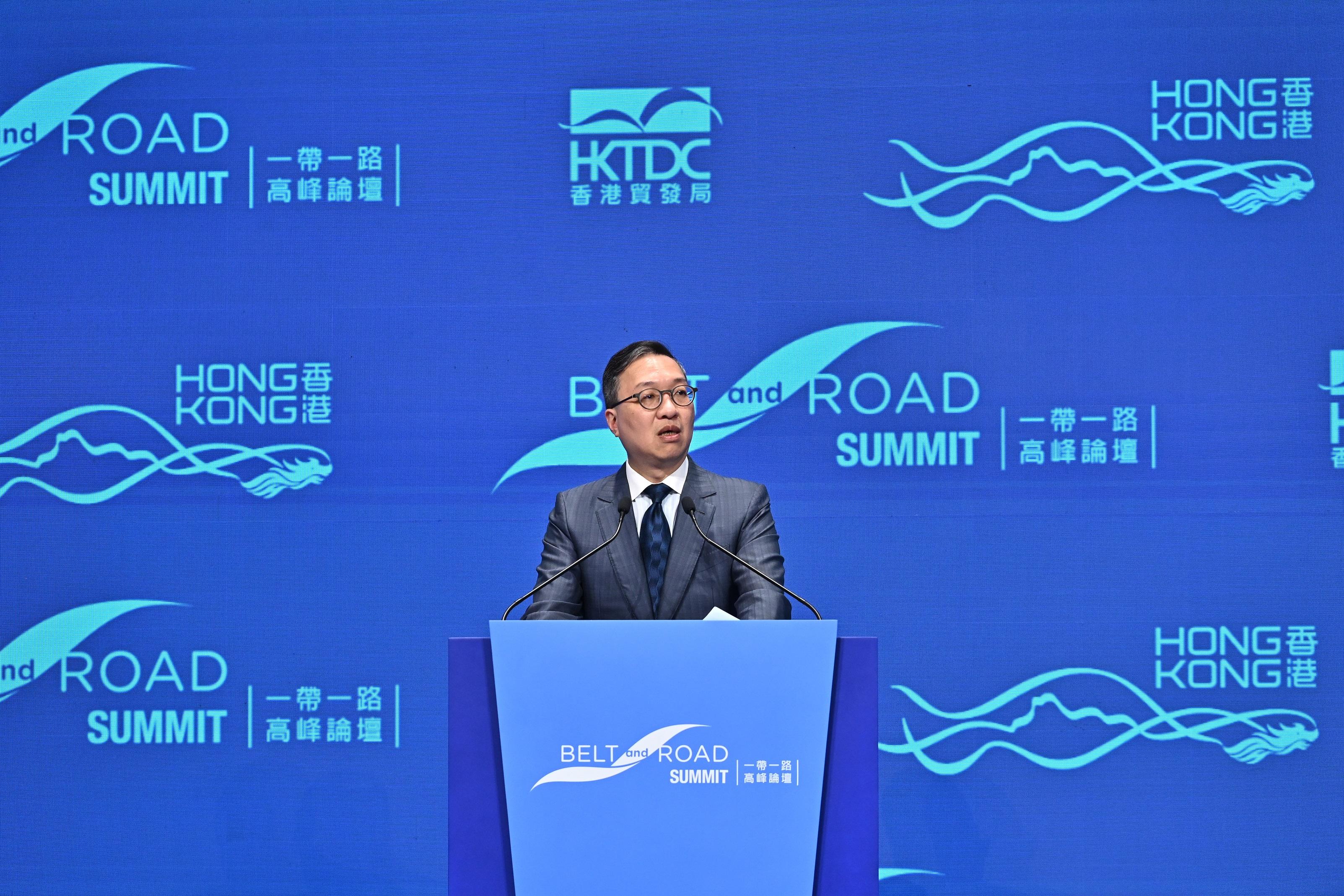
Speech by SJ at thematic breakout session of Ninth Belt and Road Summit (English only) (with photo)
Following are the welcome remarks by the Secretary for Justice, Mr Paul Lam, SC, at the thematic breakout session entitled Building a Green, Sustainable and Innovative Silk Road through Hong Kong’s Legal and Dispute Resolution Services of the Ninth Belt and Road Summit today (September 11):
Distinguished guests, ladies and gentlemen,
Good afternoon. Welcome to this thematic breakout session co-organised by the Department of Justice and the Hong Kong Trade Development Council. The theme of this session is Building a Green, Sustainable and Innovative Silk Road through Hong Kong’s Legal and Dispute Resolution Services.
This year, the Belt and Road Initiative has entered its second and golden decade. At the third Belt and Road Forum for International Cooperation held in Beijing in October last year, President Xi Jinping announced that China will take eight major steps to support the joint pursuit of high-quality Belt and Road co-operation. The fourth step is promoting green development whereas the fifth step is advancing scientific and technological innovation. In the very recent Resolution of the Central Committee of the Communist Party of China (CCCPC) on Further Deepening Reform Comprehensively to Advance Chinese Modernization adopted at the Third Plenary Session of the 20th CCCPC in July this year, it is also emphasised that China will continue to implement the Belt and Road Science, Technology, and Innovation Cooperation Action Plan and redouble efforts to develop multilateral platforms for co-operation in green development, the digital economy, artificial intelligence and other areas.
China’s commitment to build a green, sustainable and innovative silk road is beyond doubt. According to the China Belt and Road Initiative Investment Report published by Fudan University in Shanghai in August last year, China’s overseas energy-related engagement in the Belt and Road countries in the first half of 2023 was the “greenest” in terms of project type, since the inception of the Belt and Road Initiative. With the world facing increasing challenges from climate change, biodiversity loss and other transboundary environmental issues, these green projects are extremely timely and necessary to ensure that they will be sustainable in the long run. At the same time, it is equally important to promote the use of fast advanced technology to ensure that Belt and Road projects will result in high quality development.
Inevitably, legal issues and even disputes may arise from the inception to the implementation of Belt and Road projects. Top qualify legal services are plainly indispensable as an essential component of risk management and also dispute resolution. I wish to make one point only: that is Hong Kong is ideal in providing one-stop legal and dispute resolution services in the present context.
As a matter of fact, in the speech given by Mr Xiao Weiming, Deputy Secretary General of the National Development and Reform Commission of China, this morning at the opening ceremony of the Belt and Road Summit, he reiterated that the Commission supports Hong Kong to reinforce and enhance its status as the international legal and dispute resolution services centre in the Asia-Pacific region, and to assist in perfecting foreign-related legal services for the joint construction of the Belt and Road.
To begin with, there are very good reasons why investors and participants in green projects along the Belt and Road should use Hong Kong companies in accordance with Hong Kong law with the help of Hong Kong lawyers as the vehicles or platforms for their projects. Hong Kong applies very stringent environmental, social and governance (ESG) standards which are consistent with prevailing international practice. There are three regulatory ESG reporting or disclosure requirements for Hong Kong listed companies, fund managers and ESG funds respectively. The Hong Kong listed companies are required to make disclosures on environmental and social aspects in their annual ESG reports in accordance with the ESG Reporting Guide under the Listing Rules. Under the Securities and Futures Commission (SFC) Fund Manager Code of Conduct published in 2022, fund managers are required to take climate-related risks into consideration in their investment and risk management process, and make disclosure of information in relation to climate-related risks to allow fund investors to make an informed judgment about their investment. Regarding ESG funds, the SFC also published a circular back in 2021 requiring those funds to disclose their ESG focus, ESG investment strategy and asset allocation, etc.
Turning to projects involving innovation where protection of intellectual property (IP) rights is of crucial importance, Hong Kong has comprehensive intellectual property laws which encompass all aspects of IP protection, such as trademarks, patents, designs and copyright. The Government is committed to keeping our laws in tandem with fast-changing technological developments. In July this year, the Intellectual Property Department launched a two-month public consultation about enhancing the Copyright Ordinance (Cap. 528) to protect artificial intelligence technology development.
In addition, Hong Kong co-operates closely with the international community in this respect. As of today, 10 international IP conventions have been applied to Hong Kong by the People’s Republic of China. As a member of the World Trade Organization (WTO), our IP protection system adheres to the standards set forth in the WTO Agreement on Trade-Related Aspects of Intellectual Property Rights, ensuring robust protection for IP in our jurisdiction.
On the other hand, Hong Kong has also established extensive co-operation with the Mainland in the area of IP protection. In February last year, in order to advance the development of IP in Hong Kong and Shenzhen and fostering cross-boundary innovation, the Commerce and Economic Development Bureau and the Qianhai Authority in Shenzhen jointly promulgated 16 Co-operation Measures for the Development of the Qianhai Shenzhen-Hong Kong Intellectual Property and Innovation Hub. The 16 Co-operation Measures cover a wide range of areas, including co-operation in IP protection, exploitation and transformation, exchange and study, promotion and education, and IP trading.
Moving on to dispute resolution services, while what I am going to say should be applicable to all sorts of Belt and Road projects, I would like to focus on IP disputes to showcase Hong Kong’s ability in dispute resolution services.
Insofar as IP litigations in court are concerned, an IP Specialist List has been established in the Court of First Instance since 2019. The Hong Kong Judiciary has issued a Practice Direction 22.1 in 2019 to outline the special procedures for resolving IP disputes, which aim at resolving IP disputes expeditiously.
To give an example to demonstrate that the Hong Kong court is willing and able to make effective orders in intellectual property disputes with an international element, I would like to mention a landmark judgment delivered by the Honourable Mr Justice David Lok, the judge in charge of the IP list, in 2021. In that case which is known as Biozeal LLC & Ors v Nature’s Story Company Limited & Ors, the issue was whether the Hong Kong court has jurisdiction to grant an interlocutory injunction with extra-territorial effect in respect of infringement of IP rights. The court held that so long as the plaintiffs can show that the defendants’ passing-off activities are also actionable in the foreign jurisdiction concerned, and the court has personal jurisdiction over the defendants, usually by showing that the defendant is a Hong Kong resident or a company incorporated in Hong Kong, the Hong Kong court would have jurisdiction to grant an injunction to prohibit the defendants from continuing the passing-off activities in the foreign jurisdiction concerned.
It is also significant to note that many Hong Kong judgments on intellectual property disputes may now be recognised and enforced in Mainland China. An Arrangement on Reciprocal Recognition and Enforcement of Judgments in Civil and Commercial Matters by the Courts of the Mainland and of the Hong Kong SAR (Special Administrative Region) was signed in January 2019. This Arrangement eliminates the need for re-litigation of the same disputes in both places; and offers better, more effective and efficient protection to the legitimate interests of the parties who have succeeded in litigations. Notably, the Arrangement has expressly covered judgments given in respect of certain types of disputes over IP rights. This signifies a major breakthrough as, in comparison, the international Hague Convention on the Recognition and Enforcement of Foreign Judgments in Civil or Commercial Matters concluded in July 2019 expressly excludes IP matters. Hong Kong is the first and the only jurisdiction to have such an arrangement with the Mainland with such a wide range of matters. This Arrangement, which is implemented by the relevant local ordinance in Hong Kong, has already come into effect in January this year.
Hong Kong is also an ideal venue for resolving IP disputes by arbitration as an alternative to litigation. It is most telling that an Arrangement Concerning Mutual Assistance in Court-ordered Interim Measures in Aid of Arbitral Proceedings by the Courts of the Mainland and of the Hong Kong SAR was concluded April 2019. This Arrangement allows parties to arbitral proceedings administered by designated arbitral institutions in Hong Kong to apply to the Mainland courts for interim measures, including preservation of assets, evidence and conduct. This is particularly useful in IP arbitrations as it would allow an interim injunction be granted to maintain the status quo pending the final resolution of the arbitral proceedings.
To complete the picture, Hong Kong also has reputable mediation services. It is evidenced by the selection of the city as the headquarters for the International Organization for Mediation (IOMed) intended to be established pursuant to ongoing negotiations between China and other state parties. It signifies a strong vote of confidence from the international community. The IOMed will be the world’s first intergovernmental organisation dedicated to providing mediation services for settling international disputes. We are hopeful that the relevant international convention relating to IOMed may be concluded soon and the IOMed may start operation within 2025.
One of my duties as the Secretary for Justice of Hong Kong, and also the Department of Justice, is to enhance a better understanding among our friends in the Belt and Road region of the legal and dispute resolution services which Hong Kong may provide in the best interest of your jurisdictions. Apart from organising and participating in forums such as this one, we organise overseas trips to promote our legal and dispute resolution services from time to time. For example, in May this year, I led a delegation of about 30 members comprising representatives from the legal and related sectors, to visit Saudi Arabia and United Arab Emirates. At the end of this month, I will also lead another delegation to visit Brunei, Vietnam and Malaysia. I very much hope to be able to have more opportunities to share with you information concerning Hong Kong’s legal and dispute resolution services in future whether in Hong Kong, in the Mainland or your countries wherever they are.
On this note, I wish you all a very fruitful and constructive session this afternoon. Thank you very much.