Tag Archives: China

image_pdfimage_print

Draft Tseung Kwan O Outline Zoning Plan approved

     The Chief Executive in Council has approved the draft Tseung Kwan O Outline Zoning Plan (OZP).

     “The approved OZP provides a statutory land use planning framework to guide the development and redevelopment in the Tseung Kwan O area,” a spokesman for the Town Planning Board said today (September 27).

     The planning scheme area, covering about 1 718 hectares, is located at the southern part of Sai Kung District. It is bounded by Clear Water Bay Peninsula to the east, Junk Bay to the south, Lam Tin and Sau Mau Ping areas to the west, and Tseng Lan Shue and the Hong Kong University of Science and Technology to the north.
      
     The approved OZP has incorporated amendments shown on the draft Tseung Kwan O OZP No. S/TKO/29, which mainly involve (i) rezoning a site at Ying Yip Road from “Comprehensive Development Area” to “Other Specified Uses” annotated “Film Studio and Related Uses” for proposed film studio redevelopment; and (ii) rezoning a site at Hang Hau Road from “Residential (Group C)1” to “Residential (Group C)2” for proposed house redevelopment.

     The Notes and Explanatory Statement of the OZP have been amended taking into account the above amendments. Opportunity is also taken to update the general information of various land use zones and the planning circumstances, where appropriate.

     The approved Tseung Kwan O OZP No. S/TKO/30 is available for public inspection during office hours at (i) the Secretariat of the Town Planning Board, (ii) the Planning Enquiry Counters, (iii) the Sai Kung and Islands District Planning Office, (iv) the Sai Kung District Office, and (v) the Hang Hau Rural Committee.
      
     Copies of the approved OZP are available for sale at the Map Publications Centres in North Point and Yau Ma Tei. The electronic version of the OZP can be viewed at the Town Planning Board’s website (www.tpb.gov.hk). read more
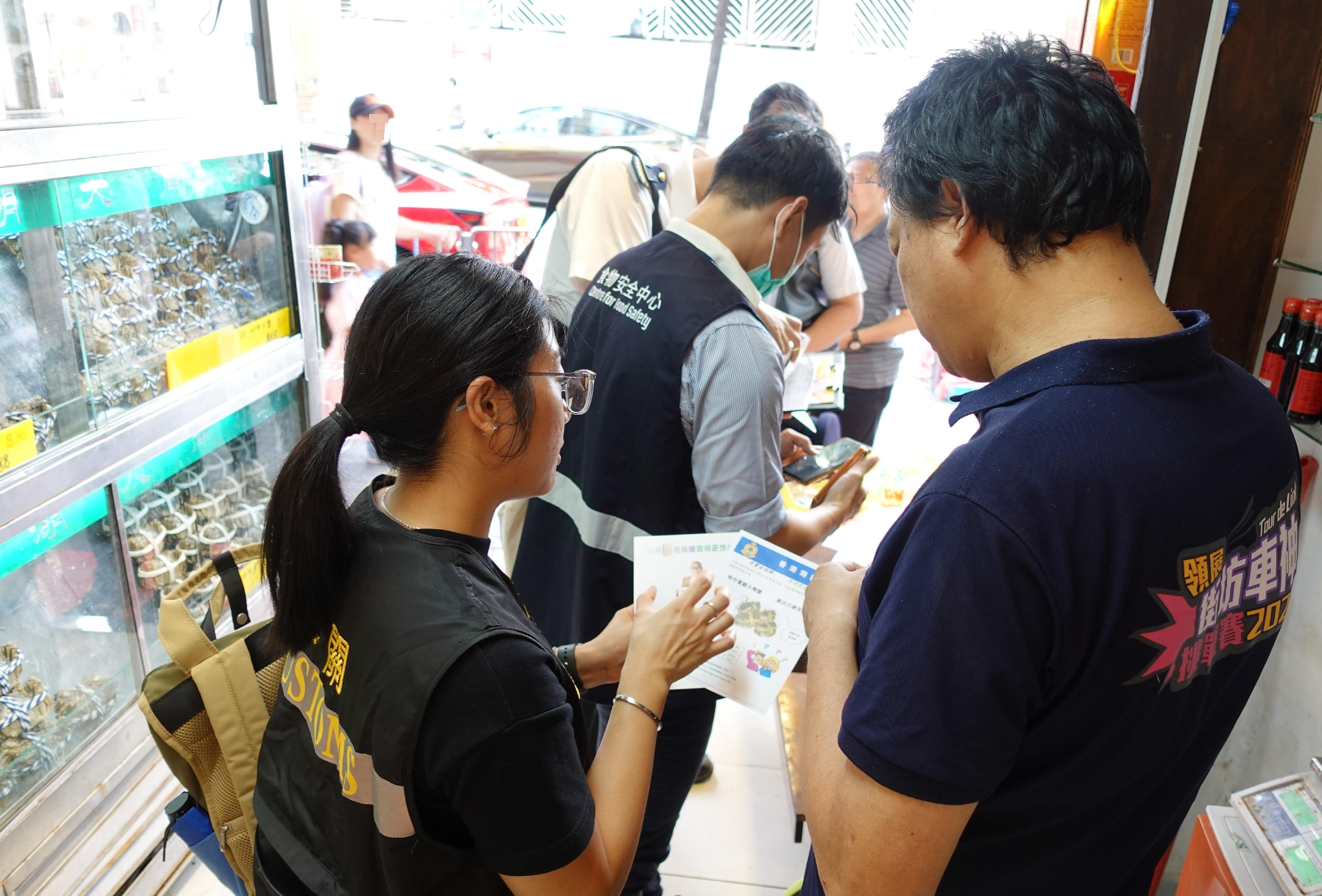
Hong Kong Customs conducts joint enforcement operations with FEHD regarding sale of hairy crabs (with photo)

     Hong Kong Customs and the Food and Environmental Hygiene Department (FEHD) have been carrying out joint enforcement operations since Monday (September 23) to inspect hairy crab retail outlets in various districts, with the aim of protecting consumer rights and upholding food safety by ensuring that the hairy crabs on sale in the market comply with relevant stipulations and requirements under the laws.
      
     During the inspections, Customs officers and officers of the Centre for Food Safety and the Environmental Hygiene Branch of the FEHD monitored the sale of hairy crabs and also checked supportive documents for the place of origin and health certificates of the hairy crabs to ensure that the hairy crabs sold at retail shops are fit for human consumption and are in compliance with the Trade Descriptions Ordinance (TDO), the Food Safety Ordinance and the Public Health and Municipal Services Ordinance.
      
     As of now, officers of the two departments have inspected 42 hairy crab retail shops, and no irregularity has been found. The relevant joint enforcement operations will continue.
      
     Apart from carrying out inspections in the market, Customs officers also made use of the big-data analytics system to conduct analysis and verify whether online shops selling hairy crabs had complied with the TDO with a view to safeguarding the interests of consumers when making online purchases. 
      
     Customs attaches great importance to the protection of consumer rights and will take appropriate enforcement action once activities in violation of the TDO are detected in the market. The department also reminds traders not to apply a false trade description to goods or services, or to supply or offer to supply goods or services to which a false trade description is applied. Those who violate the TDO are liable on conviction to a maximum fine of $500,000 and imprisonment for five years.
      
     The FEHD reminds traders that according to the Public Health and Municipal Services Ordinance, all food available for sale in Hong Kong, whether imported or locally produced, should be fit for human consumption. Also, any person who operates an unlicensed food business or sells restricted foods without permission is liable on conviction to a maximum fine of $50,000 and imprisonment for six months. Under the Food Safety Ordinance, any person who, without reasonable excuse, fails to comply with the record-keeping requirement relating to movement of food commits an offence and is liable to a maximum fine of $10,000 and imprisonment for three months upon conviction.
      
     Customs and the FEHD remind traders not to import or put on sale hairy crabs with an unknown origin. Consumers should make purchases at reputable shops with the Shell Fish (Hairy Crab) Permit or relevant written permission granted by the FEHD.
      
     Members of the public may report any suspected violations of the TDO to Customs’ 24-hour hotline 2545 6182 or its dedicated crime-reporting email account (crimereport@customs.gov.hk) or online form (eform.cefs.gov.hk/form/ced002/) if they suspect that hairy crabs bought are of falsely claimed place of origin.
      
     In addition, if members of the public suspect that there are operators selling hairy crabs without the relevant permits/permissions or the hairy crabs are not accompanied with health certificates, they may file a report to the FEHD by calling hotline at 2868 0000 or through email (enquiries@fehd.gov.hk).

Photo  
read more

Inspection of aquatic products imported from Japan

     In response to the Japanese Government’s plan to discharge nuclear-contaminated water at the Fukushima Nuclear Power Station, the Director of Food and Environmental Hygiene issued a Food Safety Order which prohibits all aquatic products, sea salt and seaweeds originating from the 10 metropolis/prefectures, namely Tokyo, Fukushima, Ibaraki, Miyagi, Chiba, Gunma, Tochigi, Niigata, Nagano and Saitama, from being imported into and supplied in Hong Kong.
 
     For other Japanese aquatic products, sea salt and seaweeds that are not prohibited from being imported into Hong Kong, the Centre for Food Safety (CFS) of the Food and Environmental Hygiene Department will conduct comprehensive radiological tests to verify that the radiation levels of these products do not exceed the guideline levels before they are allowed to be supplied in the market.
 
     As the discharge of nuclear-contaminated water is unprecedented and will continue for 30 years or more, the Government will closely monitor and step up the testing arrangements. Should anomalies be detected, the Government does not preclude further tightening the scope of the import ban.
 
     From noon on September 26 to noon today (September 27), the CFS conducted tests on the radiological levels of 228 food samples imported from Japan, which were of the “aquatic and related products, seaweeds and sea salt” category. No sample was found to have exceeded the safety limit. Details can be found on the CFS’s thematic website titled “Control Measures on Foods Imported from Japan” (www.cfs.gov.hk/english/programme/programme_rafs/programme_rafs_fc_01_30_Nuclear_Event_and_Food_Safety.html).

     In parallel, the Agriculture, Fisheries and Conservation Department (AFCD) has also tested 50 samples of local catch for radiological levels. All the samples passed the tests. Details can be found on the AFCD’s website (www.afcd.gov.hk/english/fisheries/Radiological_testing/Radiological_Test.html).
 
     The Hong Kong Observatory (HKO) has also enhanced the environmental monitoring of the local waters. No anomaly has been detected so far. For details, please refer to the HKO’s website
(www.hko.gov.hk/en/radiation/monitoring/seawater.html).
 
     From August 24, 2023, to noon today, the CFS and the AFCD have conducted tests on the radiological levels of 87 733 samples of food imported from Japan (including 56 022 samples of aquatic and related products, seaweeds and sea salt) and 19 906 samples of local catch respectively. All the samples passed the tests. read more