Effective Exchange Rate Index
The effective exchange rate index for the Hong Kong dollar on Tuesday, October 23, 2018 is 105.7 (up 0.3 against yesterday’s index). read more


The effective exchange rate index for the Hong Kong dollar on Tuesday, October 23, 2018 is 105.7 (up 0.3 against yesterday’s index). read more
Attention TV/radio announcers:
Please broadcast the following as soon as possible:
Here is an item of interest to swimmers.
The Leisure and Cultural Services Department (LCSD) announced today (October 23) that Silver Mine Bay Beach in Islands District will reopen tomorrow (October 24). The beach was temporarily closed earlier for clearance of debris and fallen trees as well as repairs of the shark prevention net and beach facilities after the typhoon.
Thirteen beaches under the LCSD have been reopened recently. They are Butterfly Beach, Castle Peak Beach, Kadoorie Beach, Cafeteria Old Beach, Cafeteria New Beach and Golden Beach in Tuen Mun District; Hoi Mei Wan Beach, Approach Beach, Anglers’ Beach and Ma Wan Tung Wan Beach in Tsuen Wan District; Hung Shing Yeh Beach and Lo So Shing Beach in Islands District; and Repulse Bay Beach in Southern District.
Meanwhile, other gazetted beaches in Southern, Tsuen Wan, Islands and Sai Kung Districts, including Deep Water Bay Beach which is normally open all year round, will remain closed until further notice as much longer time is needed for repairing beach facilities and damaged shark prevention nets or clearing debris due to the severe damage brought about by the typhoon earlier. Red flags have been hoisted at these beaches.
The LCSD reminds members of the public not to go to the beaches that are temporarily closed, and not to swim or participate in other activities at those beaches for the sake of safety. read more
​The Food and Environmental Hygiene Department (FEHD) announced today (October 23) that stalls at the 2019 Lunar New Year (LNY) fairs will be put up for open auction starting from November 5. &nb… read more
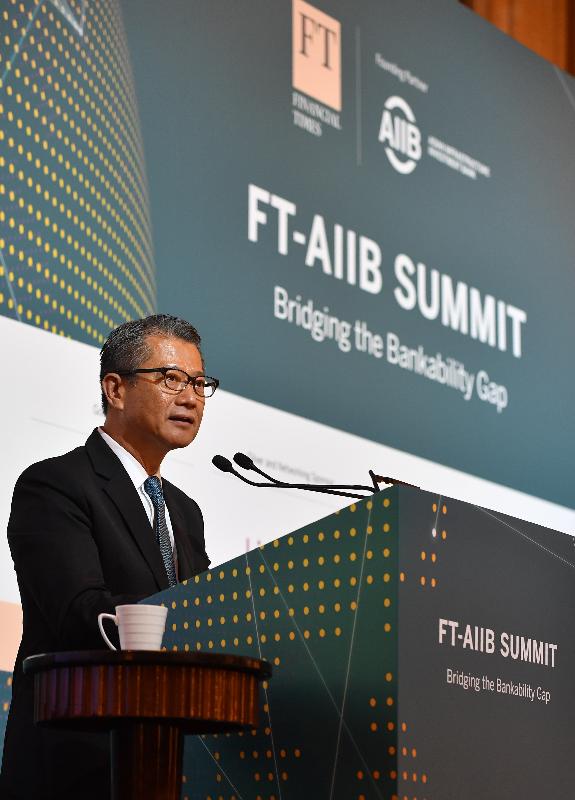
Following is the speech by the Acting Chief Executive, Mr Paul Chan, at the Financial Times-AIIB Summit this morning (October 23):
President Jin (President of the Asian Infrastructure Investment Bank (AIIB), Mr Jin Liqu), Angela (Global Publisher, FT Live and Managing Director, Asia Pacific of Financial Times (FT), Ms Angela Mackay), distinguished guests, ladies and gentlemen,
Good morning. I’m pleased to join you today for the second time at Financial Times-AIIB Summit. This year’s theme, “Bridging the Bankability Gap,” is a smart and timely topic.
Getting the right infrastructure in the right place at the right time, as you can see from here in Hong Kong, is surely key to economic growth and prosperity.
The challenge, of course, is getting the funding to make it work, or more precisely, getting private funding to play a bigger role in infrastructure development. Making infrastructure bankable is one of our great challenges.
We need answers as quickly as they can be raised. Between 2016 and 2030, developing Asian countries will require infrastructure investment totaling US$26 trillion, in other words, US$1.7 trillion a year on average, to maintain growth, fight poverty and address climate change.
Infrastructure spending, to date, has largely come from the public sector, namely governments and multilateral development agencies. As the funding gap continues to expand, public-sector investment will no longer be adequate.
At the same time, we are seeing strong infrastructure investment interest among private investors. However, there is a lack of bankable projects out there for investors and financiers due to a number of issues from political and legal risks at the country level, to construction, operation and financial risks at the project level.
In short, mitigating these risks is critical to improving the bankability of infrastructure projects and, in doing so, narrowing the infrastructure financing gap.
At the recent Finance Minister’s Meeting of the Asia-Pacific Economic Cooperation (APEC) which I attended last week in Papua New Guinea, infrastructure financing was one of the focus areas. The APEC Business Advisory Council, which comprises representatives from the private sector of each APEC economy, also urged financial ministers to explore ways to make infrastructure projects more bankable.
In this regard, the Asian Infrastructure Investment Bank (AIIB) plays a key role, bringing countries together to address Asia’s urgent infrastructure needs and improving social and economic development in the region. In operation only since 2016, the Bank has already approved projects worth more than US$5 billion.
Hong Kong has been a member of the AIIB since June of last year. We have the resources, capital, connections and expertise, to contribute to the AIIB. Indeed, we have what it takes to serve as the region’s fundraising and financial management hub for infrastructure projects.
The Stock Exchange of Hong Kong has led the world in IPO (initial public offering) fund raising in five of the past nine years. Last year, our IPO funds totalled US$16.5 billion. And it is highly likely that this year we will top the world again given the huge amount of funds raised so far this year.
As mentioned last year, our Securities and Futures Commission also set out the criteria for assessing the eligibility of infrastructure project companies looking to list on our Main Board. It provides a clear pathway for infrastructure project companies.
This year, in order to promote sustainable developments in the region, we have launched a Green Bond Grant Scheme to subsidise the costs incurred by green bond issuers in obtaining green finance certification. We are also working on a Government Green Bond Programme, with a borrowing ceiling up to HK$100 billion, to fund Government green public works projects. In addition, we have introduced a pilot Bond Grant Scheme plus tax incentives to attract more issuers to Hong Kong.
In the first half of this year, at least 15 green bonds were issued in Hong Kong, with an aggregate size of US$8 billion. The Asian Development Bank, the World Bank and the European Investment Bank were among the issuers. This speaks well of Hong Kong’s promise as a regional green finance hub.
The first and foremost important step in ensuring a project’s bankability, perhaps is a proper project feasibility study and preparation. In this regard, I applaud AIIB for the introduction of a Project Preparation Special Fund to assist lower income developing countries with funding support for appropriate technical assistance, in their preparation of projects for subsequent consideration and approval by AIIB. Hong Kong has therefore pledged to donate US$10 million to this worthy cause.
On risk mitigation, our deep pool of multicultural finance and legal professionals is our compelling advantage. Leading the field in conducting project feasibility, due diligence, financial engineering and arranging for insurance, we are able to help de-risk infrastructure projects to make it more bankable. Our legal profession can also help ensure contract enforcement and resolve disputes. We are well-positioned to serve as the region’s international arbitration hub for commercial disputes. Arbitral awards made in Hong Kong are enforceable in over 150 jurisdictions, including the Mainland of China.
As China’s international financial capital, Hong Kong is also the world’s largest offshore Renminbi (RMB) business hub. That makes us an attractive destination for those who wish to raise funds in RMB, in addition to US dollar.
The Infrastructure Financing Facilitation Office of the Hong Kong Monetary Authority (HKMA) is a first mover in infrastructure financing. Its network of partners has now exceeded 90. Coming from all over the world, they include development banks, project developers and operators, financiers, institutional investors and professional services firms.
Apart from financing green field projects, we are also looking at how we may better assist projects in brownfield stage. The new capital standards for banks do not make it attractive for them to hold on to these infrastructure loans on a long term basis, even though the projects are operating smoothly and profitably. Yet, there are many other investors, such as insurance companies and pension funds, which are looking for less risky investments that can produce stable long-term cash flow. The Hong Kong Mortgage Corporation Limited, again under the HKMA is pursuing the proposition of securitising infrastructure loans to provide banks with opportunity to offload their loans to those long-term investors. That will facilitate additional flow of capital into infrastructure projects.
Hong Kong, in short, is fast becoming a key infrastructural financing centre. We have the means, the expertise and the motivation, to serve as a hub for the AIIB, sourcing investment opportunities, prospective investors, and financing partners.
Hong Kong, of course, is a world leader when it comes to infrastructure, finishing second in the category in this year’s Global Competitiveness Report by the World Economic Forum. Our annual infrastructure investment has soared from US$2.5 billion to more than US$10 billion over the past decade. In the coming five years, we expect that the annual contract value of construction work in Hong Kong to reach US$30 billion or so, given our unshakable commitment in increasing land and housing supply, expediting hospital developments, building railway extensions and other infrastructure projects.
Infrastructure has long been the engine driving Hong Kong’s economic growth. As some of you may have heard, we have more plans in hand for Lantau. In the Policy Address earlier this month, we announced the Lantau Tomorrow Vision.
Under this Vision, we will begin studies on a large-scale reclamation in phases. The first phase will encompass some 1 000 hectares of artificial islands southeast of Lantau and to be followed by a second phase comprising 700 hectares of artificial islands. Together, they will provide land to sustain the long-term housing, economic and employment needs of Hong Kong.
The reclaimed land will also allow us to thin out our densely populated urban areas. It will enable the redevelopment of old districts and improve our overall living environment, while achieving more balanced spatial development for Hong Kong.
The artificial islands will become Hong Kong’s third Core Business District, after Central and Kowloon East. And we will ensure that plenty of space is set aside for business and industrial development.
Roads and railway networks will be built to support the new developments and to relieve traffic on the western part of the New Territories.
We also see a promising opportunity to create a cluster of airport-related businesses in the proximity of the Hong Kong International Airport.
And, let me make it clear, we are as committed to protecting the natural and rural environment of Lantau as we are to pursuing this far-reaching vision. And we have set aside a dedicated fund for that purpose.
Ladies and gentlemen, this is a development without precedent, huge in scope and vast in its significance. Such an undertaking will bring with it diverse views throughout the community. That’s both understandable and welcome. Constructive comments can help ensure its ultimate success.
Rest assured, we believe in the Lantau Tomorrow Vision, in its long-term promise – that of ensuring a sustainable, thriving and livable city for the people, and for the economy of Hong Kong.
We look forward, as well, to supporting the AIIB, in contributing to the inclusive economic development of Asia.
My sincere thanks to the Financial Times and the AIIB for organising today’s summit. I wish you all a rewarding summit and the best of business – and bankable investment, of course, in the coming years.
Thank you.
The following is issued on behalf of the Hong Kong Monetary Authority: Hong Kong Monetary Authority Exchange Fund Bills Tender Results: Tender date : October 23, 2018 Paper on offer : … read more