Tag Archives: China

image_pdfimage_print

Revised categorisation of first registration vehicle status to be implemented from January 2, 2019

     â€‹The Transport Department (TD) announced today (October 29) that with effect from January 2, 2019, the revised categorisation of First Registration Vehicle Status (vehicle status) on vehicle registration documents will be implemented to provide more objective information in respect of the status of vehicles upon first registration for reference by vehicle owners and potential vehicle buyers.
      
     A spokesman for the TD said that after considering the views from stakeholders and taking reference of the practices adopted in some overseas jurisdictions, the revised categorisation of vehicle status upon first registration is as follows:
 
A – Prior to importation into Hong Kong for sale, the vehicle has either never been registered outside Hong Kong, or was registered outside Hong Kong but in a manner that the vehicle was not permitted to be used on roads, with documentary proof.
B – Prior to importation into Hong Kong for sale, the vehicle has never been registered outside Hong Kong as declared by the vehicle importer.
C1 – The vehicle has been registered outside Hong Kong prior to importation to Hong Kong for sale. The length of the period of such registration is shorter than 15 days as proved by supporting documents.
C2 – The vehicle has been registered outside Hong Kong prior to importation to Hong Kong for sale, other than vehicles categorised as C1.
D – The vehicle was imported by the registered owner into Hong Kong for own use.
E – The vehicle was assembled in Hong Kong with specified additions to the imported chassis/cab and chassis.
F – The vehicle was acquired through auction from the Hong Kong Special Administrative Region Government.
 
     “The revised vehicle status will provide factual description on the vehicles upon first registration prior to importation to Hong Kong, e.g. whether the vehicle had been registered outside Hong Kong. It will neither indicate nor imply the condition of use of the vehicle or its level of wear and tear. This objective information will assist the public, in particular the vehicle owners and potential vehicle buyers, in realising the actual status of the vehicles on their first registration and making an informed decision on vehicle purchase,” the spokesman said.
      
     For vehicles registered before the introduction of the revised vehicle status, their statuses shown on the vehicle registration document will remain unchanged.
      
     To complement the introduction of the revised categorisation of vehicle status, the TD will strengthen the verification process of the registration history of vehicles overseas so as to ensure proper categorisation.
      
     For enquiries, please visit the TD’s website (www.td.gov.hk/en/public_services/licences_and_permits/vehicle_first_registration/index.html) or call the TD’s Hong Kong Licensing Office at 2804 2634 or the enquiry hotline at 2804 2600. read more

Hong Kong Dragon flying high in Adelaide (with photos)

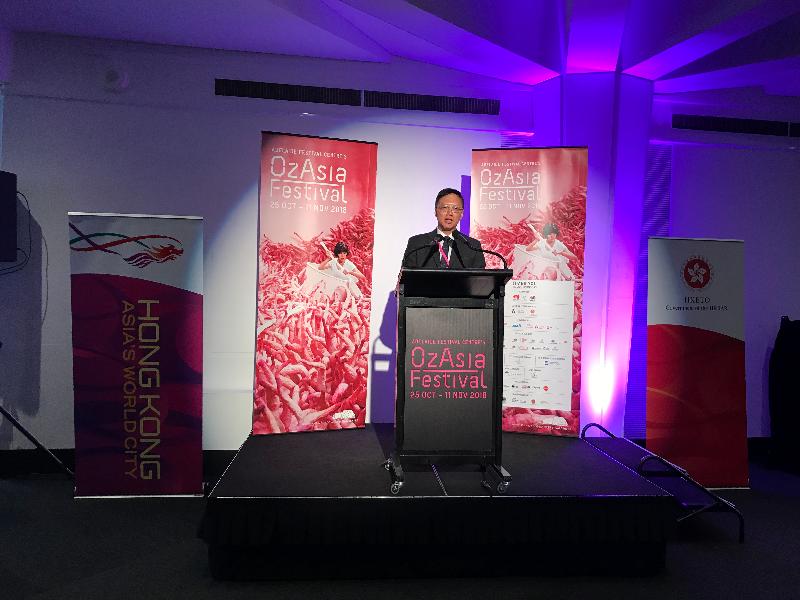
     The Hong Kong Economic and Trade Office, Sydney (HKETO), has again participated in one of Australia’s leading international arts festivals, the OzAsia Festival, which is being held in the city of Adelaide, Australia.
      
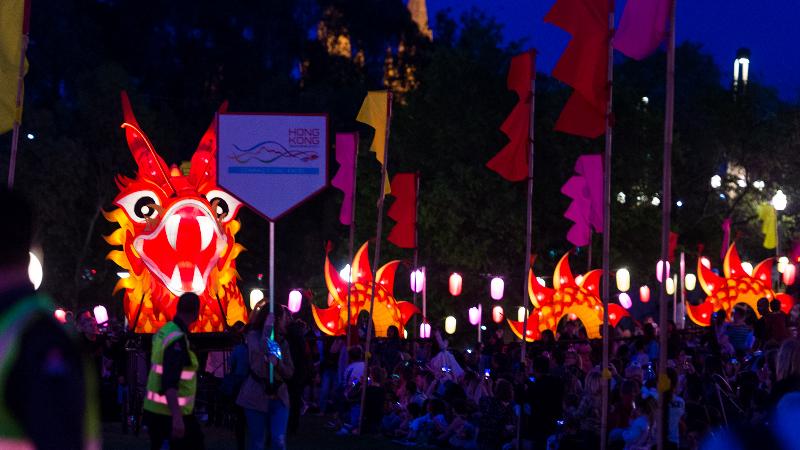
     The HKETO supported the event organiser, the Adelaide Festival Centre, in bringing a giant 40-metre-long Hong Kong Dragon to the Moon Lantern Parade at Adelaide’s Elder Park on October 27 (Adelaide time). Through this fabulous illuminated dragon, the HKETO aimed to showcase the vibrancy of Hong Kong as an international cultural metropolis grounded in Chinese traditions to the Australian audience.
      
     Speaking at a reception before the Moon Lantern Parade, the Director of the HKETO, Mr Raymond Fan, said the HKETO’s continued support for the OzAsia Festival demonstrates Hong Kong’s ongoing commitment to strengthening the cultural ties between the two places, in tandem with their long-standing trade, investment, education and people-to-people links.
      
     “The HKETO has been supporting OzAsia Festival since 2009. The event this year again provided a good opportunity to showcase our culture to the Australian audience, such as this amazing parade as well as other programmes with a Hong Kong presence,” he said.  
      
     The Hong Kong Government actively supports the development of culture and arts, and various cultural projects will be successively completed over the next few years. The West Kowloon Cultural District (WKCD) will provide a vibrant cultural quarter and is one of the largest cultural projects in the world. The Xiqu Centre and Freespace in the WKCD will be commissioned in January next year and second quarter next year respectively. The WKCD will also boast two world-class museums.
      
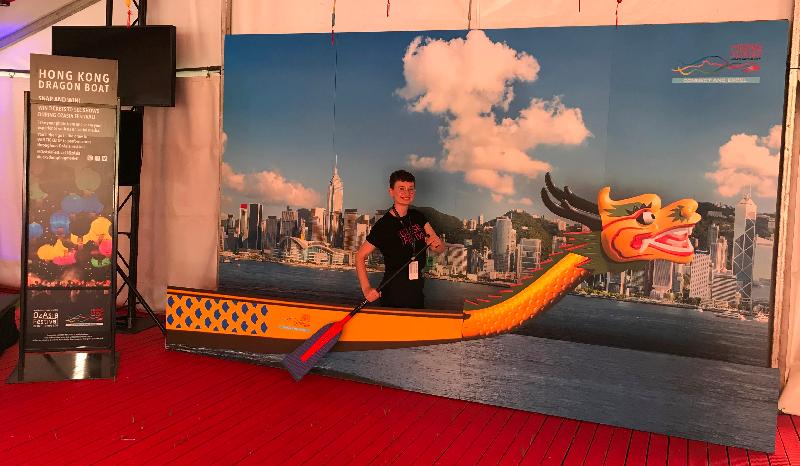
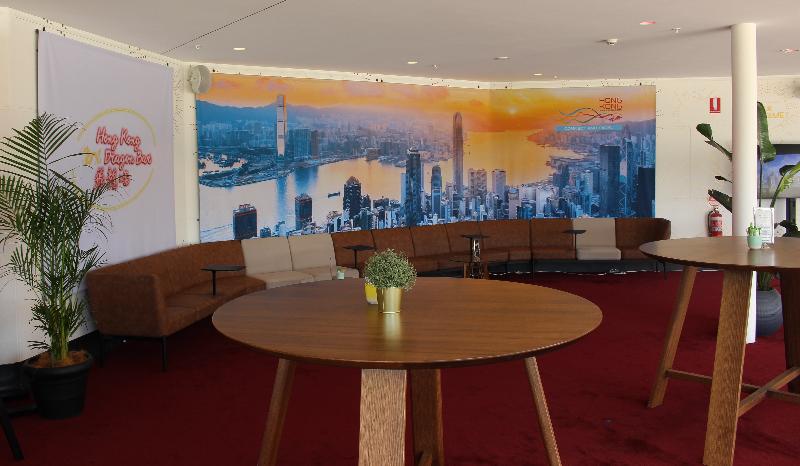
     Other interesting Hong Kong experiences brought to the festival hub by HKETO included a Hong Kong Dragon Bar with Hong Kong branding, an interactive photo site featuring Hong Kong’s skyline and a dragon boat image, and face painting activities with Hong Kong characteristics.
      
     The OzAsia Festival, presented by Adelaide Festival Centre, is Australia’s leading international arts festival engaging with Asia. Event programmes this year include contemporary dance, theatre, music, visual art, film, literature, workshops, talks and more from across Asia. The festival is expected to attract 190 000 people.
      
     Details of the programmes are available from www.ozasiafestival.com.au.

Photo  Photo  Photo  Photo  
read more

Effective Exchange Rate Index

     The effective exchange rate index for the Hong Kong dollar on Monday, October 29, 2018 is 105.9 (up 0.2 against last Saturday’s index).

     The effective exchange rate index for the Hong Kong dollar on Saturday, October 27, 2018 was 105.7 (down 0.2 against last Friday’s index). read more

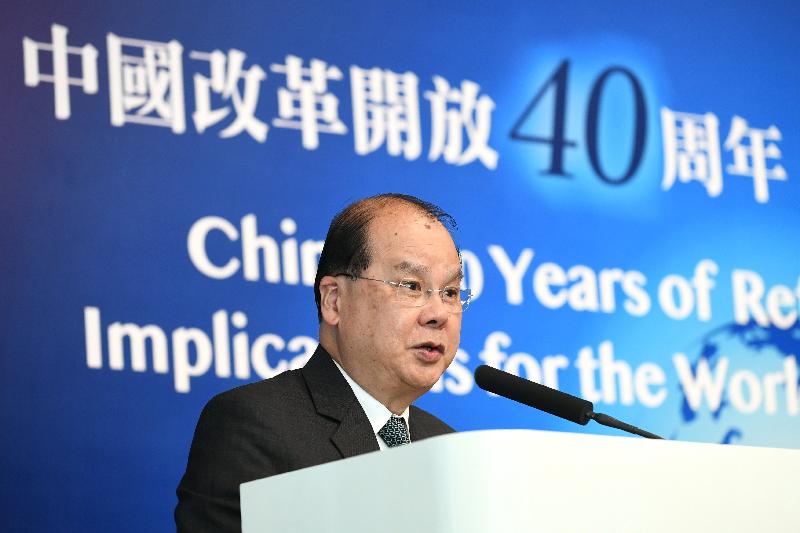
Speech by CS at seminar on “China’s 40 Years of Reform and Opening Up: Implications for the World and Role of Hong Kong” (English only) (with photo/video)

     Following is the speech by the Chief Secretary for Administration, Mr Matthew Cheung Kin-chung, at the seminar on “China’s 40 Years of Reform and Opening Up: Implications for the World and Role of Hong Kong” this afternoon (October 29):

Mr Dominique de Villepin (former Prime Minister of France), Mr Yukio Hatoyama (former Prime Minister of Japan), Mr Li Zhaoxing (Honorary President of the Chinese People’s Institute of Foreign Affairs, former Minister of Foreign Affairs), Ms Charlene Barshefsky (former United States Trade Representative), Commissioner Xie (Commissioner of the Ministry of Foreign Affairs of the People’s Republic of China in the Hong Kong Special Administrative Region, Mr Xie Feng), Dr Ronnie Chan (Chairman of the Executive Committee of the Better Hong Kong Foundation), Professor Lawrence Lau (former Vice-Chancellor and President, Chinese University of Hong Kong), distinguished speakers and guests from overseas, ladies and gentlemen,
 
     Good afternoon. In early 1978, the then Chinese Vice-Premier Gu Mu led a delegation to France and other Western European countries to understand the economic structure and development of Europe. At that time, Beijing’s international airport could manage the landing and takeoff of two planes per hour, whereas at Charles de Gaulle Airport of Paris, 60 flights took off and landed in an hour. Understandably, the Chinese delegation was spellbound.
 
     In December of 1978, the Central People’s Government made an important step and pushed through multiple economic reforms, opening up China to the world. History was made thereafter.
 
     We began to witness an unprecedented growth in the Chinese economy, and how it swiftly and effectively raised the living standards of its vast population. The world watched in awe as Mainland China created countless economic miracles and gradually increased its influence on global issues. This transformation has changed the way that the world does business. China not only exported consumption goods such as sweaters, water bottles, mobile phones, but also technology and ideas. From 1979 to 2017, China’s average economic growth stood at 9.5 per cent, significantly higher than the 2.9 per cent global average.

     In 2001, China became a member of the World Trade Organization (WTO), completing the last leg of the country’s journey of integration into the world economy. WTO membership has opened up China’s market for more international trade and investment, as well as opening up the world economy for China’s exports. “Made in China” became a household brand, drastically changing consumer habits in every corner of the world.
 
     In the wake of the country’s reform and opening up, Hong Kong’s labour-intensive production processes were relocated north to the Mainland. Hong Kong’s geographic proximity to the Mainland has allowed easy access to the huge market and the vast population in the Mainland. Businessmen from Hong Kong equipped with capital, international trading networks and management expertise started from Shenzhen, and then slowly built up a sophisticated manufacturing network in Dongguan and other cities in Guangdong, shipping all their products to the world. Success stories of Hong Kong enterprises quickly caught the world’s attention, and encouraged many multinational companies to invest in China.
 
     Hong Kong does not only contribute to the economy of China, but has also benefited substantially in many ways. At the dawn of the reform and opening up, as factories were moved to the Mainland, Hong Kong began to transform itself into a service economy, becoming an international finance, trading and maritime centre. 
 
     When we look back at the past four decades, there is absolutely no doubt that China’s reform and opening up has brought prosperity and stability to the country, as well as important changes to the economic and social landscape of Hong Kong. Hong Kong has grown from an economy focusing on light industries such as textiles and clothing, toys, watches and more to become an international financial, trading and transportation hub. Indeed, the Washington-based Heritage Foundation has rated Hong Kong the world’s freest economy for 24 years in a row. 
 
     As an externally oriented, open and vibrant economy with a robust legal system and the rule of law; as an international financial, business, professional services, logistics and maritime centre; and as a safe and welcoming metropolis with world-class infrastructure where East blends harmoniously with West, Hong Kong is strategically placed and, indeed, destined to play a crucial role as the super-connector, super-facilitator and super-promoter between China and the world as our country continues to open up to the rest of the world.
 
     To contribute towards the country’s comprehensive reform, Hong Kong will strengthen its co-operation with the Mainland. Travelling to the Mainland cities is now much faster than ever. The Hong Kong section of the Guangzhou-Shenzhen-Hong Kong Express Rail Link came on stream last month (September). The Hong Kong-Zhuhai-Macao Bridge has just commenced service. The Liantang/Heung Yuen Wai border crossing is expected to come into operation in the first half of next year and will further improve connectivity to the eastern part of the Pearl River Delta.
 
     Leveraging on our capability in scientific and technological research with four of our universities amongst the world top 100, and our institutional strengths and unique advantages under “one country, two systems”, Hong Kong is well placed to contribute to the national strategy of developing the Guangdong-Hong Kong-Macao Greater Bay Area into an international innovation and technology hub. 
 
     As we celebrate this important occasion, an occasion for the 40th anniversary, let me reassure our international and local audience today that Hong Kong will continue to contribute to the reform and opening up of the motherland by playing a key and constructive role for the long-term development and prosperity of the country.
 
     So I am cutting my story short so that we can have more time for panel discussion. Thank you very much indeed.
Photo  
read more