Tag Archives: China

image_pdfimage_print

LCQ13: Bank accounts of travel agencies

     Following is a question by the Hon Yiu Si-wing and a written reply by the Secretary for Financial Services and the Treasury, Mr James Lau, in the Legislative Council today (October 31):

Question:

     I have learnt that two bank accounts under the name of a travel agency were frozen one after another within two years. The person-in-charge of the travel agency made repeated enquiries with the bank concerned and demanded unfreezing of the accounts, but to no avail. It was only after he had sought assistance from the Hong Kong Monetary Authority (HKMA) that the two accounts were unfrozen. As far as he knows, the reason for the accounts of his travel agency being frozen was probably that his travel agency had organised several years ago a tour group to Iran which was then under the sanctions of the United Nations (UN). In this connection, will the Government inform this Council:

(1) whether the HKMA (i) has issued guidelines regarding the circumstances under which banks may freeze accounts, and (ii) knows the number of bank accounts which were frozen in each of the past three years on the grounds that there had been fund transfers between the account holders and the countries being sanctioned by the UN; if so, of the details; if not, the reasons for that;

(2) whether the HKMA has drawn up guidelines or codes of practice to require that, in respect of freezing of accounts, banks must (i) conduct it in a transparent and reasonable manner, (ii) set a time limit for the freeze, (iii) explain to the customers concerned the reasons, and (iv) propose solutions; if so, of the details; if not, the reasons for that; and

(3) as quite a number of travel agencies in Hong Kong are actively exploring business opportunities in the countries along the Belt and Road, which will give rise to fund transfers with these countries, and such travel agencies are worried that their bank accounts may be frozen in the event that such countries are suddenly sanctioned by the UN, how the HKMA will allay the industry’s concern in this regard and provide the needed assistance?

Reply:

President,

(1) to (3) In recent years, as the international community steps up efforts to combat money laundering and terrorist financing , financial institutions around the world have generally strengthened the related controls, including undertaking more comprehensive due diligence and on-going monitoring on customers. Global sanctions regimes and other regulatory requirements have added to the complexity of the global banking landscape. The Hong Kong Monetary Authority (HKMA) has been reminding the local banking industry that, in implementing robust anti-money laundering and counter-terrorist financing controls, they should be mindful not to create unreasonable hurdles for legitimate businesses and ordinary citizens to access banking services. The HKMA has issued guidance to banks in the past two years, reiterating that banks should apply a risk-based approach in conducting customer due diligence (CDD) on new and existing customers for the opening and maintenance of bank accounts. Banks should also maintain proper communication with customers throughout the CDD process, and ensure that the process is transparent, reasonable and efficient, in line with the “Treat Customers Fairly” principle.

     The HKMA requires banks to consider a range of risk factors in assessing the risk level of individual customers; country risk is only one of the factors to be considered. Individual banks also establish their own CDD policies based on internal policies and risk appetite. Banks should follow the relevant terms and conditions previously agreed with the customers when dealing with the operation of accounts.

     Generally speaking, during on-going monitoring process where banks suspect that any accounts are involved in irregular or suspicious transactions, or if customers refuse to provide the required information, banks should take appropriate risk mitigating measures, such as by filing a suspicious transaction report as required by law, or restraining the operation of the accounts. Regular operation of the account will be resumed upon the provision of relevant information by the concerned customer to address the bank’s concerns. The HKMA requires banks to explain to customers the reasons for any actions taken on the accounts where appropriate. The HKMA received 36, 40 and 36 complaint cases concerning freezing of corporate accounts by banks in 2016, 2017 and 2018 (up to September 30, 2018) respectively, some of which resumed operation after the customers had provided the requisite information. The HKMA does not maintain statistics in relation to accounts frozen due to fund flows with countries sanctioned by the United Nations.

     The HKMA requires banks to put in place appropriate and effective mechanism and procedures for handling customer complaints, and for following up individual cases in a fair and expeditious manner. Retail banks should also have procedures to handle customers’ requests for reviewing the banks’ decisions on account maintenance. If a customer considers that a bank has not handled his/her case properly, he/she can make a complaint to the bank concerned or consider lodging a complaint against the bank with the HKMA. The HKMA will follow up each and every case in an appropriate manner. read more
LCQ10: Workmanship of private residential developments

     Following is a question by the Hon Yung Hoi-yan and a written reply by the Secretary for Development, Mr Michael Wong, in the Legislative Council today (October 31):

Question:

     It has been reported that workmanship problems are more commonly seen in the private residential buildings completed in recent years than before. Such problems include hollow floor tiling within flats, leakage in the drainage pipes on external walls of buildings and within flats and leakage around windows’ opening within flats. I have also received complaints from a number of flat owners of private housing estates located in districts such as Ma On Shan and Tseung Kwan O, who pointed out that since their moving in, the remedial works necessitated by the poor workmanship had caused great distress to them. They were dissatisfied with the fact that they had spent their lifetime savings on acquiring their own homes and yet they were unable to live in peace. In this connection, will the Government inform this Council:

(1) whether it has assessed if the workmanship of newly completed private residential buildings has shown a worsening trend in recent years; if it has assessed, of the outcome and follow-up measures; if not, the reasons for that and whether it will conduct such an assessment;

(2) of the existing mechanisms and measures for regulating the workmanship of private residential developments (except those for building safety), as well as the scope of and the standards adopted for the regulatory work; when such mechanisms and measures were first introduced, as well as the date(s) on which they were last amended and the details thereof; whether it conducted in the past three years a comprehensive review to see if such mechanisms and measures were still relevant to the present circumstances; if it did, of the details and the outcome; if not, the reasons for that and whether it will conduct such a review expeditiously; and

(3) of the measures to improve the workmanship of private residential buildings, so as to better protect the rights and interests of minority property owners?

Reply:

President,

     In consultation with the Transport and Housing Bureau, the Commerce and Economic Development Bureau and the Buildings Department (BD), the Development Bureau provides a consolidated reply to the three parts of the question as follows:

     The Buildings Ordinance (Chapter 123) (BO) governs the planning, design and construction of buildings and the related works on private lands in order to ensure that they comply with safety and health standards. BD is responsible for the enforcement of the BO. According to the BO, upon completion of a development project, registered building professionals and registered contractors must submit a certification of works with an application of Occupation Permit to BD to certify that the concerned works are completed following the approved plans and complied with the provisions of BO and its allied regulations. The “rectification works” raised in the question generally involve workmanship problems for internal finishes works inside a flat. In general, workmanship problems for internal finishes works inside a flat, such as hollow floor tiling and leakage around window openings within flats fall outside the purview of the BO. For drains or sewers of any building that are inadequate or in a defective or insanitary condition, the Building Authority may, in accordance with the BO, by an order in writing served on the owner of such building require rectification within a time period specified in the order.

     On the other hand, the Residential Properties (First-hand Sales) Ordinance (Chapter 621) (the Ordinance) came into full implementation on April 29, 2013. The Ordinance aims to enhance the transparency and fairness of the sales of first-hand residential properties, strengthen consumer protection, and provide a level playing field for vendors of first-hand residential properties. The Ordinance sets out detailed requirements in relation to sales brochures, price lists, sales arrangements, register of transactions, show flats, viewing of completed residential properties, advertisements, and the mandatory provisions for the Preliminary Agreement for Sale and Purchase and Agreement for Sale and Purchase (ASP) for the sales of first-hand residential properties.

     The Ordinance requires ASP to incorporate mandatory provisions setting out that the vendor shall, at its own cost and as soon as reasonably practicable after receipt of a written notice served by the purchaser within six months after the date of completion of the sale and purchase, remedy any defects to the property, or the fittings, finishes or appliances as set out in the relevant clause of the ASP, caused otherwise than by the act or neglect of the purchaser. The provisions are without prejudice to any other rights or remedies that the purchaser may have at common law or otherwise.

     Besides, the Consumer Council (the Council) provides consumption-related information to consumers and acts as a conciliator to help consumers and traders settle their disputes by way of conciliation. The Council disseminates consumer information through various channels in order to assist consumers in making smart consumption choices and enhance their understanding of their rights and responsibilities.

     Lastly, the Government does not conduct any assessment in connection with the workmanship of internal finishes works for newly completed private residential developments in recent years. read more

LCQ9: Methadone Treatment Programme

     Following is a question by the Dr Hon Chiang Lai-wan and a written reply by the Secretary for Security, Mr John Lee, in the Legislative Council today (October 31):

Question:

     At present, the Department of Health offers two types of services, namely maintenance and detoxification treatment, through the Methadone Treatment Programme (MTP) in methadone clinics (clinics) on an outpatient basis to treat drug addicts’ opioid dependence. Recently, I have received complaints from members of the public that quite a number of drug addicts gather, take drugs and engage in drug trafficking activities near various clinics, raising doubts on the effectiveness of MTP. In this connection, will the Government inform this Council:

(1) of the respective numbers of patients who were (i) newly registered and (ii) re-registered, as well as (iii) the total number of registered patients, at each clinic in each of the past three years (set out in Table 1);

Table 1

Clinic 2015 2016 2017
(i) (ii) (iii) (i) (ii) (iii) (i) (ii) (iii)
                   

(2) of the number of (i) average daily attendance at each clinic, with a breakdown by whether the patients sought (ii) maintenance or (iii) detoxification treatment, in each of the past three years (set out in Table 2);

Table 2
Clinic 2015 2016 2017
(i) (ii) (iii) (i) (ii) (iii) (i) (ii) (iii)
                   

(3) of the number of patients who were provided with counselling services at each clinic in each of the past three years;

(4) of the respective average and longest time taken by persons who were successfully rehabilitated through MTP in each of the past three years; and

(5) whether the Government (i) reviewed the effectiveness and way forward of MTP, (ii) enhanced counselling and referral services and (iii) allocated additional resources to MTP, in the past three years, in order to more effectively help drug addicts quit the drug-taking habit; if so, of the details; if not, the reasons for that?

Reply:

President,

     Our replies to the questions raised by Dr Hon Chiang Lai-wan are as follows: 

(1) In the past three years, the numbers of patients of each methadone clinic who (i) were newly registered, (ii) were re-registered, and (iii) had registered are set out in Table 1.

(2) In the past three years, the numbers of (i) average daily attendance at each methadone clinic, and the breakdown by whether the patients sought (ii) maintenance or (iii) detoxification treatment are set out in Table 2.

(3) In the past three years, the number of patients who were provided with counselling services at each methadone clinic is set out in Table 3.

(4) Under the detoxification programme of Methadone Treatment Programme (MTP), depending on their condition, patients will receive methadone at tapered doses until total abstinence. Among those who completed detoxification in the past three years (2015-2017), the average and longest treatment durations were nine months and 85 months respectively. 

(5) MTP as administered by the Department of Health (DH) aims to provide drug abusers with a legal, affordable, safe and effective out-patient treatment to help them ease their dependence on opioid and live a normal life, and reduce crimes. The effectiveness of MTP has been recognised by international bodies such as the World Health Organization (WHO), and methadone treatment is one of the many anti-drug measures recommended by WHO. In 2012, DH had commissioned international consultants to review MTP. The review result had reaffirmed the effectiveness of MTP which was recommended to be retained to provide maintenance treatment. DH will continue to monitor the application and development of methadone treatment.

     In addition, counselling services are provided under MTP, while aftercare services are offered to rehabilitees having completed the detoxification programme to minimise relapse. Under the existing multi-modality approach in providing drug treatment and rehabilitation (T&R) services, the Government is also providing subvention for non-governmental organisations to operate voluntary residential T&R centres and community-based centres for drug counselling, which offer drug treatment and family counselling, vocational training, aftercare services, etc. People with drug abuse problems can choose the services which most suit their needs and circumstances. The Beat Drugs Fund (BDF) set up by the Government provides funding support for worthwhile anti-drug projects put forward by the community. Service providers can launch projects under BDF support to provide counselling and referral services, etc. to help drug abusers quit drugs.  read more

LCQ2: Efficiency in policy implementation

     Following is a question by the Hon Paul Tse and a reply by the Secretary for Financial Services and the Treasury, Mr James Lau, in the Legislative Council today (October 31):
 
Question:
 
     In March this year, the Financial Secretary announced the rolling out of a Caring and Sharing Scheme, under which $4,000 will be disbursed to those members of the public who are not required to pay salaries tax for the preceding year, and for those members of the public whose benefits from concessions in salaries tax and rates are less than $4,000 in total, an amount of money will be disbursed to them to make up for the difference. The Government expected that the application arrangements for the Scheme would be announced before the end of this year and the Scheme would be open for applications in February next year at the earliest, but no progress has been heard so far. I have learnt that the office under the Working Family Allowance Office responsible for implementing the Scheme has yet to be set up, and the relevant computer programme is still under development. Quite a number of members of the public have complained that the slow implementation of the Scheme has given them an impression that the Government is quick to collect taxes but slow to disburse payments and that the administrative efficiency of the bureaucracy is too low. Regarding efficiency in policy implementation, will the Government inform this Council:
 
(1) whether the implementation progress of the Scheme (including the setting up of the office and the development of the computer programme) is behind schedule; whether it will expedite the relevant work so as to implement the Scheme as early as possible and to receive applications and disburse payments on an earlier date;
 
(2) whether, in the light of the situation that the implementation of the Scheme has taken an excessively long time and thereby has fallen short of the public’s expectation, the Government will comprehensively review its efficiency in policy implementation; and
 
(3) given that it has been announced in the Policy Address delivered recently that the Government will spend about $7 billion on the construction of a civil service college, whether it has plans to provide civil servants with specialised training courses in the areas of enhancing the efficiency of policy implementation, strengthening inter-departmental collaboration as well as avoiding the lack of coordination and shirking of responsibilities among various government departments, etc.?
 
Reply:
 
President,
 
     The Financial Secretary announced on March 23 this year the introduction of the Caring and Sharing Scheme to share the fruits of our economic success with more people in the community. A person who meets the relevant eligibility criteria may apply for a maximum of $4,000. The Working Family Allowance Office (WFAO) is responsible for implementing the Scheme and will accept applications from February 2019 at the earliest.
 
     Having consulted the relevant policy bureaux and departments, my reply to the questions raised by the Hon Paul Tse is as follows:
 
(1) and (2) Since the announcement of the Scheme in March this year, the WFAO has been actively undertaking the planning and preparatory work for the Scheme. First of all, a 24-hour telephone hotline has been established to receive public enquiries and a comprehensive list of frequently asked questions have been uploaded to the WFAO’s website to address questions about the Scheme from the public. Other tasks include formulating the mode of operation of the Scheme as well as developing operational manuals and guidelines, application procedures and payment arrangements, etc. Concurrently, the WFAO needs to put in place the relevant administrative arrangements including the setting up of a new office, the development of information technology (IT) systems and installation of office automation facilities, and the recruitment of some 700 additional contract staff with training provided to process an anticipated influx of applications of about 3 000 000 applicants at maximum, etc.
 
     To set up a new office, the WFAO has identified an office premises in the urban area, which is currently rented to another government department but will soon be vacated. The new office will handle applications under the Scheme. As for the development and installation of different IT systems, as well as manpower recruitment and training, the current progress has been largely satisfactory. The WFAO is now taking forward various tasks according to the planned schedule.
 
     After the announcement of the Scheme in March, the WFAO has been pursuing various tasks promptly in a proactive and pragmatic manner. It needs to recruit and train additional staff to cater for the anticipated influx of millions of applications. Moreover, to streamline the application process, computer systems with specific functions are required to facilitate verification by departments such as the WFAO, the Inland Revenue Department and the Land Registry, etc. In view of this, it will take some time for the WFAO to complete all the preparatory and administrative work so as to ensure smooth processing of applications and payment. Judging from the current progress, we expect that the Scheme will be open for applications from February 2019 at the earliest, which is in line with the planned schedule. The WFAO will announce the details of the application arrangement at the end of this year.
 
     All government departments have been pushing forward various policies proactively and in a concerted manner; and will continue to work together to enhance efficiency in governance with a view to facilitating the early implementation of initiatives beneficial to the public.
 
(3) Regarding the civil service college, the Chief Executive announced in her Policy Address this year that a new civil service college is expected to be completed in 2026. The new college with fully upgraded training facilities will provide enhanced training for civil servants in various areas so as to ensure that our civil servants keep improving with the latest changes and providing better quality services to the public. Pending the commissioning of the new college, the Civil Service Bureau will continue to enhance civil service training. The existing training programmes for civil servants have already covered areas on leadership development, public policy and public engagement, etc. Through case analysis and interactive learning, participating civil servants would gain more in-depth knowledge of the challenges in different policy areas and the ways to strengthen co-operation among various departments and would, in turn, enhance work efficiency and deliver outstanding performance in the Government’s roles as a service provider, regulator, facilitator and promoter.
 
     Thank you, President.  read more

SDEV delivers keynote speech at 2018 World Cities Day Forum (with photos)

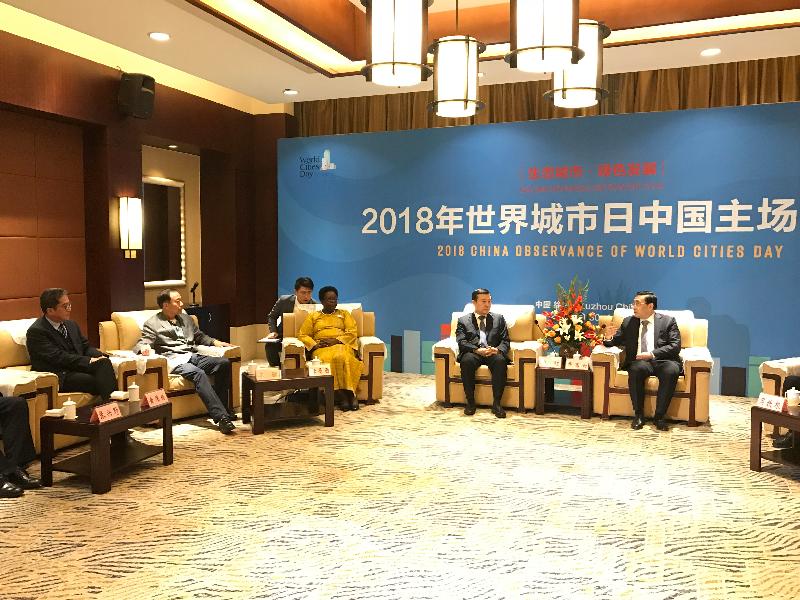
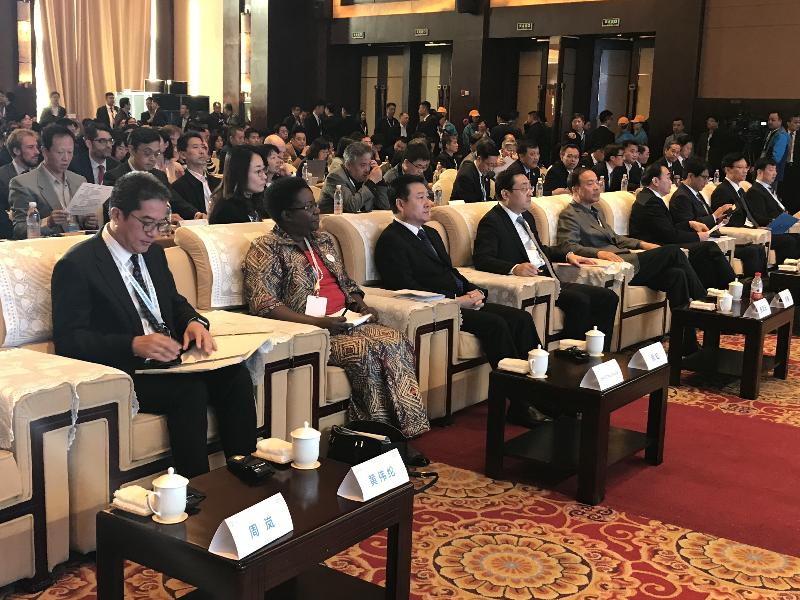
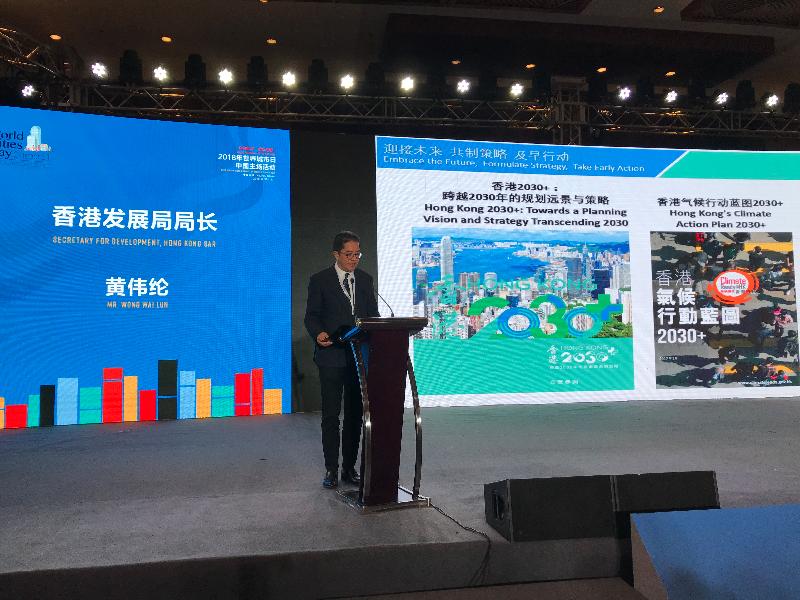
     The Secretary for Development, Mr Michael Wong, today (October 31) gave a keynote speech on green living and green cities at the 2018 World Cities Day Forum in Xuzhou, Jiangsu Province.

     In the keynote speech, Mr Wong introduced Hong Kong’s efforts in addressing the impact and challenges of urbanisation. He told participants at the forum how the Government enhances environmental capacity and promotes green living and sustainable development through innovative and meticulous town planning, engineering design and city management. 

     The 2018 World Cities Day Forum is organised by the United Nations Human Settlements Programme, the Ministry of Housing and Urban-Rural Development of the People’s Republic of China, and the People’s Government of Jiangsu Province. This year’s theme is “Building Sustainable and Resilient Cities”.

     On arrival at Xuzhou yesterday (October 30), Mr Wong attended the cultural exchange and welcome dinner. He also met with the Vice Governor of Jiangsu Province, Mr Fei Gaoyun; the Vice Minister of Housing and Urban-Rural Development, Mr Ni Hong; and the Special Envoy of the Executive Director of the United Nations Human Settlements Programme, Ms Christine Musisi, before the dinner.

     Mr Wong will return to Hong Kong this evening.

Photo  Photo  Photo  
read more