Tag Archives: China

image_pdfimage_print

FSDC holds forum to explore how big data and Fintech changed financial industry (with photo)

The following is issued on behalf of the Financial Services Development Council:
 
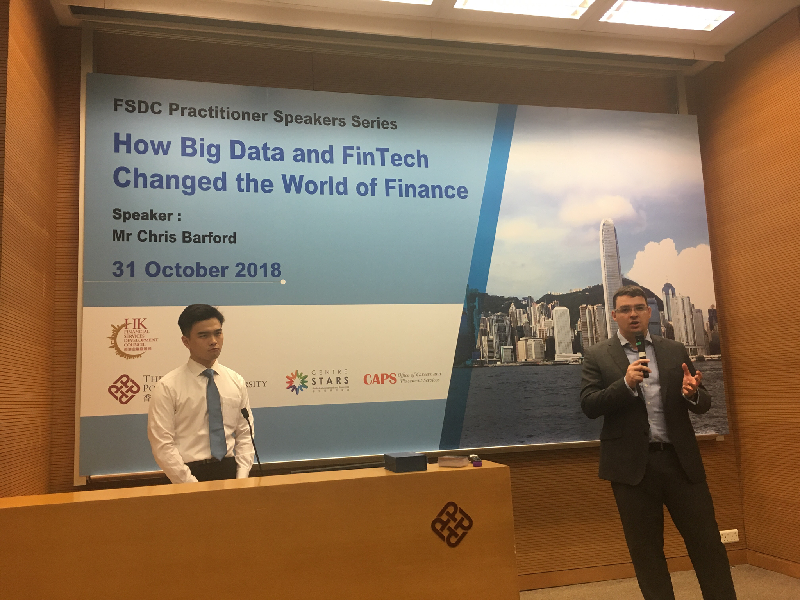
     The Financial Services Development Council (FSDC) and the Hong Kong Polytechnic University today (October 31) jointly hosted a forum to explore how big data and financial technology (Fintech) have changed financial institutions.
 
     Entitled “How Big Data and FinTech Changed the World of Finance”, the forum was the 29th event under the FSDC’s Practitioner Speaker Series. The panel featured the Director of the Financial Services Advisory Team of EY, Mr Chris Barford, who also serves as Co-chair of the Big Data Committee of the FinTech Association of Hong Kong.
 
     As Director in EY’s Data and Analytics practice leading the Financial Services team in Hong Kong, Mr Barford said, “Due to massive technological revolutions, surveys that predict that work is going to change for us all over the next 20 years may underestimate how significant the upcoming adjustments will be. However, there is so much hope and potential. In every prior technological revolution, we have created new jobs, new opportunities and different ways of being more productive.”
 
     He added, “I encourage young graduates and university students to think for themselves how big data, Fintech and disruption will benefit Hong Kong’s future as a competitive hub for financial services. The focus on working for a single large financial institution for life that was often your parents’ dream is no longer the only route to a long career in financial services. At this point in your life, I would encourage you to consider a career path that embraces data, Fintech and disruption. ‘Risk on’, as investors would say.
 
     “With the introduction of virtual banking licences, due in December 2018, Hong Kong is poised on the edge of a financial services revolution, which was kicked off with the use of stored value facilities over the last few years. I hope that the difference between a mainly cashless, mobile first Mainland and Hong Kong’s more traditional models that rely on money, paper forms and Octopus will converge. All of these innovations rely on big data, and I am hopeful this will occur imminently thanks to the Government’s focus in this area, and the significant Fintech investment that private businesses are making.”
 
     The FSDC’s Practitioner Speaker Series is a project developed between the FSDC and local universities, with speakers from the financial services industry giving talks to university students about important industry facts and the skill sets required in developing a career in financial services.
 
About the FSDC
 
     The Hong Kong Special Administrative Region Government established the FSDC in 2013 as a high-level, cross-sectoral advisory body to engage the industry in formulating proposals to promote the further development of Hong Kong’s financial services industry and to map out the strategic direction for development.
 
     The FSDC set up five committees, namely the Policy Research Committee, the Mainland Opportunities Committee, the New Business Committee, the Market Development Committee and the Human Capital Committee, as the five streams of its work.
Photo  
read more

CHP notified of human case of avian influenza A(H5N6) in Guangxi

    The Centre for Health Protection (CHP) of the Department of Health (DH) today (October 31) received notification of an additional human case of avian influenza A(H5N6) in Guangxi from the National Health Commission, and again urged the public to maintain strict personal, food and environmental hygiene both locally and during travel.
 
     The case involved a 44-year-old man from Hechi in Guangxi. He developed symptoms on October 18, was hospitalised on October 21 and died on October 27. The patient denied that he had contact with live poultry before the onset of symptoms.
 
     From 2014 to date, 22 human cases of avian influenza A(H5N6) have been reported by the Mainland health authorities.
 
     “All novel influenza A infections, including H5N6, are notifiable infectious diseases in Hong Kong,” the spokesman said.
 
     Travellers to the Mainland or other affected areas must avoid visiting wet markets, live poultry markets or farms. They should be alert to the presence of backyard poultry when visiting relatives and friends. They should also avoid purchasing live or freshly slaughtered poultry, and avoid touching poultry/birds or their droppings. They should strictly observe personal and hand hygiene when visiting any place with live poultry.
 
     Travellers returning from affected areas should consult a doctor promptly if symptoms develop, and inform the doctor of their travel history for prompt diagnosis and treatment of potential diseases. It is essential to tell the doctor if they have seen any live poultry during travel, which may imply possible exposure to contaminated environments. This will enable the doctor to assess the possibility of avian influenza and arrange necessary investigations and appropriate treatment in a timely manner.
 
     While local surveillance, prevention and control measures are in place, the CHP will remain vigilant and work closely with the World Health Organization and relevant health authorities to monitor the latest developments.
 
     The CHP’s Port Health Office conducts health surveillance measures at all boundary control points. Thermal imaging systems are in place for body temperature checks on inbound travellers. Suspected cases will be immediately referred to public hospitals for follow-up.
 
     The display of posters and broadcasting of health messages in departure and arrival halls as health education for travellers is under way. The travel industry and other stakeholders are regularly updated on the latest information.
 
     The public should maintain strict personal, hand, food and environmental hygiene and take heed of the advice below if handling poultry:
 

  • Avoid touching poultry, birds, animals or their droppings;
  • When buying live chickens, do not touch them and their droppings. Do not blow at their bottoms. Wash eggs with detergent if soiled with faecal matter and cook and consume the eggs immediately. Always wash hands thoroughly with soap and water after handling chickens and eggs;
  • Eggs should be cooked well until the white and yolk become firm. Do not eat raw eggs or dip cooked food into any sauce with raw eggs. Poultry should be cooked thoroughly. If there is pinkish juice running from the cooked poultry or the middle part of its bone is still red, the poultry should be cooked again until fully done;
  • Wash hands frequently, especially before touching the mouth, nose or eyes, before handling food or eating, and after going to the toilet, touching public installations or equipment such as escalator handrails, elevator control panels or door knobs, or when hands are dirtied by respiratory secretions after coughing or sneezing; and
  • Wear a mask if fever or respiratory symptoms develop, when going to a hospital or clinic, or while taking care of patients with fever or respiratory symptoms.
 
     The public may visit the CHP’s pages for more information: the avian influenza page, the weekly Avian Influenza Reportglobal statistics and affected areas of avian influenza, the Facebook Page and the YouTube Channel. read more

S for IT calls on Parliamentary Vice-Minister of Education, Culture, Sports, Science and Technology of Japan (with photos)

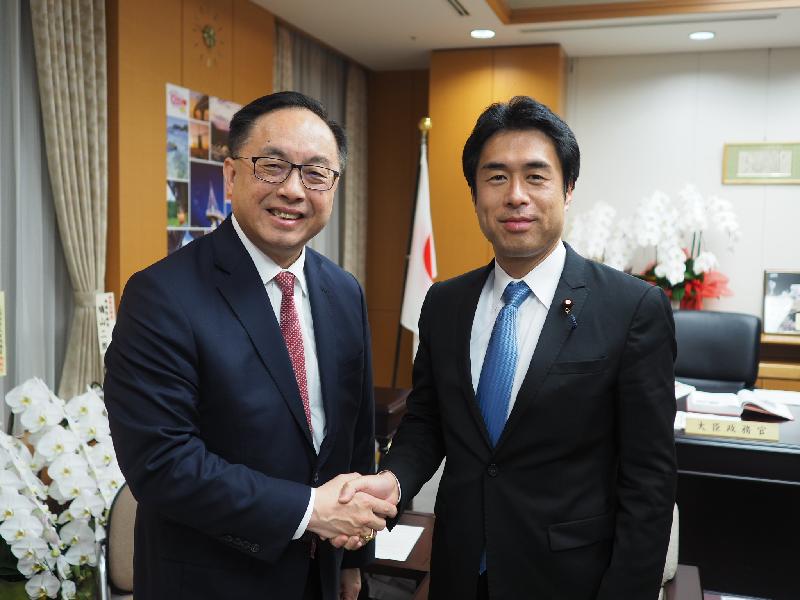
     The Secretary for Innovation and Technology, Mr Nicholas W Yang, called on the Parliamentary Vice-Minister of Education, Culture, Sports, Science and Technology of Japan, Mr Takaki Shirasuka, in Tokyo this afternoon (October 31) to boost links between Hong Kong and Japan on the innovation and technology front.
 
     The meeting enabled the two sides to have a good exchange on the promotion of science as well as innovation and technology. Mr Yang said that innovation and technology is high on the Hong Kong Special Administrative Region (HKSAR) Government’s agenda. Since the setting up of the Innovation and Technology Bureau in late 2015, the HKSAR Government has launched initiatives on various fronts with heavy investment to enhance the local innovation and technology ecosystem.
 
     Mr Yang added that Hong Kong is vigorously building up technology clusters on healthcare technologies and artificial intelligence and robotics technologies. With the provision of financial and other support, the Government aims to attract world-class scientific research institutions to join forces with local universities and research institutions in conducting more applied research and development (R&D) projects. Japanese scientific and research institutions are welcome to establish a presence in Hong Kong. Mr Yang said he looked forward to more collaboration between the two places and learning from the good practices and experiences of Japan, in particular in healthy ageing and smart city development.
 
     Earlier in the afternoon, Mr Yang was joined by the Chairman of the Board of Directors of the Hong Kong Science and Technology Parks Corporation, Dr Sunny Chai; the Chairman of the Board of Directors of the Hong Kong Cyberport Management Company Limited, Dr George Lam; and the Chief Executive Officer of the Hong Kong Cyberport Management Company Limited, Mr Peter Yan, on company visits to learn more about the companies’ smart city initiatives.
 
     The first company visit was made at Fujitsu, where Mr Yang and his party gained a deeper understanding on how the company integrates information and communications technology into daily lives to solve challenges, including its elderly care solutions using proprietary sound analysis to support home living and the AI-IoT Intelligent Dashboard using artificial intelligence and the Internet of Things to optimise production line operation.
 
     At a meeting with the Fujitsu Corporate Vice Chairman, Mr Nobuhiko Sasaki, Mr Yang gave an update on the exciting innovation and technology developments in Hong Kong amid the Central Government’s support for Hong Kong to develop into an international innovation and technology hub. Mr Yang said the HKSAR Government has made a significant move of promoting R&D activities in Hong Kong by introducing a super tax deduction for R&D expenditure incurred in Hong Kong. The first HK$2 million of qualifying R&D expenditure will be eligible for a 300 per cent tax deduction, while expenditure above that will enjoy a 200 per cent deduction and with no cap. Mr Yang encouraged Japanese companies to make good use of the super tax deduction for R&D expenditure and opportunities available in Hong Kong.
 
     Mr Yang and his party also visited the Toyota Mirai Showroom to learn more about Toyota’s latest developments in smart mobility. A presentation on the Mirai hydrogen-powered fuel cell vehicle and autonomous driving technology was given.
 
     Tomorrow (November 1), Mr Yang will attend the opening session of “Think Global, Think Hong Kong” in Tokyo.

Photo  Photo  Photo  
read more