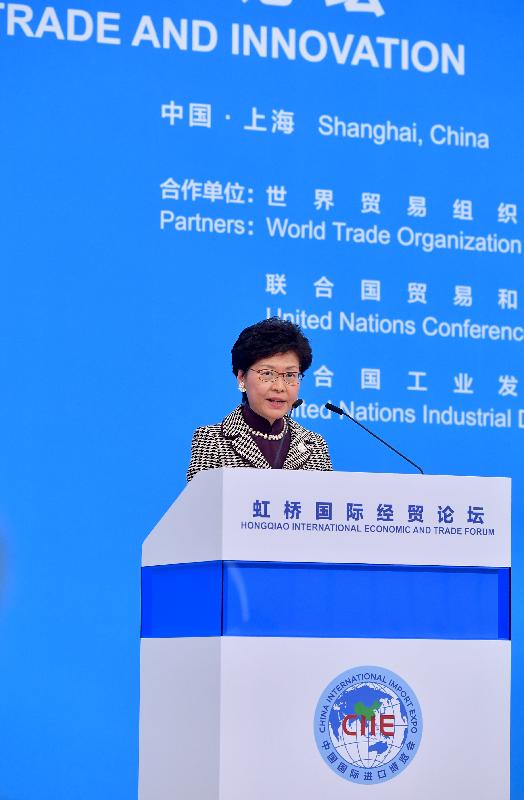
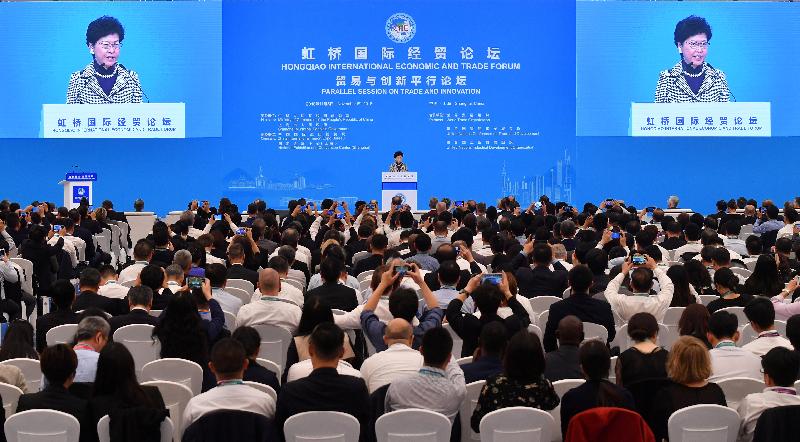
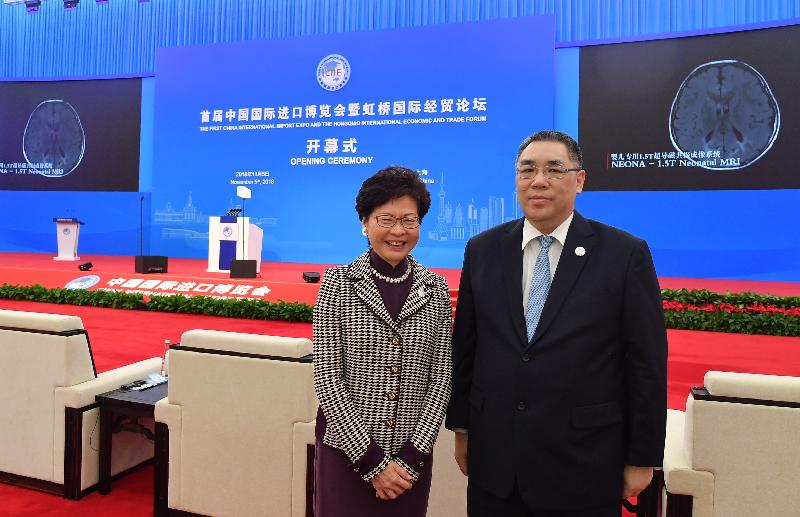
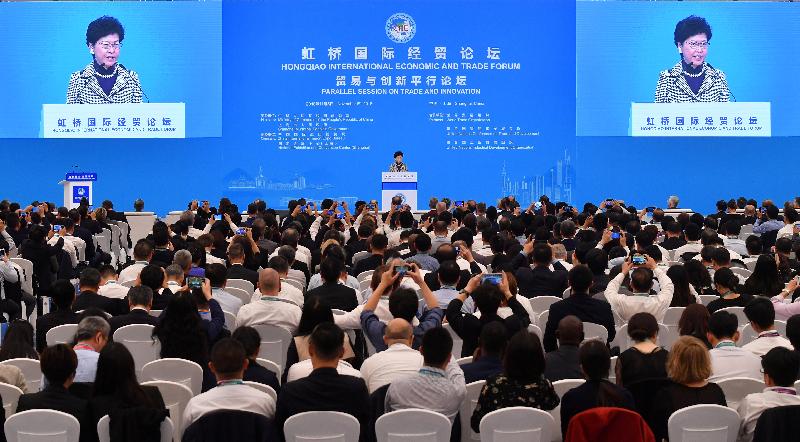
Following is the speech by the Chief Executive, Mrs Carrie Lam, at a parallel session of the Hongqiao International Economic and Trade Forum on the theme “Trade and Innovation” in Shanghai today (November 5):
Your excellencies, distinguished guests, ladies and gentlemen,
Good afternoon. It’s a great pleasure to be here today for the inaugural China International Import Expo and the Hongqiao International Economic and Trade Forum. It’s an even greater personal pleasure for me to join this platform with several state leaders, especially speaking after the Prime Ministers of Croatia and Malta, as these two beautiful countries were within my trade portfolio when I headed the Hong Kong Economic and Trade Office based in London over a decade ago. The fact that Hong Kong, a 7.4 million- population economy in Asia, would like to reach out to so many countries thousands of miles apart is, I hope, a good indication of the importance we attach to free trade.
This parallel session is on trade and innovation, and the topic – “Seizing the Opportunity of the Fourth Industrial Revolution and Promoting New Drivers for Trade Growth” – is certainly timely and promising. In his book “The Fourth Industrial Revolution” published in 2016, Professor Klaus Schwab, Founder and Executive Chairman of the World Economic Forum, reminded us that we are at the beginning of a revolution that is fundamentally changing the way we live, work, and relate to one another. By the same token, President Xi Jinping said in his speech in May this year, at the Academician Meeting of the Chinese Academy of Sciences and the Chinese Academy of Engineering, that science and technology have never as profoundly affected the country’s future and destiny and the people’s welfare as it has today.
True, while the exact impact of technological advances such as AI, robotics, Internet of Things, big data, etc, has yet to be fully grasped, we are already seeing major changes, or disruptions, in how we conduct business, arrange transactions, make payments, and even interact with each other. These changes inevitably have placed unprecedented demands on governments and institutions charged with planning and managing the economy and looking after the welfare of the people, ranging from education to health care. Technology can and will create winners and losers. If governments don’t get it right, if we can’t stay on top of the innovation and technology curve, if we can’t ensure inclusion, our industries, our workers, our societies, will pay the price. Some shared understanding amongst governments is particularly crucial if we are to find collective win-win solutions.
Hong Kong is acutely aware of the critical importance of innovation and technology in today’s world, and we are focusing on developing innovation and technology not only as a new driver for our economic growth, but also for applications in managing our city and looking after our elderly. I have therefore put in place an ambitious, eight-pronged strategy to drive Hong Kong’s innovation and technology movement three months after I took office last July. These include increasing resources for R&D; pooling together technology talent; providing investment funding; providing technological research infrastructure; reviewing existing legislations and regulations; opening up government data; promoting innovation in government procurement and strengthening popular science education. We are also moving ahead on a comprehensive Smart City Blueprint for Hong Kong.
We are investing heavily on the above. Over the past 15 months, the HKSAR Government has committed a total of US$10 billion to support the above-mentioned strategy. In addition, we have halved the profits tax rate to a single digit of 8.25 per cent to support SMEs and start-ups while incentivising private businesses to invest in R&D through super tax deductions. Our goal is to double Hong Kong’s R&D expenditure from the current 0.73 per cent to 1.5 per cent of our GDP within a period of five years.
We know that Hong Kong cannot do it all alone. Part of the funding committed is for setting up two research clusters, one for healthcare technology, the other for artificial intelligence and robotics at the Hong Kong Science Park. Institut Pasteur from France, the RWTH Aachen University of Germany as well as the Guangzhou Institute of Biomedicine and Health and the Institute of Automation in Beijing under the Chinese Academy of Sciences have already expressed interest in joining the clusters to strengthen collaboration with Hong Kong.
Equally important, we are strengthening our co-operation with Mainland China on innovation and technology. In September, we entered into a comprehensive Arrangement with the Ministry of Science and Technology of the nation, which will serve as an action guide and framework for us to take forward the various co-operation initiatives in such areas as scientific research, development of platforms, nurturing of talents and transfer of results.
There is also the Guangdong-Hong Kong-Macao Greater Bay Area, which comprises Hong Kong, Macao and nine other cities in the Guangdong province. Leveraging on Hong Kong’s unique strengths under “One Country, Two Systems” while emphasising on complementarity of the cities, Hong Kong is destined to play an important role in the Bay Area’s rise as Asia’s Silicon Valley.
Technological advancement will no doubt drive growth in trade. From railways and steamships to the computer, technology has long renewed trade and the economic and social growth it can stimulate. The technologies of this 21st century, from artificial intelligence and blockchain to the Internet of Things and so much more, will surely reshape and re-imagine global trade. The rise of e-commerce is a case in point. And we have heard from the World Bank President in his speech this morning on how e-commerce has helped to lift people out of poverty in a province in China. I am sure later on we will hear more from Jack Ma of Alibaba. Global retail e-commerce sales reached US$2.3 trillion last year, up 25 per cent over 2016. At the same time, trade will create demand for products and services, which will in turn provide the incentive for innovation.
The WTO’s “World Trade Report 2018,” focusing on how global commerce is being transformed by digital technologies, also sees great promise in the future of trade. The Report notes that trade could grow by 1.8 to two percentage points more a year until 2030, thanks to plummeting trade costs realised by new technology.
The potential is there for all to see, but in order to realise it, free trade has become ever more important. As a founding member of the World Trade Organization, Hong Kong has over the years been one of the freest and most open economies in the world. We have benefitted immensely from free trade for decades, which is instrumental in developing Hong Kong into the international trade and business centre as it is today. It is the reason why we continue to promote free trade, both by supporting the rule-based multilateral system, and expanding our network of free trade agreements.
We are naturally concerned by the unstable and fluctuating international trade environment, coupled with the rise of unilateralism in recent months. As world leaders gather here in Shanghai for the inaugural China International Import Expo, I believe that this is an excellent opportunity for us to re-affirm our commitment to free trade, and make sure that we and our future generations will be able to reap the full benefits of the Fourth Industrial Revolution. I look forward to working with you all on that front.
I wish the China International Import Expo and the Hongqiao International Economic and Trade Forum every success. Thank you very much.