Special traffic arrangements on Hong Kong Island
Police will implement special traffic arrangements this Saturday (November 17) to facilitate a public event to be held on Hong Kong Island. Road closure ———— The following roads… read more


Police will implement special traffic arrangements this Saturday (November 17) to facilitate a public event to be held on Hong Kong Island. Road closure ———— The following roads… read more
The following is issued on behalf of the Hong Kong Committee for Pacific Economic Cooperation:
The Pacific Economic Cooperation Council (PECC) published its State of the Region (SOTR) Report 2018-2019 on November 14.
The SOTR Report is an annual statement of the PECC’s views on the major developments affecting Asia-Pacific regional co-operation. The Report contains a macroeconomic overview of the current state of the region and related issues. It also includes views from opinion leaders from government, business and academic sectors on key developments in the region and priorities for Asia-Pacific Economic Cooperation (APEC).
The Report stated that the Asia-Pacific economy is expected to grow by 3.9 per cent in 2018 and 3.7 per cent in 2019. The PECC’s index of economic integration in the region showed a rebound after two consecutive years of falling. The Report identified the top five policy priorities for the region, namely rising trade tensions and the future of the World Trade Organization and the multilateral trading system; the emergence of anti-globalisation and anti-trade sentiments; progress on the APEC growth strategy to promote balanced, inclusive, sustainable, innovative and secure growth; progress towards the Bogor Goals and the Free Trade Area of the Asia-Pacific; and investing in human capital development in the digital age.
The Report also examined the future of work in the Asia-Pacific region. There is expectation that the sizes of workforces will decline due to the introduction of new technologies, that the levels of skills required will rise and that the occupational and skill structures of the workforces will change. The impact of technological change is likely to be at the forefront of concerns over the coming years.
The SOTR Report 2018-2019 is now available for download at the link below:
www.pecc.org/research/state-of-the-region.
The Hong Kong Committee for Pacific Economic Cooperation (HKCPEC) was established in March 1990 to co-ordinate Hong Kong’s participation in the PECC. In line with the nature of the PECC, the composition of the HKCPEC is tripartite, comprising members from the Government, the business sector and academia.
The PECC is a non-governmental organisation set up in 1980 to develop closer co-operation in trade and economic issues among economies in the region. For more information, please visit www.pecc.org. read more
The Legislative Council Kowloon West geographical constituency by-election will be held on November 25. The Registration and Electoral Office (REO) today (November 15) reminded electors that they must carry the original of their Hong Kong identity card to the designated polling station to vote.
The REO has mailed poll cards to about 490 000 registered electors of the Kowloon West geographical constituency to inform them of where they should cast their votes on the polling day.
“Electors may only cast their votes at the designated polling station as specified on their poll card. They are advised to note the address of the designated polling station on their poll card to ensure that they go to the correct polling station,” a spokesman for the REO said.
“Electors can log in to the Online Voter Information Enquiry System (www.voterinfo.gov.hk) if they have not yet received their poll card to check whether they are registered electors of the Kowloon West geographical constituency and their designated polling station. They can also call the election hotline 2891 1001 for enquiries,” he said.
In addition to the poll card, the electoral mail sent by the REO to each elector of the Kowloon West geographical constituency also includes an introductory leaflet on the candidates, a map indicating the location of the designated polling station, a voting procedure guide and a publicity leaflet on clean elections.
“Electors must carry the original of their Hong Kong identity card or other specified alternative documents to the designated polling station to collect their ballot papers to cast their votes,” the spokesman said.
“Voting is very simple. Electors must use the chop provided by the polling stations to stamp the ballot paper with a tick in the circle opposite the name of the chosen candidate. Electors should then fold the ballot paper once according to the pre-folding by polling staff to conceal the mark before putting the ballot paper into the ballot box.”
A total of 73 ordinary polling stations in the Kowloon West geographical constituency and a maximum of 22 dedicated polling stations will be open on the polling day for about 490 000 electors of the Kowloon West geographical constituency listed on the 2018 Final Register to cast their votes. The polling hours for the ordinary polling stations and the dedicated polling station set up at Cheung Sha Wan Police Station will be from 7.30am to 10.30pm. For the dedicated polling stations set up at penal institutions, for security reasons, the polling hours will be from 9am to 4pm.
Once the poll closes, all ordinary polling stations will be converted into counting stations for counting of votes. The counting stations will be open to the public once the conversion has been completed. Members of the public will be able to watch the counting process at designated areas inside the counting stations.
A media centre will be set up at Tiu Keng Leng Sports Centre, 2 Chui Ling Road, Tseung Kwan O, where the election results will be announced by the Returning Officer. A public gallery will be set up for members of the public to watch the announcement of results at the media centre. In view of the limited seating capacity, admission to the public gallery will be arranged on a first-come, first-served basis from 11pm on November 25. To facilitate admission control, members of the public admitted to the venue will be required to wear a wristband provided by the REO for identification purposes.
Measures have been taken by the REO to enable electors with special needs to exercise their right to vote. “In this by-election, over 90 per cent of the polling stations are accessible to electors with mobility difficulty or those who use wheelchairs. Where possible, the REO will install temporary ramps at polling stations to assist them,” the spokesman said.
The location map enclosed with the poll card specifies clearly whether the designated polling station is accessible to electors who are wheelchair users or have mobility difficulty.
“Electors with mobility difficulty or those who use wheelchairs may apply to the REO by November 20 (next Tuesday) (i.e. at least five days before the polling day) through the election hotline (2891 1001), fax (2891 1180) or email (reoenq@reo.gov.hk) for re-allocation to another polling station in case they have been allocated to a polling station inaccessible to them. If possible, the REO will also arrange for rehab buses to take them to and from polling stations upon request,” he added.
On the other hand, the Electoral Affairs Commission encourages candidates to provide a text version of their introduction to enable electors with visual impairment to understand the content using software aids. The text versions provided by candidates have been uploaded to the election website (www.elections.gov.hk). Electors with visual impairment may also listen to the candidates’ introductions by calling the dedicated telephone line 2893 3762. Braille templates will be provided at polling stations to assist electors with visual impairment to vote.
To help electors who are not familiar with Chinese and English cast their votes, guides on the voting procedure in seven ethnic minority languages (Bahasa Indonesia, Tagalog, Thai, Hindi, Nepali, Urdu and Punjabi), Japanese and Korean will be available at every polling station. Information on the by-election in these languages has also been uploaded to the election website.
The REO has also made arrangements with the Centre for Harmony and Enhancement of Ethnic Minority Residents run by the Hong Kong Christian Service to provide a telephone simultaneous interpretation service with the seven ethnic minority languages to help electors who are not familiar with Chinese and English make enquiries to the REO on election matters from November 12 to 16 and from November 19 to the polling day.
A pictorial guide showing the voting procedure will also be provided at polling stations to help electors with hearing or communication problems and electors who are not familiar with Chinese and English to understand the voting procedure.
Information about the by-election is available on the election website (www.elections.gov.hk). For enquiries, please call the election hotline on 2891 1001. read more
Hong Kong and Australia announced today (November 15) the successful conclusion of negotiations on a Free Trade Agreement (FTA) and an Investment Agreement after reaching consensus on both agreements.
The Secretary for Commerce and Economic Development, Mr Edward Yau, today met with the Australian Minister for Trade, Tourism and Investment, Mr Simon Birmingham, who was also attending the 30th APEC Ministerial Meeting in Port Moresby, Papua New Guinea to discuss the FTA and the Investment Agreement between Hong Kong and Australia. After the meeting, they signed the Declaration of Intent to signify the successful conclusion of the negotiations.
“Hong Kong and Australia are two like-minded economies in pursuit of free trade. Australia is also a very important trading partner of Hong Kong. Hong Kong has set clear objectives in launching the FTA negotiations – to achieve zero tariffs for Hong Kong products to the Australian market and to secure Australia’s best FTA commitments for Hong Kong services. Our objectives are largely met with the successful conclusion of the negotiation of the very comprehensive FTA and Investment Agreement today, thereby bringing our bilateral trade and investment relationship with Australia to a new height,” Mr Yau said.
“The two agreements encompass trade in goods, trade in services, investment and other related areas, providing us with legal certainty and better access to the Australian market, whilst also creating business opportunities and further enhancing trade and investment flows between the two places. Hong Kong’s economy stands to benefit from the two agreements,” he added.
Mr Yau said Hong Kong and Australia expect to sign the FTA and the Investment Agreement in the first half of the coming year, after completion of the respective internal procedures. Details of both agreements will then be announced.
“To help Hong Kong enterprises and investors expand their markets, further reinforce Hong Kong’s status as an international trade and investment hub and establish our worldwide network of economic and trade connections, we have been actively seeking to negotiate and forge FTAs and Investment Agreements with economies that have strong economic and trade connections with Hong Kong, markets with development potential or at strategic locations, as well as like-minded trading partners,” Mr Yau said.
The FTA and the Investment Agreement negotiations between Hong Kong and Australia commenced in May 2017 and were completed in November 2018.
In the past 12 months, the current term Government has signed three FTAs with 12 economies (the 10 Member States of the Association of Southeast Asian Nations, Georgia and the Macao Special Administrative Region). It has also concluded negotiations for an FTA with the Maldives. The FTAs with Australia and the Maldives will bring the total number of FTAs that Hong Kong has signed to nine, more than double the number signed by the Hong Kong Government prior to the current term.
In 2017, Australia was Hong Kong’s 19th largest trading partner in merchandise trade; the total merchandise trade between two sides was about HK$54.2 billion. Australia was also Hong Kong’s seventh largest trading partner in services trade in 2016 and total services trade amounted to HK$41.7 billion in the same year. On investment, as at the end of 2016, Australia ranked sixth among Hong Kong’s destinations for outward direct investment, with a stock of HK$135.3 billion, and it ranked 19th among Hong Kong’s sources for inward direct investment, with a stock of HK$24.5 billion. read more
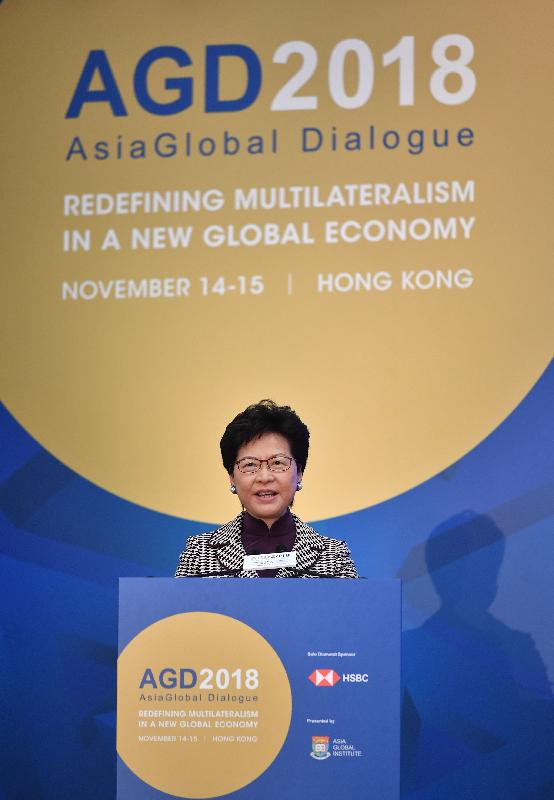
Following is the speech by the Chief Executive, Mrs Carrie Lam, at the AsiaGlobal Dialogue 2018 held at the University of Hong Kong today (November 15):
Victor (Co-chair of the Advisory Board of the Asia Global Institute, Dr Victor Fung), Professor Zhang (President and Vice-Chancellor of the University of Hong Kong, Professor Zhang Xiang), Professor Spence (Co-Chair of the Advisory Board of the Asia Global Institute, and recipient of the Nobel Memorial Prize in Economic Sciences (2001), Professor Michael Spence), ladies and gentlemen,
Good morning. I’m honoured to join you today for the University of Hong Kong’s annual AsiaGlobal Dialogue, and for the second year in a row.
It is a testing time for globalisation and multilateralism. This year’s theme – “Redefining Multilateralism for a Global Economy” – is sure to stimulate considered and spirited discussion. That is in keeping with the Asia Global Institute and its welcome mission, which is to generate innovative thinking and business-relevant research on global issues from Asian perspectives, in order to inform global policy and actions towards a prosperous and sustainable future for all.
When we talk about multilateralism, the World Trade Organization (WTO) immediately comes to mind. The establishment of the WTO in 1995 was a landmark development, a giant step towards a rule-based multilateral trading system, which is the foundation for the liberalisation of global trade and investment. Indeed, trade volume in goods and services has tripled since then. Global foreign direct investment flow is up more than four-fold over the past 22 years. Developing economies, in particular, rose almost six-fold.
The results are clear and compelling: the flow of goods and capital has unleashed immense productivity growth worldwide. In doing so, it has raised incomes and the living standards of billions of people. World GDP has grown an average 3.8 per cent a year in real terms over the past 22 years, with per capita GDP also doubling.
For developing economies, globalisation through multilateralism has helped them integrate into the global value chain, in the process lifting a great many people out of poverty. Indeed, nearly 1.1 billion people have moved out of extreme poverty since 1990, according to the World Bank.
That’s not to say that globalisation is problem-free. Some of the world’s poorest economies have been left behind; their paucity of resources, skills, equipment and infrastructure leave them unable to seize the opportunities. As for advanced economies, there is the real challenge of job losses, in part because of widespread outsourcing and the relocation of lower-skilled, labour-intensive production to developing economies.
At the same time, efforts to expand multilateralism have foundered in recent years because of profound differences among WTO members. The global financial crisis in 2008 has also had an unsettling impact, from protests against free trade to calls for de-globalisation in some advanced economies. In short, the multilateral trading system set in motion by the WTO has encountered fierce opposition, and that resistance has only swelled in recent years.
As I noted in my speech here last year, the fundamental solution lies in making economic development more inclusive, in boosting the benefits we create for our people. I outlined a number of measures essential to building an inclusive community, and I won’t repeat those this morning.
Rather, let me say that I am very concerned about global trade developments over this past year. Last year at this occasion, I said that I saw worrying signs of rising protectionism. I am afraid that now we see more than signs, with the United States introducing unilateral trade measures against other economies. The unilateral actions taken by the United States and inevitable retaliatory actions by other economies will surely raise the barriers to trade and investment, risking a widespread economic slowdown or even a global recession.
I’m pleased to note that the second largest economy in the world, that is Mainland China, is providing the much needed support for the multilateral system. This year marks the 40th anniversary of China’s reform and opening up. By the way, many of you in Hong Kong would know that I just came back to Hong Kong on Monday after leading a delegation of over 160 members from various sectors of the community to visit Shenzhen and Beijing to celebrate this anniversary. In this milestone year, the inaugural China International Import Expo was held in Shanghai last week. Victor and I were there. Actually, Hong Kong actively participated in the Expo. We set up a Hong Kong Exhibition Area, and over 160 enterprises joined the Enterprise and Business Exhibition, showcasing our unique role as a strategic gateway and important hub for the opening up of the country.
The Expo is the world’s first import expo held at the national level. Some of you may have picked up the figures about the achievements in this Expo. This reaffirms my belief that sometimes the Chinese people approach the subject of trade in a way very different from the American people, that we emphasise deeds rather than rhetoric. At the opening ceremony of the Expo, President Xi Jinping delivered a keynote address entitled “Work Together for an Open Global Economy that is Innovative and Inclusive”. He said that the Expo “demonstrates China’s consistent position of supporting the multilateral trading system and promoting free trade”, and “it is a concrete action by China to advance an open world economy and support economic globalisation”. President Xi emphasised that “openness and co-operation will remain essential for continued human progress”. He named five concrete aspects that China will step up efforts to broaden its opening up, one of which is to promote international co-operation at the multilateral and bilateral levels. In particular, he said that China will continue to advance the Belt and Road Initiative through international co-operation in the spirit of consultation and collaboration for shared benefits.
Hong Kong is determined to play an active part in the country’s noble efforts to build a community with a shared future and usher in an even better tomorrow for mankind. First of all, we will continue to promote free trade, both by supporting the rule-based multilateral trading system, which is the most effective safeguard against protectionism, and by expanding our network of free trade agreements. Let me make it clear: whatever the changes to the global economic landscape, we are committed to keeping Hong Kong markets free and unfettered, our economy open wide to global business and investment.
And we will promote international co-operation through our participation in the Belt and Road Initiative. Hong Kong is prepared to offer our expertise in professional services for countries and enterprises seeking to participate in the Initiative. Our expertise covers infrastructure development, financial services, engineering, consultancy, accounting, law, etc. These services will be in considerable demand for infrastructure and other projects arising from the Belt and Road Initiative.
Let me add that we will leverage our unique advantages under “one country, two systems” to promote multilateralism and people-to-people bonds in the global environment, which is one of the key objectives of the Belt and Road Initiative. One area that Hong Kong can contribute, which we are doing, is capacity building. We have huge experience in many areas of city management, including town planning, flood prevention, slope stabilisation, railway operation, aviation safety and emergency services. We have also built institutions to fight against corruption, promote equal opportunities and deal with administrative complaints. We are willing to share our experience in those aspects with emerging economies and help build their capacity. In fact, many of our departments and institutions, such as the Independent Commission Against Corruption and the Fire and Ambulance Services Academy, are already offering training or experience sharing with their counterparts from emerging economies, including those along the Belt and Road. We believe that such capacity building efforts will help promote inclusive growth, which in turn will strengthen the confidence in the multilateral system.
Ladies and gentlemen, economic globalisation is an irreversible trend. The rule-based multilateral trading system is one of the pillars that enable freer flows of trade and investment across economies that provide the very impetus to global economic development. At the moment, it is being tested, threatened by a wall of protectionist rhetoric and lamentable action. Through dialogue, through gatherings such as today’s, I’m hopeful that we will surmount those obstructions, that we will find our way to an open and inclusive global economy.
I wish you all a very rewarding day. Thank you very much.