Tag Archives: China

image_pdfimage_print

Government officials encourage public to receive seasonal influenza vaccination (with photos)

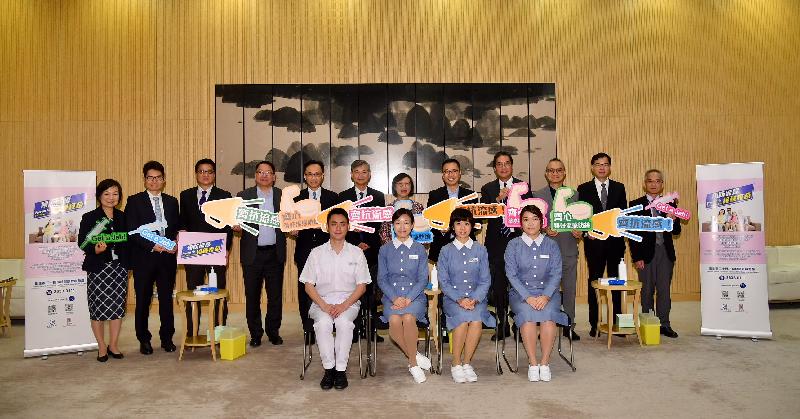
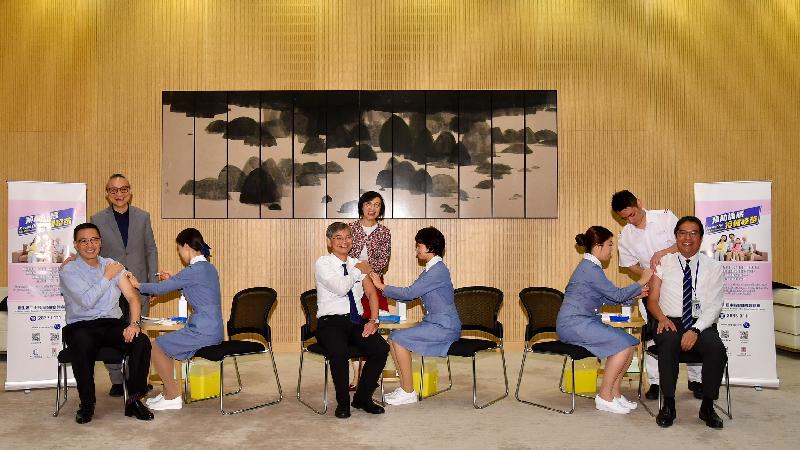
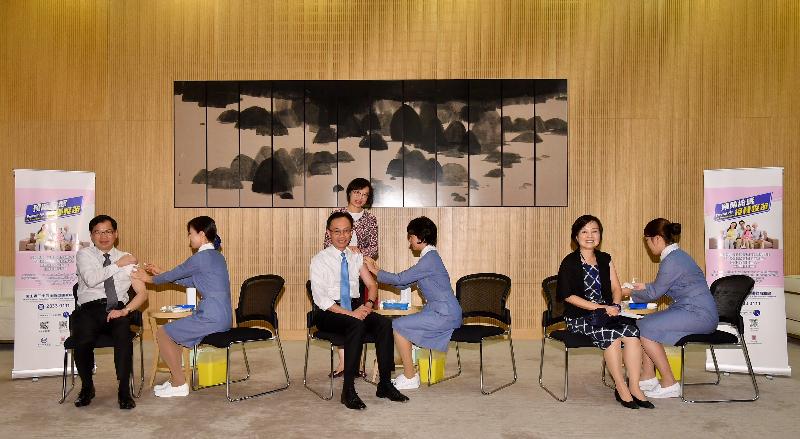
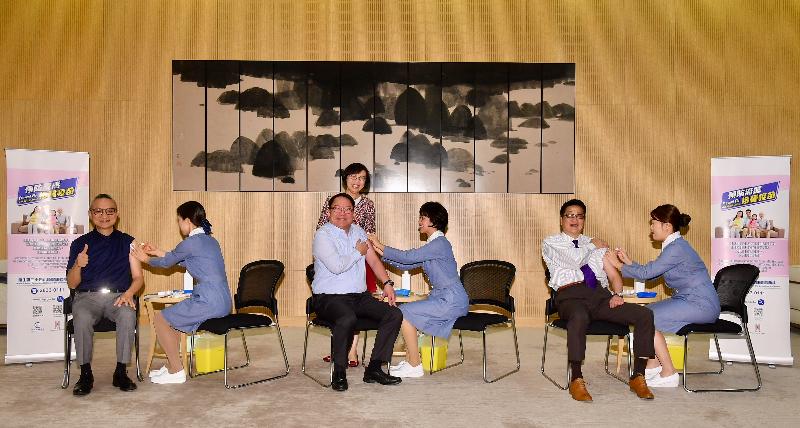
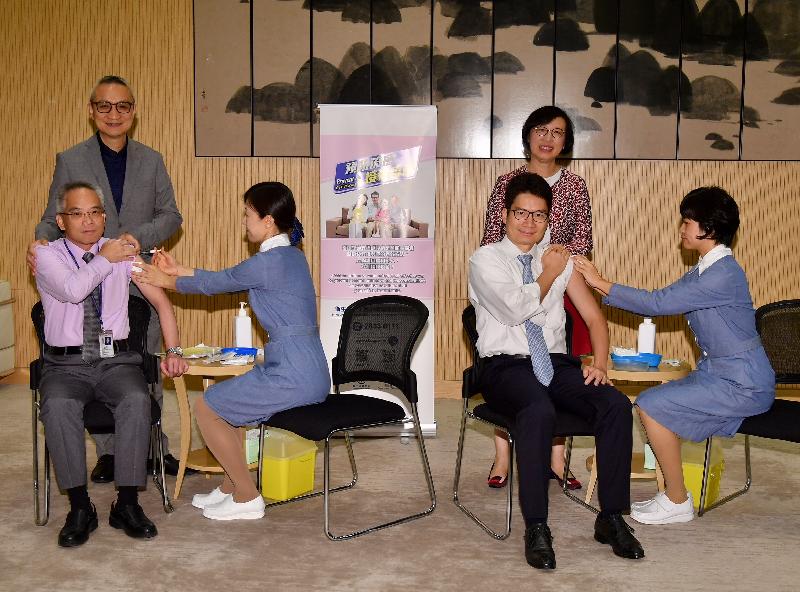
     A number of Government officials received seasonal influenza vaccination (SIV) today (November 21) and appealed to the public to prepare for the winter influenza season by receiving vaccination.  

     Officials receiving vaccination today were the Secretary for Labour and Welfare, Dr Law Chi-kwong; the Secretary for Development, Mr Michael Wong; the Secretary for Education, Mr Kevin Yeung; the Secretary for Constitutional and Mainland Affairs, Mr Patrick Nip; the Acting Secretary for Security, Mr Sonny Au; the Director of the Chief Executive’s Office, Mr Chan Kwok-ki; the Under Secretary for Education, Dr Choi Yuk-lin; the Under Secretary for Food and Health, Dr Chui Tak-yi; the Under Secretary for Financial Services and the Treasury, Mr Joseph Chan; the Under Secretary for Home Affairs, Mr Jack Chan; and the Under Secretary for Transport and Housing, Dr Raymond So.

     The Secretary for Food and Health, Professor Sophia Chan, was also present to show her support. She said, “Seasonal influenza can cause serious illnesses. Besides high-risk groups such as the elderly, children and immunocompromised patients, healthy people may also contract influenza and develop complications. Vaccination is one of the most effective ways to prevent influenza and therefore members of the public should receive vaccination early to protect themselves against influenza and its complications, hence reducing the risk of hospitalisation and death.

     “To enhance the uptake rate among primary school children, the Department of Health has launched the School Outreach Vaccination Pilot Programme this year to reach out to 184 primary schools and provide vaccination to their students through outreach teams. As of November 18, 2018, some 56 000 students have received vaccination under the Pilot Programme.”
 
     In addition, the coverage of the Vaccination Subsidy Scheme (VSS) has been extended from Hong Kong people aged 65 or above to those aged 50 or above.
 
     Professor Chan added, “As of November 18, 2018, some 218 000 doses of SIV had been administered via the Government Vaccination Programme (GVP) and around 316 000 doses had been administered via the VSS. Along with the Pilot Programme, so far around 590 000 doses have been administered under various programmes launched by the Government, representing an increase of nearly 53 per cent from the same period in the 2017/18 season.”
 
     As it takes about two weeks after vaccination for antibodies to develop in the body to prevent seasonal influenza viruses, the Government encourages people aged 6 months or above, except those with known contraindications, to receive vaccination early to avoid infection of influenza and its complications. Please refer to the webpage of the Centre for Health Protection (www.chp.gov.hk/en/features/17980.html) for details of various vaccination programmes.

Photo  Photo  Photo  Photo  Photo  
read more

Hong Kong Customs teams up with Mainland Customs to combat cross-boundary counterfeit goods activities (with photo)

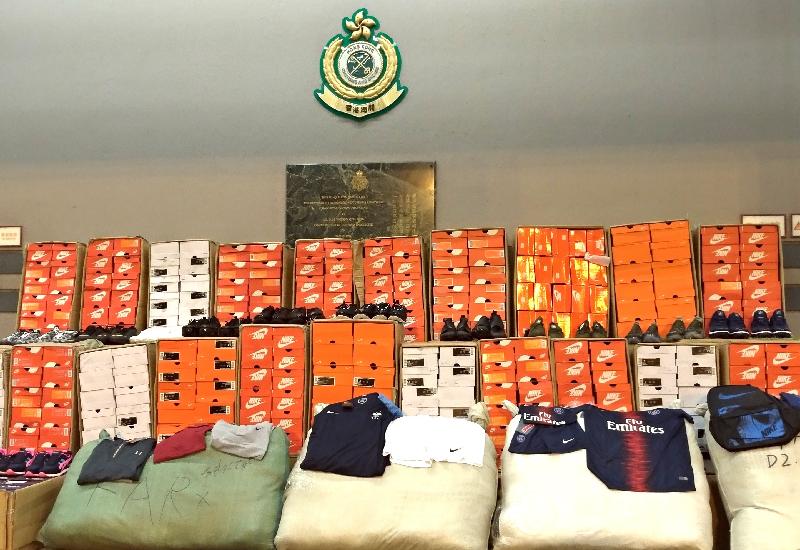
     Hong Kong Customs and Mainland Customs conducted a joint operation from October 29 to November 18 to combat cross-boundary counterfeit goods activities. During the operation, Hong Kong Customs seized about 58 000 pieces of suspected counterfeit goods, including footwear, clothes, leather products and sports products with an estimated market value of about $1.7 million.

     The two Customs administrations stepped up inspection of sea cargo during the operation and Hong Kong Customs seized the suspected counterfeit goods, effectively curbing cross-boundary counterfeit goods activities.

     Hong Kong Customs and Mainland Customs have been working closely to combat cross-boundary counterfeiting activities through intelligence exchanges and joint enforcement actions.

     Hong Kong Customs will continue to collaborate closely with the Mainland and overseas law enforcement agencies targeting cross-boundary counterfeiting activities.

     Under the Trade Descriptions Ordinance, any person who imports or exports counterfeit goods commits an offence. The maximum penalty upon conviction is a fine of $500,000 and imprisonment for five years.

     Members of the public may report any suspected counterfeiting activities to Customs’ 24-hour hotline 2545 6182 or its dedicated crime-reporting email account (crimereport@customs.gov.hk).

Photo  
read more

LCQ4: Visiting persons in custody

     Following is a question by the Hon Leung Yiu-chung and a reply by the Acting Secretary for Security, Mr Sonny Au, in the Legislative Council today (November 21):
 
     I notice that in recent years, the Correctional Services Department (CSD) has changed the arrangements for Members of this Council to visit persons in custody to perform official duties.  In the past, a Member, irrespective of whether in the company of other persons (such as the Member’s assistant or a legal adviser of the person in custody), may visit a person in custody not in the hearing of CSD officers. At present, if a Member is accompanied by other persons in a visit to a person in custody, CSD officers will keep the door of the visit room open and even sit in on the visit and record the conversation in writing. In the past year or so, I have enquired for a number of times in writing about the reasons for the changes in the arrangements, but CSD has so far not made an official reply on the grounds that it needs to consult the Department of Justice. In this connection, will the Government inform this Council:
 
 (1) since when the arrangements of CSD officers sitting in on official visits and recording the conversation in writing have been implemented; of the uses of such records and their retention period, as well as the rank of the officers responsible for inspecting the contents of the records;
 
 (2) of the justifications and the legal basis for CSD officers to sit in on official visits and the guidelines those officers have to observe; as some Members have relayed that there are differences in the arrangements for handling official visits by various correctional institutions, of the reasons for that and the measures to ensure that the relevant arrangements are consistent; and
 
 (3) whether CSD will review the arrangements for official visits and reinstate the practice whereby Members and accompanying persons may visit persons in custody not in the hearing of CSD officers, so as to protect the privacy of persons in custody and safeguard their right to confidential legal advice?
 
Reply:
 
President,
 
     The Correctional Services Department (CSD) is committed to providing a secure, safe, humane, decent and healthy custodial environment for persons in custody (PICs). In view of security considerations and the need for maintaining discipline and order in the prisons, the Prison Rules (Cap 234A) contain provisions regulating PICs’ communication with parties outside of prisons. The CSD is responsible for handling various visits in accordance with the law or relevant principles. No persons, unless specified by the law, shall visit a PIC except by special authority of the Commissioner of Correctional Services.
 
     My replies to the Member’s questions are as follows:
 
 (1) and (2) For such purposes as assisting the rehabilitation of PICs or facilitating legal proceedings, the CSD allows PICs to receive visits by specified categories of persons under suitable restrictions. The Prison Rules stipulate that a PIC may receive visits by relatives and friends, police officers, officers of the Court and his/her legal adviser. Relevant provisions are as follows: 
 
(i) Under Rule 48 of the Prison Rules, relatives and friends may visit a PIC twice a month and no more than three persons shall be allowed at one time. The visits shall be limited to 30 minutes on each occasion and conducted in the presence of a CSD officer;
 
(ii) Under Rule 49 of the Prison Rules, any police officer may visit PICs for the purpose of identification parades or inquiring into reported or reasonably suspected offences; 
 
(iii) Under Rule 50 of the Prison Rules, officers of the Court, with competent warrants or orders for serving writs or other legal process on persons within the prison, shall be admitted into the prison for that purpose; and
 
(iv) Under Rule 52(1) of the Prison Rules, reasonable facilities shall be allowed for the legal adviser of a PIC who is party to legal proceedings, civil or criminal, to interview the PIC with reference to those proceedings in the sight but not in the hearing of a CSD officer. 

     Visits by relatives and friends are video and sound recorded and conducted in the presence of a CSD officer. These arrangements are mainly for prison security and crime prevention, for instance, against self-harm behaviour committed by PICs due to emotional outburst, conversation about unlawful matters like jailbreak or disruption to discipline and order in prisons, etc. CSD officers are duty bound to follow up appropriately where necessary. Visits by police officers, officers of the Court and legal advisers may be conducted in the sight but not in the hearing of a CSD officer and without restrictions on time and frequency.
 
     Regarding visits by legal advisers, the CSD and the Law Society of Hong Kong have in place an established mechanism for specific arrangements, where a legal adviser is required to produce valid documents issued by his/her law firm as a proof of his/her representation for the PIC prior to interviewing the person, and that the interview is to discuss the relevant legal proceedings, therefore fulfilling the requirements under section 52(1) of the Prison Rules. Upon ascertaining the purpose of visit, the CSD will arrange for the interview to be conducted not in the hearing of a CSD officer. 
 
     No special arrangement has been set out in the Prison Rules on visiting PICs by Members of the Legislative Council. However, the Commissioner of Correctional Services may exercise discretion under the law to permit PICs to receive visits by Members of the Legislative Council. The CSD has all along taken into account the provisions in Rule 47C of the Prison Rules which stipulate that CSD officers shall not read letters from PICs to specified persons, i.e. the Chief Executive, Members of the Executive Council, Members of the Legislative Council, District Council Members, visiting Justices of the Peace, the Ombudsman and the Commissioner of the Independent Commission Against Corruption, or letters from specified persons to PICs. Thus, the CSD has exercised discretion and extended the principle of handling letters of specified persons to the visits to PICs by specified persons, including Members of the Legislative Council, and devised administrative arrangements to facilitate such official visits. No restrictions are imposed on the time and the frequency of such visits. They will be conducted in official visit rooms not in the hearing of a CSD officer. These arrangements for visits by specified persons are less stringent than those for visits by relatives and friends. Any specified person who needs to visit a PIC to perform official duties has to make an application to the CSD in advance to confirm that he/she has a genuine need to perform official duties. If approval is given, the CSD will notify the specified person in writing, stating that the approval is granted on the basis of his/her capacity as a specified person and that CSD is satisfied that there is a genuine need for he/she to perform official duties.
 
     Nevertheless, where a specified person conducts the visit in the company of one or more persons, the specified person must first confirm that the presence and the company of the accompanying persons is necessary. The CSD may exercise discretion when giving approval. If approval is granted, no restrictions are imposed on the time and the frequency of such visits. The visits will be conducted in official visit rooms. Yet, as the accompanying persons are not specified persons, the visit will be conducted in the sight and hearing of a CSD officer. These arrangements for visits by a specified person with accompanying persons are still less stringent than those for visits by relatives and friends.
 
     Having regard to the security and operational needs of prison, where a visit is conducted in the sight and hearing of a CSD officer, the officer may keep a record as appropriate and where necessary. After the visit, the CSD officer at the scene will report to the institutional management and the record will be destroyed immediately after the reporting. 
      
 (3) The CSD respects the privacy of PICs, but the operation of prisons is subject to the statutory restrictions stated in parts (1) and (2) above. It is also necessary for the CSD to maintain the security, discipline and order of prisons. The CSD will continue to protect the privacy and legitimate rights of PICs while ensuring good management and security of the prisons in accordance with the law and relevant rules of Hong Kong and in a professional manner. read more

LCQ6: Diversion of tourists entering territory through Hong Kong-Zhuhai-Macao Bridge

     Following is a question by the Hon Andrew Wan and a reply by the Secretary for Commerce and Economic Development, Mr Edward Yau, in the Legislative Council today (November 21):

Question:
 
     It has been reported that upon the Hong Kong-Zhuhai-Macao Bridge (HZMB) opening to traffic on the 24th of last month, a large number of tourists entering the territory via HZMB have flocked to Tung Chung, and the daily lives of the residents there have been greatly affected as a result. For example, daily commodities were snapped up and sold out, restaurants experienced an overflow of customers, and a large number of tourists waiting at Tung Chung Bus Terminus for buses heading for the Hong Kong Port caused obstruction to passageways and noise nuisances. Despite the introduction of a number of tourist diversion measures as announced by the Government on the 9th of this month, the situation has not been significantly improved.  In this connection, will the Government inform this Council:
 
(1) whether it has conducted an investigation into the number of tour groups entering the territory via HZMB, since HZMB opened to traffic, for which reception by a local travel agent had not been arranged; whether it has taken any law enforcement actions; if so, of the details;
 
(2) of the new measures to further mitigate the current situation of Tung Chung being flooded with tourists; whether it will discuss with the Mainland authorities the following proposals: (i) introducing tour groups or bus routes destined for the HZMB eastern artificial island, which is located within Mainland waters, so that those Mainland residents who merely want to visit HZMB need not enter Hong Kong, and (ii) tightening the arrangement for issuing exit endorsements for Mainland residents to visit Hong Kong; and
 
(3) given that the Tuen Mun-Chek Lap Kok Link (TM-CLKL) is expected to be fully operational in 2020 and by that time, it will take only about 10 minutes per trip for vehicles to commute between the Hong Kong Port and Tuen Mun, whether the authorities will, upon the commissioning of TM-CLKL, put in place appropriate measures to prevent recurrence in Tuen Mun the situation of a place being flooded with tourists; if so, of the details; if not, the reasons for that?

Reply:
 
President,
 
     The Government has been monitoring closely the vehicular and visitor flows crossing the border through the Hong Kong-Zhuhai-Macao Bridge (HZMB) and the operation of the Hong Kong Boundary Crossing Facilities (BCF) since the commissioning of HZMB. In view of the recent situation in Tung Chung, the Government has rolled out multi-pronged measures within a short time in order to help alleviate the pressure of the BCF and its nearby areas, improving the relevant situation.
 
     Having consulted relevant bureaux and departments, my consolidated reply to the question raised by the Hon Andrew Wan is as follows: 

(1) According to present laws and regulations, Mainland inbound tour groups without being received by Hong Kong travel agents might not contravene the laws and regulations. Travel agents outside Hong Kong are free to organise group tours to Hong Kong, but the key is that they are not permitted to conduct travel businesses, such as obtaining for others accommodation, transport and sightseeing services, in Hong Kong.
 
     The Travel Industry Council of Hong Kong (TIC), which is responsible for regulation of the trade, has clear guidelines and directives requiring that travel agents in Hong Kong should, whenever receiving Mainland inbound tour groups, register with and provide to TIC the relevant information of such tour groups in advance.
 
     Of course, the Government has all along encouraged and facilitated Mainland inbound travel agents to establish collaboration with Hong Kong receiving agents. In the past four weeks, the number of registered tour groups visiting Hong Kong through the HZMB increased from around 70 groups in the first week to over 700 groups in the week just passed. TIC also deployed manpower to conduct spot checks last weekend. Survey results show that, amongst all Mainland inbound tour groups visiting Hong Kong through the HZMB, around 70 per cent were accompanied by Hong Kong tourist guides, indicating a gradual improvement in the arrangement of receiving agents.
 
     As I said during my media stand-up in Shanghai earlier this month, all inbound tour groups must abide by the Hong Kong law. As regards tour groups suspected of violating relevant laws, the Tourism Commission (TC) has already reported the incident to the Guangdong Province Culture and Tourism Unit (the Unit) in early November. The Unit attached great importance to the incident, and has issued notices to various municipal tourism authorities in the province, urging them to strengthen market regulation and request the tourism operators in various cities to strictly abide by the laws and regulations in Hong Kong and Macao. The Travel Agents Registry under TC has also reported suspected illegal cases to the Police and the Immigration Department (ImmD) once the Registry is aware of such. The Police and ImmD are now investigating the incident, and no one has been arrested thus far.

(2) In view of the recent situation in Tung Chung, the Government has called various inter-departmental meetings to tackle the matter.
 
     Based on the experience gained from the past few weekends, around one-fifth of visitors arriving at Hong Kong through the HZMB BCF did not leave the BCF to visit other districts in Hong Kong by taking local public transportation. This indicates that many of the visitors arriving at Hong Kong through the HZMB BCF mainly intended to visit the HZMB itself and might not be keen to enter Hong Kong. The Government is exploring with relevant Mainland authorities the opening of the HZMB’s East Artificial Island to the aforementioned group tourists, so as to allow such tourists to visit the HZMB and return to Zhuhai or Macao from the East Artificial Island without crossing the border of the Hong Kong Special Administrative Region.
 
     In addition, the Government is arranging for the setting up of temporary small-scale shops or booths in the HZMB’s BCF to allow travellers to buy souvenirs therein.  We are also exploring the introduction of food trucks to serve travellers near the BCF and in Sunny Bay.
 
     On the other hand, the Transport Department (TD) has implemented new measures concerning the operating arrangements of domestic tour coaches at the BCF today (November 21). Under the new measures, registered coach operators could enter the BCF pick-up area to pick up passengers on any day provided that they had submitted an application and completed certain simple procedures via TD’s online system by 9pm the prior day. This arrangement will help Hong Kong receiving travel agents and Mainland inbound travel agents establish co-operation, so as to reduce the influx of visitors into Tung Chung through the flexible deployment of tour coaches.
 
     Furthermore, shuttle bus operators are working full steam ahead to prepare and test the online pre-booking system in the hope of implementing it from this Friday (November 23), such that travel agents or organisers of tour groups could, through the online system, purchase shuttle bus tickets (including return tickets in one single operation) for designated dates and time slots from the next day (November 24) onwards. The new arrangement will help manage and regulate visitor flows at all time slots, thereby preventing group visitors from entering and leaving Hong Kong at the same time, as well as reducing the waiting time of visitors. The shuttle bus operator will announce relevant details within this week.
 
     TC has assisted in co-ordinating the local trade to smooth the visitor flow near the BCF, including requesting the local trade to arrange travellers to use other means of transport as far as practicable. TC also encourages the trade, including tourist attractions, to launch travel itineraries and products such as half-day tours, so as to help divert travellers.
 
     In addition, the Police will continue to closely monitor the situation of Mainland tour groups visiting Hong Kong, and deploy additional manpower from time to time to maintain public order and public safety on site.
 
(3) Upon the commissioning of the Tuen Mun-Chek Lap Kok Link (TM-CLKL), there will be a new alternative route to divert travellers, alleviating the pressure borne by the Tsing Ma Bridge. TD and relevant public transport operators will devise plans having regard to relevant transport demand and traffic flows, and consult relevant District Councils and stakeholders. 
 
     Upon the full commissioning of the TM-CLKL, TD will also, depending on the demand, adjust public transport services in a timely manner to accommodate passengers’ need. read more

LCQ16: Support for non-Chinese speaking students in learning Chinese History

     Following is a question by the Hon Cheung Kwok-kwan and a written reply by the Secretary for Education, Mr Kevin Yeung, in the Legislative Council today (November 21):

Question:

     Since 2014, the Education Bureau (EDB) has implemented the Chinese Language Curriculum Second Language Learning Framework to step up the support for non-Chinese speaking (NCS) students in learning Chinese. In addition, the Chief Executive has announced in this year’s Policy Address that from the 2019-2020 school year onwards, additional resources will be provided for public sector secondary schools to support NCS students in using the Chinese language to learn Chinese History. In this connection, will the Government inform this Council:

(1) given that Chinese History has become a compulsory subject at junior secondary level since September this year, of the number of cases, received by the EDB since the commencement of the current school year, in which teachers sought assistance as they had encountered difficulties in teaching NCS students Chinese History; the immediate measures put in place to assist those teachers in overcoming the difficulties;

(2) of the outcome of the discussions and the support measures formulated by the Ad Hoc Committee on Supporting Non-Chinese Speaking Students Learning Chinese History and Chinese Culture since its establishment in May this year;

(3) as some teachers have pointed out that since all of the teaching materials for Chinese History available on the market are compiled for Chinese-speaking students, such materials are not suitable for NCS students whose cultural backgrounds and proficiency in the Chinese language are different from those of Chinese-speaking students, and hence the schools have to compile teaching materials by themselves for NCS students and provide explanations in English when teaching the subject, whether the EDB currently provides assistance to the schools concerned in compiling such teaching materials;

(4) whether the EDB has formulated a Chinese History curriculum framework and learning/examination assessment guides especially for NCS students; if not, of the reasons for that; and

(5) whether the EDB has issued guidelines to the schools concerned on how they may utilise the aforesaid additional resources to provide support for NCS students?
 
Reply:

President,

     The 2017 Policy Address announced the inclusion of Chinese History as an independent compulsory subject for the junior secondary level, with a view to enabling all secondary students to learn Chinese history in a holistic and systematic manner. As a part of the Hong Kong community, non-Chinese speaking (NCS) students should understand Chinese history and culture, learn about the development and cultural characteristics of the society in which they live, appreciate and respect different historical and cultural legacies, and integrate into mainstream Chinese society, which will be conducive to their further studies and employment in Hong Kong, or even their career development on the Mainland in future.

     The Education Bureau (EDB) understands that NCS students may encounter difficulties when studying Chinese History due to language barriers and cultural differences. Therefore, the EDB provides flexibility for the schools admitting these students to make adaptations to teaching contents, pedagogy and assessment, flexibly design school-based curricula and adopt diversified teaching strategies. Examples include adopting a story-telling approach to teach history, using teaching materials of a non-text nature such as audio-visual materials, supplementing teaching with English, and deploying the one-off grant for the promotion of Chinese history and culture provided by the EDB to develop suitable learning kits or organise diversified learning activities, with a view to enhancing NCS students’ interest in and effectiveness of learning Chinese History. The EDB has informed schools of the arrangement through briefing sessions and other channels.

     Regarding the Hon Cheung Kwok-kwan’s question, our reply is as follows:

(1) Since commencement of the current school year, we have occasionally received phone calls or emails from teachers concerning arrangements about NCS students’ learning of Chinese History. Through telephone conversations, emails, interviews and school visits, we immediately ascertained their needs and provided suggestions. We have also seconded teachers with experience in teaching NCS students to support these schools by sharing their experience and teaching materials, thereby allaying teachers’ concerns. According to our records, there have only been eight relevant enquiries.

(2) to (5) The Ad Hoc Committee on Supporting Non-Chinese Speaking Students Learning Chinese History and Chinese Culture (the Ad Hoc Committee) was established in the 2017-18 school year to advise schools on learning and teaching strategies and curriculum adaptation. Based on the Revised Curriculum Framework of Chinese History (Secondary 1-3) published in May 2018, the Ad Hoc Committee is deliberating on an adapted curriculum framework which will be available for schools’ reference as soon as it is endorsed by the Committee on Personal, Social and Humanities Education. A working group will also be set up under the Ad Hoc Committee to advise on support strategies and measures, such as tryout teaching, developing sample teaching materials and devising related learning activities, compiling a glossary of history terms in both Chinese and English and producing teachers’ handbooks. The working group would also contact relevant organisations/bodies, such as the Hong Kong Museum of History, to provide bilingual learning resources in history.

     In collaboration with experts and academics, the EDB will provide schools admitting NCS students and their teachers with enhanced professional support, including (1) allowing teachers in need of support to observe how teachers experienced in teaching NCS students teach in class; (2) organising workshops for devising and developing suitable teaching materials for NCS students; and (3) designing diversified learning and teaching activities, such as e-learning, field studies, visits, competitions and drama performances, for raising NCS students’ interests in studying Chinese History. Our school-based support services will continue to support teachers in adapting the curriculum and designing teaching strategies according to their school contexts.  

     The EDB will inform schools of the support measures available through circular memoranda and other means. Concurrently, with a view to supporting NCS students’ learning of Chinese History using the Chinese language, the EDB plans to disburse additional funding to local public sector and Direct Subsidy Scheme secondary schools which have admitted NCS students. Each school will receive a total amount of $100,000 in the 2018-19 and 2019-20 school years. Subject to the approval of the Legislative Council, the EDB will issue a circular memorandum to schools to provide details in relation to the grant. read more