Tag Archives: China

image_pdfimage_print

Seventeen immigration offenders arrested

     The Immigration Department (ImmD) mounted a series of territory-wide anti-illegal worker operations, including an operation codenamed “Twilight”, and joint operations with the Hong Kong Police Force and the Labour Department codenamed “Champion” from November 26 to 29. A total of 10 illegal workers, six suspected employers and one overstayer were arrested.
      
     During operation “Twilight”, ImmD Task Force officers raided 80 target locations including commercial buildings, a factory, a garage, industrial buildings, residential buildings, restaurants, shops and a farm. Seven illegal workers and three employers were arrested. The illegal workers comprised three men and four women, aged 23 to 51. Among them, one man and three women were holders of recognisance forms, which prohibit them from taking any employment. In addition, one man was suspected of using and being in possession of a forged Hong Kong identity card. Meanwhile, one man and two women, aged 31 to 52, were suspected of employing the illegal workers. Furthermore, one female overstayer, aged 49, was arrested.
      
     In addition, during operation “Champion”, enforcement officers raided 20 target locations in Tsing Yi, Kwai Chung, Chai Wan and North Point including car parks, a factory, restaurants and massage parlours. Three male illegal workers, aged 32 to 49, were arrested. Among them, two men were holders of recognisance forms, which prohibit them from taking any employment. Meanwhile, two men and one woman, aged 38 to 53, suspected of employing the illegal workers were also arrested.
      
     “Any person who contravenes a condition of stay in force in respect of him shall be guilty of an offence. Also, visitors are not allowed to take employment in Hong Kong, whether paid or unpaid, without the permission of the Director of Immigration. Offenders are liable to prosecution and upon conviction face a maximum fine of $50,000 and up to two years’ imprisonment. Aiders and abettors are also liable to prosecution and penalties,” an ImmD spokesman said.
 
     The spokesman warned that it is an offence to use or possess a forged Hong Kong identity card or a Hong Kong identity card related to another person. Offenders are liable to prosecution and a maximum penalty of a $100,000 fine and up to 10 years’ imprisonment.
      
     The spokesman warned that, as stipulated in section 38AA of the Immigration Ordinance, illegal immigrants or people who are the subject of a removal order or a deportation order are prohibited from taking any employment, whether paid or unpaid, or establishing or joining in any business. Offenders are liable upon conviction to a maximum fine of $50,000 and up to three years’ imprisonment. The Court of Appeal has issued a guideline ruling that a sentence of 15 months’ imprisonment should be applied in such cases. 
      
     The spokesman reiterated that it is a serious offence to employ people who are not lawfully employable. The maximum penalty is imprisonment for three years and a fine of $350,000. The High Court has laid down sentencing guidelines that the employer of an illegal worker should be given an immediate custodial sentence. According to court sentencing, employers must take all practicable steps to determine whether a person is lawfully employable prior to employment. Apart from inspecting a prospective employee’s identity card, the employer has the explicit duty to make enquiries regarding the person and ensure that the answers would not cast any reasonable doubt concerning the lawful employability of the person. The court will not accept failure to do so as a defence in proceedings. It is also an offence if an employer fails to inspect the job seeker’s valid travel document if the job seeker does not have a Hong Kong permanent identity card. The maximum penalty for failing to inspect such a document is imprisonment for one year and a fine of $150,000.
      
     Under the existing mechanism, the ImmD will, as a standard procedure, conduct initial screening of vulnerable persons, including illegal workers, illegal immigrants, sex workers and foreign domestic helpers, who are arrested during any operation with a view to ascertaining whether they are trafficking in persons (TIP) victims. When any TIP indicator is revealed in the initial screening, the officers will conduct a full debriefing and identification by using a standardised checklist to ascertain the presence of TIP elements, such as threat and coercion in the recruitment phase and the nature of exploitation. Identified TIP victims will be provided with various forms of support and assistance, including urgent interference, medical services, counselling, shelter, temporary accommodation and other supporting services. The ImmD calls on TIP victims to report crimes to the relevant departments. read more
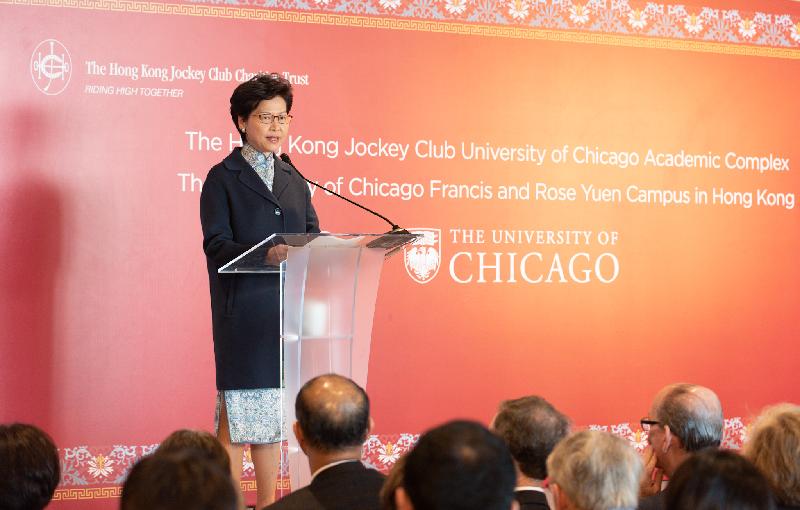
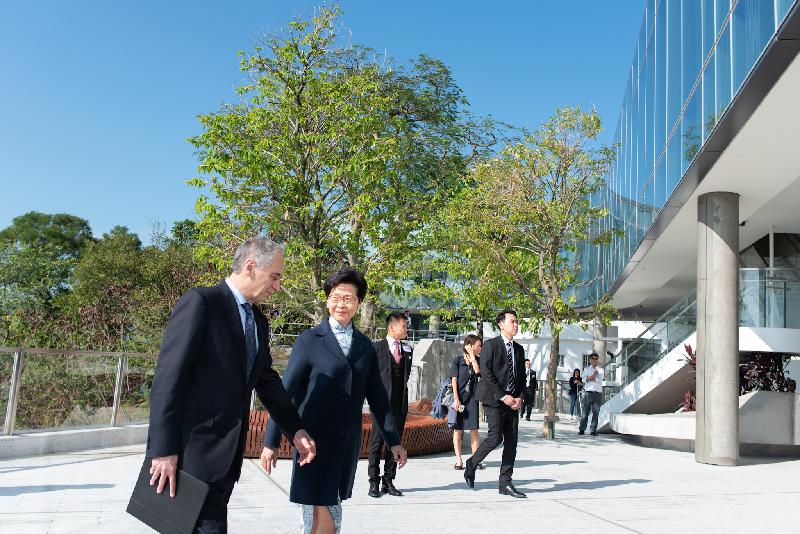
Speech by CE at University of Chicago Francis and Rose Yuen Campus in Hong Kong opening ceremony (English only) (with photos)

     Following is the speech by the Chief Executive, Mrs Carrie Lam, at the opening ceremony of the Hong Kong Jockey Club University of Chicago Academic Complex | The University of Chicago Francis and Rose Yuen Campus in Hong Kong today (November 30):

Professor Zimmer (President of the University of Chicago, Professor Robert Zimmer), Anthony (Chairman of the Hong Kong Jockey Club, Mr Anthony Chow), Francis, Rose (University Trustee of the University of Chicago and donor, Mr Francis Yuen, and his wife, Mrs Rose Yuen), distinguished guests, ladies and gentlemen,

     Good afternoon. It’s a great pleasure to join you today for the grand opening ceremony of the University of Chicago Francis and Rose Yuen Campus. I have been looking forward to this day since I officiated with Professor Zimmer at the naming ceremony of this centre in 2016 as the Chief Secretary for Administration. I am glad that, after two years, this magnificent new university centre, a US$75 million restoration and construction development, is now officially open.

     Higher education institutions are essential to creating the talent we need to succeed in the global economy. They are also essential in connecting people, institutions, business and governments. That is indeed the case today, as we formally welcome one of the world’s most prestigious universities, the University of Chicago, and the second-oldest business school in the United States, the University of Chicago Booth School of Business, to Hong Kong. The University of Chicago Francis and Rose Yuen Campus will serve as the Asian base for Chicago Booth’s flagship Executive Master of Business Administration (EMBA) Programme. It will, as well, be home to the University’s student abroad programme.

     I am pleased to note that the complex also features the Hong Kong Jockey Club Programme on Social Innovation. A partnership between the Hong Kong Jockey Club Charities Trust and the University of Chicago, this Programme offers a range of opportunities, including scholarships, social entrepreneurship workshops, and training for NGO professionals. Next week, I understand it will host the Global Launchpad, a four-month training programme designed to provide social entrepreneurs with the tools, coaching, and hands-on learning needed to effectively grow their early-stage ventures.

     Today’s opening underlines my Government’s commitment to strengthening Hong Kong’s status as a regional education hub, and to the internationalisation and diversification of our higher education sector. Our internationalisation measures include expanding quotas for non-local student admission, setting up a Government Scholarship Fund for outstanding local and international students, and allowing students from outside Hong Kong to stay here without limitation for up to 12 months after graduation. As for diversification, we encourage international institutions to set up in Hong Kong through such measures as our Land Grant Scheme, the Quality Enhancement Support Scheme and the Research Endowment Fund.

     We are glad to see that our efforts have started to bear fruit. This stunning new campus was made possible through our Land Grant Scheme, and will surely be a win-win for both Chicago Booth and for Hong Kong. For Chicago Booth, Hong Kong is an ideal choice for recruitment of quality students in the region given its excellent connectivity, diversity and vibrancy in the city. For Hong Kong, we are pleased to have another world-renowned EMBA programme provider in our city which would help establish Hong Kong as a quality education platform for both local and non-local students.

     Indeed, 130 EMBA students have enrolled in the two-year programme. They come largely from Hong Kong, but also from all over Asia as well, including India, Indonesia, Japan, Malaysia, Singapore and the Mainland. Mainland students are taking part, I should add, through a pilot scheme introduced with the support of the Ministry of Education of the Central People’s Government. In place since the 2017/18 academic year, it offers Mainland students placement in full-time locally accredited, non-local programmes here.

     The opening of this new campus also marks the successful completion of a heritage conservation and revitalisation project. The campus, which rises from two heritage buildings, is situated on a historically important site. From the late 1930s, it was part of the British Army’s Jubilee Battery, used in the defence of Hong Kong during the Second World War. Later, it became home to the Victoria Road Detention Centre, known as the “White House”. In 2010, during my term as Hong Kong’s Antiquities Authority in my then official capacity as the Secretary for Development, the compound was accorded Grade 3 historic building status by the Antiquities Advisory Board. And now, we have here a unique landmark reflecting Hong Kong’s architectural traditions and heritage.

     I understand the public is welcome to enjoy its beauty, and the history that surrounds it, through the Hong Kong Jockey Club University of Chicago Heritage Courtyard and Interpretation Centre. I learnt that guided tours and exhibitions will begin next week. The scenic trail running through and around the site, with its spectacular sea views, will also be open to the public.

     I would like to take this opportunity to join Professor Zimmer in paying tribute to the late Bing Thom, the lead architect of this project. Bing was also the designer of the Xiqu Centre in the West Kowloon Cultural District, which will be formally opened early next year. We are indebted to him for his work which has greatly enriched Hong Kong’s architectural scene.

     Finally, my thanks to the University of Chicago and Chicago Booth, to the Hong Kong Jockey Club, to Francis and Rose Yuen, and to many others who are involved in this wonderful project. Thank you for making this historic site come to a brilliant life. I wish the Centre all the best in its many endeavours.

     Thank you very much.

Photo  Photo  
read more

TD concerned about fatal traffic accident on Cheung Tsing Highway in Tsing Yi

     The Transport Department (TD) is very concerned about the fatal traffic accident involving a coach on Cheung Tsing Highway in Tsing Yi this morning (November 30).

     The TD has contacted the operator concerned to better understand the situation this morning. Meanwhile, the Commissioner for Transport has contacted the Public Omnibus Operators Association to express her concern, and a meeting between the TD and the Association will be arranged later to study and review the issue of operational safety of non-franchised buses.

     Regarding the cause of the accident, investigation by the Police is under way. According to the TD’s records, the coach involved was equipped with seats with high seat back and seatbelts. The latest vehicle examination was conducted in February this year and the coach passed the safety tests. read more