Tag Archives: China

image_pdfimage_print

Operator and manager of unlicensed guesthouses fined

     Two women were fined $3,000 and $8,000 at the Kowloon City Magistrates’ Courts today (December 12) for contravening the Hotel and Guesthouse Accommodation Ordinance.
      
     The courts heard that in April and May this year, officers of the Office of the Licensing Authority (OLA), the Home Affairs Department, inspected two suspected unlicensed guesthouses on Fuk Wa Street in Sham Shui Po. During the inspections, the OLA officers posed as lodgers and successfully rented rooms in these guesthouses on a daily basis.
      
     According to the OLA’s records, these guesthouses did not possess licences under the Ordinance on the days of inspection. The women responsible for operating and managing the premises were charged with contravening section 5(1) of the Ordinance.
      
     A department spokesman stressed that operating or managing an unlicensed guesthouse is a criminal offence and will lead to a criminal record. Upon conviction, the offender is liable to a maximum fine of $200,000 and two years’ imprisonment.
           
     The spokesman appealed to anyone with information about suspected unlicensed guesthouses to report it to the OLA through the hotline (Tel: 2881 7498), by email (hadlaenq@had.gov.hk), by fax (2504 5805) using the report form downloaded from the OLA website (www.hadla.gov.hk), or through the mobile application “Hong Kong Licensed Hotels and Guesthouses”. read more

LCQ20: Monitoring the administration of an estate for charitable purposes

     Following is a question by the Hon James To and a written reply by the Secretary for Justice, Ms Teresa Cheng, SC, in the Legislative Council today (December 12):

Question:
     
     At its meeting held on July 20, 2015, the Panel on Administration of Justice and Legal Services of this Council discussed the administration of the estate of the late Ms Nina Kung. In addition, the Government disclosed early this year that it had drawn up in May 2017 the latest draft of the administration scheme on using the estate for charitable purposes (the Scheme) and was awaiting a response from the Chinachem Charitable Foundation (the Foundation). In this connection, will the Government inform this Council:
 
(1) given that a government representative undertook at the aforesaid meeting to provide the Panel with the information on the arrangements for the interim administration of the estate and a breakdown of its properties insofar as it was allowed under the law, of the reasons why the Government has not yet provided such information, and whether it will do so immediately;
 
(2) whether it knows the following information on the estate: (i) the current total value, (ii) the respective total amounts of fees collected so far by the interim administrators of the estate, the managers recruited from outside and other persons involved in the administration of the estate (please specify), and (iii) the amounts of money used for charitable purposes in each of the past three years; and
 
(3) whether the discussions conducted between the Government and the Foundation on the Scheme have been concluded;
 
(i) if not, whether the Government has set a deadline; at what time the latest the Government will seek the Court’s directions to ensure that the Scheme will be confirmed and implemented expeditiously; whether it will consider taking measures to enhance the administration of the estate (e.g. appointing government officials to sit on the Board of Governors of the Foundation); and
 
(ii) if so, whether the Government has submitted the Scheme to the Court?

Reply:
 
President,
 
     A reply to the questions raised by the Hon James To in relation to the matters concerning the administration of the Estate of the late Mrs Nina Wang is as follows.
 
(1) and (2) At the meeting of the Panel on Administration of Justice and Legal Services on July 20, 2015, Members asked the Department of Justice (DoJ) to provide information on (a) arrangements approved by the Court concerning the interim administration of the Estate; (b) background, qualification and remuneration of each member of the Executive Committee (Exco) of the Chinachem Group; and (c) a list of the properties of the Estate. 
 
     The Secretary for Justice had explained in detail the arrangements approved by the Court concerning the interim administration of the Estate in her reply to the questions raised by the Hon Paul Tse at the meeting of the Legislative Council on January 31 early this year. Since December 10, 2007, the Estate has, pursuant to a Court order, been administered on an interim basis by independent interim administrators appointed with the sanction of the Court of First Instance. The current interim administrators are Mr Christopher Chan, Mr Jong Yat-kit and Mr Wong Tak-wai of PricewaterhouseCoopers.
 
     Being “officers of the Court”, the interim administrators owe a duty to the Court on matters relating to the interim administration of the Estate. The Court may also give directions to the interim administrators if and when necessary. The work of the interim administrators will continue to be monitored by the Court, including the consideration of the periodical reports and other relevant materials provided by them.
 
     DoJ has, at all times, been paying close attention to the administration of the Estate and has been in frequent contact with the interim administrators, including considering the periodical reports provided by the interim administrators, approaching the interim administrators to further understand matters relating to the interim administration of the Estate, requesting the interim administrators to take follow-up actions and provide reports as the circumstances require, assisting the Court in legal proceedings taken out by the interim administrators, and seeking directions from the Court in the course of interim administration as may be required.
 
     DoJ will continue to closely monitor the interim administrators’ work in managing and preserving the Estate and the litigation involving the Chinachem Group and the Chinachem Charitable Foundation (the Foundation), and take such follow-up actions as may be appropriate.
 
     DoJ has sought updates on the Estate from the parties concerned. With their consent, information which can be disclosed is set out below:
 
     The core assets of the Estate comprise the assets of the companies in the Chinachem Group with a net asset value of about HK$137 billion as at August 31, 2018 based on the relevant unaudited combined management accounts. According to the judgment of the Court of Final Appeal dated May 18, 2015, the Chinachem Group was valued in 2012 at over HK$82 billion.
 
     Since the Chinachem Group is not a listed company, after having sought the views from the concerned parties, apart from the net asset value disclosed above, it would not be appropriate for us to disclose the breakdown of its properties which contain sensitive and confidential information.
 
     The Chinachem Group is managed by its Exco and its current members are as follows (set out in the alphabetical order of the surnames in English (save for the interim administrators)):
 
(1)   Mr Chan Kam-por (Group’s Chief Financial Officer);
(2)   Mr Donald Choi (Group’s Chief Executive Officer);
(3)   Dr Kung Yan-sum (Chairman of Exco meetings);
(4)   Mr Derek Leung (Chief Treasury Officer, Head of Lands/Valuation of the Group);
(5)   Ms Liu Yuan-chun (Group’s Director of Human Resources);
(6)   Mr Ng Shung-mo (Group’s Head of Sales);
(7)   Mr Wong Hung-han (Deputy Head of Leasing and Chief Operating Officer of the Group);
(8)   Mr Osborn Edward (Representative of the interim administrators);
(9)   Mr Christopher Chan (one of the interim administrators); and
(10)  Mr Jong Yat-kit (one of the interim administrators).
 
     During the period from 2015 to 2018 (up till November 30, 2018), the Chinachem Group has in each year made donations for charity purpose to different charitable organisations and other entities in the amounts of about HK$9.7 million, HK$5 million, HK$4 million and HK$3 million respectively, the aggregate sum being over HK$22 million.
 
     As for the fees of the independent interim administrators, they have been prescribed by the Court in the Appointment Order and are subject to the Court’s scrutiny. As the relevant order was made at a hearing not open to public, it is inappropriate for DoJ to provide further details of such information in the absence of any order of the Court directing disclosure.
 
     DoJ and the Foundation have also been monitoring the fees charged by the interim administrators. Should DoJ and the Foundation consider the amount to be too high or unreasonable, an application may be made to the Court for taxation of the fees, in order to ensure that the interim administrators’ fees remain reasonable.
 
(3) By its judgment of May 18, 2015 concerning the Will of the late Mrs Nina Wang, the Court of Final Appeal held that the Foundation is to hold the Estate as a trustee rather than receiving it as an unconditional absolute gift. As the work in implementing the Will is still ongoing, the said judgment does not affect the current independent interim administrators’ discharge of the abovementioned duties to manage and preserve the Estate pursuant to the Court’s appointment until any further Court order. Therefore, at this stage the Estate has not been vested on the Foundation. DoJ will continue to pay close attention to the financial condition of the Foundation. 
 
     Since the handing down of the judgment of the Court of Final Appeal on May 18, 2015 (CFA Judgment), DoJ and the Foundation have had meetings and have been in communications on the contents of the proposed Scheme. In order to facilitate constructive and frank discussions, the parties have agreed that the details of such communications should be kept in confidence in the meantime. Meetings have been held to discuss specific areas of the proposed Scheme, including the establishment of the “supervisory” managing organisation, and that a draft Scheme has been prepared taking into account the clauses of the 2002 Will and the relevant guidance contained in the CFA Judgment.

     DoJ and the Foundation are actively discussing the content of the draft Scheme with a view to reaching consensus as soon as practicable. We anticipate that DoJ may make an application to the Court for directions concerning the Scheme by the first quarter of 2019, if necessary.
 
     In addition, DoJ will continue to liaise with the interim administrators and request relevant information when appropriate on the detailed arrangements for the implementation of the Will. read more

LCQ12: Mainland “overage children” of HK residents to settle in HK through One-way Permit scheme

     Following is a question by the Hon Leung Yiu-chung and a written reply by the Secretary for Security, Mr John Lee, in the Legislative Council today (December 12):

Question:

     At present, the daily quota for mainland residents coming to Hong Kong for settlement on Permits for Proceeding to Hong Kong and Macao (One-way Permits (OWPs)) is 150. Since April 1, 2011, the Mainland authorities have allowed eligible mainland “overage children” of Hong Kong residents (i.e. mainland residents who were under the age of 14 when their natural fathers or mothers obtained their first Hong Kong identity cards on or before November 1, 2001) to apply for OWPs for settlement in Hong Kong for reunion with their natural parents. Regarding the issuance of OWPs to mainland children of Hong Kong residents, will the Government inform this Council:

(1) as the Government told this Council in 2005 and 2009 respectively that the Security Bureau had on occasions relayed the views of the public to the Mainland authorities for their consideration of setting up a channel under the OWP system for mainland adult children of Hong Kong residents to settle in Hong Kong, of the progress of the matter;

(2) whether it will urge the Mainland authorities to relax the eligibility criteria for OWP to allow mainland “elder overage children” of Hong Kong residents (i.e. mainland children of Hong Kong residents who were over the age of 14 when their natural fathers or mothers obtained their first Hong Kong identity cards on or before November 1, 2001, who are thus ineligible to apply for OWPs in the capacity of overage children) to settle in Hong Kong for reunion with their natural parents; if so, of the details; if not, the reasons for that;

(3) whether it knows (i) the number of OWP applications approved by the Mainland authorities and (ii) unused OWP quota, in each year since April 2011; and

(4) given the former Secretary for Security’s remark that the Government has reached a consensus with the Mainland authorities to make use of the unused OWP quota to handle the OWP applications made by overage children, whether the Government knows the respective numbers of OWP applications made by overage children (i) received and (ii) approved by making use of the unused OWP quota by the Mainland authorities, in each year since April 2011; whether it will study with the Mainland authorities the use of unused OWP quota to handle the OWP applications made by elder overage children; if so, of the details; if not, the reasons for that?

Reply:

President,

     It is stipulated in Article 22 of the Basic Law that for entry into the Hong Kong Special Administrative Region (HKSAR), people from other parts of China must apply for approval. The provisions of this Article, in accordance with the interpretation by the Standing Committee of the National People’s Congress in 1999, mean that Mainland residents who wish to enter Hong Kong for whatever reason, must apply to the relevant authorities of their residential districts for approval in accordance with the relevant national laws and administrative regulations, and must hold valid documents issued by the relevant authorities. Mainland residents who wish to settle in Hong Kong for family reunion must apply for Permits for Proceeding to Hong Kong and Macao, commonly known as One-way Permits (OWPs), from the exit and entry administration offices of the public security authority at the places of their household registration in the Mainland. The application, approval and issuance of OWPs fall within the remit of the Mainland authorities. The HKSAR Government will take account of the overall interest of the community and will exchange views on matters relating to the overall OWP scheme with the Mainland authorities from time to time, and reflect to them the aspirations of the society.

     The reply to the question raised by the Hon Leung is as follows:

(1) In response to the request of Hong Kong residents and their Mainland “overage children” for reunion in Hong Kong, starting from April 1, 2011, the Mainland authorities allow eligible Mainland “overage children” of Hong Kong residents (i.e. Mainland residents who were below the age of 14 when their natural fathers or mothers, on or before November 1, 2001, obtained their first Hong Kong identity card and whose natural fathers or mothers still resided in Hong Kong on April 1, 2011), to apply for OWP to join their natural fathers or mothers in Hong Kong. The phased submission of applications by “overage children” to the Mainland authorities will be scheduled chronologically according to the order in which their natural fathers or mothers obtained their Hong Kong identity cards. At present, all eligible Mainland “overage children” of Hong Kong residents may submit applications to come to Hong Kong for reunion with their natural parents, including those whose natural fathers or mothers obtained their first Hong Kong identity cards on or before November 1, 2001. 

(3) Since the implementation of the arrangements for “overage children” to apply for entry and settlement in Hong Kong, as at the end of October 2018, the Mainland authorities have received nearly 58 000 OWP applications from overage children, of which initial assessment of over 56 000 has completed. According to the information provided by the Mainland authorities, over 51 000 OWP applications were approved. It is learnt that among those people with OWP approved, over 90 per cent of them have arrived in Hong Kong. The numbers of holders of OWPs entering Hong Kong from April 2011 to the end of October 2018 are set out in the table below. The Immigration Department does not maintain other statistics with breakdown mentioned in the question.
 

Year Number of people
(including “overage children”)
2011 (since April) 34 700
2012 54 646
2013 45 031
2014 40 496
2015 38 338
2016 57 387
2017 46 971
2018 (as at the end of October) 35 203
Total 352 772
 
     The overall usage of OWP quota depends on various factors, mainly including the number of Mainland-Hong Kong marriages and the number of other eligible applicants, i.e. the Mainland spouse and minor children of holders of OWPs who have entered Hong Kong still awaiting the approval for settlement in Hong Kong; elderly persons with no one to depend on in the Mainland applying to come to join their children in Hong Kong; and Mainland children applying to come to take care of their elderly parents with no one to depend on in Hong Kong, etc.
  
(2) and (4) The HKSAR Government has noted the views in the community concerning Mainland children of Hong Kong residents who are not eligible to apply for OWP as “overage children”, including the request from the Mainland residents who has attained the age of 14 when their natural fathers or mothers obtained their Hong Kong identity cards (commonly known as “elder overage children”). The application, approval and issuance of OWPs, Two-way Permits and exit endorsements fall within the remit of the relevant authorities in the Mainland. It is learned that at present the Mainland authorities do not have any plans to change the the existing regulations on the application criteria for “overage children”. The HKSAR Government attaches great importance to the views of various sectors of the society concerning Mainland residents settling in Hong Kong through the OWP Scheme. The Government will take account into the interests of the community and will continue to exchange views with the Mainland authorities to convey the aspirations of the society. read more

Hong Kong Customs seizes suspected methamphetamine (with photo)

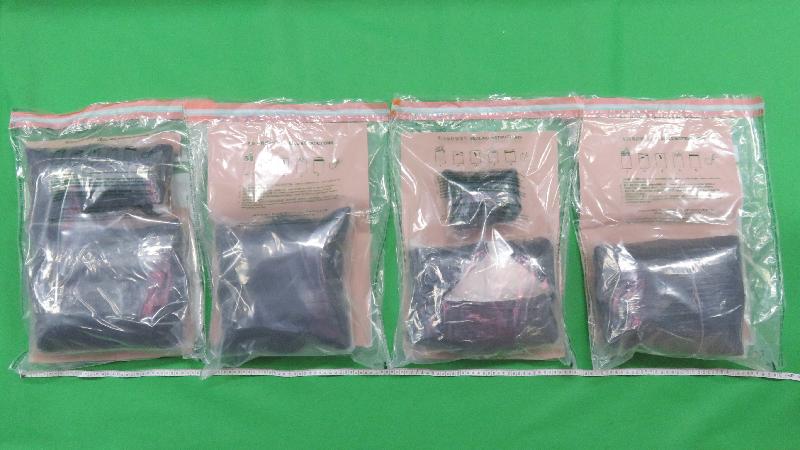
     Hong Kong Customs seized a total of about 11.7 kilograms of suspected methamphetamine with an estimated market value of about $5.6 million at Hong Kong International Airport on December 5 and December 6.

     Customs officers inspected two air mail parcels from the United States of America on December 5 and December 6 and found the batch of suspected methamphetamine wrapped in clothes.

     After follow-up investigation, Customs officers yesterday (December 11) arrested a man suspected to be in connection with the case in Tsim Sha Tsui.

     The arrested man, aged 30, has been charged with two counts of trafficking in a dangerous drug. He will appear at Kowloon City Magistrates’ Courts tomorrow (December 13).

     Under the Dangerous Drugs Ordinance, trafficking in a dangerous drug is a serious offence. The maximum penalty upon conviction is a fine of $5 million and life imprisonment.

     Members of the public may report any suspected drug trafficking activities to the Customs 24-hour hotline 2545 6182 or its dedicated crime-reporting email account (crimereport@customs.gov.hk).

Photo  
read more