Tag Archives: China

image_pdfimage_print

LCQ18: Promoting digital policies to enhance service quality

     Following is a question by the Hon Sunny Tan and a written reply by the Secretary for Innovation, Technology and Industry, Professor Sun Dong, in the Legislative Council today (October 23):
 
Question:
 
     In July this year, the Efficiency Office (EffO) and the Office of the Government Chief Information Officer merged to become the Digital Policy Office (DPO). Through the promotion of data-driven, people-centric and outcome-based digital policies, DPO enhances the efficiency and service quality of the Government to deliver better services to the citizens and the business sectors. In this connection, will the Government inform this Council:
 
(1) given that the provision of consultancy services to bureaux and departments for business process re-engineering, organisation restructuring, performance measurement, knowledge management and change management is one of EffO’s key non-digital policy areas of work, of the arrangements for such work following the establishment of DPO;
 
(2) whether it will consider having dedicated higher-level leadership to spearhead a sound top-level design, encompassing business process re-engineering, organisation restructuring and performance measurement, etc., so as to bring convenience and benefits to the people on a par with the Mainland’s “one-stop handling” inter-‍departmental approach, thereby more effectively enhancing the efficiency and service performance of Hong Kong’s public administration in dealing with members of the public and enterprises; if so, of the details; if not, the reasons for that; and
 
(3) whether it has plans to make better use of survey reports and recommendations from relevant departments (e.g. by linking them with relevant information from the Chief Executive’s Policy Unit) to assist in the proper conduct of internal studies to examine policy issues; if so, of the details; if not, the reasons for that?
 
Reply:
 
President,
 
     Our consolidated reply to the three-part question is as follows:
 
     The Digital Policy Office (DPO) established in July this year is a top-level design announced by the Chief Executive in the 2023 Policy Address. By merging the Office of the Government Chief Information Officer (OGCIO) and the Efficiency Office (EffO), the DPO is tasked to formulate policies and measures related to digital government, data governance and information technology, and accelerate the development of digital government through a top-down approach, thereby improving governance and efficacy of the administration.
 
     Following the re-organisation, the DPO consolidates the expertise and experience of the OGCIO and the EffO to provide comprehensive advice and consultancy services to various policy bureaux and departments (B/Ds) in areas such as design thinking, digital technology application, and innovation and technology project management, with a view to accelerating the development of digital government. As such, the non-digital technology related work of the former EffO, including business process re-engineering, organisation re-structuring, performance measurement, knowledge management and change management, can be further strengthened through the DPO’s digital policies and digital technology solutions.
 
     Specifically, one of the priority tasks of the DPO is to integrate the digital technologies and services of the OGCIO and the professional knowledge and talents of the EffO in promoting business efficiency, so as to steer various B/Ds in leveraging advanced technologies (including big data analytics, artificial intelligence, geospatial analysis, data dashboards, etc.) to improve decision-making and strategic planning; and to continuously enhance the government’s central data platforms and services (including Government Cloud Infrastructure Services, Big Data Analytics Platform, Shared Blockchain Platform, “iAM Smart”, Consented Data Exchange Gateway (CDEG)) to support various B/Ds in developing and implementing more data-driven, people-centric, outcome-based and efficient e-government services that bring convenience and benefit to the public and businesses. These include:

(1) To drive B/Ds to achieve service integration through “iAM Smart” to optimise user experience, with a view to achieving full adoption of “iAM Smart” by all e-government services by the end of 2025 to achieve “single portal for e-government services”;
 
(2) To promote the use of the CDEG by various B/Ds to facilitate data exchange between B/Ds, enabling citizens to authorise government departments to use personal information stored in other departments, thereby obviating the need for repetitive submission of the same information and enhancing efficiency of government services;
 
(3) To develop the Digital Corporate Identity Platform to facilitate corporations in Hong Kong to undergo corporate identity authentication and corporate signature verification processes when they use e-government services or conduct online business transactions in a secure, convenient and efficient manner, hence simplifying the complicated procedures and accelerating their digital transformation; and
 
(4) To continue promoting the open data policy and formulate data governance standards to facilitate the collection, analysis, sharing and application of data, and to compile departmental data catalogues to promote the opening up and sharing of data among B/Ds.
 
     The DPO will continue to play its top-level role in collaborating and co-ordinating with relevant B/Ds and rendering advice on service improvement of departments; promoting data-driven, people-centric and outcome-based digital government services within the government; and accelerating the development of digital government, thereby enhancing government efficiency and service quality and bringing more benefits to citizens and the business sectors. read more

LCQ12: Handling of complaints about food consumed at food premises

     Following is a question by the Hon Chan Kin-por and a written reply by the Secretary for Environment and Ecology, Mr Tse Chin-wan, in the Legislative Council today (October 23):

Question:

     Members of the public may lodge a complaint to the Food and Environmental Hygiene Department (FEHD) by calling its 24-hour hotline if they find the food consumed at a food premises is unsanitary or contains foreign substances. The complaint will be handled by duty FEHD health inspectors. It is learnt that as health inspectors take time to arrive at the food premises concerned, some health inspectors will advise those complainants who are unable to wait at the food premises to properly keep the food samples for collection by the FEHD officers at a later time. There are views that such practice may affect the laboratory test results. In this connection, will the Government inform this Council:

(1) of the number of complaint cases about unsanitary food consumed at food premises received through the aforesaid hotline in the past three years, with a breakdown by type of complaints;

(2) among the complaint cases mentioned in (1), of the respective percentages of cases in which food samples were collected by duty health inspectors on-site and kept by the complainants themselves;

(3) among the complaint cases mentioned in (1), of the number of cases in which the offenders were prosecuted;

(4) of the existing staffing establishment of health inspectors and the average time they need to arrive at the scene to collect samples of problem food; and

(5) whether it will conduct a comprehensive review of the workflow of handling complaints about unsanitary food consumed at food premises to ensure fairness of investigation and to protect the rights and interests of both the food premises and the customers; if so, of the details; if not, the reasons for that?

Reply:

President,

     The reply to the question raised by the Hon Chan Kin-por is as follows:

     The Food and Environmental Hygiene Department (FEHD) attaches great importance to food safety and the hygienic conditions of food premises. The FEHD conducts regular inspections of food premises to check their hygienic conditions (food storage and handling, condition of premises, etc.) to ensure that licensees operate in accordance with regulations, and provides relevant health education for the trade. Members of the public who wish to lodge complaints regarding suspected unhygienic food or presence of foreign substances in food from restaurants may contact FEHD 24-hour hotline or FEHD offices. Upon receiving the complaint, the health inspector on duty will contact the complainant as soon as possible and follow up with investigation at the scene.

     If the complainant is unable or unwilling to wait for the health inspector to arrive at the restaurant, the health inspector will, after gaining an initial understanding of the actual situation, provide guidance to the complainant on how to keep the exhibit properly, including how to keep the exhibit so as to maintain its condition. The FEHD officers will conduct a thorough investigation on the complaint, including meeting with the person in charge of the restaurant under complaint and inspecting the hygienic conditions of the premises concerned, and sending the exhibit for examination or testing depending on the circumstances. The Centre for Food Safety will also offer advice on the examination or testing parameters according to the circumstances and needs of the case.

     To ensure that every complaint cases is handled in a fair manner, FEHD officers will conduct a detailed review of each case taking into account various factors comprehensively. In addition to the examination or analysis results, the prosecution decision will also consider whether the exhibit was handled and kept properly, the conclusion from inspection of the premises’ environment and statements and information provided by staff of the restaurant under complaint etc.

(1) A breakdown on the number of complaints about unhygienic food etc. handled by the FEHD by category in the past three years is set out below:
 

Type of complaints Number
2021 2022 2023
Unwholesome food 2 055 1 679 2 937
Foreign substances in food (e.g. body parts of insects or excreta of animals) 1 642 1 635 1 976
Deteriorated or mouldy food 649 577 804
Others (e.g. chemicals in food or food improperly handled) 914 943 1 186
Total 5 260 4 834 6 903

(2) The FEHD does not keep the relevant statistics.

(3) The FEHD investigates complaints regarding unhygienic food from restaurants etc. If there is sufficient evidence, the Department will initiate prosecution against the sellers of such food in accordance to the Public Health and Municipal Services Ordinance (Cap. 132) and its subsidiary legislation. However, in most cases, it is often challenging to obtain sufficient evidence to initiate prosecution, as the complainants had expressed unwillingness to testify in court. Over the past three years (i.e. 2021-2023), the number of convictions for violations of the relevant legislation was 82, 70 and 81 respectively.

     Even in cases where there is insufficient evidence for prosecution (e.g. the complainant is unwilling to testify in court or complete a statement of food complaint), the FEHD will still conduct inspections of the premises concerned. If any irregularities are found during inspections, the FEHD will take appropriate follow-up actions.

(4) The FEHD maintains Health Inspectors on duty at various times to respond to public inquiries or requests for assistance. During office hours, one to two Health Inspectors are on duty at each of the FEHD’s 19 District Environmental Hygiene Offices across Hong Kong to manage routine work and food complaints in their respective districts. Outside office hours, one to two Health Inspectors are on duty at each of the three regional duty rooms in Hong Kong, Kowloon and the New Territories to handle enquiries or requests for assistance in the region. Upon receipt of any complaint regarding unhygienic food or related issues, the duty officer will process it as soon as possible. The FEHD does not keep the statistics on the time taken by officers to collect exhibit at the scene.

(5) The FEHD reviews its workflow from time to time. The Environmental Hygiene Offices in various districts will continue to investigate complaint cases expeditiously according to the resources available and the actual situation, and handle each complaint case in a fair and impartial manner to safeguard the interests of both restaurants and diners. read more

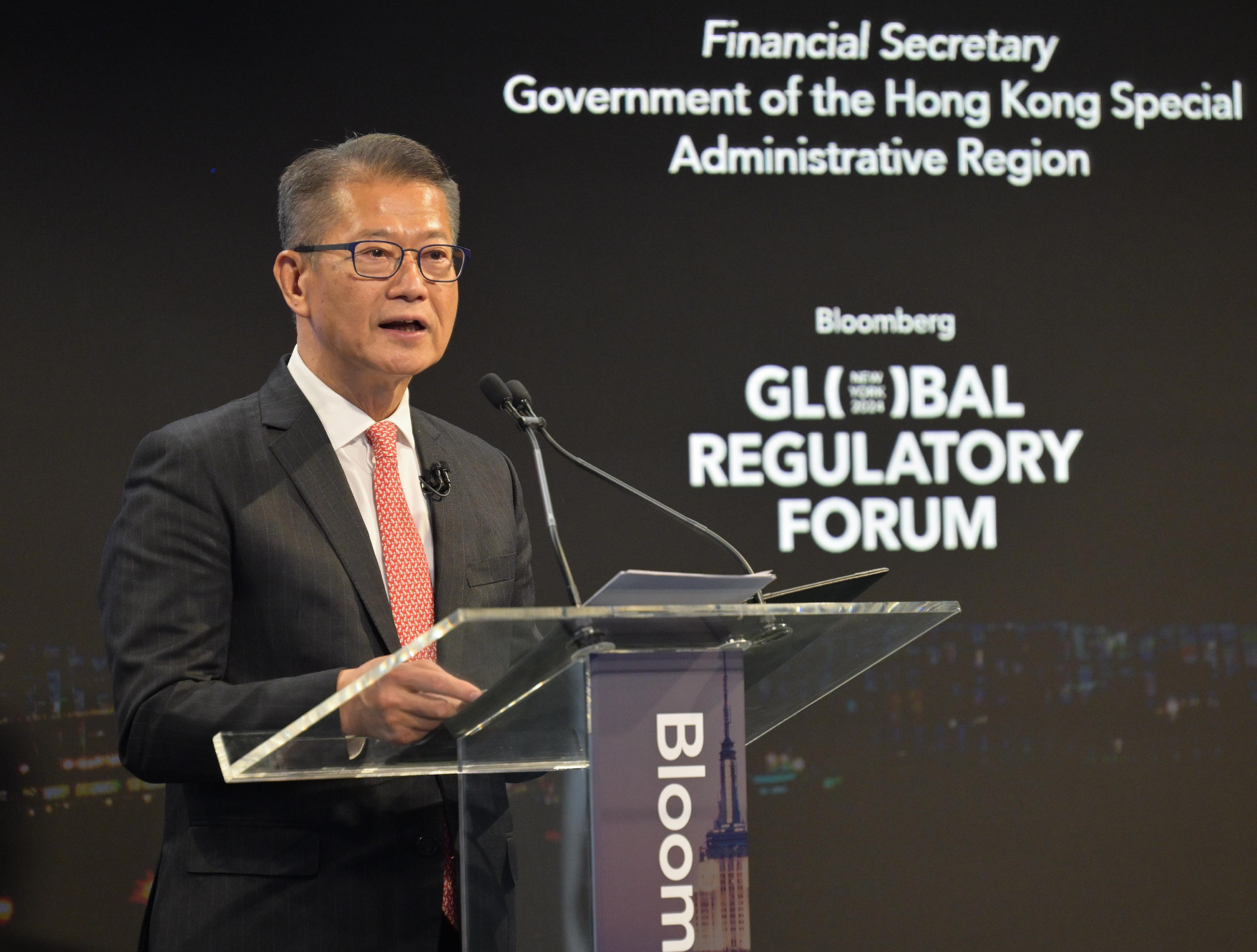
FS attends Bloomberg Global Regulatory Forum in New York (with photos/video)

     The Financial Secretary, Mr Paul Chan, began his visit to New York, the United States, yesterday (October 22, New York time).
      
     In the afternoon, Mr Chan attended the Global Regulatory Forum hosted by Bloomberg, delivering a keynote speech on how to build a future-proof financial system. He stated that despite facing various challenges in recent years, Hong Kong’s economic and financial fundamentals remain strong and resilient. Data, as well as international rankings and assessments, have shown that Hong Kong continues to play an important role in the global financial market and serve as a leading international financial centre in Asia, with a degree of economic freedom and competitiveness among the best in the world. Recent inflows of investment from United States and European investors have also reflected their confidence in Hong Kong. Mr Chan also noted that with the long-term adherence to the “one country, two systems” arrangement, and the country’s pursuit of high-level opening-up, Hong Kong’s unique advantages will only be more evident, and the city will better fulfil its role as a “super connector.”
      
     In his speech, Mr Chan also elaborated on Hong Kong’s robust financial regulation. He pointed out that as a small and fully open economy, Hong Kong has learned from past experience to respond to potential or even unpredictable external shocks and market volatility. This has been achieved through identifying and addressing systemic weaknesses, establishing a cross-sector, co-ordinated and round-the-clock risk detection and monitoring system, and building strong buffers to respond to various risks and challenges.
      
     Mr Chan emphasised that the ultimate goal of financial regulation is to promote healthy and sustainable market development. Therefore, Hong Kong’s financial regulators take on dual roles as both regulators and market enablers.  This requires them to establish an agile and forward-looking regulatory regime, respond swiftly to market changes, and embrace technological innovation, with a view to creating the conditions for a thriving market and promote the long-term development of the financial system.
      
     Finally, Mr Chan shared two key future development directions for Hong Kong: continuing to deepen the Connect Schemes and strengthen the links and regulatory co-operation with Mainland and global capital markets; and embracing innovation, which includes enabling the responsible and sustainable development of digital assets.
      
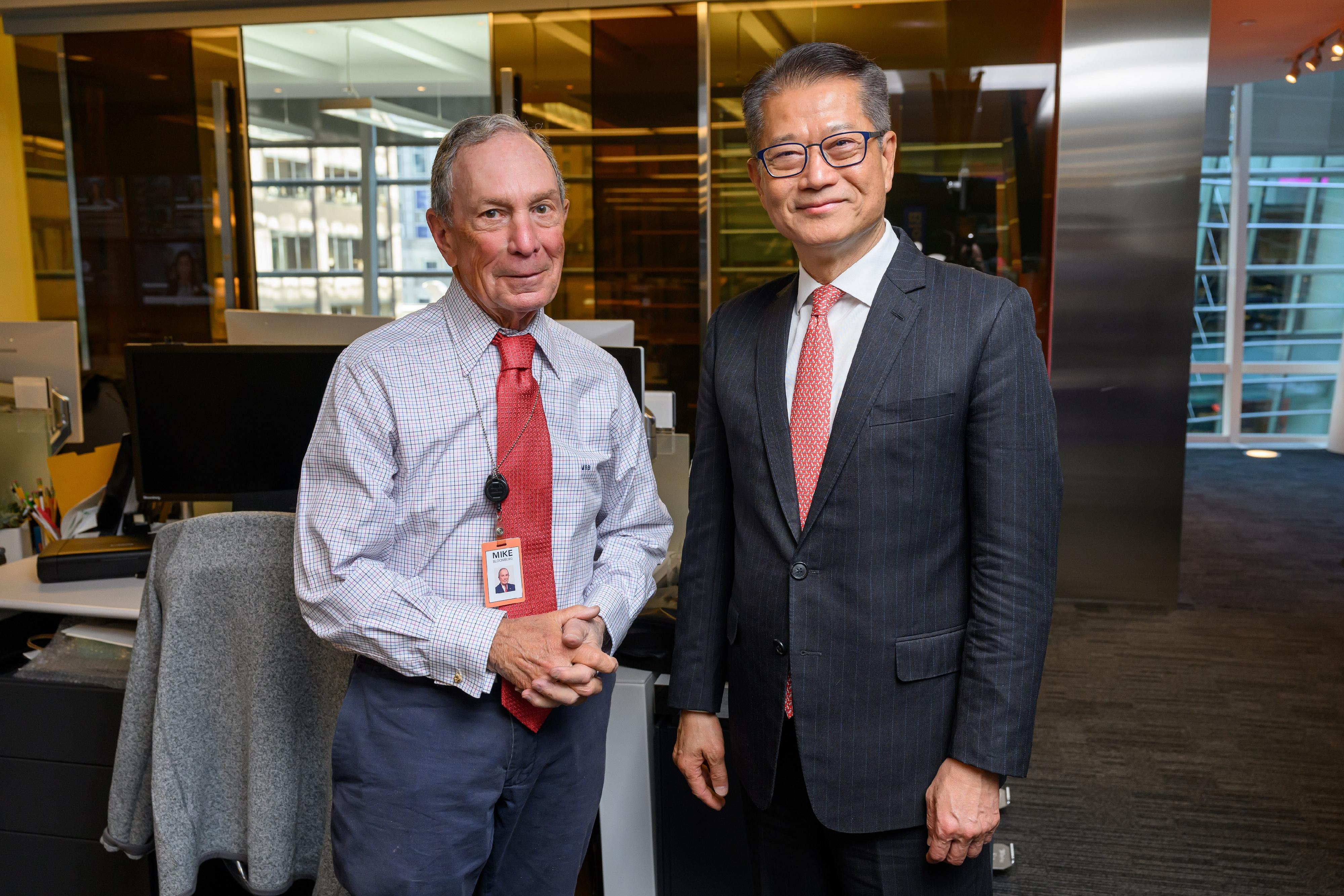
     Before attending the forum, Mr Chan met with the Founder of Bloomberg L.P. and Bloomberg Philanthropies, Mr Michael Bloomberg, to exchange views on issues of mutual concern.
      
     Mr Chan will continue his visit in New York today (October 23, New York time).

Photo  Photo  Photo  Photo  
read more

LCQ16: Enhanced Supplementary Labour Scheme

     â€‹Following is a question by the Hon Chau Siu-chung and a written reply by the Secretary for Labour and Welfare, Mr Chris Sun, in the Legislative Council today (October 23):

Question:
 
     On September 4 last year, the Government launched the Enhanced Supplementary Labour Scheme (ESLS) to suspend the general exclusion of the 26 job categories as well as unskilled or low-skilled posts from labour importation under the Supplementary Labour Scheme. However, many local frontline workers engaged in the relevant sectors have indicated that they are worried that the ESLS may affect their remuneration packages and even employment opportunities. In this connection, will the Government inform this Council:

(1) since the launch of the ESLS, of the respective numbers of (a) the applications received (and the imported workers involved) and (b) ‍the applications approved (and the imported workers involved) by the Government, as well as (c) the imported workers who have arrived to work in Hong Kong, together with a breakdown by (i) the aforesaid 26 job categories, (ii) unskilled or low-skilled posts (including cleaners, security guards and room attendants), and (iii) ‍other posts (set out in Tables 1 to 3 respectively);

Table 1
 

(i) (a) (b) (c)
1.      
……      
26.      
Total      

Table 2
 
(ii) (a) (b) (c)
Cleaners      
Security guards      
Room attendants      
……      
Total      

Table 3
 
(iii) (a) (b) (c)
1.      
……      
Total      

(2) since the launch of the ESLS, of the number of labour importation applications rejected by the authorities, and the main reasons for rejecting such applications;

(3) as it has been reported that some employers have used “bogus recruitment” (e.g. placing job advertisements to attract applicants and then rejecting their job applications on the ground that they have failed to meet the requirements) to create the illusion of having recruitment difficulties, so as to apply to the Government for importation of labour, since the launch of the ESLS, of the respective numbers of (i) suspected “bogus recruitment” cases discovered by the Government after taking the initiative to investigate employers applying for labour importation, and (ii) complaints about suspected “bogus recruitment” received by the Government;
 
(4) whether the authorities have conducted monthly surveys and analyses on the salaries and benefits as well as the employment situation of local workers engaged in the job categories approved for labour importation since the launch of the ESLS; if so, of the details, including whether any reduction in the salaries, benefits as well as employment opportunities of local workers in the relevant sectors had been found; if not, the reasons for that;
 
(5) whether the Government has received views or complaints from imported workers who have already been working in Hong Kong about their labour rights being undermined since the launch of the ESLS; if so, of the details; and
 
(6) whether it will consider reviewing the ESLS expeditiously and suspending the arrangement for the importation of labour for the aforesaid 26 job categories as well as unskilled or low-skilled posts, so as to adequately safeguard the remuneration packages and employment opportunities of local workers in the relevant sectors?
 
Reply:

President,
      
     To cope with the challenges brought about by manpower shortage, the Government has enhanced the mechanism for importation of workers. Apart from launching sector-specific labour importation schemes for the construction sector, transport sector, and residential care homes for the elderly and residential care homes for persons with disabilities, the Labour Department (LD) has also implemented the Enhanced Supplementary Labour Scheme (ESLS) since September 4, 2023, to enhance the coverage and operation of the previous Supplementary Labour Scheme (SLS), including suspending the general exclusion of the 26 job categories as well as unskilled or low-skilled posts from labour importation for two years.
      
     The reply to the Hon Chau’s questions is as follows:
     
(1) From September 4, 2023, to September 30, 2024, 7 448 applications seeking to import 66 230 workers were received under the ESLS. During the same period, 3 886 applications involving 28 818 quotas for importation of workers were approved. A breakdown of the numbers of imported workers applied for and approved by the 26 job categories, unskilled/ low-skilled posts and other posts is at Annex.
 
     Employers approved to import workers under the ESLS are required to arrange for their prospective imported workers to submit visa/entry permit applications to the Immigration Department within the periods specified in the approval-in-principle letters (generally within six months from the issue dates of the said letters). The arrival time of imported workers depends on the progress of employers’ handling of relevant procedures. The LD does not maintain the number of imported workers arriving and working in Hong Kong under the ESLS.

(2) Since the launch of the ESLS, as at September 30 this year, the LD refused 34 applications mainly because the concerned applications had failed to meet all the requirements of the ESLS, such as the manning ratio of the number of imported workers to the number of local employees.

(3) To safeguard employment priority for local workers, applicant employers of the ESLS must undertake a four-week local recruitment exercise and accord priority to employing suitable local workers to fill the vacancies. The LD conducts job matching for the vacancies and refers local job seekers to employers for interviews, and widely disseminates vacancy information to members of the Labour Advisory Board, relevant trade unions and training institutions to facilitate their referrals of suitable local job seekers for application. As required under the ESLS, the employment terms of local workers recruited through all channels during the local recruitment period for the posts applied (including the entry requirements, monthly salary and hours of work, etc.) must be no less favourable than the recruitment terms agreed by the LD.

     Upon completion of the above recruitment procedures, employers shall report the results to the LD. The LD will contact each of the local job seekers who is not employed by the employers, and assess whether the employers have sincerity in recruiting local workers. If there is evidence showing that an employer has violated the requirements of local recruitment (such as employing local workers with a monthly salary lower than that agreed by the LD) or refused to employ qualified local job seekers without reasonable reasons during the local recruitment period, the LD will terminate the processing of the application submitted by that employer for importation of labour. Administrative sanction will also be imposed on the concerned employer whereby any ESLS application submitted by the employer in the following year will not be processed. Since the implementation of the ESLS, the LD has not found any employer suspected of conducting “bogus recruitment” or received any relevant complaint from job seekers.

(4) The Census and Statistics Department regularly conducts different surveys, such as the General Household Survey, the Labour Earnings Survey, and the Annual Earnings and Hours Survey, to gather and analyse statistics about the employment situation and earnings overview of local employees. The LD closely monitors the employment market situation and the relevant statistics.

(5) Since the launch of the ESLS, as at September 30 this year, the LD received 62 complaints involving workers imported under the SLS/ESLS. The complaint items mainly involved wages, arrangements for working hours, etc.

(6) The LD has been closely monitoring the implementation of the ESLS, and will review the ESLS prior to the lapse of its two-year implementation period.

     â€‹The LD will continue to keep in view the applications for importation of labour in different industries. On the premise of upholding employment priority for local workers, employers are allowed to import workers to alleviate the manpower shortage and foster the economic development of Hong Kong. The Government will also strengthen the training and recruitment services to underpin employment priority for local workers. read more

S for Housing expresses sorrow over passing of Mr Michael Suen

     The Secretary for Housing, Ms Winnie Ho, today (October 23) expressed condolences over the passing of the former Secretary for Housing, Planning and Lands and former Chairman of the Hong Kong Housing Authority (HA), Mr Michael Suen, and extended her sincere condolences to his family.

     Mr Suen served as the Secretary for Housing, Planning and Lands since 2002 and was appointed as the Chairman of the HA since 2003. Both terms ended in 2007.

     Ms Ho said, “Mr Suen’s connections with housing affairs began very early when he joined the HA upon its establishment in 1973 as its first Secretary General. Later in 2002, he took up an important role in housing policies again as the Secretary for Housing, Planning and Lands until 2007.

     “I am saddened by Mr Suen’s passing and would like to extend my deep condolences to his family on behalf of my colleagues in the Housing Bureau, HA and Housing Department.” read more