Tag Archives: China

image_pdfimage_print

LCQ4: Civil service lifeguards under the Leisure and Cultural Services Department

     Following is a question by the Hon Ho Kai-ming and a reply by the Secretary for Home Affairs, Mr Lau Kong-wah, in the Legislative Council today (January 16):
      
Question:
      
     Regarding the recruitment of civil service lifeguards under the Leisure and Cultural Services Department (LCSD) as well as the induction training and remuneration for them, will the Government inform this Council:
 
(1) as LCSD introduced last month a new test item under which applicants for the post of civil service lifeguard must be able to skin-dive to a depth of two metres for carrying out lifesaving duties, but lifeguards may need to skin-dive to a depth of more than two metres when performing lifesaving work, of the criteria adopted by LCSD for setting the requirements of the recruitment interview and trade test for civil service lifeguards;
 
(2) whether LCSD will require that civil service lifeguards must have completed all the induction training programmes before they are arranged to perform lifesaving work, so as to safeguard the life safety of swimmers; and
 
(3) given that the duties of civil service lifeguards include cleaning up oil spill at beaches as well as the faeces or vomit found in swimming pools, whether the Government will consider providing them with a hardship allowance for obnoxious duties; if so, of the details; if not, the reasons for that?
 
Reply:

President,
 
     To protect the safety of swimmers, the Leisure and Cultural Services Department (LCSD) employs lifeguards to perform lookout, patrol, lifesaving and first aid duties etc. at its venues.  As at August 1, 2018, there were 1,959 lifeguards in LCSD comprising civil service lifeguards and non-civil service contract (NCSC) seasonal lifeguards.
      
     My reply to the three parts of the Hon Ho’s question is as follows:
 
(1) LCSD requires that all serving and newly recruited lifeguards possess the Lifeguard Award issued by the Hong Kong Life Saving Society (HKLSS).  HKLSS is the only body recognised by the International Life Saving Federation for assessing and awarding lifeguard qualifications in Hong Kong. The entry requirements for NCSC seasonal lifeguards in LCSD are the possession of the Beach Lifeguard Award or Pool Lifeguard Award issued or reassessed by HKLSS within the past three years; whereas the entry requirements for civil service lifeguards include the possession of the Beach Lifeguard Award and Pool Lifeguard Award issued by HKLSS, as well as possession of a valid certificate from the St. John Ambulance Association, Hong Kong Red Cross or Auxiliary Medical Service. Applicants for the posts of civil service lifeguard and NCSC seasonal lifeguard also have to pass the selection interview and trade test. Other recruitment procedures, including integrity checking and medical examination etc., are also applicable.
 
     The recruitment examination for civil service lifeguards conducted by LCSD consists of a selection interview and trade test, which aim to select the most suitable candidates from qualified applicants for the posts concerned having regard to the applicant’s abilities, performance, character, physical competence and skills of lifesaving and first aid.
 
     Before the launching of a new round of recruitment exercise for civil service lifeguards, LCSD will review the contents of the selection interview and trade test in the light of various factors, such as job requirements of the post, expected attributes of the suitable candidates, manpower resources, time and venue required for selection interview and trade test and their effectiveness, etc, and make appropriate changes. For instance, while candidates were only required to perform cross chest tow in previous rescue tests, candidates will be required, in the new round of recruitment exercise, to skin dive to the pool bottom at a depth of approximately two metres to search for a drowning manikin and then save it using cross chest tow in order to have a more comprehensive assessment of the candidates. The new rescue test is included taking into account of the actual operational needs since most of the swimming pools of LCSD have a water depth of two metres or less. 
 
     In addition, the selection board will assess the candidates’ performance in the selection interview and trade test with reference to a set of objective, fair and measurable assessment criteria.
 
(2) All employed lifeguards had passed the assessments administered by professional bodies concerned and possessed recognised lifesaving qualifications. They have also passed LCSD’s recruitment examination. To enable the new recruits to gain an understanding of lifesaving practice as soon as possible, LCSD provides them with a series of induction programme. The department has reviewed the design and arrangements of the induction programme for lifeguards. Starting from 2019, LCSD will arrange for newly employed civil service lifeguards and NCSC lifeguards on long-term employment to complete part of the induction programme before assuming duties, which include, introductory practical training, general training, and courses on advanced skills of skin diving rescue, and require them to pass a five-metre depth skin diving test. Furthermore, LCSD lifeguards will undergo enhanced training by means of regular drills at swimming pools/beaches, and through which they should possess sufficient skin diving skills and be physically competent to carry out search and rescue operation in deep water at swimming pools/beaches, including deep diving pools.
 
(3)  According to the Civil Service Regulations (the Regulations), “Hardship Allowances” is one of the categories under Job-Related Allowances (JRAs). Departments and their respective bureaux shall comply with the Regulations and the governing principles of JRAs when considering any proposal in relation to JRAs having regard to the operational needs of the department, inherent duties of individual grade and working conditions of staff. The relevant general principle stipulated in the Regulations includes that JRAs are only payable when the staff are required to deliver the extra or unusual duties for such duration and frequency as considered appropriate in the light of service need and operational efficiency or when the pay structure of the grade/rank concerned is such that the inherent duties cannot be fully reflected in the pay scale. In addition to the above general principle, as compensation, consideration may be given to paying “Hardship Allowances” under JRAs to officers who are subject to work environment which would render them liable to bodily harm or physical impairment of a degree not normally expected by staff in the same grade or rank.
 
     The duties of lifeguards include rescuing drowning swimmers, ensuring the safety of swimmers, maintaining order and keeping beaches and swimming pools clean. In performing their daily cleansing work, lifeguards may be required to clean up vomitus or faeces found in swimming pools or assist in cleaning up oil spill or marine refuse occasionally found at beaches. Such work is not extra or unusual duties.  Hence, having thoroughly considered the inherent duties and working conditions of lifeguards (including the time spent on and frequency of performing the tasks, bodily harm or risk which may arise from carrying out such duties) in accordance with the Regulations mentioned above, it is considered that there are not sufficient justifications to support the granting of “Hardship Allowances” to lifeguards. LCSD will continue providing suitable equipment and operational guidelines to ensure the safety of its staff working at beaches or swimming pools. read more
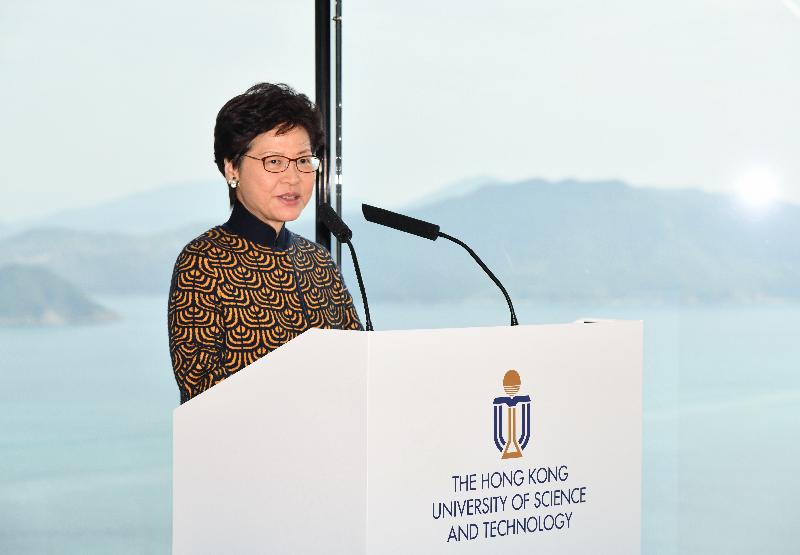
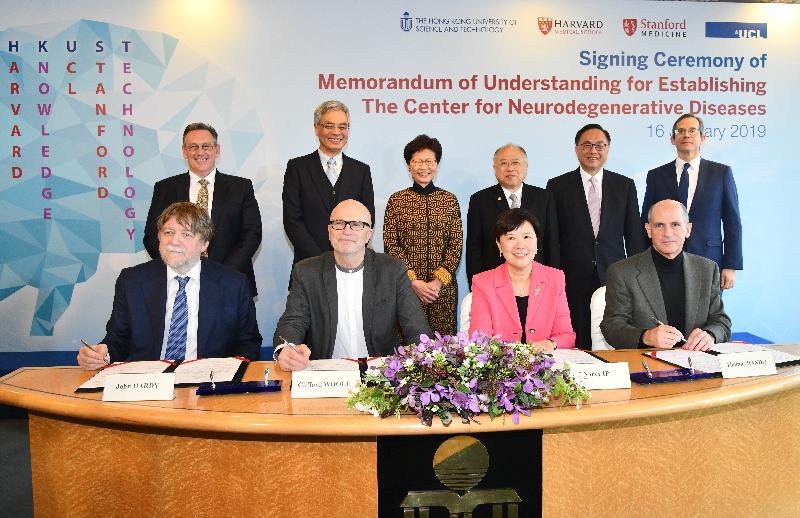
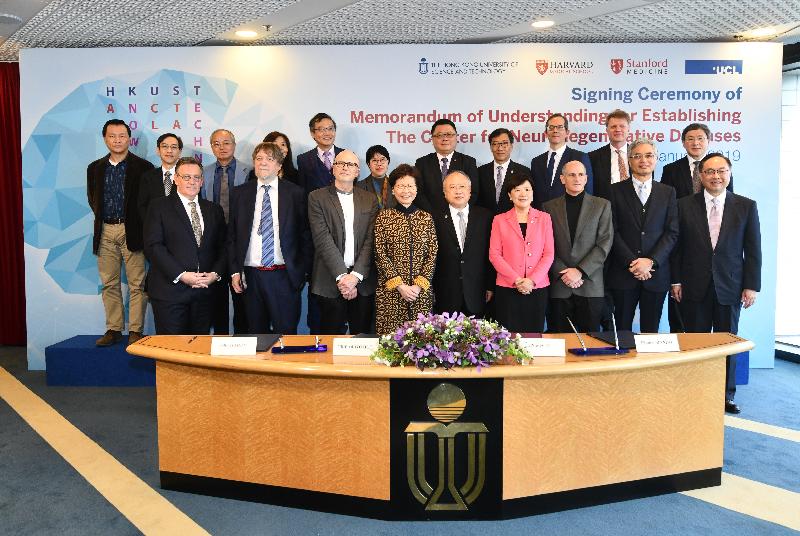
Speech by CE at signing ceremony of Memorandum of Understanding for Establishing the Center for Neurodegenerative Diseases (English only) (with photos)

     Following is the speech by the Chief Executive, Mrs Carrie Lam, at the signing ceremony of the Memorandum of Understanding for Establishing The Center for Neurodegenerative Diseases today (January 16):
 
Andrew (Chairman of the Council of the Hong Kong University of Science and Technology (HKUST), Mr Andrew Liao), Professor Shyy (President of HKUST, Professor Shyy Wei), Andy (British Consul General to Hong Kong and Macao, Mr Andrew Heyn), Thomas (Acting Consul General of the United States to Hong Kong and Macau, Mr Thomas Hodges), Professor Woolf (Director of F M Kirby Neurobiology Center of Boston Children’s Hospital, Professor Clifford Woolf), Professor Rando (Director of the Paul F Glenn Center for the Biology of Aging of the Stanford University School of Medicine, Professor Thomas Rando), Professor Hardy (Professor of Neuroscience of University College London, Professor John Hardy), distinguished guests, ladies and gentlemen,
 
     Good morning. I am delighted to join you for this signing ceremony today, which establishes the Center for Neurodegenerative Diseases in Hong Kong, the first of its kind here.
 
     This milestone occasion brings together four of the world’s leading universities – and from three continents – for pioneering medical research here in Hong Kong. It is indeed the fourth occasion of an MoU signing ceremony for such collaborative research that I had witnessed in the past seven months. The other three MoU signing occasions involved equally distinguished and renowned institutions from France, Germany and the United States. One could not help thinking that this is clear and compelling testimony of Hong Kong’s singular ability to create connections, to help people, businesses and institutions excel, whatever they’re pursuing, whatever their vision. That said, I must thank those overseas renowned universities and research institutions for placing their trust in us, and our local Consulates for helping us to connect. The presence today of the United Kingdom Consul General and the Acting Consul General of the United States is much appreciated.
 
     Developing Hong Kong into an innovation and technology (I&T) hub is central to my Government’s economic policy. In my maiden Policy Address delivered in October 2017, which is just three months after I have assumed the office of the Chief Executive, I set out eight major areas for our innovation and technology progress, including expanding our infrastructure, pooling technology talent and boosting R&D funding. Since then, my Government has allocated about US$10 billion for I&T initiatives, including significant resources for R&D activities. Among other things, we are bolstering R&D in our universities and public research institutes. We have also instituted a super tax deduction of up to 300 per cent to private enterprises for their R&D expenditure.
 
     No less important, we have set aside US$1.3 billion to establish two research clusters – one for healthcare, the other for artificial intelligence and robotics. The good news is the newly created partnership we are witnessing today will apply for participation in the healthcare research cluster – known as health@InnoHK. Specifically, the Hong Kong University of Science and Technology, Boston Children’s Hospital, a Harvard Medical School Teaching Hospital, Stanford University School of Medicine and University College London will conduct research on neurodegenerative diseases, working out of Hong Kong Science Park.
 
     As we all know, neurodegenerative diseases – particularly Alzheimer’s – are becoming more prevalent in ageing populations. And while understanding of neurodegenerative diseases continues to advance, there are few effective treatments available, either to delay the onset or to affect the course of Alzheimer’s and other daunting neurodegenerative diseases.
 
     I am, however, hopeful that the combined excellence and collective commitment and expertise of four of the world’s leading institutions, and their scientists and researchers, can lead to significant advances in the diagnosis and treatment of neurodegenerative diseases. I am also confident that this research consortium will create wide-ranging, world-class opportunities for the next generation of Hong Kong scientists and researchers, and in doing so, establish Hong Kong as an international centre for research in neurodegenerative diseases.
 
     Ladies and gentlemen, I wish the four universities, and everyone behind this landmark collaboration in Hong Kong, a great success. Thank you very much.

Photo  Photo  Photo  
read more

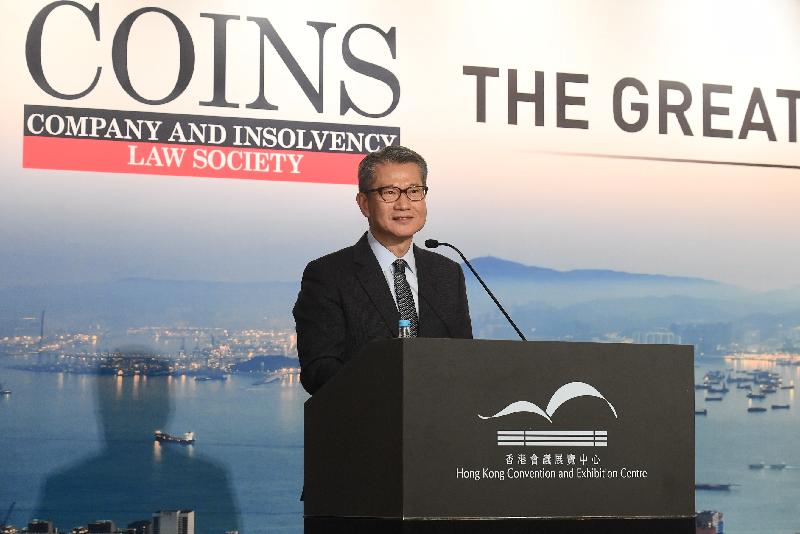
Speech by FS at Greater China Restructuring Forum 2019 (English only) (with photo)

     Following is the speech by the Financial Secretary, Mr Paul Chan, at the Greater China Restructuring Forum 2019 this morning (January 16):
 
The Honourable Mr Justice Harris (Honorary President of the Company and Insolvency Law Society and Judge of the Court of First Instance of the High Court), distinguished guests, ladies and gentlemen,
 
     Good morning.

     I am pleased to join you today for the Greater China Restructuring Forum. My thanks to COINS – the Company and Insolvency Law Society – for organising this timely gathering of high-profile experts from all over the world.
      
     Today’s forum is part of the International Financial Week here, and underscores Hong Kong’s role as one of the world’s leading financial centres. It puts a deserved spotlight on our restructuring practice, and the myriad opportunities that such practice presents. This forum, and its organiser, also reflect the diversity and dexterity of our financial sector.
      
     Hong Kong is a global capital formation centre, renowned for attracting businesses and investors from all over the world, providing them with world-class financial and professional services, essential connections and the means to excel.
      
     As the world’s largest offshore Renminbi business hub, and Asia’s major asset management centre, Hong Kong is the central connector between the Mainland of China and the rest of the world. That singular role also gives us unparalleled advantages in serving the investment and financing needs of the Belt and Road Initiative.

     Belt and Road companies can raise capital and seek financing in Hong Kong through IPOs (initial public offerings), post-listing arrangements, bond issuance, bank loans and many other means. 

     As the world economy becomes more integrated, cross-border transactions have also soared. This has led to increasing demand for financial services in Hong Kong.
      
     A well-structured corporate insolvency regime can only boost Hong Kong’s competitive edge as a global financial centre, attracting companies from all over the world.

     We are fully committed to realising that advantage. In 2016, we modernised the Companies (Winding Up and Miscellaneous Provisions) Ordinance through a series of legislative amendments, enhancing our protection for creditors and streamlining the winding up process.
      
     We are now working to introduce a statutory corporate rescue procedure for Hong Kong.

     The proposed corporate rescue procedure will help financially strapped companies revive their businesses. A key objective of the proposed procedure is maximising the viability of a company or, if this is not possible, achieving a better return for the creditors of the company than is the case now with an immediate insolvent winding-up.
      
     We are drafting the proposed law. In the process, we have referred to comparable regimes in the United Kingdom and Australia.

     The law’s key features will include the following: largely out-of-court arrangements to save time and costs; the presence of a moratorium under which legal proceedings will be stayed; a defined time frame for specified actions to speed up the determination of a company’s fate; and a phased payment schedule for outstanding employee entitlements.

     Let me add that the legislative exercise is both technically complex and politically controversial. In fact, this will be our third legislative attempt to introduce a corporate rescue procedure in Hong Kong. 

     Challenges notwithstanding, we are charging ahead. Our target is to introduce a bill into the Legislative Council this legislative year.

     In parallel, we are examining the issue of cross-border insolvency. In recent years, cases of cross-border insolvency have become increasingly common.

     At the moment, Hong Kong has no domestic legislation on cross-border insolvency, which means that winding-up proceedings would have to be introduced in each jurisdiction. This, of course, is expensive and time consuming. More recently, Hong Kong courts have resorted to the common law to assist foreign liquidators.

     With that in mind, we plan to introduce domestic cross-border insolvency legislation, applying an international co-operation framework. 
     
     One option is adopting the United Nations Commission on International Trade Law’s “Model Law on Cross-Border Insolvency,” with suitable modifications to protect local creditors.

     Insolvency and restructuring services often require a stable financial market, providing the required liquidity to businesses in an efficient manner. 

     Our world-class financial infrastructure and deep liquidity make Hong Kong an ideal centre for insolvency and restructuring deals. These advantages also make us an attractive option in raising capital for Belt and Road projects and companies in the Greater Bay Area ready to go global. To that end, the Government has taken steps to create a conducive environment for such companies.

     The Hong Kong Monetary Authority has set up an Infrastructure Financing Facilitation Office, which works with a cluster of partner stakeholders to help enable infrastructure investments and their financing. 

     To date, 95 organisations from the Mainland, Hong Kong and overseas have joined the Office as partners. They include multilateral financial agencies and development banks, public-sector and private-sector investors, asset managers, banks, insurance companies, pension funds, infrastructure-project developers and operators, professional service firms and international business councils. In short, the response to the Office has been wide ranging and enthusiastic.

     In addition, the Securities and Futures Commission issued a statement last year, explaining the factors it takes into account in reviewing the proposed listing of infrastructure project companies in Hong Kong.

     By doing so, the Commission has clarified the pathway for infrastructure project companies to seek listing here. 

     On IPOs, last year we implemented a new listing regime, enabling companies from the emerging and innovative sectors to list on the Stock Exchange of Hong Kong.

     The Government has also introduced initiatives to promote Hong Kong’s bond market and green finance, including launching a Pilot Bond Grant Scheme, a Green Finance Certification Scheme, and offering enhanced tax concessions to encourage investor participation in the bond market.

     The launch, in recent years, of the Stock Connects and Bond Connect, as well as the mutual recognition of funds arrangement, are all strong testimony to Hong Kong’s unique role in the internationalisation of the Renminbi and as the gateway between international markets and investors and their counterparts on the Mainland. 

     The introduction of a statutory corporate rescue procedure and cross-border insolvency legislation will build on this foundation, boosting our status as an international financial centre and China’s international financial capital.

     My thanks, once again, to COINS and our financial and legal professionals, for promoting Hong Kong as a centre for international debt restructuring and providing access to the Mainland’s debt market.

     The legal profession, let me emphasise, plays an essential role in attracting Mainland and overseas companies to Hong Kong, because rule of law underpinned by an independent judiciary is fundamental to their confidence in us. Here, they gain peace of mind, knowing that contracts are enforced, disputes are equitably settled and intellectual property rights are well protected.

     Ladies and gentlemen, I am confident that, with your continuing support and considered input, Hong Kong will soon be recognised, internationally, for its insolvency and restructuring expertise and services.

     I wish you all a rewarding forum and a happy, healthy and solvent New Year.
     
     Thank you.

Photo  
read more

Public urged to follow safety precautions when cleaning windows

     As the Chinese New Year is approaching, the Labour Department (LD) has reminded employers and cleaning workers to stay alert and pay attention to safety when cleaning windows to prevent accidents.

     “It is customary for families to conduct a thorough clean-up of their homes to get ready for the Chinese New Year. Many will either perform the chores themselves or engage cleaning workers to help. Both employers and cleaning workers should take heed of safety precautions when undertaking household chores. In particular, special attention should be paid to window cleaning, which involves potential risks of falling from height,” an LD spokesman said today (January 16).

     The LD reminds employers and cleaning workers to observe the following rules when cleaning windows:

– Install secured window grilles as far as practicable and keep them closed while cleaning windows;
– Always stand on the floor when cleaning windows without grilles;
– Never stretch the body out of windows;
– Never lean against windows or window grilles; and
– Use proper tools with long handles where necessary.

     In addition, cleaning agents should be used in the proper concentration and manner in accordance with the instructions on the labels of the packaging. Different types of cleaning agents should not be mixed for use. Plastic gloves should be worn to protect the skin from harm caused by chemical agents.

     For enquiries about occupational safety and health matters, please contact the LD’s Occupational Safety Officers at 2559 2297. read more

LCQ8: Information security of using certain Chinese telecommunications products

     Following is a question by the Hon Alvin Yeung and a written reply by the Secretary for Innovation and Technology, Mr Nicholas W Yang, in the Legislative Council today (January 16):
 
Question:
 
     It has been reported that in recent months, the governments of a number of countries (including the United States, Japan and Australia) have banned, on national security grounds, their respective government agencies and telecommunications service operators from using the telecommunications equipment supplied by Huawei Technologies Co. Ltd (Huawei) and ZTE Corporation (ZTE). Regarding the information security in relation to the use of these two companies’ equipment by the Government, will the Government inform this Council:
 
(1) of the details of the products of (i) Huawei and (ii) ZTE being used by various government departments (set out separately in tables of the same format as the table below); and
 

  Type of products Quantity Total value Purpose Year of purchase Government department
1.            
……            
 
(2) whether it inspected, in the past 12 months, those Huawei and ZTE products being used by various government departments to see if there were hidden backdoors or functions which enabled unauthorised persons to steal the information in Government possession; if it did, of the outcome, and the follow-up actions taken by the Government?
 
Reply:
 
President,
 
     At present, in procuring network equipment products, government departments can either conduct their own tendering exercises or select suitable products from the Standing Offer Agreement for the Supply of Network Products and Server Systems (SOA) under the Office of Government Chief Information Officer (OGCIO). In formulating the SOA, the OGCIO takes into account mainly product functionality, compatibility, relevant technical and security standards, and support offered by the suppliers. There are no restrictions on the brand of equipment.
 
     Replies to each part of the question are provided as follows:
 
(1) For the period from February 2016 (commencement date of the prevailing SOA) to November 2018, government departments procured around 190 Huawei Technologies Co. Ltd products through the SOA including network switches (for connecting equipment on a network), routers (for connecting different networks) and accessories (fibre transceivers and cables for connecting fibre optics, and fan modules for cooling equipment). The total expenditure is around $1.76 million.
 
     The contractors in the prevailing SOA do not offer any ZTE Corporation products.
 
     For network equipment procured by individual departments through their own tendering exercises, relevant information such as product categories and expenditure is kept by the departments and the OGCIO does not have statistics in this regard.
 
(2) In drawing up the arrangements and procedures for procuring information and communication products, the Government makes reference to international and industry standards including information security, and stipulates the requirements for safeguarding information systems and data assets to ensure the security of government information systems and data as well as to protect the privacy of the general public. At present, the network equipment brands and models procured by the Government are widely used by other international cities and should not have a backdoor programme or other inappropriate functions. Therefore, the prevailing procurement procedures do not include additional checking in this respect.

     Regarding government-wide risk management of information technology security, the OGCIO has worked together with relevant departments to formulate a comprehensive set of policies and guidelines, management framework and technical measures, and closely monitor the operation of government information systems and networks so as to detect and intercept various potential security threats and assess the risks of cyber attacks. Such guidelines, management framework and technical measures are applicable to all products or brands.
 
     To ensure the security of government’s information systems and data as well as to protect privacy of the general public, government departments must perform independent information security risk assessments and audits for their information systems and network facilities before commissioning and during operation on a regular basis. They will make improvement as necessary to ensure the relevant information systems and network facilities comply with the security requirements and regulations. Furthermore, in order to ensure the security of data asset, confidential and restricted data must be encrypted in storage or transmission.
 
     The OGCIO will also monitor closely the information disseminated by the information security industry and computer emergency response teams from all over the world, including security threats and trends of cyber attacks. Having regard to the actual circumstances, the OGCIO will assess and plug the potential security risks, including risks of product vulnerabilities or data leakage. read more