Tag Archives: China

image_pdfimage_print

Quality Education Fund announces 2019/20 funding priorities

The following is issued on behalf of the Quality Education Fund Steering Committee:

    The Chairman of the Quality Education Fund (QEF) Steering Committee, Dr Gordon Tsui, today (July 4) announced the direction of the QEF, including the seven priority themes for 2019/20 and the “My Pledge to Act” (2019) funding programme.

     Dr Tsui said, “Since its establishment in 1998, the QEF, in line with the education development and policies of Hong Kong, has been striving to enhance the quality of school education and promote quality education by introducing new priority themes to address the needs of school education. The QEF will on August 1 introduce seven priority themes, which are more concise and focused, for QEF applications. The new priority themes are ‘STEM Education’, ‘IT in Education’, ‘Assessment Literacy’, ‘Life-wide Learning’, ‘Positive Values’, ‘Students’ Balanced Development’ and ‘Effective Leadership and School Management’.”

     Dr Tsui added that apart from the above priority themes, applicants could apply to undertake other innovative projects that meet the needs of schools to enhance the quality of school education.

     Dr Tsui continued, “The QEF has also formulated theme-based funding programmes in the past. In the 2019/20 school year, the QEF will introduce a new funding programme – ‘My Pledge to Act’ (2019), to rally concerted efforts of schools, families and other stakeholders in society to enhance our commitment to nurturing talent as well as cultivating a positive school atmosphere.”

     This funding programme will be applicable to all publicly funded schools and the kindergartens joining the kindergarten education scheme. The programme will be implemented for three consecutive school years starting from 2019/20. The call for submission of applications will start in September 2019. The QEF has devised a simplified application form and provided relevant reference materials for schools’ reference. Details of the application and relevant reference materials will soon be uploaded to the QEF website and the Education Bureau website of “My Pledge to Act” respectively.
     
     To provide further details on the priority themes and the “My Pledge to Act” (2019) funding programme, two briefing sessions will be held on August 20 and August 21 respectively. Interested parties may refer to the details on the QEF website (qef.org.hk).

     In future, the QEF will continue to enhance communication and partnership with various stakeholders to create and share successful QEF project experiences. More than 40 QEF Thematic Networks will be launched in the coming year to encourage knowledge transfer and sustainable professional development of teachers and benefit more schools. The QEF also regularly uploads the proposals of QEF funded projects to the QEF Cyber Resource Centre (qcrc.qef.org.hk) for applicants’ reference.

     QEF deliverables (such as learning and teaching resources) can be purchased by completing the order form at the QEF Cyber Resource Centre website or via Hong Kong Education City (edmall.hkedcity.net/store). In addition, the QEF deliverables are available at ShopThruPost (shopthrupost.hongkongpost.hk) administered by Hongkong Post. The QEF has also identified good projects for developing electronic deliverables with interactive functions to facilitate students’ self-directed learning. So far, over 100 sets of electronic deliverables have been developed. The public can access these deliverables via the QEF Cyber Resource Centre and Hong Kong Education City. read more

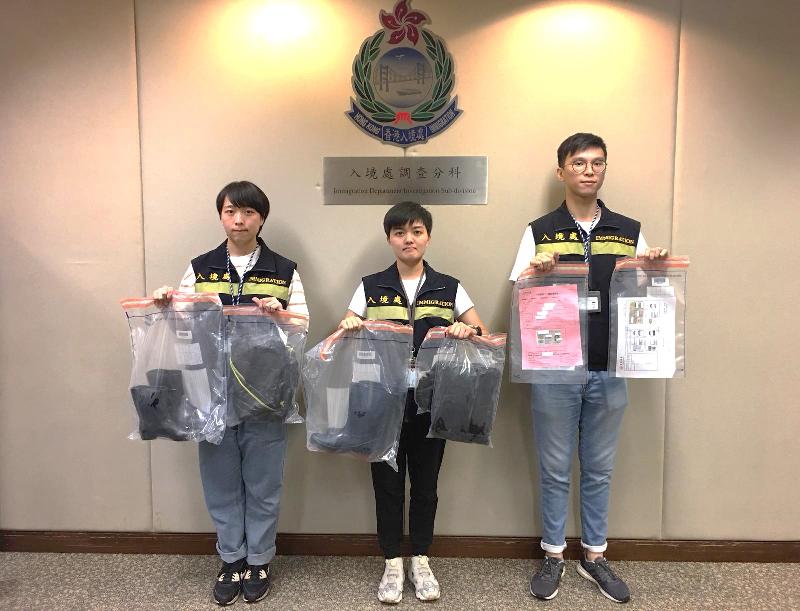
Twenty immigration offenders arrested (with photos)

     The Immigration Department (ImmD) mounted an anti-illegal worker operation codenamed “Twilight” on July 2 and 3. A total of 14 illegal workers and six suspected employers were arrested.
      
     During the operation, ImmD Task Force officers raided 19 restaurants in Kowloon. Fourteen illegal workers and six employers were arrested. The illegal workers comprised four men and 10 women, aged 21 to 60. Among them, two men were holders of recognisance forms, which prohibit them from taking any employment. In addition, two men and eight women were suspected of using and being in possession of forged Hong Kong identity cards or identity cards relating to another person. Meanwhile, three men and three women, aged 33 to 57, were suspected of employing the illegal workers.
      
     “Any person who contravenes a condition of stay in force in respect of him shall be guilty of an offence. Also, visitors are not allowed to take employment in Hong Kong, whether paid or unpaid, without the permission of the Director of Immigration. Offenders are liable to prosecution and upon conviction face a maximum fine of $50,000 and up to two years’ imprisonment. Aiders and abettors are also liable to prosecution and penalties,” an ImmD spokesman said.
 
     The spokesman warned that, as stipulated in section 38AA of the Immigration Ordinance, illegal immigrants or people who are the subject of a removal order or a deportation order are prohibited from taking any employment, whether paid or unpaid, or establishing or joining in any business. Offenders are liable upon conviction to a maximum fine of $50,000 and up to three years’ imprisonment. The Court of Appeal has issued a guideline ruling that a sentence of 15 months’ imprisonment should be applied in such cases. It is an offence to use or possess a forged Hong Kong identity card or a Hong Kong identity card related to another person. Offenders are liable to prosecution and a maximum penalty of a $100,000 fine and up to 10 years’ imprisonment.
     
     The spokesman reiterated that it is a serious offence to employ people who are not lawfully employable. The maximum penalty is imprisonment for three years and a fine of $350,000. The High Court has laid down sentencing guidelines that the employer of an illegal worker should be given an immediate custodial sentence. According to the court sentencing, employers must take all practicable steps to determine whether a person is lawfully employable prior to employment. Apart from inspecting a prospective employee’s identity card, the employer has the explicit duty to make enquiries regarding the person and ensure that the answers would not cast any reasonable doubt concerning the lawful employability of the person. The court will not accept failure to do so as a defence in proceedings. It is also an offence if an employer fails to inspect the job seeker’s valid travel document if the job seeker does not have a Hong Kong permanent identity card. The maximum penalty for failing to inspect such a document is imprisonment for one year and a fine of $150,000.
 
     Under the existing mechanism, the ImmD will, as a standard procedure, conduct initial screening of vulnerable persons, including illegal workers, illegal immigrants, sex workers and foreign domestic helpers, who are arrested during any operation with a view to ascertaining whether they are trafficking in persons (TIP) victims. When any TIP indicator is revealed in the initial screening, the officers will conduct a full debriefing and identification by using a standardised checklist to ascertain the presence of TIP elements, such as threat and coercion in the recruitment phase and the nature of exploitation. Identified TIP victims will be provided with various forms of support and assistance, including urgent interference, medical services, counselling, shelter, temporary accommodation and other supporting services. The ImmD calls on TIP victims to report crimes to the relevant departments.

Photo  Photo  
read more