Tag Archives: China

image_pdfimage_print

Hong Kong Customs seizes suspected ketamine and cocaine (with photos)

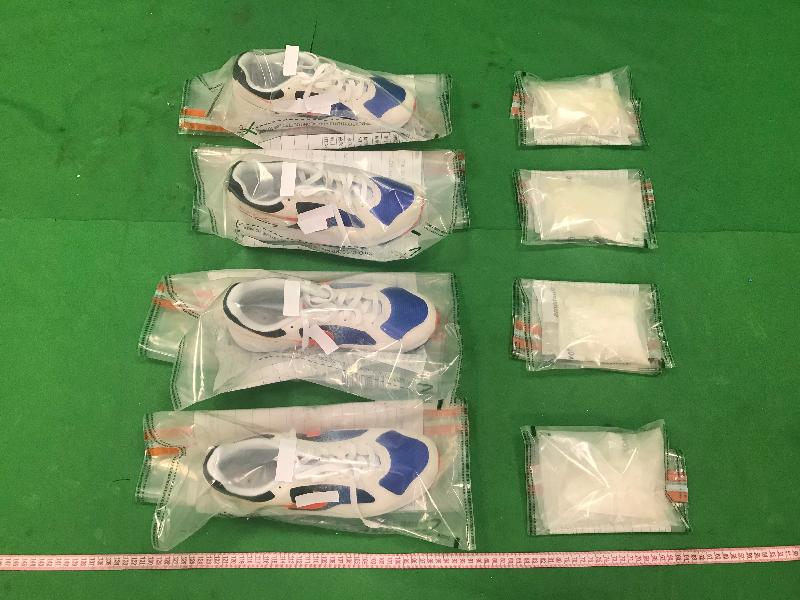
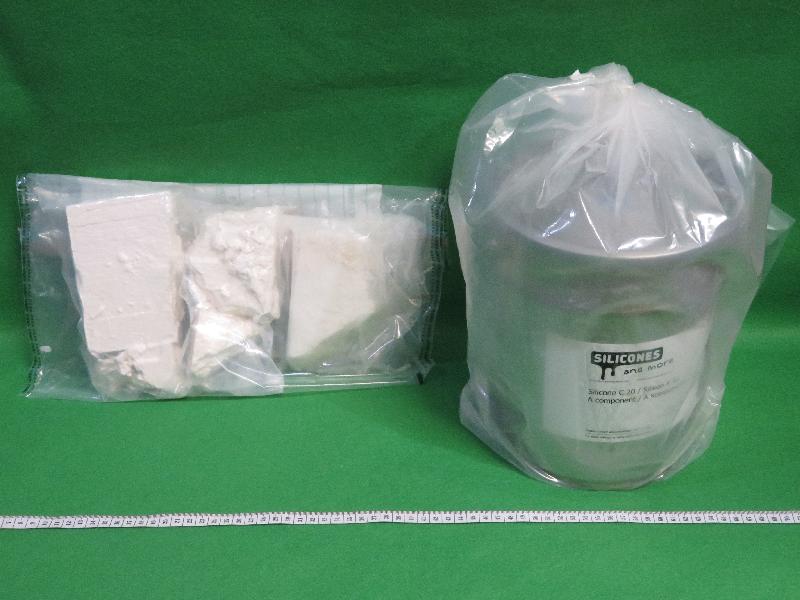
     Hong Kong Customs seized about 520 grams of suspected ketamine and about 1 kilogram of suspected cocaine at Hong Kong International Airport on November 22 and 23 respectively with a total estimated market value of about $1.6 million.

     Customs officers inspected two air express parcels arriving in Hong Kong on the above-mentioned dates. The batch of suspected ketamine in four packages was found concealed inside two pairs of sports shoes in a parcel from Germany. Then, the batch of suspected cocaine was found concealed inside a metal container filled with white liquid in a parcel from the Netherlands.

     Upon follow-up investigation, Customs officers yesterday (November 26) arrested two men, aged 39 and 33, suspected to be connected with the cases in Central and Kwun Tong respectively.

     Investigations of both cases are ongoing and the arrested men have been released on bail pending further investigation.

     Customs will maintain close contact with Hongkong Post and the logistics industries to step up action against drug trafficking through postal parcels and express courier channels.

     Under the Dangerous Drugs Ordinance, trafficking in a dangerous drug is a serious offence. The maximum penalty upon conviction is a fine of $5 million and life imprisonment.

     Members of the public may report any suspected drug trafficking activities to Customs’ 24-hour hotline 2545 6182 or its dedicated crime-reporting email account (crimereport@customs.gov.hk).

Photo  Photo  
read more

LCQ13: Police use appropriate force to maintain public safety and public order

     Following is a question by the Hon Gary Fan and a written reply by the Secretary for Security, Mr John Lee, in the Legislative Council today (November 27):

Question:     

     Since the eruption of the “anti-extradition to China” movement in June this year, the Police have deployed, for dealing with hundreds of large-scale public events, specialised crowd management vehicles (commonly known as “water cannon vehicles”) from August 25 onwards to spray coloured water to disperse crowds, and issued extendable batons and pepper sprays to off-duty police officers from September 10 and October 15 onwards respectively to facilitate their discharge of duties in case of emergency. In this connection, will the Government inform this Council:

(1) as many members of the public who were hit by the coloured water sprayed from water cannon vehicles experienced stinging sensations in their eyes and intense burning sensations on their skin, of the respective chemical compositions of the colouring materials and pepper based solutions in the coloured water; if such information cannot be made public, of the reasons for that;

(2) as the Police have indicated that the coloured water can help the Police identify demonstrators, of the to-date number of demonstrators arrested by the Police by such means, with a tabulated breakdown by the date, time and venue of the relevant public events and the offence allegedly committed by the arrestees;

(3) of the to-date total number of off-duty police officers who have been issued with extendable batons and pepper sprays by the Police;

(4) as the Police have indicated that they will conduct a review of the arrangement one month after issuing extendable batons to off-duty police officers, whether such a review has been conducted as scheduled; if so, of the outcome; if not, the reasons for that;

(5) whether the Police have conducted any review of the arrangement of issuing pepper sprays to off-duty police officers; if so, of the outcome; if not, the reasons for that;

(6) of the utilisation of extendable batons and pepper sprays by off-duty police officers for discharging duties (including the number of off-duty police officers using such weapons in public events, with a tabulated breakdown by the date on which and the place at which those weapons were used); and

(7) whether police officers will be granted overtime allowances for the off-duty hours during which they discharged duties by using the extendable batons or pepper sprays; if so, of the total amount of payment made so far; if not, the reasons for that? 

Reply:

President, 

     Members of the public enjoy the freedoms of expression, speech and assembly but such freedoms have to be exercised in a peaceful and lawful manner.  The Police have a statutory duty to maintain public safety and public order.  When public order and public safety are severely threatened by situations such as illegal blockage of roads, paralysed traffic, unlawful assemblies and violent charging of police cordon lines, the Police must take appropriate actions to maintain law and order and safeguard public peace.   The Police emphasised that if members of the public could express their views in a peaceful and rational manner, there would be no need for the Police to use any force. 

     Since early June 2019 up till now, more than 900 protests, processions and public assemblies have been staged in Hong Kong, and many of them ended up as violent illegal activities.  In the past five months or so, rioters repeatedly committed serious unlawful acts including wantonly blocking roads, paralysing the traffic, hurling petrol bombs and bricks and setting fire at different locations, vandalising and burning shops and MTR and light rail facilities with intent, and violently assaulting people holding different opinions.  These acts have seriously threatened personal safety, as well as public order and public safety.  To curb violence, the Police have to take actions to bring rioters to justice or disperse the crowd and control the situation so as to restore public safety and public order. 

     The Police have in place prudent and stringent guidelines for the use of force.  Police officers will only use appropriate force when it is necessary.  Such force is used in response to the prevalent situation, and the place and the level of force used depend on the level of violence committed by rioters and the then circumstances at the scene.  To control the scene and disperse violent persons, police officers at the scene will make professional assessment and judgement having regard to the situation at the time and decide on the different levels of force as appropriate, including the use of non-lethal weapons such as pepper sprays, tear gases, bean bag rounds, rubber bullets, pepperballs and specialised crowd management vehicles (SCMVs) for lawful discharge of their duties.

     My reply to the various parts of Hon Gary Fan’s question is as follows:

(1) and (2) SCMVs are the equipment used to disperse crowd, the purpose of which is to stop people from gathering or committing illegal acts. According to the Police’s information, the colourant used in the SCMVs is non-toxic and will not cause bodily harm or pose risks to public health.  When using the SCMVs, the Police may, having regard to the actual situation, also add in pepper-based solution. The main effect of pepper-based solution is similar to pepper spray. Exposure to pepper-based solution will cause brief burning sensation of the skin and discomfort in the eyes.  The symptoms will subside after a short period of time. It is not appropriate for the Police to disclose the composition of the solution or else it may undermine the capability of Police operations. The Police have not kept the relevant statistics on using the colourant in the SCMVs to assist their arrest of demonstrators.

(3) to (6) In the past few months, violence of demonstrators was escalating, causing grave threat to public safety and public order.  Therefore, the Police consider it necessary to equip their officers with extendable batons and pepper sprays for exercising and discharging police duties in case of emergency during off-duty in order to protect the safety of members of the public more effectively and directly.  

     As details regarding deployment of extendable batons and pepper sprays involve police operation and tactics, the information cannot be made public as their disclosure will affect the Police’s operational capability. Equipment used by police officers are under timely and regular reviews.  The Police have maintained the arrangement of issuing extendable batons to off-duty police officers after review having regard to the current situation.  

(7) Overtime work of police officers may only be undertaken when it is strictly unavoidable, and is subject to the Civil Service Regulations as well as the stringent control under the relevant internal requirements of the Police. According to the Regulations, overtime work will normally be compensated by time off in lieu. Where the granting of time off is likely to be impracticable within 30 days of the date on which overtime work is performed, payment of Disciplined Services Overtime Allowance to eligible officers may be approved.

     The Police will, having regard to operational needs, deploy manpower as appropriate, and permit their officers to take time off or receive overtime allowance according to individual needs and work situation.  For the compensation of overtime work, the issue is not whether an officer is equipped with certain equipment during off-duty hours, but whether his or her conduct constitutes to the discharge of police duty.

     In 2019-20, a provision of $20.2 billion was made under Subhead 000 Operational expenses for salaries, allowances and other operating expenses of the Police.  The amount of payment for overtime allowance in the 2019-20 financial year will be reflected in the relevant revised estimate. read more

LCQ7: Impacts of social events on tourism industry

     Following is a question by the Hon Wong Ting-kwong and a written reply by the Acting Secretary for Commerce and Economic Development, Dr Bernard Chan, in the Legislative Council today (November 27):
    
Question:
 
     Some members of the tourism industry have relayed that the disturbances arising from the opposition to the proposed legislative amendments, which erupted in June this year and have not yet subsided, have dealt a heavy blow to Hong Kong’s tourism industry and affected the livelihood of the practitioners of the tourism industry.  In this connection, will the Government inform this Council:
 
(1) whether it has estimated the economic losses caused to the tourism industry by the social disturbances since June this year; if so, of the amount of money;
 
(2) given that so far 40 countries/regions have issued alerts/advice on travelling to Hong Kong, whether it knows if the Hong Kong Tourism Board (HKTB) has, in response to such situation, (i) made adjustments, (ii) rolled out new measures, and (iii) increased the budgeted expenditure, in respect of the publicity and promotion work targeting at the various visitor source markets; if HKTB has, of the details; if not, the reasons for that;
 
(3) given that HKTB has cancelled this year’s Hong Kong Wine & Dine Festival and Hong Kong Cyclothon originally scheduled to be held last month, whether it knows (i) if HKTB has estimated the resultant impacts on and the economic losses so suffered by the tourism industry, and (ii) how HKTB will deal with the unspent funds earmarked for holding those two events;
 
(4) whether it knows if HKTB is considering the cancellation of the large-scale tourism promotion events to be held in the coming six months, and the factors being considered by HKTB;
 
(5) whether it knows the specific contents of and the budgeted expenditure for the promotional programme “Hong Kong Takes Off Again” to be rolled out by HKTB; and
 
(6) given that starting from September this year, Hong Kong tourist guides and tour escorts may apply to the Mainland authorities for working in Hengqin New Area, Zhuhai, whether it knows the respective numbers of applications received, approved and rejected by the Mainland authorities so far?

Reply:
 
President,
 
     The tourism industry is one of the sectors that is hard hit by the continuous social events recently.  The Government has been closely monitoring the development of the situation and maintaining close communication with the Hong Kong Tourism Board (HKTB), the Travel Industry Council of Hong Kong and the tourism sector.  In view of the impact of social events on the tourism trade, the Government has also rolled out several rounds of support measures to alleviate the operating pressure of the industry.
 
     Our reply to the questions raised by the Hon Wong is set out below:
 
(1) Tourism is a key sector of the Hong Kong economy.  In 2017, tourism employed over 250 000 persons and accounted for 6.7 per cent of total employment.  It also generated value added of HK$114.2 billion, accounting for 4.5 per cent of Gross Domestic Product. 
 
     Due to factors such as the persisting trade conflict between China and the US as well as recent social events, inbound tourism had suffered severely. While visitor arrivals recorded growth in the first six months of 2019, the trend reversed in July.  Overall visitor arrivals in the third quarter of 2019 plunged by 26 per cent from a year earlier to 11.9 million, the sharpest year-on-year fall since the second quarter of 2003.  The fall in visitor arrivals reached about 40 per cent in October 2019.  There is also a drop of over 50 per cent in the provisional figures of the first half of November 2019.
 
     The hotel sector also suffered a setback.  The average hotel room occupancy rate fell distinctly from 91 per cent a year earlier to 72 per cent in the third quarter of 2019.  The average achieved hotel room rate likewise dropped by 16.2 per cent from a year earlier.
 
     As inbound tourism was hard hit, the unemployment rate of the consumption- and tourism-related segment (viz. retail, accommodation and food services sectors) increased from 3.9 per cent in the second quarter to 5.0 per cent in August to October, the highest level since the beginning of 2017.  Within this segment, the unemployment rate of the food and beverage services sector rose sharply from 4.3 per cent in the second quarter to 6.1 per cent in August to October, the highest in more than six years.  The year-on-year decline in employment of the segment as a whole also enlarged noticeably from 0.8 per cent in the second quarter to 7.2 per cent in August to October.  Compared with the second quarter, the number of employees in the segment decreased by around 47 000.
 
(2) to (5) HKTB has adjusted the approach of promotion campaigns in the source markets in view of the travel advisories issued by various countries and regions.  Currently, HKTB has been communicating closely with the travel trade and visitors to keep them updated about the latest situation in Hong Kong via various channels, including website and LINE Chat, so that visitors can better grasp the latest situation and adjust their itineraries as necessary.  Moreover, HKTB has also extended the service hours of visitor services to provide enhanced support to visitors.
 
     Besides, HKTB has rolled out a series of relief and incentive measures to support the travel trade, including:
 

  • Starting from October 1, 2019 to March 31, 2020, HKTB has been waiving the participation fees of the travel trade for joining trade fairs and travel missions organised by HKTB in the Mainland and overseas;
  • Starting from October 1, 2019 to September 30, 2020, all merchants (over 8 000 outlets) accredited under HKTB’s Quality Tourism Services Scheme can have full renewal fees waived for one year while new applications to the Scheme can enjoy a 50 per cent reduction on the application fee; and
  • Support the Government to roll out the Travel Agents Incentive Scheme to encourage travel agents to attract more overnight visitors to Hong Kong so as to boost local consumption for the benefits of the hotel, retail, catering and transportation sectors.

     The recent social events have seriously damaged Hong Kong’s destination image, resulting in the decline of visitor arrivals which have affected various sectors.  To address the situation, HKTB has been working on both short-term and long-term promotion plans which will be rolled out gradually at opportune time.  HKTB has been closely monitoring the development and will make corresponding arrangements.  Details will be announced later.
 
     Regarding the Hong Kong Cyclothon and the Hong Kong Wine & Dine Festival that have been cancelled, it is difficult to forecast the participation and the respective contribution to tourism.  With reference to the record of 2018, there were about 70 000 and 168 000 participants for these two events respectively.  HKTB will make the best use of the remaining budget of these two events after deducting necessary expenses incurred for the preparatory work.  For example, part of the Hong Kong Wine & Dine Festival budget has been re-allocated to enhance the Hong Kong Great November Feast and the rest will be used for other large-scale promotions.
 
(6) The Human Resources and Social Security Department of Guangdong Province and the Department of Culture and Tourism of Guangdong Province published the pilot implementation plan regarding Hong Kong, Macao tourist guides and tour escorts to practise in Zhuhai Hengqin New Area (Hengqin) on September 5, 2019. According to the plan, Hong Kong and Macao tourist guides and tour escorts are eligible to apply for Hengqin tourist guide certificate (certificate) and work in Hengqin after completing the training and passing the examination organised by Hengqin’s tourism authority.
 
     According to the information of the authorities of Hengqin, as at October 31, 2019, 669 Hong Kong tourist guides and tour escorts have applied for the training.  Due to overwhelming response, 53 Hong Kong tourist guides and tour escorts have been admitted to the training through balloting, among them 52 passed the examination and have applied or are going to apply for the certificate.  For those who have applied for the training but yet to be admitted, they will be admitted to subsequent trainings through balloting. read more

LCQ3: Complaints against police officers

     Following is a question by the Hon Pierre Chan and a reply by the Secretary for Security, Mr John Lee, in the Legislative Council today (November 27):
 
Question:
 
     There have been ongoing demonstrations since June this year. Conflicts and frictions between the Police and members of the public as well as media workers have occurred from time to time. In this connection, will the Government inform this Council:
 
(1) of the number of complaints against police officers received by the Complaints Against Police Office (CAPO) since June this year; among such complaints, the number of those about police officers violating the Police General Orders by inflicting sexual violence (including sexual insult, indecent assault, sexual harassment and rape) on demonstrators, with a tabulated breakdown by the gender and age group to which the victims belonged and by the rank of the police officers under complaint; the number of such cases which are under investigation;
 
(2) of the number of complaints received by CAPO since June this year about police officers refusing to produce their warrant cards and not displaying their police identification numbers on their uniforms, thereby making it difficult for the members of the public to identify them; the Police’s improvement measures; and
 
(3) of the number of persons since June this year who were injured during the period from their arrest to their arrival at the hospitals; whether such persons have lodged complaints against the Police for delaying their treatment; if so, of the number of complaints received?

Reply:

President,

     Since early June this year, more than 900 protests, processions and public assemblies have been staged in Hong Kong, many of which ended up in serious violent illegal acts. In the past five months or so, rioters engaged in illegal blocking of roads, paralysing the traffic, hurling petrol bombs and setting fires at various locations, throwing bricks, assaulting others holding different opinions flagrantly, wounding with intent, vandalising and burning shops, railway facilities, traffic lights, etc. These acts have posed serious threat to public order and public safety, and caused fear among members of the public. Travelling to work and school, going outdoors and all normal activities have also been gravely affected.

     In view of these serious illegal acts, the Police took measures to maintain public safety, stop illegal acts, protect life and property, and bring rioters to justice in accordance with the law. From June 9 to November 21 this year, the Police arrested more than 5 800 persons in major public order events (POEs), and 923 of them had been charged. 

     My reply to Hon Pierre Chan’s question is as follows.

     Hong Kong’s well-established two-tier mechanism of complaint against the Police has been in effective operation for more than 10 years. The first tier is the Complaints Against Police Office (CAPO) of the Police which receives and investigates complaints; and the second tier is the Independent Police Complaints Council (IPCC) which is a statutory body. The two-tier complaint mechanism operates effectively under the Independent Police Complaints Council Ordinance (Cap 604), which provides a clear legal basis to ensure that every complaint against the Police will be handled in a fair and just manner. Under the two-tier mechanism, when CAPO, the operation of which is independent of other units of the Police, has completed the investigation of each reportable complaint, it will submit a detailed investigation report for the scrutiny of IPCC which is independent. If IPCC is of the view that there is deficiency in CAPO’s handling and investigation, it may request CAPO to make clarification or further investigation. Meanwhile, IPCC may convey its views and recommendations to the Commissioner of Police and the Chief Executive in respect of any complaint case.
     â€‹
     IPCC administers an Observers Scheme under which IPCC Members and Observers may attend interviews and observe the collection of evidence in connection with CAPO’s investigation of complaints. The observations may be carried out on a surprise or pre-arranged basis. Should there be any irregularities observed by IPCC Members or Observers, IPCC will take the matter up with CAPO accordingly.

     IPCC and CAPO hold regular quarterly joint meetings to discuss matters related to complaints against the Police.  To enhance transparency and public awareness of the work of IPCC, part of a joint meeting is open to the public and media. 

     As at November 25 this year, CAPO had received 1 261 complaint cases against the Police related to major POEs that took place since June 9.  The subjects of the complaints include “misconduct”, “impoliteness”, “assault”, etc. These complaint cases involve 1 647 allegations. Of which, 467 complaint cases involving 687 allegations were lodged by persons directly affected (reportable complaints). As regards anonymous complaints or complaints lodged by persons who are not directly affected, or complaints which are vexatious and frivolous (notifiable complaints), there were 794 complaints involving 960 allegations. All complaint cases are now under investigation. CAPO does not maintain other figures requested in the question. 

     Currently, CAPO has set up a designated team of 26 members who did not take part in handling the unrest in the past few months. This designated team is sparing no effort in following up the relevant complaints. 

     A police officer can be identified regardless of the officer’s post. During recent major POEs, uniformed police officers on duty would display their unique identification (UI) numbers or identifiable operational call signs. When plainclothes police officers exercise police powers, they would identify themselves or produce warrant cards, or display identifiable operational call signs, as long as doing so is not infeasible under the operational circumstances. 

     The operational call signs mentioned above were introduced by the Police as a pilot measure in response to public concerns on the display of UI numbers by police officers at major POEs. Operational call signs are identifiable call signs for all police officers who participate in an operation, and facilitate effective identification of an officer. In respect of identifying a police officer, operational call signs are as effective as UI numbers. Apart from enhancing the overall effectiveness of the Police in large-scale operations, this arrangement also strikes a proper balance between ensuring the identification of police officers on the one hand, and protecting their personal data from malicious disclosure on the other. The Police will continue to listen to views from within and from members of the public, and conduct a review of the arrangement in due course having regard to operational needs.

     If members of the public wish to lodge complaints against the conduct of police officers, they may identify the officers concerned based on such information. Even if the information is not provided, the Police will identify the police officers concerned through various avenues, including manpower deployment, duty records, the time and location of the incident in relation to the complaint, etc. 
 
     From June 9 to November 26 this year, more than 2 600 persons were injured in large-scale POEs and sought treatment at public hospitals. More than 470 of them were police officers. For all injured persons, the Police uphold the principle that they should be sent to hospital for treatment as soon as possible, and safeguard their right in receiving medical treatment. If an arrestee was injured at the spot or during the arrest, arrangements would be made for sending the arrestee to hospital directly. Moreover, most police officers had received first aid and basic medical training, and are able to provide preliminary treatment for injured persons before the arrival of ambulance personnel. While handling injured arrestees, the Police would also take into account their safety and security. The Police has all along been doing their best to facilitate all ambulance services and assist in rescue efforts where practicable. 

     Thank you, President. read more