Missing man in Kowloon City located
A man who went missing in Kowloon City has been located. Lau San-yee, aged 73, went missing after he left a hostel on South Wall Road on November 8 afternoon. The hostel staff made a report… read more


A man who went missing in Kowloon City has been located. Lau San-yee, aged 73, went missing after he left a hostel on South Wall Road on November 8 afternoon. The hostel staff made a report… read more
In the third quarter of 2019, 25.6% of Hong Kong’s total exports to the mainland of China (the Mainland) were for outward processing in the Mainland. On the other hand, 37.4% of Hong Kong’s imports from the Mainland were related to outward processing in the Mainland, according to statistics released today (December 10) by the Census and Statistics Department (C&SD). Over the same period, 70.0% of Hong Kong’s re-exports of Mainland origin to other places were produced through outward processing in the Mainland.
In the third quarter of 2018, the corresponding proportions were 26.6% for total exports to the Mainland, 37.4% for imports from the Mainland and 71.5% for re-exports of Mainland origin to other places.
In the first nine months of 2019, 25.9% of Hong Kong’s total exports to the Mainland were for outward processing in the Mainland. On the other hand, 38.6% of Hong Kong’s imports from the Mainland were related to outward processing in the Mainland. Over the same period, 68.8% of Hong Kong’s re-exports of Mainland origin to other places were produced through outward processing in the Mainland.
The corresponding proportions in the first nine months of 2018 were 26.5% for total exports to the Mainland, 38.9% for imports from the Mainland and 69.7% for re-exports of Mainland origin to other places.
In value terms, $150.6 billion of Hong Kong’s total exports to the Mainland in the third quarter of 2019 were for outward processing in the Mainland, representing a decrease of 9.2% compared with the third quarter of 2018. On the other hand, the value of imports from the Mainland related to outward processing in the Mainland decreased by 8.9% compared with the third quarter of 2018 to $200.3 billion. Meanwhile, $228.4 billion of Hong Kong’s re-exports of Mainland origin to other places were produced through outward processing in the Mainland, representing a decrease of 12.6% compared with the third quarter of 2018.
In the first nine months of 2019, $414.1 billion of Hong Kong’s total exports to the Mainland were for outward processing in the Mainland, representing a decrease of 8.1% compared with the first nine months of 2018. On the other hand, the value of imports from the Mainland related to outward processing in the Mainland decreased by 5.5% compared with the first nine months of 2018 to $586.8 billion. Meanwhile, $663.6 billion of Hong Kong’s re-exports of Mainland origin to other places were produced through outward processing in the Mainland, representing a decrease of 6.9% compared with the first nine months of 2018.
The statistics for the third quarter and first nine months of 2019 are given in the attached tables.
Information on trade involving outward processing in the Mainland is collected in a sample survey conducted by the C&SD. For the purpose of the survey, exports to the Mainland for outward processing refer to raw materials or semi-manufactures exported from or through Hong Kong to the Mainland for processing with a contractual arrangement for subsequent re-importation of the processed goods into Hong Kong.
Imports from the Mainland related to outward processing refer to processed goods imported from the Mainland, of which all or part of the raw materials or semi-manufactures have been under contractual arrangement exported from or through Hong Kong to the Mainland for processing.
Re-exports of Mainland origin to other places involving outward processing in the Mainland refer to processed goods re-exported through Hong Kong, of which all or part of the raw materials or semi-manufactures have been exported from or through Hong Kong to the Mainland for processing with a contractual arrangement for subsequent re-importation of the processed goods into Hong Kong.
In interpreting the statistics, it should be noted that all imports and exports of goods (not including transhipments and goods-in-transit) are recorded as external trade, irrespective of whether the goods are associated with outward processing or not. Moreover, the value and proportion of imports from the Mainland and re-exports of Mainland origin to other places involving outward processing in the Mainland refer to those of the entire goods instead of just the value added contributed by outward processing in the Mainland.
A sample of import/export declarations in respect of Hong Kong’s trade with the Mainland and Hong Kong’s re-exports originated in the Mainland to other places is selected for enumeration to obtain the required information from the establishments concerned. The findings of the survey facilitate a more informed analysis of the nature of Hong Kong’s trade with the Mainland. In this respect, the survey results are a useful supplement to the regular trade statistics.
The above survey results will be included in the December 2019 issue of the “Hong Kong External Merchandise Trade”. The publication will be available in February 2020. Users can download this publication free of charge from the website of the C&SD (www.censtatd.gov.hk/hkstat/sub/sp230.jsp?productCode=B1020005).
Enquiries on the survey results may be directed to the Outward Processing and Shipping Statistics Section of the C&SD (Tel: 2582 2126 or email: ops@censtatd.gov.hk). read more
​The Civil Engineering and Development Department announced today (December 10) that the Stage 1 public consultation period for the Feasibility Study on Environmentally Friendly Transport Services in Hung Shui Kiu/Ha Tsuen New Development Area and Adjacent Areas will be extended to January 14, 2020.
A public forum will be held at Tin Yiu Community Centre, Tin Yiu Estate, Tin Shui Wai, Yuen Long from 10.30am to 1pm on January 4, 2020 (Saturday). Members of the public wishing to attend the public forum can make a reservation on or before January 2, 2020, by completing the registration form on the study’s website (www.hskefts.hk) or contacting the study consultant, AECOM Asia Co. Ltd, at 3922 8136 (Monday to Friday, 9am to 5pm, except public holidays).
Members of the public can also provide their views on the study findings and recommendations through the following channels on or before January 14, 2020:
Email: enquiry@hskefts.hk
Tel: 2158 5680
Fax: 2693 2918
Post: Civil Engineering and Development Department,
West Development Office, 9/F, Sha Tin Government Offices,
1 Sheung Wo Che Road, Sha Tin, New Territories
(Please specify “Feasibility Study on Environmentally Friendly Transport Services in Hung Shui Kiu/Ha Tsuen New Development Area and Adjacent Areas”.) read more
The following is issued on behalf of the Standing Committee on Language Education and Research: With a view to creating and nurturing a conducive language learning environment for the people of Hong Kong, the Standing C… read more
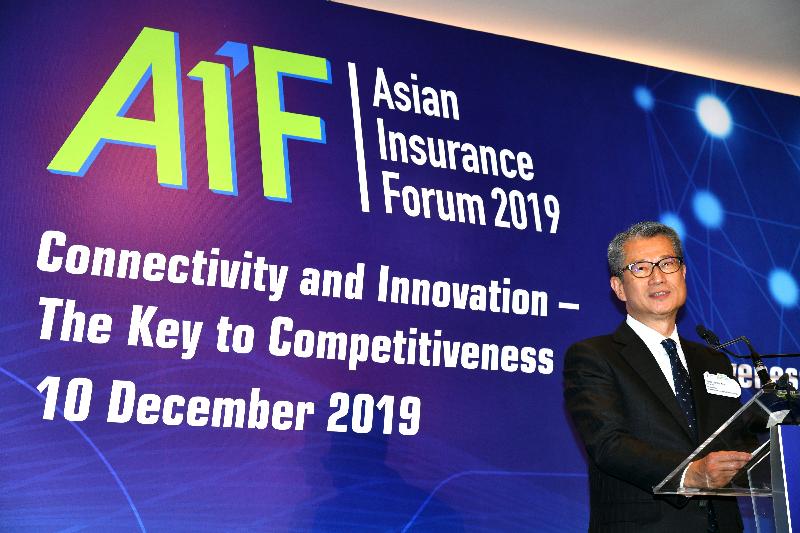
Following is the speech by the Financial Secretary, Mr Paul Chan, at the Asian Insurance Forum 2019 Keynote Luncheon today (December 10):
Moses (Chairman of the Insurance Authority, Dr Moses Cheng), Clement (Chief Executive Officer of the Insurance Authority, Mr Clement Cheung), distinguished guests, ladies and gentlemen,
It is a pleasure to join you today at the Asian Insurance Forum Luncheon.
It is always a pleasure to speak to the insurance industry and the people who have made it so successful – so important to the financial services sector and Hong Kong economy as a whole.
That said, there is little pleasure for me, and I’m sure for all of you here today, in discussing the shape of the Hong Kong economy.
Forecasts of Hong Kong’s economic growth in 2019 by the International Monetary Fund and private sector analysts range from -2.1 per cent to +0.7 per cent. Our own estimate is -1.3 per cent.
At best, it is a distressing result. The reasons behind this are both global and local.
Globally, the protracted trade dispute between the United States and China has put a brake on global GDP this year, while disrupting the Hong Kong economy.
And, of course, the social unrest in Hong Kong over the past few months has severely affected our economy, particularly tourist trade and related industries. The volume of retail sales fell sharply by 19.5 per cent in the third quarter, and then almost 25 per cent in October, which is indeed the worst decline on record.
To counter the increasingly bleak economic environment, I have announced several rounds of relief measures to support companies and to help alleviate the burden weighing on the people of Hong Kong.
These measures include a new loan scheme with a 90 per cent guarantee from the Government, electricity subsidy, rate concession, waiver of Government fees and charges, etc, just to name a few. Nevertheless, they alone would not solve all our problems.
What will help locally is finding a way forward through community dialogue. The Government, let me assure you, is working very hard to make that happen.
No less important, we must ensure that Hong Kong’s institutional strengths remain uncompromised. I’m talking of the “one country, two systems” framework, the rule of law, the independent judiciary, an open and free society, the free flow of capital, goods and talents, freely convertible currency, and our simple and low tax regime.
As for the insurance industry, I believe that the theme of this year’s Forum, “Connectivity and Innovation – the Key to Competitiveness and Inclusiveness”, is certainly relevant.
Over the past few months, I have done a good deal of business travelling, from South America to North America and on to the United Kingdom, and I’ve noticed that “innovation” is a recurring element among most of these visits and meetings.
In October, for example, I led a Hong Kong fintech business delegation to London to promote fintech co-operation. We met with local industry leaders and regulators and explored a variety of innovative fintech opportunities.
In November, I attended the Hong Kong Fintech Week, a showcase event that combined innovation lab visits as well as industry-driven side events and education.
Wherever I went, it was abundantly clear to me, and those I talked with, that innovation is the key to global competitiveness.
For the insurance sector, innovation spurs new service ideas and products and creates alternative distribution channels to reach out to underserved customers and those among the public still unserved. This can narrow the protection gap, while broadening financial inclusiveness.
In that regard, I am happy to note that the Future Task Force of the Insurance Industry has been set up. It will work hand in hand with the Insurance Authority in exploring insurance industry prospects and possibilities. That includes insurtech.
I spoke of connectivity a moment ago. Our ever-deepening economic connectivity with the Mainland will contribute to our competitiveness long down the insurance road.
The Central Government announced 16 policy measures following the third meeting of the leading group for the development of the Greater Bay Area last month. Three of these measures were related to the insurance industry.
Let me briefly run through them for you. The first measure is the extension of preferential treatment. Capital requirements on Mainland insurers will be reduced when they cede their business to qualified Hong Kong reinsurers.
The second measure removes the operating experience requirement for Hong Kong service suppliers looking to provide insurance-loss adjusting services on the Mainland.
The third measure affirms the Central Government’s support for Mainland insurers wishing to issue catastrophe bonds in Hong Kong.
Taken together, these measures will enhance our regional competitiveness, encourage companies to expand into the Greater Bay Area and reinforce Hong Kong’s position as the insurance hub of Asia.
There are also encouraging developments under CEPA – our free trade pact with the Mainland. Just a few weeks ago, the Hong Kong SAR Government and the Ministry of Commerce signed an amendment agreement under CEPA. It updates the liberalisation and facilitation of trade in services implemented in 2016.
For the insurance sector, the amendment agreement introduces a number of new measures. They include the removal of specific market-entry requirements for insurance companies and the removal of the maximum shareholding percentage allowed for Hong Kong companies in Mainland insurance companies.
It also relaxes requirements for Hong Kong insurance agencies setting up companies in the Mainland, making it easier for them to tap into the vast Mainland market.
If you’re looking to the Mainland for new business opportunities, I know that the Insurance Authority, which works closely with its Mainland counterparts, will be pleased to advise you on all the details.
Then there is the Belt and Road Initiative, designed to promote market integration and expand connectivity among economies, cultures and peoples.
Hong Kong is indeed well positioned to provide insurance and re-insurance for large-scale infrastructure projects along the Belt and Road.
Hong Kong is also an ideal domicile for Mainland companies looking to establish captive insurance companies to meet their risk management needs as they go global.
According to a research paper produced by a major international insurance corporation, up to 2016, Belt and Road projects had a value of US$1.2 trillion, and the insurance premium potential from such projects was estimated at US$7 billion.
It was also estimated that Belt and Road construction projects from August 2016 to 2030 could generate another US$27 billion in insurance premiums.
The Insurance Authority, I’m pleased to note, under the capable leadership of Moses and Clement, has established a Belt and Road insurance exchange platform. It’s designed to promote the exchange of intelligence, to build alliances and enable networking. In short, it will help the industry seize the far-reaching promise of the Belt and Road Initiative.
To take full advantage of the opportunities, we will need to find a continuing supply of financial talent.
The Government’s Pilot Programme to Enhance Talent Training for the Insurance Sector has been doing just that since 2016.
As of October, more than 4 000 practitioners have participated in courses under the Pilot Programme. They include technical courses, as well as the latest international developments on insurance industry regulation.
The Hong Kong Academy of Finance, announced in my 2018-19 Budget, was established in June this year. It enjoys the participation of the Hong Kong Monetary Authority, the Securities and Futures Commission, the Mandatory Provident Fund Schemes Authority and, of course, the Insurance Authority.
Ladies and gentlemen, Hong Kong is in a testing time. And we have much to do to resolve our difficulties in a peaceful and harmonious manner. But, in good time, we will do so. In good time, our community, as well as our economy, will find its way forward again. And in that, we will all be beneficiaries.
I wish you all a rewarding afternoon, and the best of business in 2020.
Thank you very much.