Tag Archives: China

image_pdfimage_print

Communications Authority press release

The following is issued on behalf of the Communications Authority:
 
     This press release summarises the decisions of the Communications Authority (CA) following its 92nd meeting held in January 2020:

CA publishes the Spectrum Release Plan (SRP) for 2020 – 2022
————————————————————————–

     The CA published today (January 10) the new SRP for 2020 – 2022 in accordance with the Radio Spectrum Policy Framework promulgated by the Government in April 2007 to inform the industry of the potential supply of spectrum for provision of public mobile and/or other wireless communications services in the following three years.

     According to the newly published SRP, the CA will release a maximum of 160 MHz of spectrum in the 600/700MHz bands and 80 MHz of spectrum in the 4.9 GHz band to the market in 2021 as an ongoing effort to release more spectrum to facilitate the development of public mobile services including the fifth generation mobile (5G) services. In addition, there is 2 900 MHz of spectrum available in the 26/28 GHz bands for assignment. The latest SRP also covers the planned re-assignment of 15 MHz of spectrum in the 850 MHz band and 90 MHz of spectrum in the 2.5/2.6 GHz bands upon the expiry of the existing terms of assignment in 2023 and 2024 respectively.

     The SRP for 2020 – 2022 is available on the CA’s website (www.coms-auth.hk/filemanager/en/content_613/spectrum_plan2020_en.pdf).

Free TV licensees not required to broadcast educational television (ETV) programmes from next school year
———————————————————————————–

     The CA decided to lift the requirement for domestic free television programme service (free TV) licensees to broadcast ETV programmes for schools after the end of the current school year in June 2020.

     The Broadcasting Ordinance (Cap. 562) and the free TV licences empower the CA to require the licensee to broadcast without charge any ETV programme supplied by the Government. At present, Television Broadcasts Limited (TVB) is required to broadcast on its English channel (viz. the Pearl channel) one hour of ETV programmes (from 9am to 10am) on each school day. ETV programmes are also broadcast by Radio Television Hong Kong (RTHK) on its free TV service. The other two free TV licensees (i.e. HK Television Entertainment Company Limited and Fantastic Television Limited) are currently not required to broadcast ETV programmes.

     In response to a request from TVB for lifting the broadcasting requirement for ETV programmes, the CA consulted the relevant government bureaux, namely the Commerce and Economic Development Bureau and the Education Bureau (EDB).

     The CA noted that there has been a growing trend in accessing ETV programmes through the Internet and the mobile app, and the consistently low TV ratings (from 0 to 0.5). The need/demand for viewing ETV programmes on free TV channels at designated hours on each school day is expected to further diminish in the future. The CA also noted that following a review on ETV service, the EDB has concluded that ETV service will be re-positioned, from the 2020-21 financial year, to go beyond the confines of traditional TV programmes with a view to developing more diverse curriculum resources in the era of e-learning. The CA considered that the requirement for TVB to broadcast ETV programmes may cease after the end of the current school year (i.e. June 5, 2020) so as to tie in with the EDB’s timetable for implementing new measures relating to ETV service from the 2020-21 financial year.

     Having regard to TVB’s request and the above considerations, the CA decided to lift the requirement on TVB for broadcasting ETV programmes with effect from June 6, 2020. The effect of lifting the requirement would be minimal given that the public could continue to have access to ETV programmes through RTHK’s free TV service and other new media platforms. The airtime released may be used by TVB to provide other programmes, thereby broadening the programme choice to cater for the interests of viewers. read more
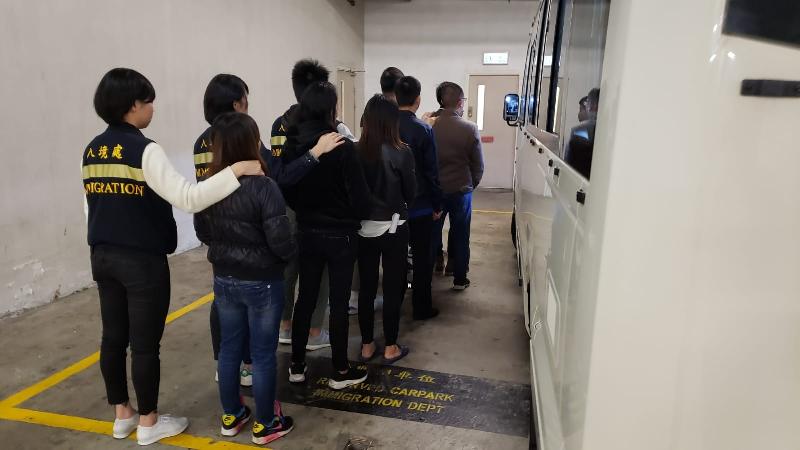
Thirty-four persons arrested during anti-illegal worker operations (with photo)

    The Immigration Department (ImmD) mounted territory-wide anti-illegal worker operations codenamed “Twilight”, “Contribute” and “Fastrack” from January 6 to yesterday (January 9). A total of 25 suspected illegal workers and nine suspected employers were arrested.

     During the operations, ImmD Task Force officers raided 31 target locations including commercial buildings, a construction site, a hair salon, massage parlours, premises under renovation, restaurants, stores and a watch maintenance centre. The suspected illegal workers comprised 12 men and 13 women, aged 23 to 53. Among them, two men were holders of recognisance forms, which prohibit them from taking any employment. In addition, three men and four women were suspected of using and being in possession of forged Hong Kong identity cards. Meanwhile, six men and three women, aged 40 to 63, were suspected of employing the suspected illegal workers.

     “Any person who contravenes a condition of stay in force in respect of him shall be guilty of an offence. Also, visitors are not allowed to take employment in Hong Kong, whether paid or unpaid, without the permission of the Director of Immigration. Offenders are liable to prosecution and upon conviction face a maximum fine of $50,000 and up to two years’ imprisonment. Aiders and abettors are also liable to prosecution and penalties,” an ImmD spokesman said.

     The spokesman warned that, as stipulated in section 38AA of the Immigration Ordinance, illegal immigrants or people who are the subject of a removal order or a deportation order are prohibited from taking any employment, whether paid or unpaid, or establishing or joining in any business. Offenders are liable upon conviction to a maximum fine of $50,000 and up to three years’ imprisonment. The Court of Appeal has issued a guideline ruling that a sentence of 15 months’ imprisonment should be applied in such cases. It is an offence to use or possess a forged Hong Kong identity card or a Hong Kong identity card related to another person. Offenders are liable to prosecution and a maximum penalty of a $100,000 fine and up to 10 years’ imprisonment.

     The spokesman reiterated that it is a serious offence to employ people who are not lawfully employable. The maximum penalty is imprisonment for three years and a fine of $350,000. The High Court has laid down sentencing guidelines that the employer of an illegal worker should be given an immediate custodial sentence. According to the court sentencing, employers must take all practicable steps to determine whether a person is lawfully employable prior to employment. Apart from inspecting a prospective employee’s identity card, the employer has the explicit duty to make enquiries regarding the person and ensure that the answers would not cast any reasonable doubt concerning the lawful employability of the person. The court will not accept failure to do so as a defence in proceedings. It is also an offence if an employer fails to inspect the job seeker’s valid travel document if the job seeker does not have a Hong Kong permanent identity card. The maximum penalty for failing to inspect such a document is imprisonment for one year and a fine of $150,000.

     Under the existing mechanism, the ImmD will, as a standard procedure, conduct initial screenings of vulnerable persons, including illegal workers, illegal immigrants, sex workers and foreign domestic helpers who are arrested during any operation with a view to ascertaining whether they are trafficking in persons (TIP) victims. When any TIP indicator is revealed in the initial screening, the officers will conduct a full debriefing and identification by using a standardised checklist to ascertain the presence of TIP elements, such as threats and coercion in the recruitment phase and the nature of exploitation. Identified TIP victims will be provided with various forms of support and assistance, including urgent intervention, medical services, counselling, shelter, temporary accommodation and other supporting services. The ImmD calls on TIP victims to report crimes to the relevant departments.

Photo  
read more

Hong Kong Customs continues “Tornado” special operation against unfair trade practices by fitness centres

     Hong Kong Customs has mounted a special operation codenamed “Tornado” since the end of 2018 against unfair trade practices by fitness centres. Customs officers continued to conduct the fourth phase of the enforcement operation in the past two months and smashed four fitness centres in Mong Kok and Yau Ma Tei. A total of 16 persons were arrested after being suspected of having engaged in aggressive commercial practices in the course of selling fitness services, in contravention of the Trade Descriptions Ordinance (TDO). Around $660,000 is involved in the service contracts. Coupled with the earlier operations, a total of 32 persons were arrested during the special operation up to yesterday (January 9).

     Customs officers earlier received information alleging that staff members of four fitness centres in Mong Kok and Yau Ma Tei imposed undue influence and used aggressive commercial practices when selling fitness services to customers, forcing them to procure fitness club membership. In some cases, victims were even taken to another retail shop for high-value consumption.

     Subsequent to in-depth investigation, Customs officers took enforcement action and arrested 16 persons. Aged between 22 and 56, they comprise seven directors and seven salespersons of the fitness centres, and two persons connected with the cases.

     The special operation “Tornado” is ongoing.

     Customs has cumulatively arrested 32 persons during the “Tornado” operation after suspecting them of having engaged in aggressive commercial practices in the course of selling fitness services in contravention of the TDO. The arrested persons, aged between 21 and 56, comprise 11 directors and 17 salespersons of the fitness centres, and four other persons connected with the cases. A total of about $2.46 million is involved in all of the service contracts.

     The Group Head (Unfair Trade Practice Investigation), Ms Suzette Ip, said at a press conference today (January 10) that Hong Kong Customs will continue to step up enforcement to strive to combat unfair trade practices by fitness centres.

     She reminded traders that they must comply with the requirements of the TDO. Consumers are also reminded to procure services from reputable shops. Before making a purchase decision, consumers must not give their identity cards, credit cards or automated teller machine cards to salespersons. They should not purchase the services if they do not fully understand the service and price details. They must also refuse firmly to sign any paper if they do not intend to make a purchase.

     Under the TDO, any trader commits an offence of engaging in aggressive commercial practices if harassment, coercion or undue influence is used to impair a consumer’s freedom of choice or conduct, causing the consumer to make a transactional decision. The maximum penalty upon conviction is a fine of $500,000 and imprisonment for five years.

     Stressing its priority given to consumer rights protection and zero tolerance for unfair trade practices, Customs pledges that it will continue its stringent enforcement actions against such practices by fitness centres.

     Members of the public may report any suspected violations of the TDO to Customs’ 24-hour hotline 2545 6182 or its dedicated crime-reporting email account (crimereport@customs.gov.hk). read more

Statistics on Code on Access to Information for second quarter of 2019

     The Government received a total of 2,764 requests for information under the Code on Access to Information in the second quarter of 2019, a spokesman for the Constitutional and Mainland Affairs Bureau said today (January 10).
 
     The total number of requests received since the introduction of the Code in March 1995 and up to the end of June 2019 amounted to 73,749. Of these, 4,292 requests were subsequently withdrawn by the requestors and 3,615 requests covered cases in which the bureaux/departments concerned did not hold the requested information or cannot confirm or deny the existence of information. As at June 30, 2019, 344 requests were still being processed by bureaux/departments.

     Among the 65,498 requests which covered information held by bureaux/departments and which the bureaux/departments had responded to, 63,454 requests (96.9 per cent) were met, either in full (61,883 requests) or in part (1,571 requests), and 2,044 requests (3.1 per cent) were refused.

     Any member of the public who is dissatisfied with the response of a bureau/department under the Code may request that the matter be reviewed. He or she may also lodge a complaint with the Ombudsman.

     In the second quarter of 2019, the Ombudsman received 16 complaints relating to requests for information. In this quarter, the Ombudsman concluded 13 complaints, among which four were substantiated, four were partially substantiated and five were settled after inquiries by the Ombudsman. As at June 30, 2019, the Ombudsman’s investigations on 28 complaints were ongoing.

     “The Code has provided an effective framework for the public to seek access to information held by the Government,” the spokesman said. read more