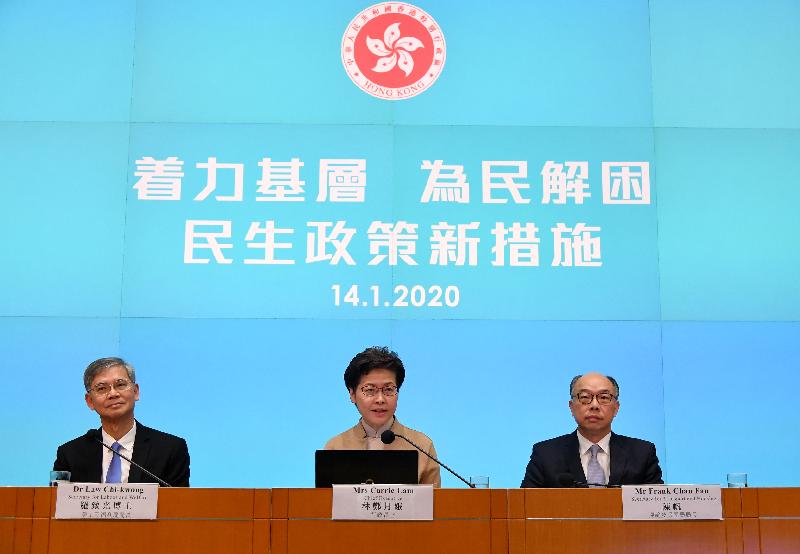
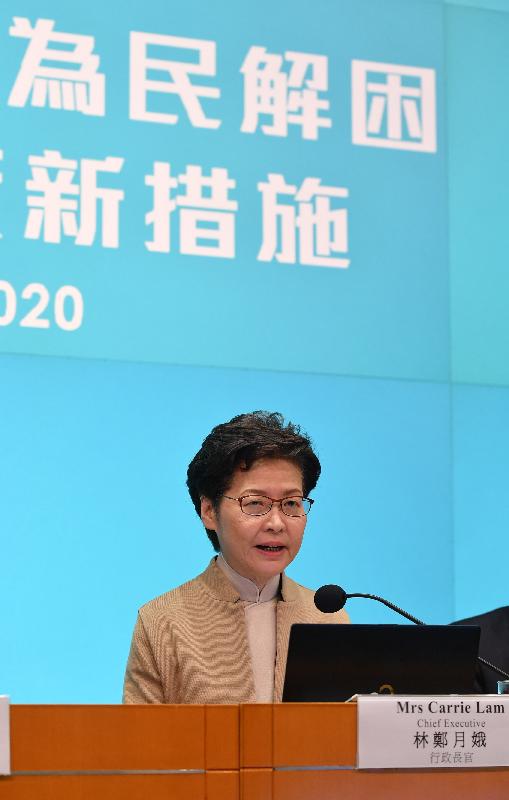
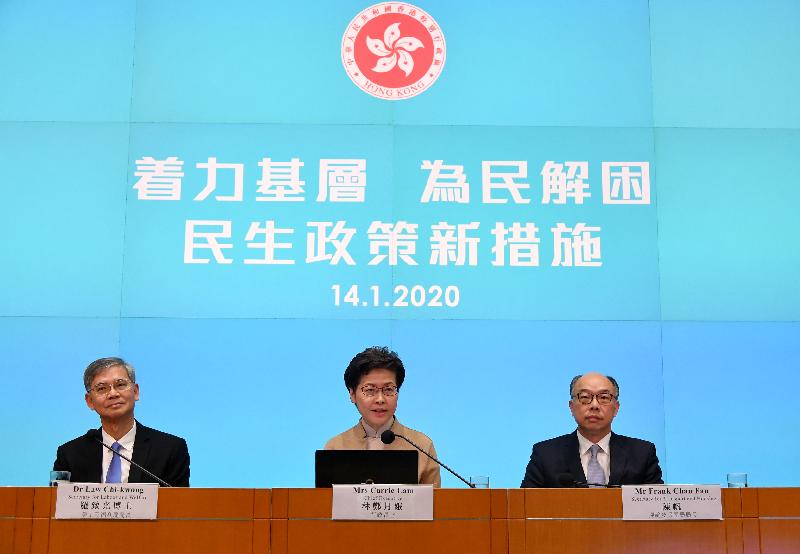
The Chief Executive, Mrs Carrie Lam, together with the Secretary for Labour and Welfare, Dr Law Chi-kwong, and the Secretary for Transport and Housing, Mr Frank Chan Fan, announced today (January 14) a package of 10 new livelihood initiatives to substantially enhance the support for grassroots and underprivileged people.
“The current-term Government attaches great importance to supporting the underprivileged. The recurrent expenditure on social welfare has increased from $65.3 billion in 2017-18 to $84.3 billion in 2019-20, representing a 29 per cent rise, the largest among all policy areas,” Mrs Lam said.
“The 10 new initiatives announced today will benefit over a million grassroots and underprivileged people, including the elderly, workers, low-income households not living in public housing and not receiving Comprehensive Social Security Assistance (CSSA) as well as the unemployed or underemployed and people who are inadequately housed. Building on the foundation of my past three Policy Addresses, we have stepped up efforts and take bolder measures to respond to the aspirations of our grassroots and the underprivileged citizens,” she added.
Mrs Lam said that to cope with an ageing population, the Government has to provide diversified services and suitable support for the elderly such that they can enjoy their golden years. Meanwhile, labour is a valuable asset for Hong Kong. The Government should also enhance protection for the labour force, especially the grassroots workers.
She pointed out that in the face of the economic downturn and rising unemployment rate, apart from supporting enterprises and safeguarding jobs, the Government must provide transitional support for the unemployed or underemployed.
On the housing problem, which is of primary concern to people, Mrs Lam said, “Although the Government has been taking multi-pronged short, medium and long-term measures to expand land resources to increase the housing supply as well as implementing a number of new initiatives to address people’s aspirations for home ownership, it takes time to increase the housing supply. Therefore, we need to provide further assistance to the inadequately housed.”
Reforming the Old Age Living Allowance Scheme (OALA)
—————————————————————
The Government suggested combining the Normal OALA and Higher OALA with a standard monthly payment rate of $3,585, i.e. the monthly payment rate for Higher OALA, and significantly raising the standardised asset limit to $500,000.
The monthly income limit for current recipients of Higher OALA and Normal OALA is $7,970 while the asset limit and the monthly allowance are $150,000 and $3,585 respectively for the former and $343,000 and $2,675 respectively for the latter. There are about 510 000 Higher OALA recipients and about 50 000 Normal OALA recipients. They are elderly people aged 65 or above.
Mrs Lam said, “Some 50 000 current recipients of Normal OALA can receive $910 more per month upon implementation of the proposal and those who have assets of less than $500,000 can receive OALA of $3,585 per month.”
(2) Expanding the $2 transport fare concession scheme
————————————————————–
“Since its launch in 2012, the Government Public Transport Fare Concession Scheme for the Elderly and Eligible Persons with Disabilities, commonly known as the ‘$2 transport fare concession’, has been warmly welcomed by the elderly. The Government proposed to lower the eligible age of the Scheme from the current 65 to 60, benefiting about 600 000 silver-age persons aged 60 to 64,” Mrs Lam said. Details of the implementation timetable will be announced upon completion of the review of the Scheme by the Labour and Welfare Bureau and the Transport Department in the first half of this year.
The Government will study the possibility of issuing a personalised octopus card to all silver-age/elderly persons who are eligible for the $2 transport fare concession scheme, which may also serve as the Social Welfare Department’s Senior Citizen Card.
(3) Paying Mandatory Provident Fund (MPF) contributions for low-income persons
——————————————————————————————-
The Government will pay the 5 per cent contributions on behalf of low-income employees and self-employed persons who are exempted from making MPF contributions. About 200 000 people whose monthly income is less than $7,100 will benefit. The proposal will be carried out upon the implementation of the eMPF Centralised Platform by the Mandatory Provident Fund Schemes Authority in 2024.
(4) Increasing progressively the number of statutory holidays
———————————————————————
At present, the Employment Ordinance provides for 12 days of statutory holidays a year but the General Holidays Ordinance provides for 17 days of public holidays a year. To allow all employees to enjoy the same number of holidays in order to address society’s longstanding concern about unfair treatment, the Government will ask the Labour Advisory Board to work out a proposal to increase progressively the number of statutory holidays so that it is eventually on par with the number of public holidays. It is estimated that more than one million employees will benefit from the proposal. The Government will facilitate and support its work.
“Implementing the proposal progressively will facilitate businesses to shoulder the additional expenditure involved and make adjustments to their operation,” Mrs Lam said.
(5) Improving remuneration packages for employees under government outsourced service contracts
———————————————————————————————————–
In the 2018 Policy Address, Mrs Lam announced improvement measures for the tendering of government service contracts (e.g. cleaning services) to enhance the remuneration packages and protection for the interests of non-skilled employees, and increase the weighting of wage levels in tender assessments thus avoiding the “lowest bid wins”.
“The new policy achieved impressive results in improving the remuneration for workers. The Labour and Welfare Bureau will complete a review by the end of this year and will consider further improvement measures,” she said.
(6) Providing cash allowance for low-income households not living in public housing and not receiving CSSA
—————–
The Government will, on a trial basis, provide a cash allowance to eligible General Applicant households which have been waiting for public rental housing for more than three years, until they are offered the first public rental housing allocation. Approximately 91 900 General Applicant households waiting for public rental housing for more than three years will benefit.
In determining the rate of cash allowances, reference will be made to the level at about half of the CSSA rent allowance ceiling. The trial scheme is expected to be launched in the second half of next year, with a review to be conducted three years after implementation.
Noting that providing cash allowances can alleviate the on-going pressure faced by grassroots citizens from renting private property, Mrs Lam said that the Government will set higher household monthly income limits under the Working Family Allowance Scheme for non-CSSA low-income families that have not applied for public rental housing or have been waiting for public rental housing for less than three years. It will enable them to receive a higher rate of allowance. It is expected to be implemented in the second half of next year, benefiting about 9 000 households.
(7) Conducting a study on tenancy control of subdivided units
———————————————————————
“It is estimated that about 86 500 families have been living in subdivided units for a long time, while bearing heavy rents and unfavourable rental arrangements. There are suggestions that without proper rental regulations, assistance provided by the Government, such as rental subsidies or electricity and water charge reductions, will hardly benefit the target households. The Transport and Housing Bureau will set up a task force to study feasible options on the tenancy control of subdivided units,” said Mrs Lam.
(8) Further increase transitional housing
———————————————
“I committed in the 2019 Policy Address to provide 10 000 transitional housing units over the next three years. Through the collaboration of ‘community, businesses and Government’, land has been identified to achieve the original target. To build on our efforts, we will raise the three-year target to 15 000 units, of which 2 000 will be built on multiple ‘Government, Institution or Community’ sites that currently have no firm development schedule.”
(9) Providing a time-limited cash allowance for the unemployed
———————————————————————–
Due to the deterioration of economic and employment conditions, from April 1 this year to March 31 next year, individuals who have been unemployed for one month or longer and have received assistance from the Working Family Allowance or Student Financial Assistance Schemes before April this year may apply for a cash allowance for that month and for a maximum of three months.
The Community Care Fund Task Force will work out details of the scheme. Payment of the allowance is expected to commence in October this year at the earliest.
(10) Providing a time-limited cash allowance for the under-employed
—————————————————————————–
At present, applicants who meet the requirements of working hours, income and asset limits may apply for the Working Family Allowance.
“In view of worsening under-employment, the Government proposes that, from April 1 this year to March 31 next year, individuals who have received Working Family Allowance in certain months and meet the reduced total monthly working hour requirement for other months may still apply for cash allowance in the respective months with a maximum of three months. The Community Care Fund Task Force will work out details of the scheme, which is expected to be launched in October this year at the earliest,” said Mrs Lam.
Mrs Lam said that the aforementioned proposals for “helping our grassroots people” are consistent with her vision stated in the 2017 Policy Address – to alleviate poverty and support the disadvantaged in order to build a caring and inclusive society. They are also consistent with the fiscal philosophy of wisely using wealth derived from the community for the benefit of the community. She also pointed out that the Financial Secretary is consulting the public on the 2020-21 Budget, and will propose measures to “support enterprises, safeguard jobs, stimulate the economy and improve people’s livelihoods” to further address the needs of the community.