Tag Archives: China

image_pdfimage_print

HKSAR Government’s response to Moody’s announcement of changes to Hong Kong’s long-term issuer rating and credit outlook

     In response to the announcement by Moody’s Investors Service yesterday (January 20) to downgrade Hong Kong’s long-term issuer rating to “Aa3” from “Aa2”, while changing the credit outlook to “stable” from “negative”, a Government spokesman made the following comments:

     “We strongly disagree with Moody’s assessment of Hong Kong’s current situation and are deeply disappointed by Moody’s decision to downgrade Hong Kong’s credit rating.

     “The constitutional and legal status of the Hong Kong Special Administrative Region (HKSAR) is very clear. Article 1 of the Basic Law points out that the HKSAR is an inalienable part of the People’s Republic of China (PRC). Article 12 of the Basic Law states that the HKSAR shall be a local administrative region of the PRC which shall enjoy a high degree of autonomy and come directly under the Central People’s Government. Article 43 of the Basic Law stipulates that the Chief Executive of the HKSAR shall be accountable to the Central People’s Government and the HKSAR in accordance with the provisions of the Basic Law. Since the return to the Motherland, the HKSAR Government has been implementing ‘one country, two systems’, ‘Hong Kong people administering Hong Kong’ and a high degree of autonomy in strict accordance with the Basic Law. We do not consider that there is sufficient ground for Moody’s to raise any query on them.

     “Although Hong Kong has faced the most severe social unrest since its return to the Motherland in the past seven months or so, the HKSAR Government, with the staunch support of the Central Government, has firmly upheld the ‘one country, two systems’ principle and handled the situation in accordance with the law to curb violence on its own to restore social order as soon as possible.
 
     “Moody’s rating falls way out of line with Hong Kong’s sound credit fundamentals. Our fiscal performance and external positions have long been amongst those of the top-rated economies and serve as a strong buffer for Hong Kong to withstand shocks. Confidence in the Linked Exchange Rate System has remained strong, as acknowledged by Moody’s. The banks are well cushioned given their strong capital base, sound liquidity and healthy asset quality. Capital markets have had a good run in the past year, as initial public offerings and bond financing activities have continued to thrive, and Stock Connect and Bond Connect saw surges in turnover.

     “The persistent social unrest reflects that there are deep-seated problems in society in Hong Kong, on which the Government will conduct an independent review soon. We are also proactively engaging people from different backgrounds, political stances and age groups through dialogue and listening to their views humbly to find a way out for society.

     “Actually, quite a number of social issues that Hong Kong is facing, including wealth inequality, an ageing population and high home prices as mentioned by Moody’s are not unique to Hong Kong. Hong Kong’s institutional strengths and its core competitiveness as an international financial centre, trade hub as well as one of the best places in the world to do business remain well in place. They include the rule of law and an independent judiciary; a robust supervisory regime; free flows of capital, talent, goods and information; a simple and low tax regime; efficient infrastructure; and quality professional services.

     “The HKSAR Government has been proactively handling the above-mentioned social issues over the years. On improving people’s livelihoods, the current-term Government announced in the Chief Executive’s Policy Addresses in 2017, 2018 ad 2019 a series of initiatives to help the underprivileged, including various social security schemes with cash allowances and welfare services for people in need. As a result, the recurrent expenditure on social welfare has increased from $65.3 billion in 2017-18 to $84.3 billion in 2019-20, representing a 29 per cent rise.

     “In the face of an ageing population, the HKSAR Government has been implementing targeted measures to provide better retirement protection. For instance, the Higher Old Age Living Allowance launched in 2018 has become the most popular elderly social security payment, with more than 510 000 elderly persons currently receiving $3,585 per month. The Chief Executive has recently announced major improvements to the Allowance, which include substantially increasing the standardised asset limit of the above-mentioned payment to $500,000, benefiting more elderly people.

     “On housing prices, maintaining the healthy development of the property market remains one of the policy objectives of the Government. To achieve this objective, the HKSAR Government has all along adopted a two-pronged approach by increasing the housing land supply through short, medium and long-term means under the ‘supply-led’ strategy to address the demand-supply imbalance at source in the long run, and at the same time implementing appropriate demand-side management measures as and when necessary to minimise various adverse consequences that may arise from an overheated market.

     “To intensify the effort to meet the needs of the people for public housing, the Government has increased the ratio of public housing from 60 per cent to 70 per cent in the 10-year Long Term Housing Strategy, introduced a ‘starter home’ scheme for middle-income families and delinked the sale prices of subsidised flats from market prices to ensure affordability. The Government will continue to strive to avert the current demand-supply imbalance and strengthen the housing ladder, with a view to helping families in different income brackets to gain access to adequate and affordable housing.

     “The HKSAR Government will continue to humbly listen to members of the public and strengthen communications with the citizens, overcome these challenges and help relaunch Hong Kong.” read more

EPD announces air quality monitoring results in 2019

     The Environmental Protection Department (EPD) announces today (January 20) the overview of Hong Kong’s air quality in 2019. The annual average concentrations of five major air pollutants (including respirable suspended particulates (PM10), fine suspended particulates (PM2.5), nitrogen dioxide (NO2), sulphur dioxide (SO2) and ozone (O3) in 2019 are listed in Annex 1.

     With the implementation of emission reduction measures and collaboration with the Guangdong province to improve regional air quality over the years, the overall air quality in Hong Kong has shown a discernible improvement. From 1999 to 2019, the concentrations of PM10, PM2.5, NO2 and SO2 in ambient air have reduced by 34 per cent to 80 per cent from their highest levels, while the roadside concentrations of the same pollutants have also reduced by 34 per cent to 82 per cent from their highest levels as well (as detailed in Annex 2). As for smog, the number of hours of reduced visibility in Hong Kong has also reduced by 70 per cent from the peak. Regarding regional air quality issue, the analysis of the satellite data from the Hong Kong University of Science and Technology shows that the PM2.5 level in the Pearl River Delta (PRD) region has improved significantly (as detailed in Annex 3).

     Although roadside NO2 shows a significant declining trend, it is still at a high level. Its annual average concentration in 2019 is 80μg/m3, which is twice the Air Quality Objectives (AQOs) limit. Although commercial vehicles (including trucks, buses, minibuses, and taxis) account for only about 20 per cent of the total number of vehicles, they are the main source of roadside NO2 emissions, accounting for more than 90 per cent of the total emissions of all vehicles in Hong Kong. Therefore, commercial vehicles will continue to be the focus of the Government’s efforts to improve roadside air quality.

     The ambient ozone is still on a rise. An EPD spokesman said, “Ozone was a complicated air pollution issue as well as a regional issue. It was not directly emitted from pollution sources but formed through photochemical reaction between nitrogen oxides (NOx) and volatile organic compounds (VOCs) in the presence of sunlight. Apart from the high regional background ozone level, the rise in the ozone levels in recent years could be attributed to the reduction in local NOx emissions from vehicles (which led to less nitric oxide to react with and titrate ozone and hence less ozone consumption and higher ozone level in the ambient air), and indirectly resulted in the rise in the roadside and urban ozone levels.”

     Based on the experience in improving air pollution by some European countries and the United States, they also encounter the lag effect in ozone concentrations. Owing to complicated photochemical reactions, the smog problem and the reduction of NOx at the early stage will often lead to an increase in the levels of ozone. After continued emission reduction efforts, the ozone concentrations will start to decline. Regional collaboration is the key point in improving ozone levels. The Hong Kong and Guangdong Governments have commenced the study on post-2020 regional air pollutant emission reduction targets and concentration levels, with a view to formulating emission reduction targets beyond 2020 and predicting the achievable air quality levels. To tackle ozone problem specifically, the Governments of Hong Kong, Guangdong and Macao will launch a 3-year joint study from 2020 to 2023 on “Photochemical Ozone Pollution in Greater Bay Area and Characterization of Regional and Super-Regional Transportation of Ozone”, in order to better apprehend the origins of ozone precursors, the formation mechanism of ozone in the Greater Bay Area and its regional and super-regional transportation. In addition, the Hong Kong and Guangdong Governments are also adding the real-time VOCs monitoring in the regional air quality monitoring network by stages. The Government is also planning to install Light Detection and Ranging (LIDAR) system to measure real-time vertical and three-dimensional distribution of the concentrations of ozone and particulates, as well as wind profile at higher altitudes for tracking transportation of pollutants over Hong Kong, with a view to devising policies to tackle ozone pollution.

     The Environment Bureau (ENB) released “A Clean Air Plan for Hong Kong” in 2013 to implement a wide range of measures on local pollution sources covering land and sea transport as well as power plants, including phasing out some 80,000 pre-Euro IV diesel commercial vehicles; strengthening the control of emissions of liquefied petroleum gas and petrol vehicles; tightening the vehicle emission standards; progressively tightening the emissions of power plants; and requiring vessels to use cleaner fuels.

     “In addition to the policies implemented, the Government will continue to launch various air quality improvement measures to reduce local emissions, including reducing vehicle emissions, promoting the use of electric vehicles, reducing emissions of marine vessels and controlling the emissions of power plants (as detailed in Annex 4). We are in the progress of reviewing the AQOs. Upon its completion, we will update ‘A Clean Air Plan for Hong Kong’ to work out the long-term plans to further improve Hong Kong’s air quality,” the spokesman added. read more

Hong Kong Customs celebrates 2020 International Customs Day (with photos)

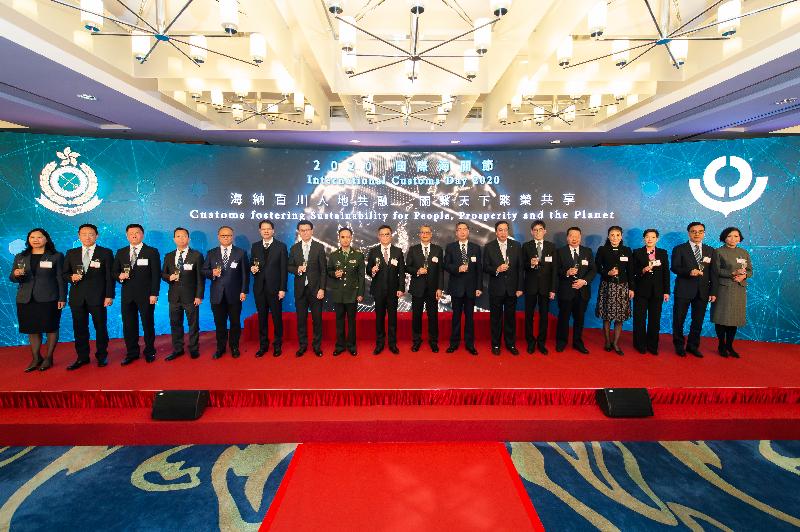
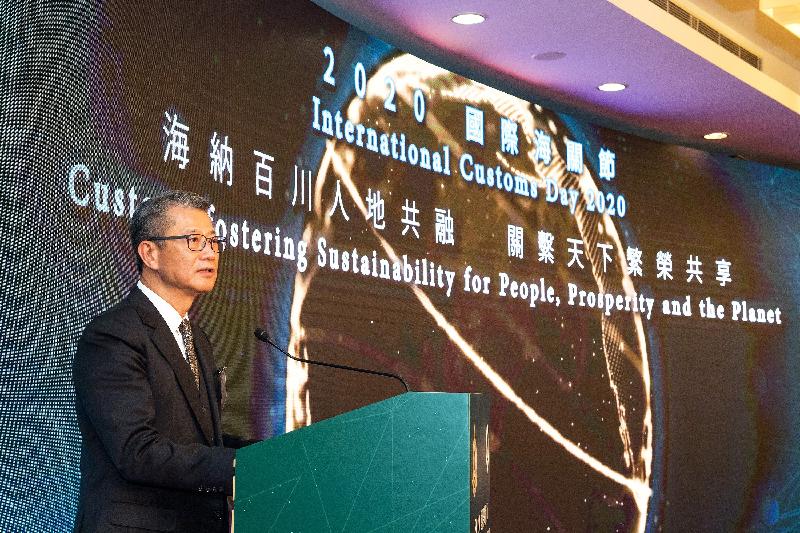
     Officiated by the Financial Secretary, Mr Paul Chan, and the Commissioner of Customs and Excise, Mr Hermes Tang, a reception in celebrating the 2020 International Customs Day (ICD) was held by Hong Kong Customs at the Customs Headquarters Building today (January 20).

     This year, the World Customs Organization (WCO) devotes ICD to the theme of “Customs fostering Sustainability for People, Prosperity and the Planet”, which aims at ensuring a sustainable future where social, economic and environmental elements are at the centre of Customs actions.

     Officiating at the reception, Mr Chan said that Hong Kong Customs is making considerable contributions to combat illegal activities and to provide a safe and stable environment for the people of Hong Kong. Without Customs’ collective efforts, illegal drugs, endangered species, counterfeit products and other illicit goods would seriously damage our community. Hong Kong Customs also plays a pivotal role in facilitating trade and promoting our economy.

     In his remarks, Mr Tang elaborated the close relationship between Hong Kong Customs’ work and the theme of this year’s ICD along three concepts: “People”, “Prosperity” and “Planet”. The work includes people-oriented enforcement and crime prevention operations, trade facilitation measures to bring prosperity, and anti-smuggling of endangered species to conserve the earth. 

     He expressed that the three concepts are in line with the notion of “community with a shared future for mankind” while the Belt and Road Initiative serves as a platform to build the community.  

     Hong Kong Customs has celebrated the ICD since Hong Kong became a member of the WCO in 1987. At the reception, Mr Chan presented WCO Certificates of Merit to officers of Hong Kong Customs and private stakeholders in recognition of their remarkable efforts contributing to sustainable development.

     About 350 guests, including Members of the Executive and Legislative Councils, HKSAR Government officials, Consuls General, foreign Customs attachés, representatives from Customs administrations of the Mainland and Macao, as well as private stakeholders, attended the reception.

Photo  Photo  Photo  
read more