Serious impact on public hospital services
The following is issued on behalf of the Hospital Authority: The spokesperson for Hospital Authority (HA) made the following announcement today (4 February). &nbs… read more


The following is issued on behalf of the Hospital Authority: The spokesperson for Hospital Authority (HA) made the following announcement today (4 February). &nbs… read more
The following is issued on behalf of the Hospital Authority: During the winter surge, the Hospital Authority is closely monitoring the service demand of Accident and Emergency Departments and the occupancy rates in public ho… read more
In response to the situation of the novel coronavirus infection and having considered the advice of experts, the Government yesterday (February 3) announced that the consolidation of control points must be taken in a more resolute manner in order to further reduce the flow of people between the Mainland and Hong Kong significantly. Cross-boundary passengers by land or by sea will be converged to Shenzhen Bay and Hong Kong-Zhuhai-Macao Bridge control points, while passenger clearance services at four control points – Lo Wu, Lok Ma Chau Spur Line, Lok Ma Chau and Macau Ferry Terminal – will be suspended. Coupled with the other control point management measures implemented on January 30, the number of control points with passenger clearance services suspended will increase to 10.
A Government spokesman said that a number of measures to reduce the flow of people between the Mainland and Hong Kong were implemented on January 30, yielding a significant result. The number of passenger trips arriving in Hong Kong via all control points (except the airport) on February 2 was 73 019, which has dropped 57 per cent compared to the figure on January 29 before the measures came into effect, with Hong Kong residents (63 316 passenger trips) taking up 87 per cent of the total (73 019 passenger trips). Meanwhile, the Government noted that there were still a large number of Hong Kong residents (31 771 passenger trips) departing via all control points (except the airport) on February 2. As these Hong Kong residents return to Hong Kong from the Mainland, the risk of the disease being imported into Hong Kong will increase.
The spokesman said that, from a public health point of view, the spread of the virus occurs regardless of race, nationality and residency status. It is necessary to reduce as much as possible the flow of people across the border, which should cover Hong Kong residents, Mainland residents and other travellers. Since Hong Kong has close ties with the Mainland in terms of the flow of people and goods, it is necessary to maintain limited and controllable services at control points.
The spokesman said that Hong Kong must strictly manage the control points to reduce the cross-boundary flow of people. As a result, the control point services at four control points – Lo Wu, Lok Ma Chau Spur Line, Lok Ma Chau and Macau Ferry Terminal – will be suspended with effect from today (February 4) until further notice. The consolidation of the control points will enable relevant government departments to focus their manpower and carry out more stringent disease control and prevention measures including enquiries, health declarations and body temperature checks at the control points still in service.
Starting from today, people – including Hong Kong residents – travelling between Hong Kong and the Mainland or between Hong Kong and other places will have to use control points at the Hong Kong International Airport, Shenzhen Bay and the Hong Kong-Zhuhai-Macao Bridge which provide regular services, plus the Kai Tak Cruise Terminal that provides services when cruise liners are berthed.
The spokesman stressed that all land-based cargo clearance remains normal, so members of the public need not worry about food supplies.
The spokesman said that the Government will continue to monitor closely the situation including the development of the spread of the disease and the changes in the number of passenger traffic, pointing out that it will not hesitate to adopt further measures if necessary including imposing a mandatory quarantine on certain inbound travellers. The Government will continue to prepare more quarantine centre facilities to meet the demand. The Department of Health had also announced earlier the arrangement for mandatory home isolation when necessary.
The spokesman said that the Chief Executive wrote to Consuls-General in Hong Kong on February 2, while the Chief Secretary for Administration together with relevant directors of bureaux met with them, explaining in detail the measures taken by Hong Kong in disease prevention and control, which are in line with the World Health Organization’s advice. The Consuls-General were requested to convey to their capital that Hong Kong has a robust, multi-faceted and well-tested system that is open and transparent to tackle the current situation. The Government takes the view that suspending air passenger services to Hong Kong or drastic measures such as restrictions against entry of Hong Kong residents are unjustified and unwarranted, and it will maintain close contact with various governments on the issue.
The spokesman appeals to members of the public not to travel to places where there is an outbreak of the disease and to co-operate with the Centre for Health Protection and healthcare staff including providing accurate information about their travel history to enable officers to perform follow-up duties. Pointing out that the current supply of surgical masks remains tight, the spokesman appeals to the public to stay at home as much as possible and observe personal hygiene to help reduce the consumption of surgical masks. Expressing once again its gratitude to those healthcare workers who stand fast at their posts against the current epidemic, the Government pledged to do its utmost to provide sufficient protective gear and equipment to front-line officers.
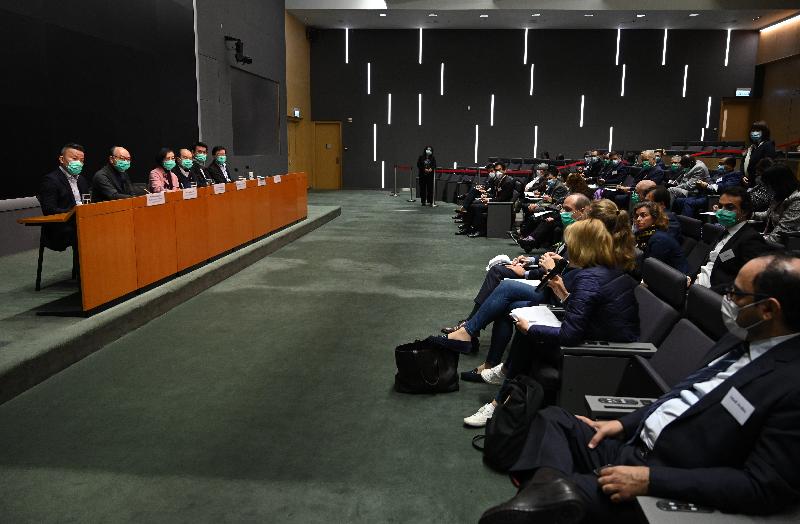
The following is issued on behalf of the Hospital Authority:
The Hospital Authority (HA) today (February 3) urged all healthcare workers participating in industrial action to return to work as soon as possible to avoid further affecting public hospital services and patient treatment.
The HA Chief Executive, Dr Tony Ko, had a meeting with staff members this evening. Dr Ko said, “I hope our colleagues can return to work as soon as possible in the interests of our patients and to avoid overloading the other colleagues stay on duty.”
“We share the same objective with our colleagues that the cross-boundary passenger flow should further be reduced to avoid the spreading of the virus. However, we disagree with compromising patient safety when expressing opinions.”
The HA Major Incident Control Centre has been closely monitoring the operation of public hospitals today, noting about 2,700 healthcare workers were absent from duty. Although some of the non-emergency services have been reduced in advance, hospital services are still being further affected today.
“While public hospitals have already adjusted service volume earlier to maintain emergency services. For instance, the service quota in General Outpatient Clinics has been reduced by about 25 per cent, while other non-emergency services and Allied Health services have also been reduced by half. Consultation arrangements, treatment procedures and elective surgeries of some patients have also been postponed.”
Services that have been affected to a more serious extent include the Neonatal Intensive Care Unit, High Dependency Unit, Cardiothoracic Surgery, Isolation Ward and Emergency Medicine Ward in various hospitals. In addition, percutaneous coronary intervention procedures and radiological diagnostic services in some hospitals have also been affected. Many of these services being affected are provided to severely-ill patients.
“If the industrial action continues, public hospitals need to further curtail services, which may eventually affect emergency services and the epidemic prevention work,” Dr Ko added.
Dr Ko again thanked the staff who have stayed on duty and being deployed to cope with the extra workload caused by the strike.
The HA welcomes the Government’s implementation of more measures to further reduce cross-boundary passenger flow, which shall enhance the capability of Hong Kong in the combat against the epidemic.
For media enquiries, please contact the News Duty Officer (pager: 7328 3855). read more
The Centre for Health Protection (CHP) of the Department of Health is today (February 3) investigating a case of severe paediatric influenza A infection and reminded the community to heighten vigilance against influenza.
The case involves an 8-year-old boy with good past health, who has presented with fever, cough and sore throat since February 1 and vomiting today. He was sent to Tuen Mun Hospital today where he was admitted for further management. His respiratory specimen tested positive for influenza A (H1) virus upon laboratory testing. The clinical diagnosis was influenza A infection complicated with encephalopathy. He is now in serious condition.
Initial enquiries revealed that the patient had received seasonal influenza vaccination (SIV) for this season and had no travel history during the incubation period. The patient’s home contacts have remained asymptomatic so far.
The CHP’s investigations are ongoing.
A spokesman for the CHP said, “Hong Kong has already entered the 2019-20 winter influenza season and seasonal influenza activity is expected to remain at an elevated level for some time. Members of the public aged six months or above who have not yet received influenza vaccination, particularly children, the elderly and those with underlying illnesses, are advised to receive an SIV as early as possible to better protect themselves in the coming winter influenza season against influenza A and B infections. It takes about two weeks for antibodies to develop in the body after vaccination.”
The 2019/20 seasonal influenza vaccination programmes, including the Vaccination Subsidy Scheme and the Government Vaccination Programme, have been launched. As well, the SIV school outreach has been regularised to allow all primary schools to join, and has been extended to kindergartens, child care centres and kindergarten-cum-child care centres as a pilot.
“Influenza can cause serious illnesses in high-risk individuals and even healthy persons. Given that influenza vaccines are safe and effective, all persons aged six months or above, except those with known contraindications, are recommended to receive an SIV for personal protection. Vaccinations among family members is key to protecting their personal and family health,” the spokesman said.
The public should maintain good personal and environmental hygiene for protection against influenza and other respiratory illnesses:
• Receive an SIV for personal protection;
• Wash hands with liquid soap and water properly whenever possibly contaminated;
• When hands are not visibly soiled, clean them with 70 to 80 per cent alcohol-based handrub as an effective alternative;
• Wash or clean hands frequently, especially before touching the mouth, nose or eyes, or after touching public installations such as handrails or door knobs;
• Cover the nose and mouth when sneezing or coughing, and wash hands thoroughly afterwards;
• Dispose of soiled tissue paper properly in a lidded rubbish bin;
• Put on a surgical mask when respiratory symptoms develop;
• Maintain good indoor ventilation;
• Avoid going to crowded or poorly ventilated public places; high-risk individuals may consider putting on surgical masks when staying in such places; and
• Maintain a balanced diet, exercise regularly, take adequate rest, do not smoke and avoid overstress.
The public may visit the CHP’s influenza page and weekly Flu Express for more information. read more