Tag Archives: China

DH announces latest situation regarding Legionnaires’ disease cases

     The Centre for Health Protection (CHP) of the Department of Health (DH) today (November 16) reported the latest number of Legionnaires’ disease (LD) cases, and reminded the public of the importance of using and maintaining properly designed man-made water systems, adding that susceptible groups should strictly observe relevant precautions.

     From November 8 to 14, the CHP recorded three LD cases, including two community-acquired cases and one imported case, involving two males and one female aged between 62 and 67. All of them had underlying illnesses. Details are as follows:

Community-acquired cases
———————————

  • a 63-year-old male living in Tuen Mun District; and
  • a 67-year-old male living in Wong Tai Sin District.

Imported case
——————
  • a 62-year-old female who travelled to the Chinese Mainland during the incubation period.
 
     The CHP is conducting epidemiological investigations to identify the potential sources of infection and high-risk exposure. An initial investigation revealed that the aforesaid cases are sporadic cases. No epidemiological linkages have been established between these cases and other confirmed cases previously recorded in Hong Kong.

     As of November 14, 178 LD cases had been recorded this year. In 2025 and 2024, there were 167 and 135 LD cases respectively.

     Men, people aged over 50, smokers, alcoholics and persons with weakened immunity are more susceptible to LD. Some situations may also increase the risk of infection, including poor maintenance of water systems; living in areas with old water systems, cooling towers or fountains; using electric water heaters, whirlpool spas or hot water spring spas; and recent stays in hotels or ships.

     Legionellae are found in various environmental settings and grow well in warm water (20 to 45 degrees Celsius). They can be found in aqueous environments such as water tanks, hot and cold water systems, cooling towers, whirlpool spas, water fountains, humidifiers and home respiratory devices that support breathing. People may become infected when they breathe in contaminated droplets (aerosols) and mist generated by artificial water systems, or when handling garden soil, compost and potting mixes.

     Immunocompromised persons should:
 
  • Use sterile or boiled water for drinking, tooth brushing and mouth rinsing;
  • Avoid using humidifiers, or other mist- or aerosol-generating devices; and
  • If using humidifiers, or other mist- or aerosol-generating devices, fill the water tank with only sterile or cooled freshly boiled water, and not water directly from the tap. Also, clean and maintain humidifiers/devices regularly according to manufacturers’ instructions. Never leave stagnant water in a humidifier/device. Empty the water tank, wipe all surfaces dry, and change the water daily.
    
     ​The public should observe the health advice below:
 
  • Observe personal hygiene;
  • Do not smoke and avoid alcohol consumption;
  • Strainers in water taps and shower heads should be inspected, cleaned, descaled and disinfected regularly or at a frequency recommended by the manufacturer;
  • If a fresh-water plumbing system is properly maintained, it is not necessary to install domestic water filters. Use of water filters is not encouraged as clogging occurs easily, which can promote growth of micro-organisms. In case water filters are used, the pore size should be 0.2 micrometres (µm) or less and the filter needs to be changed periodically according to the manufacturer’s recommendations;
  • Drain and clean water tanks of buildings at least quarterly;
  • Drain or purge for at least one minute infrequently used water outlets (e.g. water taps, shower heads and hot water outlets) and stagnant points of the pipework weekly or before use;
  • Seek and follow doctors’ professional advice regarding the use and maintenance of home respiratory devices and use only sterile water (not distilled or tap water) to clean and fill the reservoir. Clean and maintain the device regularly according to the manufacturer’s instructions. After cleaning/disinfection, rinse the device with sterile water, cooled freshly boiled water or water filtered with 0.2 µm filters. Never leave stagnant water in the device. Empty the water tank, keep all surfaces dry, and change the water daily; and
  • When handling garden soil, compost and potting mixes:
  1. Wear gloves and a face mask;
  2. Water gardens and compost gently using low pressure;
  3. Open composted potting mixes slowly and make sure the opening is directed away from the face;
  4. Wet the soil to reduce dust when potting plants; and
  5. Avoid working in poorly ventilated places such as enclosed greenhouses.

     The public may visit the CHP’s LD page, the Code of Practice for Prevention of LD and the Housekeeping Guidelines for Cold and Hot Water Systems for Building Management of the Prevention of LD Committee, and the CHP’s risk-based strategy for prevention and control of LD.

     Additionally, as smokers and alcoholics are more susceptible to LD, the Government urges members of the public to quit smoking and avoid drinking. Members of the public may call the DH Integrated Smoking Cessation Hotline at 1833 183, which is answered by registered nurses who provide professional counselling and referrals to a wide range of free smoking cessation services. The public may also visit the smoking cessation thematic website (www.livetobaccofree.hk) for more information on smoking cessation. The DH has also developed and promulgated the Alcohol Screening and Brief Intervention tool to primary healthcare service providers to facilitate the early identification and management of at-risk drinkers. For information on alcohol-related harm, please visit the DH’s Change for Health website.
  read more
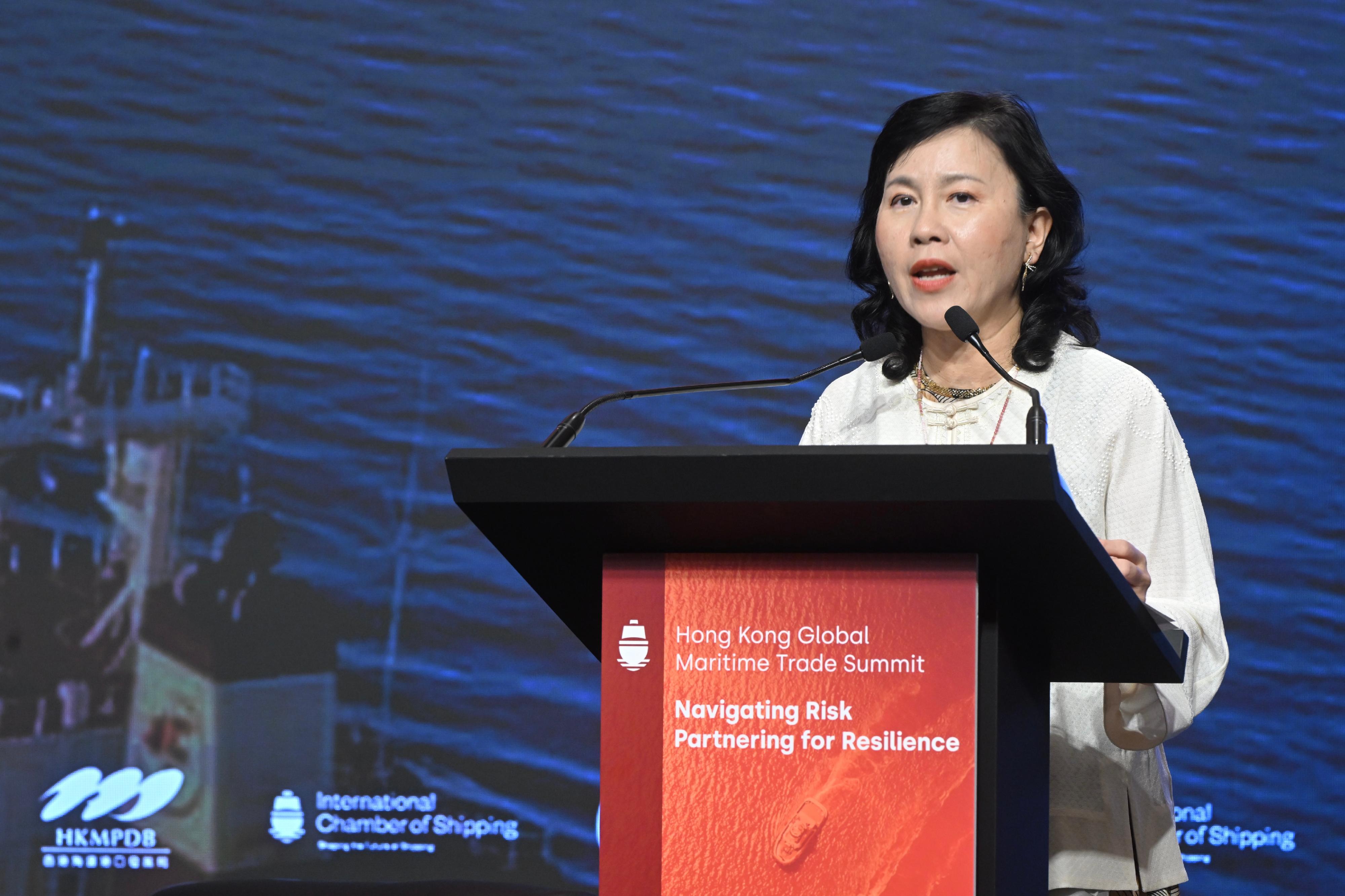
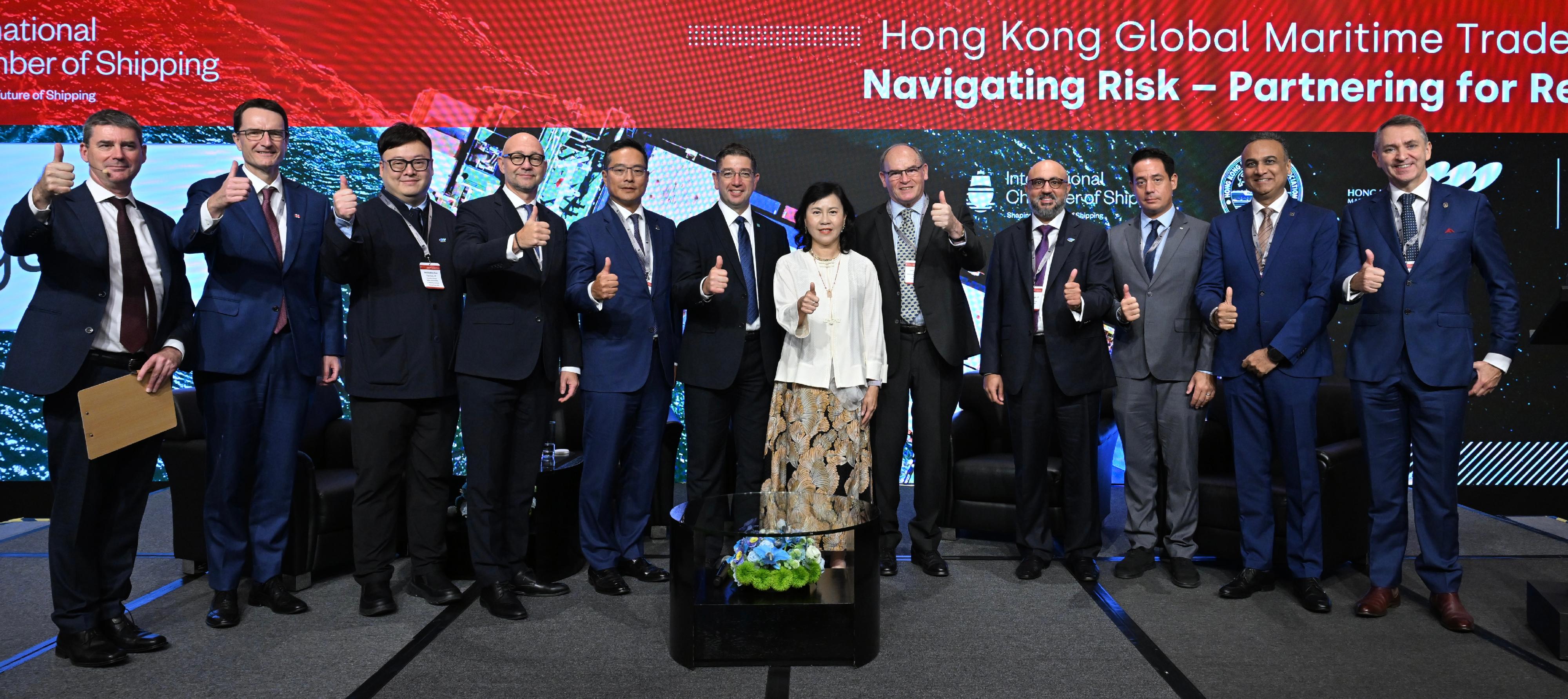
Closing remarks by STL at Hong Kong Global Maritime Trade Summit (English only) (with photos)

     ​Following are the closing remarks by the Secretary for Transport and Logistics, Ms Mable Chan, at the Hong Kong Global Maritime Trade Summit today (November 16):

John (Chairman of the International Chamber of Shipping (ICS), Mr John Denholm), Moses (Chairman of the Hong Kong Maritime and Port Development Board, Dr Moses Cheng), Richard (Chairman of the Hong Kong Shipowners Association, Mr Richard Hext), Ambassadors and Your Excellencies, Peter (World Trade Editor of the Financial Times, Mr Peter Foster):

     Good afternoon. As we bring the third Hong Kong Global Maritime Trade Summit to a close, allow me to express my heartfelt appreciation to the International Chamber of Shipping and the Hong Kong Shipowners Association (HKSOA) for once again staging this landmark summit in Hong Kong. My sincere thanks also go to our moderators, panellists, and the many global industry leaders and participants who have joined us today. Your candid exchanges and shared commitment truly embody the spirit of partnership that defines this summit. Having been able to join you for the last couple of minutes, I could see that you must have enjoyed this morning’s open-door summit very much as I enjoyed yesterday’s closed-door summit. A few key themes and buzzwords kept coming up, and we had a very candid and frank exchange today. I would like to use my few minutes to share with you my observations and lessons learned.

Planning the Course, Delivering on Action: Hong Kong’s First Five-Year Plan and 2026 Policy Address

     Throughout today’s discussions under the theme “Navigating Risk – Partnering for Resilience”, one truth has come out: In an era of redrawn trade lanes, geopolitical friction and climate urgency, no single jurisdiction, or port, or sector can build supply chain resilience alone. In our discussions yesterday, we had quite a number of interactive exchanges on how the industry looks upon the Government to lead and invest. We, the Government, would also like to figure out and explore how the industry would react to and resonate with the policy objectives, operational targets and investment plans, so that we can partner, align and collaborate. Resilience is really a very key subject for all of us. Resilience is not merely about enduring disruption; it is about adapting through strategic partnership, shared investment, and forward-looking innovation. And partnership, at its core, means governments and industry pulling in the same direction, with jurisdictions choosing co-operation over competition.

     In Hong Kong, we are very blessed. Yesterday, a few guests asked me how we see the collaboration between the Government and the industry in Hong Kong. I would say that it is a very close collaboration. I see a lot of our stakeholders here, including an honourable Legislative Councillor, who himself is also an industry stakeholder and a participant. Through different channels, we can hear their views directly, and I hope that they consider my team to be very responsive, reactive, and very sincere in getting to the bottom of every issue that they have pointed out to us. That same spirit guides how Hong Kong is charting its course. As you may have heard throughout the past two days of discussions at the summit, grounded in Hong Kong’s First Five-Year Plan and the 2026 Policy Address announced just two months ago, the Hong Kong Special Administrative Region Government is working hand in hand with the industry to drive a dual-core strategy – enhancing port competitiveness and optimising the high value-added maritime services ecosystem. Together, these efforts under the dual-core strategy are propelling Hong Kong Port’s vital transformation from “volume to value”, building Hong Kong into a global maritime capital.

     I would like to share with you how we are moving on these two fronts. On enhancing port competitiveness, it means building resilience directly into the physical and digital arteries of global trade. The guest speakers just now mentioned a few key areas, which are mainly the areas that we are investing in the physical infrastructure. We are pursuing this on two fronts: quality and quantity. On the quality front, we are accelerating digitalisation, smart transition as well as green transformation. Today, our Port Community System (PCS) connects sea, land and air transport networks, with close to 10 000 enterprises registered. It is a very sharp learning curve. We just introduced it back in January this year, and by now the rate of growth of participation is being accelerated. They include Chinese Mainland medium-sized enterprises as well as local SMEs (small and medium-sized enterprises). We are partnering with the industry to chart a roadmap for driving smart transition and green transformation of the Hong Kong Port.

     On quantity, we are widening our reach by extending our cargo hinterland through consolidating the “rail-sea-land-river” intermodal system while deepening collaboration with neighbouring ports in the Guangdong-Hong Kong-Macao Greater Bay Area and other strategic ports across the Chinese Mainland, not to mention some of our close partner ports overseas. But expanding our reach is only half the equation. You may have learned from our Financial Secretary this morning that we established a “brother port” relationship with Shanghai last month. I did travel to Shanghai and sealed the deal. We hope to strengthen strategic ties with the international maritime hub of the Chinese Mainland, as well as to strengthen our function as a transit hub for all cargoes to go global, and for the global network with all cargoes to go to the Chinese Mainland. 

     And we will soon, in the afternoon, announce the second batch of partner ports, and the collaboration milestones to prepare for Hong Kong’s first-ever green shipping corridor.

     Optimising our high value-added maritime services ecosystem means building resilience through diversification. For resilience, we cannot just treat it as a slogan, but really have to diversify our efforts and risks. Ensuring Hong Kong’s strength rests not only on cargo throughput alone, but also on the depth of the entire maritime services cluster. We are actively revamping our ship registration regime, introducing the “dual registration arrangement” to provide greater operational flexibility. We are also moving full steam ahead with a half-rate profits tax concession for physical commodity trading, which we aim to have in place within this year. Thanks to the high efficiency and high professional knowledge demonstrated by our legislators, we have been able to put in place a series of legislative amendments throughout the past 12 months or so. At the same time, working closely with the Hong Kong Maritime and Port Development Board (HKMPDB), which is under the leadership of Dr Moses Cheng, and the industry, we are exploring strategies to synergise the co-development of maritime and financial services. Furthermore, we are building the green fuel value chain by announcing our first Green Energy Corridor with a Chinese Mainland city this week, and supporting a market-driven green maritime fuel trading platform.

     Ladies and gentlemen, we talked about rules yesterday at our closed-door session. The rules of global trade are something that should not be shied away from or avoided. These are being rewritten before our eyes. In this new chapter, the “one country, two systems” arrangement gives Hong Kong a unique value proposition that grows more relevant by the day – a stable, bilingual common law system, a trusted legal framework, the free flow of capital and information, and world-class professional expertise that helps remove risk from global trade. Whatever your needs, we in Hong Kong have the capabilities. Hong Kong is here to serve and help you do more than weather today’s challenges – we are here to help you seize tomorrow’s opportunities.

     While this summit is drawing to a close, our shared collaboration carries forward. This summit serves as a fitting centrepiece of the 10th anniversary of Hong Kong Maritime Week. In the coming days, a wide array of flagship conferences, forums, seminars and networking events will take place across our city, bringing together maritime leaders, industry experts and delegates from around the world. I hope by the day we take stock of the number of activities and participants, they will surpass the records last year.

     Beyond the conference hall, we have also arranged a few experiences that show Hong Kong at its best after dark. Tomorrow evening, please do join us aboard the Aqualuna for a harbour cruise, an iconic red-sailed junk, a glass in hand, and the skyline at its most spectacular. This Wednesday, step aboard our Party Tram for a lively evening of conversation as we glide through the city’s streets. The Party Tram is operated by the Hong Kong Tramways, a French company that has been here operating this iconic and historic tram that runs across the shoreline of Hong Kong Island. And on Thursday, a perfect way to round off the week with a ride on the Star Ferry, back to the core business of the maritime sector, seeing the harbour the way generations of Hong Kong people have. I warmly invite you all to join, connect with your peers, and experience the vibe, hospitality, and iconic harbour of Hong Kong – the very core on which we have built our harbour and from which all of our shipping and maritime businesses started.

     Once again, my heartfelt thanks and gratitude go to the ICS and HKSOA as our co-organisers. I have to thank Kenneth (Founder and Chief Executive Officer of SeaKapital and ICS Board Member, Mr Kenneth Lam) for bringing another exceptional summit to Hong Kong. I wish you all a very rewarding remainder of your stay, and I hope you leave with a sense of the energy that makes Hong Kong Asia’s world city. Thank you very much.

Photo  Photo  
read more

Effective Exchange Rate Index

     The effective exchange rate index for the Hong Kong dollar on Monday, November 16, 2026 is 100.4 (same as last Saturday’s index).

     ​The effective exchange rate index for the Hong Kong dollar on Saturday, November 14, 2026 was 100.4 (same as last Friday’s index). read more

Speech by CE at Opening Ceremony of Hong Kong Maritime Week 2026 cum World Maritime Merchants Forum 2026 (English only)

     Following is the speech by the Chief Executive, Mr John Lee, at the Opening Ceremony of Hong Kong Maritime Week 2026 cum World Maritime Merchants Forum 2026 today (November 16):

Honourable Vice-Chairman C Y Leung (Vice-Chairman of the National Committee of the Chinese People’s Political Consultative Conference), Vice Minister Li Xinghu (Vice Minister of Transport of the People’s Republic of China), Deputy Director Zhang Yong (Deputy Director of the Liaison Office of the Central People’s Government in the Hong Kong Special Administrative Region (HKSAR)), Chairman Miao Jianmin (Chairman of the China Merchants Group), Deputy Head Lin Jiandong (Deputy Head of the Office for Safeguarding National Security of the Central People’s Government in the HKSAR), Deputy Commissioner Li Yongsheng (Deputy Commissioner of the Office of the Commissioner of the Ministry of Foreign Affairs of the People’s Republic of China in the HKSAR), Vice Governor Yang Guoqiang (Vice Governor of the People’s Government of Hainan Province), ambassadors, distinguished guests, ladies and gentlemen,

     Good afternoon. Welcome to Hong Kong, a global maritime capital, and the 10th anniversary edition of Hong Kong Maritime Week, as well as the sixth World Maritime Merchants Forum.

     I’m grateful to the organiser and co-organisers, the Hong Kong Shipowners Association and the Hong Kong Maritime Museum, for bringing together the vitality and professionalism of our maritime cluster for this grand opening. Your laudable efforts reflect our shared ambition – to sustain Hong Kong as a renowned and reform-minded global maritime hub.

     Over the past years, Maritime Week cum World Maritime Merchants Forum has grown into a world-class event, an annual coming together of industry leaders, a showcase of our maritime prowess, and a proven springboard for global maritime business.

     This year’s theme, “Trusted Resilience Powering Global Maritime Trade”, reflects the pivotal juncture we find ourselves at today. International shipowners and shipping enterprises are navigating daunting headwinds, powered by complex geopolitical shifts, supply chain fragmentation and heightened market volatility. Such testing waters demand steady hands and decisive leadership.

     In times of complexity, we look for certainty. Under the enduring principle of “one country, two systems”, Hong Kong stands proudly as the international shipping community’s “safe harbour”. We are deeply supported by our country’s economic development and national strategies, and we are globally connected. Hong Kong maintains its own common law system, a simple and competitive tax regime, free port status and the unimpeded flow of capital and information. For international shipowners seeking stability and predictability, along with a secure jurisdiction to anchor their operations and capital, Hong Kong is truly the port in a storm.

     Our international standing reflects these attributes. Hong Kong ranked fourth, globally, in this year’s International Shipping Centre Development Index, marking our seventh consecutive year in the top tier. Around 1 200 port and maritime-related enterprises call Hong Kong home, offering world-class expertise across the high value-added maritime services chain.

     That said, the global maritime community faces shared problems, challenges that no single economy can resolve alone. On this, our stance is clear and unwavering: global shipping thrives on openness, seamless connectivity and an unyielding commitment to the rules-based international trading system.

     Protectionism and fragmentation threaten the global economy. A staunch champion of free trade and multilateralism, Hong Kong firmly rejects isolationism. The future of maritime trade depends on keeping shipping lanes open, upholding international maritime law and standards, and promoting unhindered economic co-operation across East and West, South and North. 

     That, ladies and gentlemen, is the purpose of Hong Kong Maritime Week cum World Maritime Merchants Forum – bridging divides, building networks and keeping channels open and welcome. That’s also why the HKSAR Government is working to steer Hong Kong from a regional port to a pre-eminent global maritime hub. 

     Hong Kong’s First Five-Year Plan, introduced two months ago, will help us get there. It fully aligns with the National 15th Five-Year Plan, deepening our integration into the national strategies. Guided by this strategic blueprint, my 2026 Policy Address outlines concrete measures to shift our growth focus from volume to value.

     Our primary emphasis is on high value-added maritime services, building closer collaboration with our sister cities in the Greater Bay Area, and nurturing industry talent. We will also participate in the development of autonomous ships for use in Hong Kong waters, contributing to the national “water-to-water transshipment” initiative, and enhancing our “rail-sea-land-river” intermodal transport system.

     Decarbonisation and digitalisation are mandatory co-ordinates for the future of global shipping. And Hong Kong is ready to lead this transition. To unlock the full commercial potential of the green transition, we are advancing from physical bunkering to a market-driven, globally oriented and diversified green fuel-trading platform.

     Just before this session, we announced the formation of the dedicated Task Group on the Development of the Green Fuel Trading Platform. To secure broad backing, it brings together leading industry experts. They will advise on strategic direction, infrastructure set-up and market-tailored operating rules.

     The initiative will integrate the entire value chain. It will leverage Hong Kong’s advantage as a “super-connecter” and “super value-adder”, forging partnerships to promote green fuel trading. And that will help establish Hong Kong as an international hub for green maritime fuel trading.

     We are already building partnerships. Last month, we signed an agreement with Shanghai to create a “brother port” partnership. That follows last year’s “partner port” agreements with Guangxi and Dalian, as well as Chile’s San Antonio Port. Today, I am pleased to announce another agreement, the establishment of a green shipping corridor between Hong Kong Port and the Port of Piraeus in Greece. This landmark collaboration is a significant step forward in driving decarbonisation along major Asian-European shipping routes.

     There’s more. We will soon witness MOU (Memorandum of Understanding) signings with Hainan and Guangdong’s Zhanjiang. The Hainan MOU establishes a partner port relationship with Yangpu Port. The Zhanjiang MOU focuses on our first green energy corridor. It will reinforce our commitment to end-to-end, low-carbon, green-fuel supply chains, connecting green fuel produced in the Chinese Mainland with global maritime markets.

     These new partnerships with our Mainland maritime partners show how closely our industry is connected. And I am delighted that so many Mainland friends are here with us today. So, before I close, let me say a few words in Putonghua.

     各位,我很高興今天與全球航運界領袖一同出席香港海運週2026開幕典禮暨世界航商大會。當前,國際航運業正處於前所未有的變革期。面對地緣政治變局與供應鏈重塑,全球航運業比以往任何時候都更需要確定性和戰略協同,而香港正是國際航運界可靠的「避風港」。

     緊接開幕典禮舉行的世界航商大會,是凝聚全球航運界共識的高層次對話平台。我感謝招商局集團發揮帶領作用,提供這個交流機會。我們應善用這平台,廣拓朋友圈,讓所有同坐一條船的四方好友,充分利用香港在「一國兩制」下「背靠祖國、聯通世界」的獨特優勢,乘國家發展的東風,共同開拓合作共贏的廣闊空間。

     Ladies and gentlemen, I wish you all a rewarding Hong Kong Maritime Week, the best of business at the World Maritime Merchants Forum, and an enjoyable stay in Hong Kong. To all guests, fair winds and following seas on every journey. Thank you. read more