Tag Archives: China

image_pdfimage_print

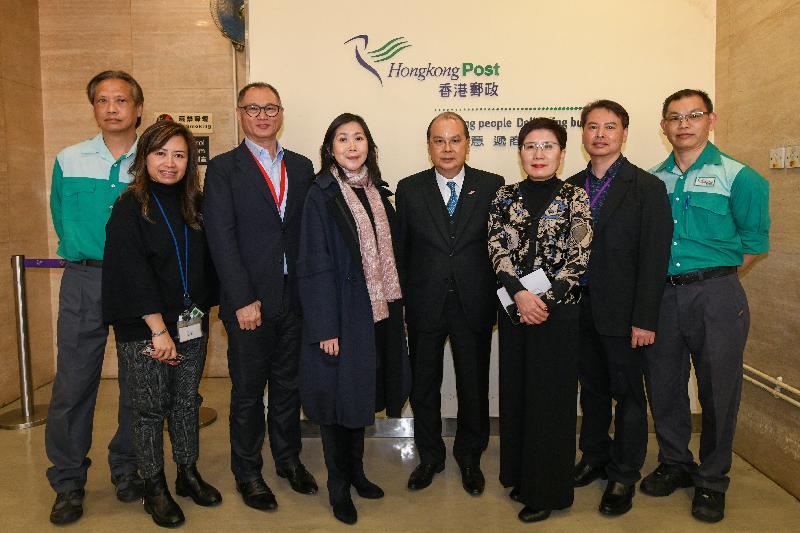
CS visits HK Post on according priority to surgical mask parcels (with photos)

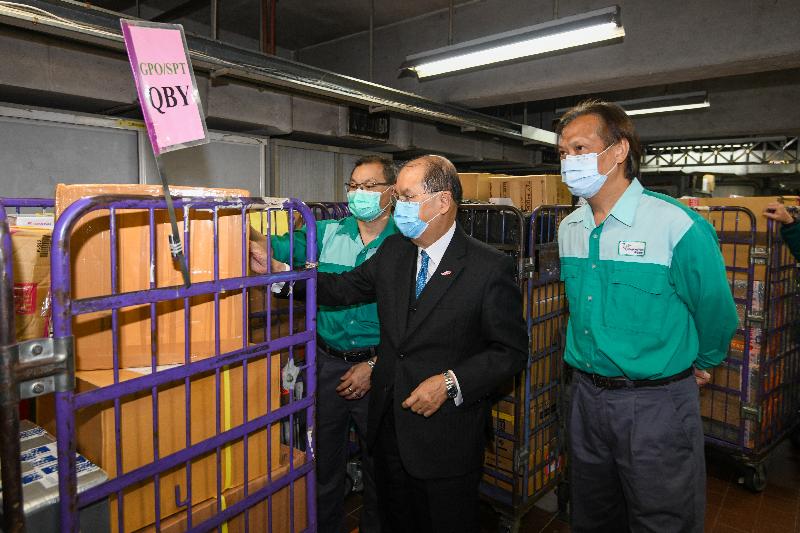
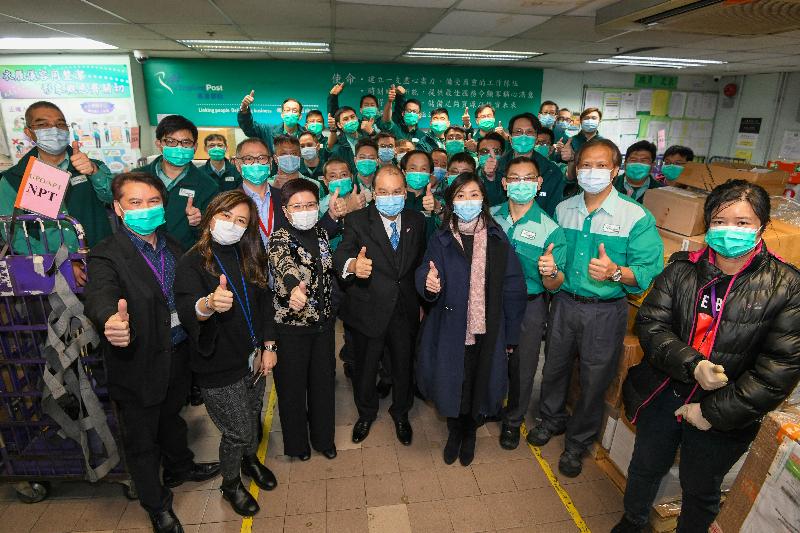
     The Chief Secretary for Administration, Mr Matthew Cheung Kin-chung, today (February 17) visited Hongkong Post to gain better understanding of how frontline colleagues handle the large amount of surgical mask parcels. He expressed gratitude to its frontline staff for standing fast to their posts to help Hong Kong fight against Covid-19.
 
     Accompanied by Postmaster General, Miss Cathy Chu and relevant staff, Mr Cheung inspected the workflow of Speedpost boxes containing surgical masks.
 
     He was most pleased to learn that since the Lunar New Year, Hongkong Post had accorded top priority to Speedpost items containing surgical masks on the principle of “surgical masks first”. Over 40 000 boxes of surgical masks items have been delivered last week.
 
     Mr Cheung expressed his warmest appreciation to Hongkong Post for its speedy action to address the community’s pressing needs during this emergency period. Noting that the volume of incoming mail has continued to outrun the usual volume by 70 to 80 per cent and that many of the mail items are surgical masks urgently needed by Hong Kong people, Hongkong Post has made special arrangements by re-deploying manpower from other divisions to speed up the processing of Speedpost boxes and deliver the boxes on Sunday and resumed daily mail delivery service fully so that parcels containing surgical masks can reach the hands of the recipients as soon as possible.
 
     In spite of Government’s announcement of special work arrangements for government departments to reduce the risk of Covid-19 outbreak in the community, Hongkong Post has maintained normal delivery services for Speedpost service and arranged staff to take shifts in the work of parcel sorting and delivery. The staff also took the initiative to identify parcels containing surgical masks for priority delivery.
 
     Mr Cheung also talked to frontline staff including retirees who return to Hongkong Post to provide support as well as colleagues who are willing to work on Sundays. He expressed his sincerest gratitude to colleagues for their relentless efforts in the fight against the disease and commended Hongkong Post for its dedication in serving Hong Kong people wholeheartedly.
 
     Mr Cheung also stressed that as the current situation was still challenging, members of all Government departments and the Hospital Authority would join hands to fight the disease. He is confident that Hong Kong will win this battle with the concerted efforts of the government and the public.

Photo  Photo  Photo  Photo  
read more

HAD opens temporary cold shelters

     The cold weather warning has been issued. In view of the novel coronavirus infection, the Home Affairs Department has opened temporary shelters in 13 districts today (February 17) for people in need of the service.
 
     The temporary shelters will remain open during the daytime tomorrow (February 18) when the cold weather warning is still in force.
 
     To ensure that cold shelter users can rest in a quiet and undisturbed environment, members of the public or agencies wishing to make donations to shelter users are requested to register with the staff of the shelter first. Donors will then be directed to place the donated items at a specified indoor location. The staff will help notify the shelter users to collect the items on their own.
 
     Anyone seeking temporary refuge, or those who have any questions about the donation arrangements at the cold shelters may call the department’s hotline 2572 8427 for more information.
 
     The 13 temporary cold shelters are located at:
 
Hong Kong Districts:
——————–
 
Central and Western:
Sai Ying Pun Community Complex Community Hall
3/F, Sai Ying Pun Community Complex, 2 High Street, Sai Ying Pun
 
Eastern:
Causeway Bay Community Centre
3/F, 7 Fook Yum Road, Causeway Bay
 
Wan Chai:
Wan Chai Activities Centre
LG/F, Wan Chai Market, 258 Queen’s Road East, Wan Chai
 
Kowloon Districts:
——————
 
Kowloon City:
Hung Hom Community Hall
1/F, Kowloon City Government Offices, 42 Bailey Street, Hung Hom
 
Kwun Tong:
Lam Tin (West) Estate Community Centre
71 Kai Tin Road, Lam Tin
 
Sham Shui Po:
Nam Cheong District Community Centre
1 Cheong San Lane, Sham Shui Po
 
Wong Tai Sin:
Tsz Wan Shan (South) Estate Community Centre
45 Wan Wah Street, Tsz Wan Shan
 
Yau Tsim Mong:
Henry G Leong Yaumatei Community Centre
60 Public Square Street, Yau Ma Tei
 
New Territories:
—————-
 
Kwai Tsing:
Tai Wo Hau Estate Community Centre
15 Tai Wo Hau Road, Kwai Chung
 
Tai Po:
Tai Po Community Centre
2 Heung Sze Wui Street, Tai Po
 
Tsuen Wan:
Lei Muk Shue Community Hall
G/F, Hong Shue House, Lei Muk Shue Estate, Tsuen Wan
 
Tuen Mun:
Butterfly Bay Community Centre
Butterfly Estate (near Tip Sum House), Tuen Mun
 
Yuen Long:
Long Ping Community Hall
Long Ping Estate, Yuen Long read more

Update on cases of Legionnaires’ disease

     The Centre for Health Protection (CHP) of the Department of Health today (February 17) reported the latest number of cases of Legionnaires’ disease (LD), and stressed the importance of using and maintaining properly designed man-made water systems, adding that susceptible groups should strictly observe relevant precautions.
 
     From February 9 to 15, three community-acquired LD cases were reported:

1. A male patient, aged 56 with underlying illnesses, who lives in 1H Sands Street, Central and Western District;
2. A male patient, aged 85 with underlying illnesses, who lives in Ma Tong Tsuen, Chuen Lung, Tsuen Wan; and
3. A male patient, aged 52 with underlying illnesses, who lives in 7 Sau Fu Street, Yuen Long.

     “Epidemiological investigations are ongoing to identify potential sources of infection, high-risk exposures and clusters, if any,” a spokesman for the CHP said.
 
     As of February 15 this year, 22 LD cases had been reported. In 2019 and 2018, there were 105 cases each year.
 
     “Men, people aged over 50, smokers, alcoholics and persons with weakened immunity are more susceptible to LD. Some situations may also increase the risk of infection including poor maintenance of water systems leading to stagnant water; living in areas with old water systems, cooling towers or fountains; using electric water heaters, whirlpools and spas or hot water spring spas; and recent stays in hotels or vessels,” the spokesman said.
 
     Legionellae are found in various environmental settings and grow well in warm water (20 to 45 degrees Celsius). They can be found in aqueous environments such as water tanks, hot and cold water systems, cooling towers, whirlpools and spas, water fountains and home apparatus which support breathing. People may become infected when they breathe in contaminated droplets (aerosols) and mist generated by artificial water systems, or when handling garden soil, compost and potting mixes.
 
     Immunocompromised persons should:
  
• Use sterile or boiled water for drinking, tooth brushing and mouth rinsing;
• Avoid using humidifiers, or other mist- or aerosol-generating devices. A shower may also generate small aerosols; and
• If using humidifiers, or other mist- or aerosol-generating devices, fill the water tank with only sterile or cooled freshly boiled water, and not water directly from the tap. Also, clean and maintain humidifiers/devices regularly according to manufacturers’ instructions. Never leave stagnant water in a humidifier/device. Empty the water tank, wipe all surfaces dry, and change the water daily.

    The public should observe the health advice below:
 
• Observe personal hygiene;
• Do not smoke and avoid alcohol consumption;
• Strainers in water taps and shower heads should be inspected, cleaned, descaled and disinfected regularly or at a frequency recommended by the manufacturer;
• If a fresh-water plumbing system is properly maintained, it is not necessary to install domestic water filters. Use of water filters is not encouraged as clogging occurs easily, which can promote growth of micro-organisms. In case water filters are used, the pore size should be 0.2 micrometres (µm) and the filter needs to be changed periodically according to the manufacturer’s recommendations;
• Drain and clean water tanks of buildings at least quarterly;
• Drain or purge for at least one minute infrequently used water outlets (e.g. water taps, shower heads and hot water outlets) and stagnant points of the pipework weekly or before use;
• Seek and follow doctors’ professional advice regarding the use and maintenance of home respiratory devices and use only sterile water (not distilled or tap water) to clean and fill the reservoir. Clean and maintain the device regularly according to the manufacturer’s instructions. After cleaning/disinfection, rinse the device with sterile water, cooled freshly boiled water or water filtered with 0.2 µm filters. Never leave stagnant water in the device. Empty the water tank, keep all surfaces dry, and change the water daily; and
• When handling garden soil, compost and potting mixes:
     1. Wear gloves and a face mask;
     2. Water gardens and compost gently using low pressure;
     3. Open composted potting mixes slowly and make sure the opening is directed away from the face;
     4. Wet the soil to reduce dust when potting plants; and
     5. Avoid working in poorly ventilated places such as enclosed greenhouses.

     The public may visit the CHP’s LD page, the Code of Practice for Prevention of LD and the Housekeeping Guidelines for Cold and Hot Water Systems for Building Management of the Prevention of LD Committee, and the CHP’s risk-based strategy for prevention and control of LD. read more

Forty surgical mask samples test-purchased by Hong Kong Customs comply with requirements of Consumer Goods Safety Ordinance

     Hong Kong Customs launched a large-scale territory-wide special operation codenamed “Guardian” on January 27 to conduct spot checks, test purchases and inspections in various districts on surgical masks available in the market. More than 80 samples have been test-purchased as at yesterday (February 16). The first batch of 20 samples have passed the tests on bacterial counts early this month, while the test results of the second batch of 20 samples also revealed compliance with the bacterial count standard.

     Up till now, all of the 40 test-purchased surgical masks in two batches have passed the tests on bacterial counts and no violations of the Consumer Goods Safety Ordinance (CGSO) have yet been found.

     Customs will continue to arrange safety tests for samples and the results will be announced as soon as possible.

     The second batch of 20 samples was test-purchased from different retail spots in various districts, including chain stores, pharmacies, medicine stores and shops selling daily necessities. Of these samples, 15 were in proper packaging and five were in loose packaging. Among those 15 samples of surgical masks, most were packed in 50-piece packages, while others were packed in packages ranging from five to 30 pieces.

     As at yesterday, the “Guardian” operation has been underway for 21 days, with over 13 000 inspections conducted at retail spots selling surgical masks. The operation will carry on to ensure that the surgical masks being sold in the market comply with the Trade Descriptions Ordinance (TDO) and the CGSO. Customs will continue to promptly issue update announcements if any irregularities are spotted.

     Under the CGSO, it is an offence to import, manufacture or supply consumer goods unless the goods comply with the general safety requirements for consumer goods. The maximum penalty upon conviction is a fine of $100,000 and imprisonment for one year on first conviction, and $500,000 and imprisonment for two years on a subsequent conviction.

     Under the TDO, any person who supplies goods with a false trade description in the course of trade or business, or is in possession of any goods for sale with a false trade description, or sells or possesses for sale any goods with a forged trademark, commits an offence. The maximum penalty upon conviction is a fine of $500,000 and imprisonment for five years.

     Customs reiterates that the department has all along attached great importance to public safety and consumer rights. Law enforcement action will be taken immediately if any violation of the CGSO or the TDO is detected.

     Customs reminds traders not to sell products with false origins or false trademarks, or unsafe consumer goods. Members of the public should also make purchases at reputable shops.

     Members of the public may report any suspected violation of the TDO or the CGSO to Customs’ 24-hour hotline 2545 6182 or its dedicated crime-reporting email account (crimereport@customs.gov.hk). read more