Tag Archives: China

image_pdfimage_print

DH to further strengthen health quarantine arrangements on inbound travellers from overseas

       Following the Hong Kong Special Administrative Region (HKSAR) Government’s announcement today (March 10) on the Red Outbound Travel Alert issued on the whole of Italy, France (Bourgogne-Franche-Comte and Grand Est), Germany (North Rhine-Westphalia), Japan (Hokkaido) and Spain (La Rioja, Madrid and Pais Vasco) in response to the latest situations of COVID-19, the Department of Health (DH) will also strengthen health quarantine arrangements on inbound travellers arriving from these countries/regions.
 
       Starting from 0.00am on March 14, the DH’s Port Health Division officers will issue quarantine orders under the Prevention and Control of Disease Regulation (Cap. 599A) to people arriving in Hong Kong who have been to France (Bourgogne-Franche-Comte and Grand Est), Germany (North Rhine-Westphalia), Japan (Hokkaido) and Spain (La Rioja, Madrid and Pais Vasco) in the past 14 days, regardless of whether they are Hong Kong residents. They will be arranged to stay in a quarantine centre for quarantine. The arrangement also extends on the same day to people arriving from the whole of Italy to replace the existing three areas of Emilia-Romagna, Lombardy and Veneto regions in Italy.
 
       Separately, the quarantine measures announced earlier for those who have been to Korea and Iran in the past 14 days remain unchanged.
 
       A spokesman for the Centre for Health Protection (CHP) said that the Government has been conducting detailed assessments for formulating port health measures in response to the occurrence of outbreaks in countries or areas outside Hong Kong. The assessment will take into account factors such as the number, distribution and rate of increase of infected persons, measures put in place for surveillance and control of the outbreak, and the frequency of visits by Hong Kong residents. The Government will review and adjust the measures in view of the developments.
 
       The CHP will continually update the list of places with active community transmissions of COVID-19 under the reporting criteria for suspected cases to include the above countries/areas. Medical practitioners are requested to report to the CHP any individual fulfilling the following for further investigation:
– Presented with fever or acute respiratory illness or pneumonia; and
– Either one of the following conditions within 14 days before the onset of symptom(s):
1. With travel history to a place with active community transmission of COVID-19; or
2. Had close contact with a confirmed case of COVID-19.
 
     The CHP reminded members of the public that a number of confirmed cases of COVID-19 were recorded in Hong Kong recently related to a tour group to India, indicating the possibility of community transmission there. Meanwhile, as the transmission of the COVID-19 virus has been increasing around the world, members of the public are advised to consider delaying all non-essential travel outside Hong Kong. Meanwhile, the Government has drawn up corresponding port health and quarantine measures in response to the health risk of individual countries/areas. Before travelling outside Hong Kong, members of the public should be aware of the potential health risk and applicable quarantine arrangements upon returning to Hong Kong.
 
     If it is unavoidable to travel to countries/areas outside Hong Kong, the public should avoid close contact with persons with fever or respiratory symptoms during travel and wear a surgical mask when taking public transport or staying in crowded places. Furthermore, the public should observe personal and environmental hygiene and take preventive measures, in particular, avoid touching animals (including game) poultry/birds or their droppings; avoid visiting wet markets, live poultry markets or farms; and do not consume game meat or patronise food premises where game meat is served. read more
Government issues Red Outbound Travel Alert on some regions in France, Germany, Japan and Spain, as well as on Italy

     In view of the health risks arising from the outbreak of the COVID-19 in the Bourgogne-Franche-Comte and Grand Est regions in France, the North Rhine-Westphalia region in Germany, Hokkaido in Japan as well as the La Rioja, Madrid and Pais Vasco regions in Spain, the Hong Kong Special Administrative Region Government today (March 10) issued the Red Outbound Travel Alert (OTA) on the aforementioned regions. As well, the Government expanded the Red OTA currently in force on Emilia-Romagna, Lombardy and Veneto regions in Italy to cover the entire country.
 
* France (Bourgogne-Franche-Comte and Grand Est regions), Germany (North Rhine-Westphalia region), Japan (Hokkaido) and Spain (La Rioja, Madrid and Pais Vasco regions)
 
     In view of the persistent and rapid increase in the number of COVID-19 cases in the Bourgogne-Franche-Comte and Grand Est regions in France, which cover the Burgundy area and Strasbourg, the North Rhine-Westphalia region in Germany, which covers Düsseldorf and Cologne, Hokkaido in Japan, as well as the La Rioja, Madrid and Pais Vasco regions in Spain, which cover the city of Madrid, the Government has decided to issue the Red OTA on the aforementioned regions based on public health considerations. 
 
* Italy
 
     The Government issued the Red OTA on the Emilia-Romagna, Lombardy and Veneto regions in Italy on February 28, 2020, due to health risks arising from the outbreak of COVID-19 cases in the three regions. In view of the persistent and rapid increase in the number of COVID-19 cases in Italy in the past few days, the Government decided to expand the existing Red OTA to cover the entire country.

     The Red OTA urges members of the public planning to travel to the aforementioned regions to adjust travel plans and avoid non-essential travel. In general, members of the public are advised to consider delaying all non-essential travel outside Hong Kong.

     For those who are already in the aforementioned countries/regions, they should:

  • pay attention to announcements by local authorities;
  • put on a surgical mask all the time;
  • avoid unnecessary visits to healthcare facilities and crowded places;
  • avoid close contact with persons with fever or respiratory symptoms;
  • wear a surgical mask and inform the hotel staff or tour escort and seek medical advice at once if experiencing a fever or cough; and
  • perform hand hygiene frequently, especially before touching the mouth, nose or eyes; after touching public installations such as handrails or door knobs; or when hands are contaminated by respiratory secretions after coughing or sneezing.

     If it is unavoidable to travel to the aforementioned countries/regions, the public should pay close attention to the latest situation of COVID-19 and the corresponding travel health advice issued by the Department of Health (DH). If assistance is needed, they may call the 24-hour hotline of the Assistance to Hong Kong Residents Unit (AHU) of the Immigration Department (ImmD) at (852) 1868. After returning to Hong Kong, consult a doctor promptly if experiencing a fever or other symptoms, take the initiative to inform the doctor of any recent travel history and any exposure to animals, and wear a surgical mask to help prevent spread of the disease until 14 days after returning to Hong Kong.

     Hong Kong residents in France may contact the Chinese Embassy in France at the consular protection hotline: (33) 153758840.

     Hong Kong residents in Germany may contact the Chinese Embassy in Germany at the consular protection hotline: (49) 3027588551.

     Hong Kong residents in Japan may contact the Chinese Embassy in Japan at the consular protection hotline: (81) 3-34033064.

     Hong Kong residents in Spain may contact the Chinese Embassy in Spain at the consular protection hotline: (34) 699089086.

     Hong Kong residents in Italy may contact the Chinese Embassy in Italy at the consular protection hotline: (39) 3939110852.

     The Food and Health Bureau will closely monitor the situation. Any updates will be issued through the media, the Government’s “COVID-19 Thematic Website” (www.coronavirus.gov.hk/eng/index.html), the DH’s webpage (www.gov.hk/ncv) and the Security Bureau’s OTA webpage (www.sb.gov.hk/eng/ota). Any enquiries on health information on COVID-19 may be addressed to the DH’s hotline at (852) 2125 1122 (operating daily from 8am to midnight).
 
     In addition, Hong Kong residents are encouraged to use the online Registration of Outbound Travel Information service (www.gov.hk/roti) to register their contact details and itinerary when outside Hong Kong. The information provided allows the DH and AHU of the ImmD to disseminate practical information to them through appropriate means, including SMS on mobile phones, on a timely basis when necessary.

     Apart from the aforementioned countries/regions, the Government also issued the Red OTA on Korea on February 24, 2020, and alerted the public on February 28, 2020, about the outbreak of COVID-19 cases and associated health risks in Iran under the Red OTA currently in force, in light of the persistent and rapid increase in the number of COVID-19 cases in these countries. read more

Woman arrested for illegal sale of unregistered pharmaceutical products (with photo)

     The Department of Health (DH) today (March 10) conducted an operation against the sale of unregistered pharmaceutical products, during which a 29-year-old woman was arrested by the Police for the illegal sale of unregistered pharmaceutical products and Part 1 poisons.    
 
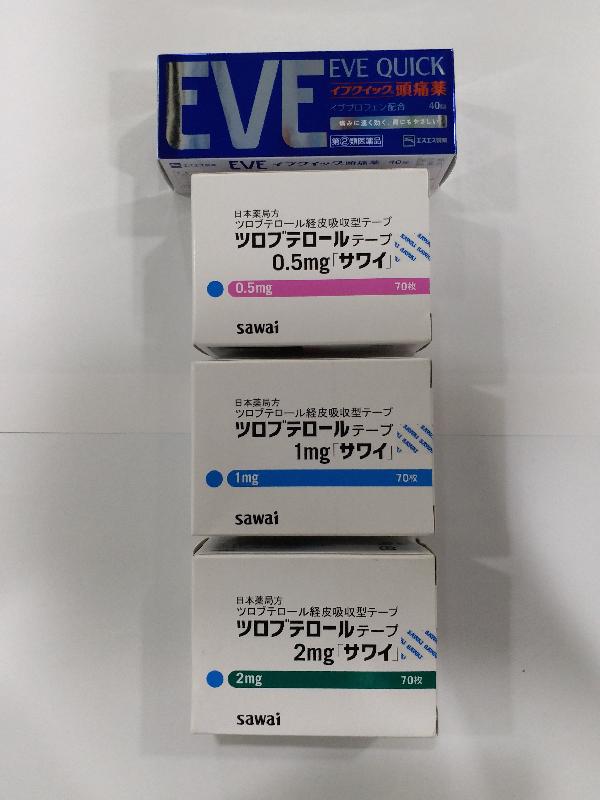
     Acting upon a public complaint, two types of pharmaceutical products for asthma and pain relief were found being offered for sale via a social media platform. The products were labelled in Japanese and do not bear Hong Kong pharmaceutical product registration numbers.   
 
     The product for asthma relief is believed to contain tulobuterol (with three strengths of 0.5mg, 1mg and 2mg, and all labelled with “sawai”) while the product for pain relief is believed to contain ibuprofen (labelled with “EVE QUICK”). Both ingredients are Part 1 poisons under the Pharmacy and Poisons Ordinance (Cap 138) (the Ordinance). 
 
     Tulobuterol is a bronchodilator and its side effects include palpitations, arrhythmias, headaches and tremors. Ibuprofen is a non-steroidal anti-inflammatory pain killer and its side effects include nausea, gastrointestinal discomfort and peptic ulcers. Products containing the above ingredients should only be supplied by a pharmacy under the supervision of a registered pharmacist or upon the advice of a medical practitioner. The DH’s investigation is ongoing.   
 
     According to the Ordinance, all pharmaceutical products must be registered with the Pharmacy and Poisons Board of Hong Kong before they can be legally sold in the market. Illegal sale or possession of Part 1 poisons and unregistered pharmaceutical products are criminal offences. The maximum penalty for each offence is a fine of $100,000 and two years’ imprisonment.    
 
     The DH spokesman strongly urged members of the public not to buy products of unknown or doubtful composition, or to consume products from unknown sources, as the safety, quality and efficacy of unregistered pharmaceutical products are not guaranteed. All registered pharmaceutical products carry a Hong Kong registration number on the label in the format of HK-XXXXX.
 
     People who have purchased the above products should stop using them and consult healthcare professionals for advice if in doubt or feeling unwell after use. They can submit the products to the DH’s Drug Office at Room 1801, Wu Chung House, 213 Queen’s Road East, Wan Chai, Hong Kong, during office hours for disposal.

Photo  
read more

Income and asset limits for public rental housing for 2020-21

The following is issued on behalf of the Hong Kong Housing Authority:
 
     The Hong Kong Housing Authority (HA)’s Subsidised Housing Committee today (March 10) discussed the outcome of the review of income and asset limits for public rental housing (PRH) for 2020-21, and endorsed the revised income and asset limits for applicants of different household sizes with effect from April 1 (see table).
 
     “The PRH income and asset limits are reviewed annually in accordance with the established mechanism to keep them in line with the prevailing social and economic conditions. The PRH income and asset limits for 2020-21 for all household sizes have increased by an overall average increase of 5.4 per cent and 3.4 per cent respectively over those for 2019-20,” a spokesman for the HA said.

     Under the established mechanism, the PRH income limits are derived using a household expenditure approach, which consists of housing costs and non-housing costs, plus a 5 per cent contingency provision. Housing costs measure the costs of renting a private flat comparable to PRH, and these depend on the relevant unit rents of private accommodation and reference flat sizes (i.e. average space allocated to PRH applicants in the past three years). Non-housing costs are determined with reference to the results of the latest Household Expenditure Survey conducted by the Census and Statistics Department, and adjusted by the latest movements in the Consumer Price Index (CPI)(A) (excluding housing costs), or the change in the nominal wage index, whichever is higher. The PRH asset limits are adjusted with reference to movements in CPI(A) over the year. read more