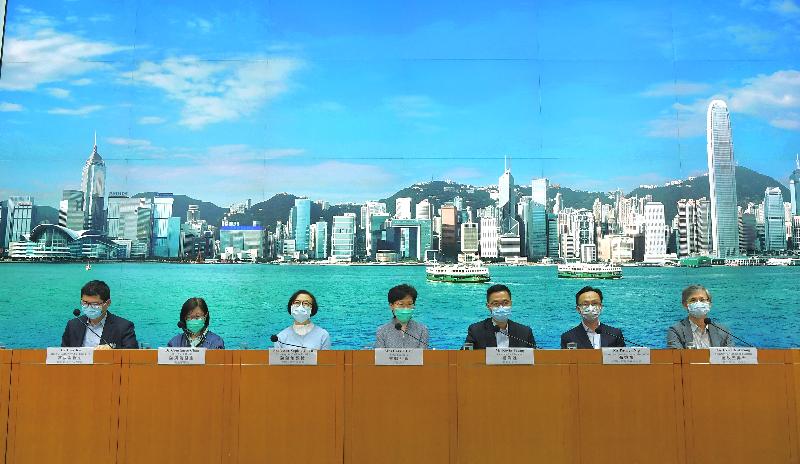
The Chief Executive, Mrs Carrie Lam, held a press conference this afternoon (March 21). Also joining were the Secretary for Labour and Welfare, Dr Law Chi-kwong; the Secretary for Food and Health, Professor Sophia Chan; the Secretary for Education, Mr Kevin Yeung; the Secretary for Constitutional and Mainland Affairs, Mr Patrick Nip; the Director of Health, Dr Constance Chan; and the Chief Executive of the Hospital Authority, Dr Tony Ko. Following is the transcript of remarks of the press conference.
Reporter: Chief Executive, you just said that the number of overseas visitors has dropped to a low point, but why can’t the Government take the extra step to bring the number to zero by closing the border completely, namely to bar non-Hong Kong residents from coming into Hong Kong? And secondly, there’s been a lot of concerns about the current home quarantine arrangement for people returning from overseas with many saying that it is not stringent enough. So does the Government have any plans to use some hotels as designated quarantine centres or use other places to accommodate the tens of thousands of returnees? And also you talked about, just now the Health Secretary, Sophia Chan, talked about providing guidelines for the hotel staff but how do you make sure that the hotels will comply with the guidelines? Will you consider stationing health experts and law enforcement officers at the hotels? And to the Education Secretary, if the outbreak continues or even worsens, will the Government consider cancelling this year’s DSE exams?
Chief Executive: There are at least four questions. I’ll answer the first and then invite Sophia to deal with the next two and perhaps Kevin to answer the questions about DSE examinations.
Throughout this process of tackling the coronavirus infection, the Hong Kong SAR Government has been adopting measures based on scientific evidence and statistics. We try not to yield to slogan-type of demands because that would not be the preferred approach. It’s exactly the same reason why I appointed at the very beginning this panel of experts to guide us in our work. At every stage, whether it is worries about infection coming from the Mainland or now infection coming from abroad, we have adopted very decisive measures to reduce as much as possible the admission of non-Hong Kong residents. But we have to strike a balance. There will be some genuine needs arising from this sort of restrictions, which we need to cater for. I showed you some figures, which is equally the situation in early February when we adopted that compulsory 14-day quarantine for all arrivals from Mainland. Similarly, now we have this 14-day quarantine arrangement for all arrivals from all overseas countries. The impact is very significant and very effective. The numbers of arrivals from these countries who are non-Hong Kong residents have dropped to a very low level, and I have further analysed for you that amongst the very low level, there are some very genuine cases, like Macao residents who have to use the Hong Kong International Airport to go home. When Hong Kong people want to come back because of the pandemic situation in all parts of the world, Macao residents also want to go back to Macao. This is where our aviation hub and the Hong Kong International Airport is fulfilling that purpose.
And secondly, we mustn’t forget that Hong Kong is an international city. We have a very large population of expatriates, and by status these expatriates are Hong Kong residents. They are living here, working here. So they will have family members who for one reason or another, they need to come. To deny all entry of non-Hong Kong residents will give rise to all sorts of problems, for example, one of the so-called non-Hong Kong resident case confirmed, later on we discovered it’s actually the spouse of a Hong Kong resident who has also been confirmed. This spouse could not be denied entry even if there is a ban because this is a matter of human rights and humanitarian grounds. So it’s much better to have a channel, but a well-controlled and regulated channel for this very small number of non-Hong Kong residents to continue to come into Hong Kong. That’s point number two.
Point number three is, if we look at the figures of the confirmed cases amongst the about 300 by now, my data is there are only a few non-Hong Kong residents, discounting the first wave of Wuhan tourists coming into Hong Kong. So there is no strong basis for going for very drastic measures in order to achieve the objective.
Secretary for Food and Health: Thank you for your question. About the new quarantine order, under the Regulation, relevant person during the quarantine period will be (put under) quarantine in a place assigned by an authorised officer, or if an authorised officer considers it prudent and appropriate in the circumstances of a case, in a place nominated by the person. When the quarantine order is made against a person, that means by default most of these people will put their homes as the designated place. Many people would choose home to be their place of quarantine. Occasionally, we understand there are people who have chosen hotels as their place of quarantine,that is accepted by this law. We also understand that in the market, actually there are hotels now offering packages or 14-day quarantine packages for some of the people. (The packages) are put in the market. They have different packages to provide food and also other services in the hotels. We also understand there are people who have already subscribed to such services. Obviously this is commercial operation. As far as the guideline for the hotels is concerned, it is a guideline issued by the Centre for Health Protection. It is a guideline of good practice, not only for the people (under quarantine) themselves as preventive measures, but it also serves as a general guideline to the hotel management. For example, the staff should wear a surgical mask and maintain good personal hygiene, etc. The preventive measures are for the hotel management as well as advice given to the hotels upon, for examples, reception staff, guests and also guests put under compulsory quarantine orders. As far as guests with respiratory symptoms are concerned, they will also give advice to those guests to seek medical advice immediately. And also, (advice on) cleaning, as well as disinfection of the environment will be given where there is a suspected or confirmed case. It is a very detailed guideline. Of course, it is a good practice for hotels. The Centre for Health Protection has already been in touch with the Tourism Commission and also the trade, so that it can make known to them this guideline so that they can follow in case there are people who choose to quarantine in their hotels.
Secretary for Education: For the DSE examination, we all know that this is a very important examination for our secondary students. And I am sure many of them have spent months or years in the preparation. So I believe most of them would not like to have their efforts wasted if we do not have the examination to proceed as scheduled. But at the same time, safety of course is also our concern. So we would closely monitor the situation and also take the necessary measures to ensure that the examination would be held in a controlled and safe environment.
Reporter: Chief Executive, do you think the Government perhaps has sent the wrong message to society in scrapping work from home for civil servants earlier, since many private firms actually follow the Government’s work arrangement quite closely? And also, if Hong Kong is to experience a community-level outbreak, will you consider more stringent measures in using the law to perhaps shut down premises that may attract crowds, such as bars and cinemas, or perhaps put a curfew in place? And thirdly, about the zero tolerance for people who violate their quarantine orders, can you explain what would happen if the Police, say on the street, were to find somebody who should be at home under quarantine and have left their premises? What will the Police do at that instance and what do you mean by zero tolerance? Because in earlier cases, the Police have found people violated quarantine orders and gave them two or three chances before they were prosecuted. Is that still a fair enforcement of the law? Thank you.
Chief Executive: Thank you for the three questions. First of all, as I have said at the very beginning of our anti-epidemic work, we have to adjust our policies in accordance with the changing circumstances and in those adjustments we have to act fast and decisively. It is only natural that as the circumstances change then of course we have to adopt different measures.
I said in my opening remarks that the 7.5 million Hong Kong people have effectively and safely sailed through two waves of epidemic. The first wave was the worries of transmissions from Mainland, so we have put in a lot of measures. You can see from the statistics that actually the last Mainland-related infection case happened a long time ago now – it’s in February, early February. The second wave was the local transmissions, with those clusters arising from dinners and other things. Now we are facing the third wave. It is only natural that when we sail through a wave, of course we have suppression, and then towards the end of that wave, we will have to relax a bit. Otherwise, we’ll not be able to sustain. You imagine if the Government continues from the end of January, that is after the Chinese New Year, to stop providing services to the public – the postal services, licensing services, approval of building plans – what will happen now? But in light of the changing circumstances and this most difficult and challenging wave arising from a surge in the global situation and the large number of returnees, then we have to adjust and go back to measures which will ensure more social distancing. That’s exactly the reason behind it.
Now, as far as more draconian measures to use the law to ban this and that, or to cease operation, again my answer is the same logic. We will have to look at and monitor the situation very closely – people’s behaviour, the co-operation of enterprises – and if we do need to act that decisively, we will not shy away. That’s why throughout the process we have already made four pieces of regulations under the Prevention and Control of Disease Ordinance.
As far as zero tolerance, I think this reflects the aspirations of the community. The community, i.e. the 7.5 million population, together through their joint efforts, have resisted this community transmission and ensure that Hong Kong’s confirmed cases, both in terms of absolute numbers and in terms of incidence per one million population, are relatively low when compared to other places all over the world. Hong Kong people would not like this situation to be undermined by individuals who refuse to abide by the quarantine order. So the time has come for us again to be very decisive and adopt a zero-tolerance approach. Previously, where cases were discovered to have left home, we will give them a warning and the second time we will send them to the quarantine centre. But I am now saying and telling those individuals on the quarantine order, if we find you on the street when you should be at home under quarantine order, then immediately we will prosecute, which means that the policemen will take evidence and then will put it through the Department of Justice as usual for prosecution. Thank you.
(Please also refer to the Chinese portion of the transcript.)